Thursday, June 29, 2023

‘Veracity,’ An Impactful LGBTQ Short Film

Veracity film poster. 

Olivia learns the hard way that popularity can turn on a dime, especially in high school. It offers no protective shield against the early developmental stages of teenage homophobia— a condition that some will continue to latch onto in adulthood. Unfortunately, it has deep negative history in the Black community, that of which still exists today. 

Olivia (Kiki Layne) performs her monologue in drama class. DP: Tommy Maddox-Upshaw.

Carolyn (Christina Harper) begs Olivia (Kiki Layne) to attend James’s party with her, saying that only with Olivia can Carolyn receive entry. DP: Tommy Maddox-Upshaw.

Veracity highlights the super quick turnaround Olivia faces after she’s discovered kissing the new student Imani, a quiet, isolated girl kicked out of her old school for the very thing Olivia is suddenly ostracized for. Carolyn, the best friend character immediately removes herself as Olivia’s sidekick, becoming instead a fellow instigator. 

Olivia (Kiki Layne) is very much intrigued by the new transfer in her drama class Imani (Shea Vaughan-Gabor). DP: Tommy Maddox-Upshaw.

At James’s house party where lots of underage drinking happens, Olivia is assaulted by James. Yet, no one seems to care about it. She even brushes it off and warms him that his advances remain unwanted. Instead, Olivia finds out Imani lives there. Since unsuccessful at getting the quiet girl to enjoy the party backfires, the two watch television together. A tickling session becomes a full out passionate session which is then rudely interrupted, causing a huge humiliation for both Olivia and Imani. Everyone is so comfortable seeing James kiss on Olivia without her consent, but two girls making out because they want to disgusts their young impressionable minds— minds that are conditioned to only be okay with heteronormativity. 

Olivia walking through the hallways, feeling the repercussions from the party. DP: Tommy Maddox-Upshaw.

The heart of the matter is that growing up many Black parents/guardians teach the values in respecting racial differences/backgrounds. The later sexual talks (uncomfortable as they are) only focus on heteronormativity. Thus, when queerness comes, everybody is appalled, unprepared to react accordingly. Parents will abandon their children, even disown if they’re not “acting normal.” There can be no celebration when there’s little understanding and lack of empathy. 

Imani coldly informs Olivia that before she was kicked out of her old school, she had a girlfriend and received consequences for it including expulsion. DP: Tommy Maddox-Upshaw.

Olivia makes the girl’s bathroom her escape place. DP: Tommy Maddox-Upshaw. 

With award-winning actress Kiki Layne in a stellar debut as Olivia, brilliantly directed by Seith Mann, and bravely written by Janaya Greene (who wrote the screenplay during her senior year of high school), Veracity could have easily transformed into a full-length feature, a perfect companion piece to dee rees unforgettable Pariah— a film that came out three years prior which also started as a short. Veracity touches on significant changes the outcasted Olivia undergoes in order to put her mental health on a good path— attending support group and compromising with Imani that she is there to be a friend, not necessarily form a romantic relationship.

Another student offers Olivia a positive outlet. DP: Tommy Maddox-Upshaw.

A man shares his story about falling for his teammate, losing that friendship, and being disowned by his mother. DP: Tommy Maddox-Upshaw.

Olivia is moved by the story, perhaps seeing the commonality in her own present. DP: Tommy Maddox-Upshaw.

Veracity deserves immense love and flowers for bringing awareness to the issues LGBTQIA+ teenagers experience on top of trying to get an education. They have to survive daily bullying from their peers at school and whatever exists at home— that’s stacked pressure weighing on their vulnerable impressionable minds often leading to self-harm. Imani definitely presents the identity struggle, contemplating doing the unthinkable as events continue escalating for her, her own cousin disgusted by who she is. Although it is unclear what Olivia endures in her home life, she no longer has to channel her lesbianism alone and neither does Imani. 

So Carolyn doesn’t need Olivia around to get into James’s good graces. DP: Tommy Maddox-Upshaw.

Imani contemplates the tragic way out. DP: Tommy Upshaw-Maddox.

Often, a hug can bring the most beneficial source of comfort— something of which the quiet Imani needed from Olivia. DP: Tommy Maddox-Upshaw.

From beginning to the powerful end, Veracity showcases that there is love and care— a supportive community waiting— to all those who are undergoing traumatic consequences for being different. This solid short film is available to view on YouTube as part of the Scenarios USA series. 


Wednesday, June 21, 2023

May 2023 Film Watches


Alima Satouka plays a woman determined to pay for her daughter’s schooling by independent means in Fanta Régina Nacro‘s Bintou.

May saw a slight decline in film watching. A few treasures in the Criterion Channel included Andrew Lau and Andy Mak’s acclaimed Infernal Affairs trilogy, the work of the late Kayo Hatta (her Picture Bride film is on Hoopla), a queer sci-fi futuristic film by Michelle Parkerson, and the shorts of the first woman filmmaker based in Burkina Faso: Fanta Régina Nacro. 


May 2023 Film Watches

1.) “Persuasion” (1995) Roger Mitchell # 7.5/10

2.) “Nightwatcher” (2018) Amira Hasib #^= 9/10

3.) “Secretary” (2002) Steven Shainberg # 3.5/10

4.) “Cinderella” (2000) Beeban Kidron #* 2.5/10

5.) “Odds & Ends” (1993) Michelle Parkerson #*+ 9.5/10

6.) “Infernal Affairs” (2002) Andrew Lau & Adam Mak #^ 9/10

7.) “Picture Bride” (1995) Kayo Hatta #*^ 8/10

8.) “Chinese Odyssey” (2000) Jeffrey Lau #^ 7/10

9.) “A Certain Morning” (1992) Fanta Régina Nacro #*+ 8/10

10.) “Misbehavior” (2016) Kim Tae-yong #^ 3/10

11.) “Middle of Nowhere” (2012) Ava DuVernay *+ 10/10

12.) “The Little Mermaid” (1989) John Muskers and Ron Clements 7/10

13.) “The Little Mermaid” (2023) Rob Marshall # 6.5/10

14.) “Internal Affairs II” (2005) Andrew Lau & Adam Mak #^ 8.5/10

15.) “Otemba” (1988) Kayo Hatto #*^ 9/10

16.) “Bintou” (2001) Fanta Régina Nacro #*+ 10/10

17.) “Eriko, Pretended” (2016) Akiyo Fujimura #*^ 8/10

18.) “The Bedroom Window” (1987) Curtis Hanson # 3.5/10

19.) “Puk Nini” (1996) Fanta Régina Nacro #*+ 10/10

20.) “Konaté’s Gift” (1997) Fanta Régina Nacro #*+ 9.5/10

21.) “I Will Follow” (2010) Ava DuVernay *+ 9/10

22.) “Memoirs of A Geisha” (2005) Rob Marshall 7/10

23.) “As I Open My Eyes” (2015) Leila Beyhid #^ 9/10

24.) “Internal Affairs III” (2005) Andrew Lau & Adam Mak #^ 8.5/10


# first time watch

*woman filmmaker

*+Black woman filmmaker

*^ nonwhite woman filmmaker

^nonwhite filmmaker

= biracial filmmaker


Other notes: 20 first time watches, 17 films directed/written by nonwhite filmmakers, and 12 films made by women.


Monday, May 29, 2023

‘The Little Mermaid’ Review


The Little Mermaid film poster.

When I was a child, I snuck off in the bathroom and cut off the brilliant red hair of my little sister’s Ariel, a cruel act of revenge. Our dolls were mainly generic and her Ariel was the most famous, a mermaid with her own Disney film, the best of the story tapes we repeatedly played on the cassette tape player (for our household had no VHS’s). Thus, immediately after I saw the new live-action on a Wednesday afternoon, I reread Hans Christian Anderson’s original classic immediately on the bus ride, anxious to perhaps rid myself of the startling disappointments. I imagined Anderson’s darker tale depicted on the big screen— the girl awaiting her turn to see the above world like her sisters, her painful dancing bargain exchange, her sisters also giving up their valued hair to the sea witch, and the final plea to kill the prince just so the girl could return to the sea— so much fascinating horror all for the sake of harrowing desire. 

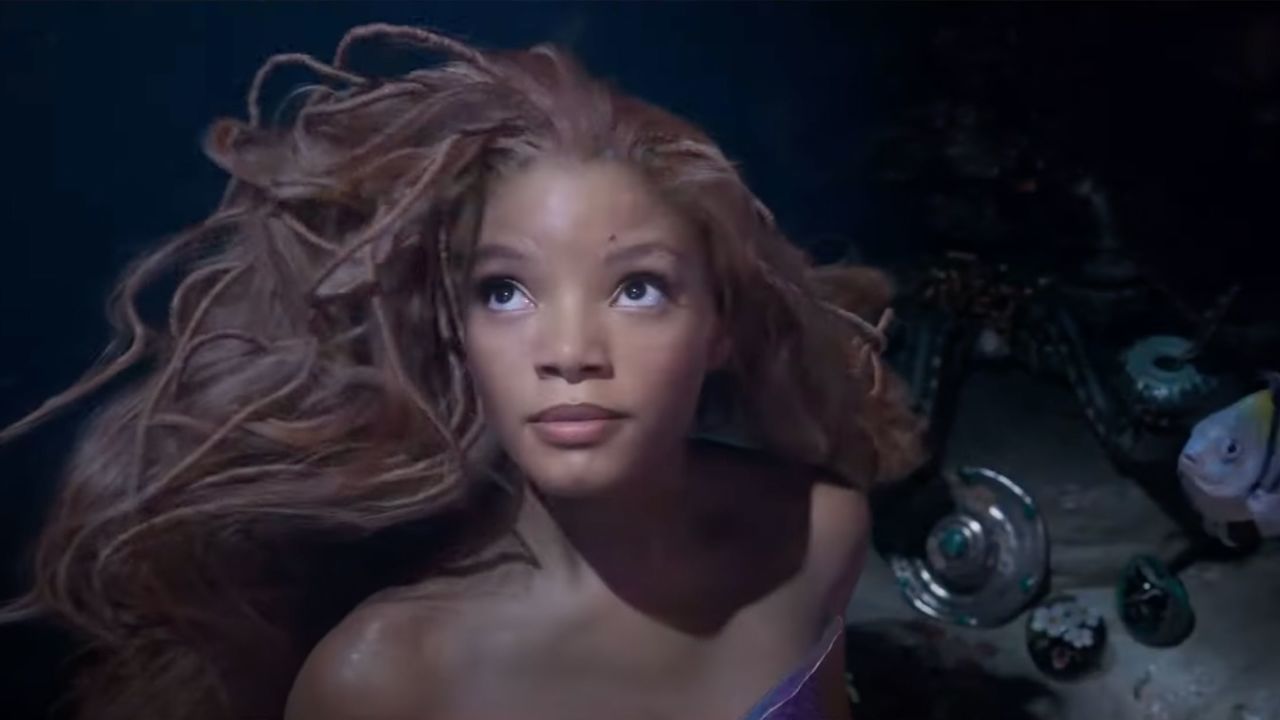
Ariel (Halle Bailey) under a seemingly waterless sea. DP: Dion Beebe. 

In Rob Marshall’s Disney adaptation (the same director of Chicago and Memoirs of a Geisha, shot by Oscar winning cinematographer Dion Beebe), Halle Bailey leads an otherwise poorly made ode to the 1989 animated film— which had the audacity to open with an Anderson quote. Bailey’s take on Ariel is the most convincing of the new cast, a young mermaid naturally curious about the entirety of the world, a collector of unique objects despite learning their meanings from the wrong sort of creature— and with a voice that carries resplendent notes through and through. Of course, anyone would want to capture that lilting sound and make it their own. Innocence, charm, and sweetness are very irresistible character traits and her gorgeous honey brown locs are a unique signifying force. Ariel is unfortunately bogged down by her main screen partners: the terribly designed Flounder and Sebastian (not a lobster, instead a googly eyed crab that must have escaped a parallel universe of Everything, Everywhere All At Once). Also, Scuttle is downright garbage. 

Flounder: sometimes you gotta smile to keep from crying and/or cringing. 

Sebastian: horrifying.

The sisters, however, were mere cameos— introduced by King Triton himself on high throne chairs in a lackluster scene that looks suspended in an outdated Windows backdrop. The animated version had the hyped girls singing “we are the daughters of Triton” during a lavish, heavily attended party. Here, the ladies representing each of the seven seas sit quietly, looking at their father as decorative objects more so than women with differing personalities. Where is the joy in the sea life? The thrills? The other merpeople? You would think that a two plus hour runtime would grant them a say, but then we wouldn’t have gotten Prince Eric or Scuttle’s awful songs. Also, King Triton shows obvious favoritism (and possessiveness) in regards to Ariel— this happens a lot in family structures, the youngest often being the apple of the parent’s eye. Yet, King Triton’s overbearing nature always seems a bit too… trifling? 

Ariel belts out an incredible Part of Your World reprise after saving Prince Eric from drowning. DP: Dion Beebe.

Apparently the sea is dull and the strict rules equals no fun. Anyone would want to escape. Plus, honestly, the above the surface shots are far more believable than the watery depths below. Ariel should be applauded for leaving such dreariness behind in order to obtain the feet that don’t hurt her. Her spellbound wonder for the majestic fireworks (probably most of the film budget) and even petting the shaggy Max are lovely touches of her affectionate nature. Despite mermaids being forbidden to interact with humans, Ariel’s longing to understand them (more importantly Prince Eric) is a universal belief akin to those of us who have a specific desire in life. Ariel’s private grotto mirrors an art collector’s trove later seen in Prince Eric’s library, even Ursula’s realm. Again, King Triton’s treasures are his daughters with one most preferred. 

We don’t talk enough about King Triton’s abuse— him destroying Ariel’s organized hoarding piece by piece would encourage even the kindest daughter to never return to someone that cruel. 

Ursula entices her niece (eye roll) with an offer she cannot refuse. DP: Dion Beebe.

As Melissa McCarthy’s Ursula did her best nod to the late Pat Carroll, Queen Latifah came to mind, especially Marshall having directed that splendid Mama’s Been Good To You number in Chicago (that should have gotten her the Oscar win). Awful choice to make Ursula and King Triton siblings. Why even? Worse, Ursula puts an amnesia spell on Ariel— so the poor girl doesn’t remember that Prince Eric must kiss her by the third day. 

Jude Akuwudike of the incredible Eyimofe (This Is My Desire) cameos as the fisherman who finds the newly limb-ed Ariel in his net and takes her to the palace at once. There, she sees Prince Eric again and they share an intense eye exchange, but he’s convinced that she is not his savior. Later, a downtrodden Ariel takes a bath— in more pretty scenes that demonstrate the look and feel of water. Sebastian arrives in her window, determined to help her fall in love, possibly feeling guilty for King Triton’s severe punishment, then again this isn’t conveyed quite clearly. A charmed Ariel wanders about the castle, well adjusted to walking and racing about on her new legs. For that, a viewer is easily swayed by her happiness and enthrallment, her captivation of human nature. The best moments are contained in Ariel’s delight— played beautifully by Bailey. 

Ariel looks around Prince Eric’s majestic library. DP: Dion Beebe.

While the other princesses have their men reflect them, for specifically Black and biracial women, Disney has a history of not finding them a Black Prince. This began in its 2009 animated adaption of Princess and the Frog. They’re still not ready to depict the soft Black boys/men that Barry Jenkins and Ryan Coogler bring to life.

Ever since reading a review calling Prince Eric a Himbro and looking up the meaning, it cannot be un-remembered. They tried to make Prince Eric a worldly, adventurous sort in a time of colonialism, but he really represents the same regurgitated formula as the other white Disney princes— blue eyed measure of attractiveness, desired rebelliousness from a privileged status, and little else. Well, Ariel if this is whom you want to flip your fins for, have at it. Interesting too, on this Caribbean influenced island that a Black Queen chooses to adopt a white child, seemingly the only baby ever to be put in this vulnerable position, the only to melt the queen’s heart. Okay. 

Ursula sees that Prince Eric is actually falling for the quiet, intelligent Ariel and ups the ante by disguising herself as the young slim Vanessa. They treat us to a godawful rap song as Scuttle’s dumb way of congratulating Ariel who sadly learns Maury Povich style that she is not the intended bride. Instead of a sunset wedding sailing away on a boat, Prince Eric has an engagement party overlooking the majestic sea. Scuttle again delivers news to Ariel sans that amazing line “she was singing with a set of stolen pipes.” Afterwards, fighting, shock, fighting, sacrifice, and finale fighting. The change to the victory may be a testament to Ariel not representing a damsel-in-distress, but man, Strong Black Woman trope came to sea us. 

Other notes: always found it an intriguing matter that in both the animated and live version, the mermaids understand and can speak English, but cannot write— which could have saved Ariel a lot of trouble. Anderson’s story is stronger because you do get the sense that the mermaid’s only language for the Prince is dancing. When King Triton returns to solid form after Ursula’s demise, the impact loses something because it is only him. None of the other poor unfortunate souls come back to fruition. Why did King Triton not give Ariel a new glittering outfit upon realization that the sea is no longer her heart’s desire? That blue dress was just overused. After Prince Eric threw it in the sea, never wanted to see it again. Definitely not Colleen Atwood’s best designs. The ending also really, really needed that Pride rainbow. Otherwise why quote Hans Christian Anderson if you’re not going to utilize the full scope of this metaphorical fairy tale masquerading his queer identity?

Prince Eric’s adopted mom the Queen is played by Noma Dumezweni aka the Black Hermoine in Broadway who is no stranger to the “Black girl taking the role of white girl” controversy. 

Furthermore, color blind casting cannot truly succeed if most of the speaking characters are white. The nonwhite people/merfolk exist as though they were props collected in Ariel’s burnt down grotto. Yes, The Little Mermaid broadcasts the star potential in Halle Bailey and a small testament to Laurence Olivier winner Noma Dumezweni’s steadily growing legacy. Yet, they feel secondary to an all-white realm even with its pockets of brown and Black figures sprinkled about. At the same time, the film gives us nothing memorable for Sienna King, Simone Ashley, and the other mermaid sisters. Those are who I showed up for— those who now have dolls in the stores— dolls that were not there in the 1990’s. It remains a lesson that just because women of color are featured in big budget vehicles doesn’t necessarily mean a promotional win regardless if minorities work behind-the-scenes. Blockbusters can mesh the explosive thrills with indie vibe storytelling— Everything Everywhere All At Once, Black Panther, Get Out. Disney, however, set in the past, remakes their old films and believes that making a Black women lead a farce excuses their years of ignoring us. So, she must endure a decent screenplay with low quality CGI and music from Lin Manuel Miranda’s EGOT thirsty pen. Bailey is an excellent singer and a brilliant songwriter (listen to Chloe X Halle) with no credits to what could be awards frontrunners, especially enjoyed her inner thoughts expressed as a mental song. Like Ursula, Miranda may be finally taking home the prize due to Bailey’s gifted voice. 

Although The Little Mermaid situates in the murky limbo between failure and triumph and is obviously not meant for someone like me, the children and Disney loving adults alike will cherish the film and truly enjoy Bailey’s multifaceted performance. Can’t wait to see her again— in an original film where she could write the music. 

Until then, I will probably reread Anderson’s story and write my own dark fairytale. Perhaps maybe centering why I cut my sister’s doll’s hair to a rather fetching shoulder length bob. 


Wednesday, May 10, 2023

The Promising Evolution of Janine & Gregory


Love can still be a splendored thing between friends/coworkers Janine (Quinta Brunson) and Gregory (Tyler James Williams).

Be patient and set aside your clever portmanteaus.  

A few weeks ago, Janine Teagues launched our summer hiatus by surprisingly choosing herself over an immediate relationship with coworker Gregory Eddie in Abbott Elementary’s second season finale, Franklin Institute. Although obviously “in like” with each other, Janine and Gregory simply are not ready to embark on their potential togetherness. It also may be unhealthy for Janine and Gregory to waste other people’s time whilst on the journey to finding themselves as well. They both should refrain from dating anyone and focus on teaching the youngsters. Most importantly, they need to come to terms with their respective childhood traumas. With therapy. Lots of therapy. 

Gregory couldn’t tell Barbara’s daughter Taylor, he didn’t like clam chowder. However, he did tell Janine.

Infectious, optimistic, and extremely upbeat Janine has issues separating her personal life from her teaching. Often, it shows up to school anyway. From the light bulb situation of the first season’s second episode all the way to second season, episode twenty-one’s Mom, Janine carries a heavy emotional load. 

Janine is a good teacher, but it is not surprising that people confuse her as a “big kid.”

Throughout Janine’s high school, college, and early teaching career, she has only been in one relationship. Imagine the significant moments in Janine’s life: a teenager’s first intimacies, homecoming and prom, several graduations, apartments— all experiences shared with Tariq. Janine’s mother Vanetta checks out and sister Ayesha skipped town as a healing mechanism. Thus, leaving a boyfriend who does not always prioritize Janine. In turn, delaying and hindering her improvement possibilities. For the longest time, Janine has been attached, her identity slumped to another man, a man who did not deserve her loyalty, let alone devout longevity. Tariq may be talented and good with children, but he was not good for Janine. 

Next to seeing her kids, Gregory is another good part of Janine’s work day. It’s only right that she continues to savor her joy.

Janine has various immature tendencies: toxic positivity, interfering in situations that are none of her business, not understanding that you can simultaneously like people, and entering into a messy situation with her coworker’s friend while obviously infatuated with said coworker. She should have more time to adapt to single hood, to learn her potential as a young Black woman in Philadelphia hoping to make a change in the corrupt educational system. When Barbara, Melissa, and Ava applauded Janine instead of condemning or making jokes on her single girl trip, that was a step in the right direction. After what has happened in her third teaching year, Janine could build on a stronger relationship with herself, with Ayesha. She’s already gradually setting boundaries with Vanetta.  

Erika (Courtney Taylor) has been a sweet, much-needed addition to Janine’s extremely small circle. 

Moreover, Black love is a form of activism, especially in television and film. The phenomenon is either sparsely sprinkled or tokenism remains alive. Black characters caring about each other and also valuing the self— that takes tremendous effort. It doesn’t always have to imply romance. Abbott Elementary has Barbara bonding further with her work daughter, willing to sacrifice for Janine. Those moments in Mom were beautifully rendered. Unafraid to tell Janine she’s messy, Erika is a blunt and honest encouragement outside of elementary school children and coworkers. Even Ava occasionally seems to give a little heart to Janine (sometimes against Ava’s iron will). At the same time, however, we do appreciate Melissa and Jacob as well because they demonstrate support and respect to Barbara, Janine, Gregory, and Ava (sometimes). 

That leads to Gregory— carving his own path towards Black Boy Joy.

Gregory may be Teacher of the Year, but he has ways to go before truly earning that title. Perhaps by then, he will either stay teaching or become principal with a proud Janine cheering him on. 

Militant Gregory finds comfort in his shell, closed off to people who are not Janine. Sure, Gregory asks Barbara and Melissa for advice on occasion, but he still retains a reserved persona. He lies about small things hating pizza and liking donuts, clandestine gardening, staying in relationships that do not serve him (Taylor and Amber), and reluctant to pursue friendly rapports beyond his circle (important if you want to become principal). Also, Gregory nearly kissing Janine in Holiday Hookah and actually initiating that move two episodes later (a day after his breakup) while she was dating his friend Maurice hints at his more selfish flaws. Let’s not even address the awkward, secondhand embarrassment of Gregory and Janine dumping Maurice together— too much to unpack there. 

Yet, Gregory moves on the cusp of change— declining his father Martin’s offer to join the family gardening business, to continue building on becoming a better teacher (despite that lingering principal desire as seen in Fire), and finally seeing Jacob as a genuine friend, a confidante. Gregory giving into Jacob’s hug at the Franklin Institute after Janine’s rejection (a year after not receiving the principal job) was a tender step in the right direction for his personal developmental growth. Gregory is shedding vulnerability, letting down his guard, and owning his journey to happiness. When he was proudly digging in the garden, acknowledging that the time came to “plant new seeds,” it symbolized perhaps a significant step towards change. 

Janine slowly but surely steps back from parenting her mother Vanetta (Taraji P. Henson).

In his last visit, Martin (Orlando Jones) tells Gregory that he’s proud of his secret progress attending to the school garden.

Martin and Vanetta have both visited Abbott, but have yet to respectively run into Janine and Gregory. Perhaps when the stern Martin meets Janine and kleptomaniac Vanetta meets Gregory, the offspring defends both their friend/co-worker and themselves. You can already imagine Martin believing Janine unworthy of his son or Vanetta just being uninterested altogether in Gregory (she didn’t even know Janine and Tariq broke up). Still, the united front a matured Janine and Gregory could put together against their problematic parents (and the triggers of their harm)… incredible. Moving. Cycle ending. 

Without the convincing chemistry between Quinta Brunson and Tyler James Williams’s portrayals, Janine and Gregory surely would not be this dynamic. We’ve seen them on A Black Lady Sketch Show and heard their voices in the Harley Quinn episode A Very Problematic Valentine’s Day. Hopefully, Brunson and Williams continue building a solidified partnership on Abbott Elementary and afterwards shift into making films together. If Gabrielle Union and Morris Chestnut can keep at it, why not Brunson and Williams too? 

Abbott Elementary’s writing has been consistently top notch— and a primary reason to support the WGA strike. We deserve quality television on all fronts and that starts with the writers. Thank the writers for giving us this strong development between Janine and Gregory. May their pens never run dry— especially on this terrific show, on this beautifully rendered slow burning pairing. Whether good friends till the end or the next smolderingly hot couple— either way the blossoming love between Janine and Gregory has sweet possibilities once the characters come to terms with who they truly are. 


Tuesday, May 9, 2023

‘Nightwatcher,’ Greatest Vulnerabilities Reveal A Black Girl’s Greatest Weapon


Leila (Arséma Thomas) has a very special gift. DP: Alexander Mejía.

Octavia Butler’s Kindred seems to arrive in the surprising form of Amira Hasib’s 2018 short film, Nightwatcher. Newcomer Arséma Thomas (who portrays Queen Charlotte’s young Lady Agatha Danbury) stars as Leila, a Black woman with the phenomenal ability to leave situations that frighten her. However, unlike Dana whose shifts from past and present occur the moment she moves into a new home, Leila appears to have had the adapted the skill since childhood— and it happens a whenever she needs saving. 

A passive Leila (Rylee King) quietly takes the abuse. DP: Alexander Mejía.

In the schoolroom, Leila endures cruel teasing from two giggling girls and a teacher who does little to reprimand the bullies. Leila’s friend and classmate Lance tells Leila to ignore them— an early instruction to be complacent, to simply say or do nothing. A conditioned Leila must be on her best behavior even when all around her is civil disobedience and undermined chaos. She internalizes her frustration, her agony, and her despair. To stand up for herself against her attackers (the innocent white girls) potentially categorizes Leila as disrespectful, wild, and unruly. 

“Please just ignore them,” Lance (Destin Hopkins) repeats. DP: Alexander Mejía.

Lance cannot protect Leila either. The collateral damage thrown his way means a more severe punishment for him and a cry out for feminism (and it’s problematic lack of intersections). Despite Lance’s soft and tender nature, if he blasted the two girls, they would paint him as a violent catalyst— an instigator. 

Thus, in these few minutes alone, only two kids are allowed a carefree existence (under the disguise of prejudice) while Leila and Lance withhold any disciplinary reaction. Once class is dismissed, Leila runs out into the bathroom and the two bullies give chase with a concerned Lance hot on the trail. As the torturers play an even naughtier game, daringly raising scissors near the bubblegum they’ve stuck into Leila’s hair, Leila suddenly vanishes into thin air. 

An unsmiling Leila takes a look at her reflection. DP: Alexander Mejía.

Leila stretches her hair against her cheek. DP: Alexander Mejía.

The mirror repeatedly reinforces an acknowledgment.  

Leila is beautiful, lovely, precious.  

The colonized globe wants everyone to hate their reflections and mimic all things European. It takes time for a persuaded mindset to relearn history; to prioritize self over prevalent media representation. Often, the first people that harm us are not the pictures on television or in books— it’s our peers in the classroom. Leila’s crushing experiences are eerily similar to endless Black girls. This still exists today and will exist tomorrow. 

Older Leila (Arséma Thomas) is pleased with her appearance— straight haired bob and impeccable makeup. DP: Alexander Mejía.

At a mundane party, an adult Leila practices her powers in the mirror; hoping to return home. The disappearance act only works in genuinely frightening situations— not as an operative excuse to flee boring life events. That small isolated moment grants a taste of Leila’s carefree spirit. Perhaps she has been practicing for years, testing out her powers for other possibilities. Still, she deserves inside joking as a coping mechanism in light of her supernatural abilities relying on pure vulnerability, on being extremely scared. 

Meanwhile, Leila surrounds herself with good friends Lance and Kailey. Instead of hanging out at Leila’s place, however, Kailey has other plans: a man who can afford an expensive Uber XL to pick her up from random parties. 

Leila and Michelle (Sydney Thomas) hide out in a dull party’s bathroom. DP: Alexander Mejía

Older Lance (Jashawn Richardson), Michelle (Sydney Thomas), and Leila (Arséma Thomas) leave out the party. DP: Alexander Mejía.

Once Kailey’s ride comes and she ditches her friends for a boyfriend rendezvous, Leila and Lance walk alone in the night together. If only the generous boyfriend had paid for Leila and Lance to get home too— even though, yes, that’s a tough ask in this society, in this economy.

Leila and Lance are stopped before heading home. DP: Alexander Mejía. 

The man berates them and acts like a cop. DP: Alexander Mejía.

Unfortunately, Leila and Lance are immediately pursued. The white male stranger tells a story of a nearby robbed liquor store, believing they fit the description. He does not allow them to leave. The situation escalates, the man impermissibly searching and pushing Lance on the ground. The man— conditionally convinced of guilt and wrongdoing— does not buy their stories or that their IDs are genuine. A horrified Leila moves her body, seeming prepared to launch an attack of her own. Instead, Leila grabs hold; causing both she and Lance to disappear together. 

Leila pulls off her wig and breathes. Maybe she remembers wanting to flee the party earlier. Lance probably would not have made it home. DP: Alexander Mejía.

Lance is still shaken by the event. DP: Alexander Mejía.

Nightwatcher— found on Thomas’s Wikipedia page versus IMDb and Letterboxd— showcases the various racist encounters that Black people face every single day, no matter their age. People would write off girls putting gum in another’s hair as “something kids do,” write off bullying as though bullying does not impact emotional/psychological development in addition to Leila’s temporarily destroying physical presentation. Moreover, the harmful neighborhood watch, police, and “do-gooder” bystanders cause trauma.  

Pratt Institute alum writer/director Amira Hasib demonstrates tenacious skill in Nightwatcher— a piercing dedication to the many Black girls and women in the tragically ongoing Say Her Name movement. A story begins with ferocious laughter at a Black girl’s expense and ends on a Black woman’s tearful note echoes the daily struggle, that familiar sad rite of passage. Hasib candidly depicts Leila’s presence as one to be tolerated or extinguished. Yet, Leila’s bravery lies in the supernatural force ensuring that the latter does not become an option for her or Lance. She can be afraid, she can let fear overcome her senses, her entire being. Although Lance implies that Leila can save others, the question becomes could her consciousness bear the heavy burdens of trauma after trauma— hers and those that she rescues? Then, the lingering memories would perhaps overload her mind, destroy any remaining fragilities. She is human too. 

Hasib’s unique fifteen-minute narrative should have been a remarkable basis for that Kindred series— something that Mrs. Butler would applaud. Leila is the modern-day Dana— just a Black girl surviving and trying to thrive in a society that still reminds her and her friends that they will always be treated differently. 

Leila and Lance reflect on the rooftop. DP: Alexander Mejía.

The cast shines in their limited yet powerful screen time: Rylee King (who utters not a single word) and Arséma Thomas both portraying Leila at specific moments where they are made aware of the Black stigma; Destin Hopkins and Jashawn Richardson as two Lance’s, a little worried boy who encounters the most horrifying experience as a Black young adult male. The saturated colors, especially the pleasing pinks and purples of Alexander Mejía‘s commendable cinematography build up Leila’s complicated world. Plus, perfectly lit Black skin impresses every scene. 

The evocative, thought-provoking Nightwatcher inches between realistic drama and subdued science fiction; keeping in mind that Black people are rarely allowed an opportunity to be innocent in the eyes of those who do see color first and human last— if ever at all. 

Leila’s purpose is both a beautiful sentiment and a profound poem embodying authentic Black love. 


Monday, May 1, 2023

April 2023 Film Watches


A still from David Chung’s Royal Warriors (1986).

April was a month featuring a few terrible remakes and wonderful, original feature-length and short films (som making it on my review/essay to write list). Most were streamed on Prime, Criterion Channel, Hulu, and Tubi (highly recommend even if the commercials can be a minor hindrance). Three feature films were seen in theaters and seven shorts were included in this year’s amazing Lunafest Film Festival program. 


1.) “The Housemaid” (2010) Im Sang-soo #^ 3/10

2.) “A Thousand and One” (2023) A. V. Rockwell #*+ 9/10 

3.) “Royal Warriors” (1986) David Chung #^ 7.5/10

4.) “Magnificent Warriors” (1987) David Chung #^ 8.5/10 

5.) “Miss India America” (2015) Ravi Kapoor #^ 2.5/10

6.) “Persuasion” (2007) Adrian Shergold # 7.5/10

7.) “Univitellin” (2016) Terence Nance #^ 10/10

8.) “How Would You Feel?” (2010) Terence Nance #^ 8/10

9.) “Swimming In Your Skin Again” (2015) Terence Nance #^ 8/10

10.) “The Mighty Quinn” Carl Schenkel (1986) # 6/10

11.) “Only You” (2015) Hao Zhang #^ 7.5/10

12.) “Reclaim Your Water” (2022) Faith Briggs #* 9/10 

13.) “Pete” (2023) Bret Parker #* 10/10 

14.) “Syed’s Xmas Eve Family Game Night” (2021) Fawzia Mirza *^ 9/10 

15.) “Miss Chelove: From Java to the Streets of D.C.” (2022) Sara Gama #*

16.) “This Is Beth” (2022) Jen Randall #* 6.5/10 

17.) “More Than I Want to Remember” (2022) Amy Bench #* 6.5/10

18.) “Swimming Through” (2022) Samantha Sanders #* 7/10 

19.) “Love And…” (2005) Zhang Lu #^ 6/10 

20.) “Hawa” (2022) Maïmouna Doucouré #*+ 10/10

21.) “April and the Extraordinary World” (2015) Christian Desmares and Franck Ekinci # 7/10

22.) “House of Hummingbird” (2020) Bora Kim #*^ 9.5/10

23.) “All About You” (2001) Christine Swanson #*+ 9/10

24.) “Clock” Alexis Jacknow (2023) #* 4/10

25.) “All About Us” (2005) Christine Swanson #*+ 6/10

26.) “ear for eye” (2022) debbie tucker-green #*+ 8/10

27.) “The Bone Collector” (1999) Phillip Noyce # 3/10

28.) “Girlfriends” (1978) Claudia Weill #* 9.5/10

29.) “Sunday Dinner” (2023) Monique Needham #*+ 7/10 

30.) “Polite Society” (2023) Nida Manzoor #*^ 10/10

31.) “Posies” (2021) R. H. Stavis and Katherine Fisher #* 6/10

32.) “Life of Pi” (2005) Ang Lee #^ 6/10

33.) “Dune” (1984) David Lynch # 4/10


# first time watch

*woman filmmaker

*+Black woman filmmaker

*^ nonwhite woman filmmaker

^nonwhite filmmaker


Other notes: 32 first time watches, 20 films directed/written by nonwhite filmmakers, and 18 films made by women.


Wednesday, April 26, 2023

‘A Thousand and One,’ Breaking Down Its Essential Relationships


A Thousand and One film poster.

A Thousand and One— the Sundance Grand Jury Prize winner— proves to be a commendable contemporary film about America’s neglectful foster care system. Set against the gritty Brooklyn backdrop and beginning with the problematic mayor Rudy Giuliani’s reign on New York City, a woman strives to make a better life for herself and her son despite many stacked odds set in place. Moreover, several key character relationships tie everything together in unexpected ways. 

Inez (Teyana Taylor) vows to always put Terry (Aaron Kingsley Adetola) first. DP: Eric Yua.

The first relationship grounds and builds solid foundation: Inez and Terry. 

Young, gorgeous Inez is a tough, outspoken woman shaped by her past. Recently released from prison, Inez dreams of opening her own hair salon. Unfortunately, her overreactive mouth and eager fists jump to fight people and systems, even if they are trying to help. Little Terry—Inez’s son tucked away in the foster care system, seemingly isolated and abandoned— compels Inez to kidnap him. Under aliases and frequent moves across the city, facing great poverty including homelessness, Inez and Terry are inexplicably committed to keeping the secret— a secret that would years later threaten their livelihood. Through all the ugliness and horror, Inez tries her damnedest to be the best possible parent to Terry. She wants what good mothers want to provide for their children: a safe, loving home, respectable manners to display out in the world, street intuition (mainly when dealing with cops), and a fulfilling education. As the sweet, intelligent Terry grows up, defined by Inez’s valid learning-as-she-goes attempt of nurturing, he becomes a healthy product of his environment. 

Kim (Terri Abney) instills some wisdom into Inez about picking fights. DP: Eric Yua.

The second relationship establishes a good BFF: Inez and Kim. 

It may be a difficult choice to make, deciding whether or not to risk your promising future for your best friend. Kim, however, is the reliable confidante the fugitive Inez needs. Inez has a hard time trusting people and her attitude causes a thorny ruckus in Kim’s household. Yet, soft and patient Kim stands by Inez, vowing to keep Inez’s secrets and in turn play a vital role in Terry’s life. Also, Kim genuinely wants what’s best for Inez— something that the woman deserves whilst trying to survive in a city that does not always demonstrate kindness, let alone love and support, especially to former felons. 

Lucky (Will Catlett) and Inez (Teyana Taylor) on their unconventional wedding day. DP: Eric Yua.

The third relationship showcases the pros and cons of turbulent history repeating itself: Inez and Lucky.

Lucky, a former lover, returns to Inez’s life, fresh out the penitentiary. Their love story presents two damaged individuals from the corrupt system gambling on creating a legacy together— to put up a united front for Terry.

“What do two crooks know about raising a family?” —Lucky 

More often than not, people like Inez and Lucky did not grow up seeing the structured family model; that televised cookie cutter dynamic of a loving mama, papa, and children having set meals and celebrating holidays and birthdays together. Thus, mirroring other folks trapped in endlessly traumatic generational cycles, Inez and Lucky do the best they can with their circumstances. Sure, they fight. Oftentimes, violently (verbal insults and destroyed furniture). No one is physically hurt. Feelings are bruised, yes. 

However, Inez and Lucky have one major factor in common: putting Terry at the top of their hierarchy. 

Lucky puts his heart, soul, and music into winning Terry’s heart. DP: Eric Yua.

The fourth relationship places high value on the father/son dynamic: Terry and Lucky. 

Lucky emerges into this new role as though he was destined to carry Terry on his shoulders. Lucky instills profound wisdom, pushes himself as a father figure even though he is far from perfect. No one is truly perfect anyway. Terry begins looking up to this man, opening up from his quiet shell, allowing the trusting bond to naturally form. The heavy, unbearable dramas depicting Black life can turn moviegoers away; this “why must we always showcase our pain and struggle” question that arises at every new picture that comes along, asking us to think and feel. Yet, in light of this excruciating weight, the powerful tie between Lucky and Terry gives the film its effervescent rainbow, its shining glory. There is never an uncomfortable moment, no desire to turn away from their important, must-watch scenes. Although no biological blood exists in these two individuals, Lucky and Terry prove that instinctive hearts choose families.  

As witnessed in her beautiful short film Feathers (on the Criterion Channel), A Thousand and One writer/director A. V. Rockwell places an eloquent emphasis on championing impressionable Black boys. By giving them inspiring figures that believe in and vouch hard for them in a country aggressively holding onto its historically brutal nature, Rockwell allows Black boys to be seen as children worthy of love and compassion. They are not depicted as future criminals— not in the eyes of those who care about them. Following behind previous Sundance winners: Ava DuVernay, Chinonye Chukwu, Ryan Coogler, and Nikyatu Jusu, Rockwell’s future shines brightly. She is one to watch as more and more filmmakers (especially Black women filmmakers) continue highlighting our stories with phenomenal originality, often times giving fresh actors/actresses a chance to shine in an industry valuing the same ole, same ole. 

Celebrate her choices or disagree with her, Inez only did what she thought was best. Illegal. Still, who else would have guaranteed Terry receive what he needed most out of life? DP: Eric Yua.

In addition to A Thousand and One’s Black woman writer/director, other behind-the scenes diverse inclusivity include the incredible Gary Gunn, a gifted Black composer, Eric Yua, an Asian American cinematographer, and women on editing, production design, art, and costuming roles. The acting too is top notch. Teyana Taylor (personally first seen in a certain must-not-be-named music video) convincingly portrays Inez’s varied complexities, giving her a compelling range of vulnerability— happiness, ferocity, regret, and love. Will Catlett (First and Black Lightning) has enormous screen presence as the tender, adoptive father figure Lucky— a man of flaws, but with a very sincere heart and spirit. The three Terry’s (Aaron Kingsley Adetola, Aven Courtney, and Josiah Ross) were exceptionally good— although Courtney’s part was shorter than the other two. 

The stunning, well-crafted A Thousand and One will leave anyone speechless by its depth and emotionally stirring surprises.