Showing posts with label Michael B. Jordan. Show all posts

Tuesday, February 24, 2026

Thoughts On The Shameful 79th Annual BAFTA Awards


Michael B. Jordan and Delroy Lindo at the BAFTA Awards. 

Sunday started off on a disrespectful final week of Black History Month in London. Ever since the painful humiliation Michael B. Jordan, Delroy Lindo, Hannah Beachler, and another aforementioned Black woman in the audience bravely endured from hard “n” word screaming Paul Davidson—a sufferer of Tourette syndrome— at the 79th Annual BAFTA Awards, the opened wound has continued bleeding and bleeding and bleeding. The call coming from inside the house—or institution rather—requests that the offended parties understand Davidson’s condition and not grant any genuine salve to those affected by the racist tics. Every time such prejudice glares its ugly face, Black people are left compartmentalizing an unfair balance of holding the grace bag in one hand while trying to stitch together the gaping holes with the other. They’re instructed to be compliant, to have nuance, gentle and kind. 

It’s a mighty fine gaslighting tactic. 

Where is the empathy for them? The respect? 

Now certain awards shows never seemed true safe spaces for people of color, considering what they tend to honor and the systems that they continue upholding— a system that’s still donning firsts at their big ages. Invited nominees and presenters must be walking along eggshells, especially Black women actresses and filmmakers who are often more likely to hand out trophies than win them. 

Production designer Hannah Beachler’s tweets on her firsthand accounts of the word being said not once but three times.

Many have applauded the compassionate response of the stilled BAFTA audience including host Sir Alan Cummings, but the changed faces on Michael B. Jordan and Delroy Lindo’s will haunt us for a lifetime, looks of shock and dismay, even horror and pain happening on a live stage in front of their friends and peers. Hearing that Jordan’s parents cried added another layered sting. BAFTA also chose to keep the slur in the airing even as Warner Brothers asked them to remove it. That spoke volumes regarding censorship since this part of Akinola Davies Jr.’s acceptance speech was purposefully omitted, 

“Archive your loved ones. Archive your stories yesterday, today, and forever. For Nigeria,  for London, the Congo, Sudan. Free Palestine.” 

Davidson and BAFTA provided insensitive statements that were anything but apologetic. Their empty words fail to comfort the very people it harmed shows the world that blackness matters so little, that Black people must show humility in the face of blatant cruelty. BAFTA remains standing ten toes down on whiter ground— more so than the Oscars at times— and the events on Sunday and the glaring aftermath prove it. They care more about Davidson than the historically negative connotations of the hard n word.


Thursday, July 12, 2018

'Fahrenheit 451,' Brother, Where Art Thou the Black Women?

Fahrenheit 451 poster.
Ray Bradbury’s classic Fahrenheit 451 is an outstanding piece of dystopian literature. It made perfect sense to create a new film adaptation of a story entailing a post apocalyptic world without books, without knowledge turning pages grants us. With Michael B. Jordan tapped as lead and serving executive producer duties, why not be excited about HBO's reenactment?

Captain Beatty (Michael Shannon) and Guy Montag (Michael B. Jordan) burning all books.
Ramin Bahrani's film shows a quite compelling opening sequence that is heated and alluring all at once. Heartbreaking imagery of beloved books and art devoured by smoldering flames. Classics like Zora Neale Hurston's Their Eyes Were Watching God, Herman Melville's Moby Dick, and Flannery O'Connor's Wise Blood and works by Vermeer, Henri de Toulouse-Lautrec, Horace Pippin, James Van Der Zee, and Gordon Parks are consumed by melodious fire. Archival photos including The Kissing Sailor are also torched alive. Poetry, fiction, theory, and everything in between translated in various languages across the globe are destroyed, seemingly lost forever.

Left behind, however, is a hardened yet vulnerable world surviving on inaccurate information, without art and music, nearly 7,000 languages lost, doomed for collapse.

Secretly seduced, Montag pockets a slim copy of Fyodor Dostoyevsky's "Notes From the Underground."
The firemen break into houses, damage property, and humiliate the guilty via surveillance that can be seen outside on skyscrapers, all over the web. Captain Beatty and Guy Montag lead their team, burning up computers and books, determined to stop anyone from uploading thousands of existing material onto the Internet. They're a rough, aggressive bunch, often celebrating victories over these intelligent renegades, believing that burning books are necessary, saving people from sin and depravity.

Beatty and Montag have a close bond, an almost familial allegiance. Montag is Beatty's righthand man, someone he can count on most, and a topnotch replacement for his upcoming retirement.  Both men, though, are hiding secrets from one another and from Yuxie, their in house Suri. She is in charge of securing the home, offering a vocal companionship, and instructing them to take their eyedrop cocktails.Unlike Beatty who instructs, "Yuxie, go dark" and places a lampshade over Yuxie's sleek head, Montag only tells her, "go dark," believing that he has complete privacy.

Guy (Michael B. Jordan) finds himself beguiled by dimly lit stacks of paperbacks and hardcovers. If you're a library/bookstore enthusiast, the smell of books, the sight of books is a tantalizing seduction, albeit innocent, but worthwhile and pleasant. Fahrenheit 451 definitely captured that lure.
Just like Black Panther's Erik Killmonger, Montag has strong patriarchal ties, his memories flooded with father and son interactions. It is beautiful, an expression of tenderness and compassion, thoughtfully expressing a father's love, a black father's love that is present and undeniable. Without exchanging words, the father and the son look upon one another in a genuinely endearing affection. However, the black mother's absence isn't explained. Had she fallen for books? Was she a betrayer to the regime? Or had she died in childbirth due to the lack of knowledge doctors likely held? Although it starts to become obvious that Montag's thoughts are rigged, there is no indication as to what has happened to his mother. Montag's desire for a father figure makes his relationship with Beatty appear a desperate clinch, a reach that ultimately starts to unravel once Montag's views on burning books changes.

Enter Clarisse McClellan, a woman who helps those eels (the rebel organization) in need and moonlights for the fire department, granting them information to keep them off her revolutionary trail. Montag is intrigued by her, sneaking visits to her room in the slums, which also showcases a great class difference between the two. Clarisse's knowledge, however, puts her in a whole other league from Montag. He no longer feels driven by duty, but by destiny. Soon, they're reading Dostoyevsky together- she reading with purpose, he struggling with reading flow as though illiterate. After witnessing a woman sacrifice herself along her vast book collection ala Joan of Arc fashion, Montag begins to understand the draw of the written word.

Guy (Michael B. Jordan) and Clarisse (Sofia Boutella) have a bland, short lived romance.
Of Jordan, fresh off one of Marvel Universe's most successful hero origin films where blackness held vital key, is it not too much to ask that the same logic be shown in a small HBO picture such as Fahrenheit 451? This is a man set on producing films with the inclusive rider clause. Yet, however, this film doesn't include black women in a way that is valid and celebratory. Sure, Khandi Alexander shows up one hour and nine minutes in, calling herself Toni Morrison, a fierce leader among a gang of folks ushering the rebel change. Now Jordan knows black women are his hugest fans, his biggest support group. The love is definitely not returned here. Once Toni Morrison arrives, the main points have been made, the shift has already been set in stone, and the film is only an hour and forty minutes.
"The most disrespected woman in America is the black woman. The most un-protected person in America is the black woman. The most neglected person in America is black women."- Malcolm X
Yes, books, art, and music have to survive. They're absolutely needed. Humanity would be in a sunken place without people's individual opinions, convictions, passions, and talents. Most importantly, black women are imperative.  And a world without them, is a world without strength, dignity, and backbone.

Monday, February 19, 2018

‘Black Panther’ Gloriously Delivers Wakanda

Black Panther film poster.
Black Panther was indescribably above expectations and is the best Marvel film by far.

Although not the originally slated four hours that anxious fans desperately hoped for, the shorter run time still had plenty of juicy appeal to satisfy the appetite for all things African. This film is definitely not the average Marvel verse. At last, we see ourselves, our ancestral pride stitched in every detail. From the far and wide casting choices of black American, Kenyan, Zimbabwean, Ugandan, Rwandan actors/actresses to the elaborate costumes that pay homage to roots, to the jewelry to the sights of drums and dance and ritual to face painting, hair styles, makeup, fashion, language (both phonemic and hand communication) and scenery. Every ingredient unifies the world of Wakanda, taking audiences to a place they’ve always wanted to go, but rarely realized it could finally happen.


Nakia (Lupita Nyong'o), T'Challa (Chadwick Boseman), and Okoye (Danai Gurira) are now home.
Black Panther starts off with an unexpected betrayal in the past, an act that will unravel and change the course of Wakandan allegiances in the future. Thus, in the present-day, after catastrophic events from Captain America: Civil War, T’Challa embarks home, retrieving Nakia, a bold, brazen woman spy who often leaves him rightfully "frozen," along the way. Upon his most welcomed return, the traditional ceremony of his crowning as King of Wakanda is a joyous occasion with music, dance, and battle.

Like an eloquent black Eve bearing an apple of fruitful knowledge, Nakia, refusing to be wife, offers T'Challa the first taste of forbidden resistance. She wants to share Wakanda to those in need, to generously spread the great wealth of resources all over the world, especially to black people. This is where they differ. T'Challa wants to stick with Wakandan tradition, to remain apart, and continue on with sacred, privileged black utopia. They are on opposing sides, but the love they have for Wakanda and for one another is a delightful. refreshing energy. Their banter, their looks into each other's eyes, their handholding, and their kissing is that splendid, exasperating thing, the first black on black heterosexual love story shown in the Marvel films.

T'Challa is reluctant, but is ready to be a remarkable leader. At the same time, he is not his father. He is tested throughout, challenged to consider exactly where Wakanda's loyalties lie. In his eventual pursuit of Klaue, he faces being surveillanced under the scrutiny of public eye and finding out some disheartening truths about his father, who had once said in the astral plane, "that a father who cannot prepare his son for the future has failed as a father."

The hypocrisy levels definitely tore T'Challas's fatherly love and admiration asunder. There is no question that what the former Wakandan king had did a horrific, inexcusable wrong.
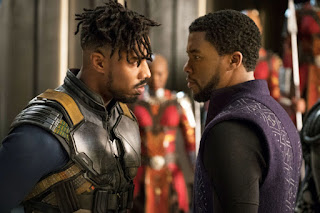
Erik Killmonger (Michael B. Jordan) faces off against T'Challa (Chadwick Boseman).

With his malice lying deep in the feelings of isolation and trauma, Erik Killmonger is such a terrific many layered villain. Beyond the bad seed trope, he is the physical consequences of residual scars of seeing the abandoned body of his dead father like that of the black body grossly depicted in history, in our current landscape, dead and unattended, left without a sliver of compassion and empathy. The desire for revenge rightfully brews in him, gaining substantial ground as he grows up on American soil, experiencing heinous racism and oppression, while desiring a place in his father’s native homeland, the very place that he blames for his tragic childhood. Thus, his extreme politics bear great similarities between of the righteous need to arm civilians with tools necessary to flourish and thrive without fearing white supremacy. He is the Malcolm X to T'Challa's Martin Luther King Jr.

The heart of the film is finding one self conflicted between T’Challa and Erik, finding both sides wrong and right on different political and social parallels. That wherein the genius.


Okoye (Danai Gurira) and her beloved spear taking names in the midst of an awesome car chase.
Black Panther fearlessly passes Bechdel and Ava DuVernay tests with flying emergent colors. The women of Wakanda were an absolute, scene stealing treat! There are no background players and props here. Firstly, the dynamism between the four leading women was a chemistry barely tapped in the Marvel Comics film sphere seeing as most of its core female characters, Black Widow especially, operate alone in a male dominated situations. In Wakanda, levels of trust and friendship went beyond protecting their supreme ruler. Queen Ramonda, Shuri, Nakia, and Okoye are a beautiful, inspiring sentiment, an awesome portrayal of the communal bonds between the black women’s love for each other and their undying allegiance to their country.

Nakia (Lupita Nyong'o) and Princess Shuri (Letitia Wright) are ready to fight for their country.
Queen Ramonda has birthed two amazing individuals who have inherited her goodness, her tenacity, and her courage. Princess Shuya, the computer tech whiz behind Wakanda’s highly advanced superior technology had more than once saved the day behind-the-scenes. She is valiant, witty, sharp, and intelligent, a supreme highlight who had some of the best deep seated one-liners, especially about colonialism. Nakia, the prince’s heart, has love for all people, wanting nothing more than to share Wakanda’s wealth of knowledge and resources to those of the diaspora, but of course, her kind of vigilantism often gets her into trouble. She too is an excellent warrior, her fighting skills a tremendous glory to watch, seen in the visually stunning choreography sequence in the casino scene with her fellow sister, Okoye, the powerful, resilient, staff wielding leader of the impressively elite Dora Milaje. Okoye is fierce and loyal to the throne, which adds to her internal struggles further down the line.

In the forests near the mountains of Gorilla City, Jabari's Tribe, Queen Ramonda (Angela Bassett) and Shuri (Letitia Wright).  

When Nakia, having successfully taken the last of Wakanda’s most precious plant as Killmonger orders it all burned down, is pleaded by Queen Ramonda herself to engulf the advanced Black Panther powers, the powers entrusted in her familial line. Even with her own young daughter standing by, it is Nakia, that Queen Ramonda believes can save them.

Other must see highlights: Nakia's first secret mission of freeing captive women (because of its heartbreaking reminder of "Bring Back Our Girls," a movement to finding the missing kidnapped girls from Chibok in Borno State, Nigeria); Killmonger wisely informing a curator of the Museum of Great Britain that they stole artifacts from Africa (because us knowledged people cannot imagine Africans gifting precious artworks to "The Other" aka colonizers); M'Baku and his people barking over Agent Everett Ross, telling him that he couldn't talk (because white people constantly tend to speak over black people). A sweet Moonlight actor makes a cameo at the end (because this brings to full circle the monumental range of diaspora unleashed in this film, us brown and darker skinned complexions with our broad noses and protruding foreheads and full lips are present together).

Wakanda Ensemble: Forest Whittaker, Daniel Kaluuya, Michael B. Jordan, Lupita Nyong'o, Chadwick Boseman, Angela Bassett, Danai Gurira, and Letitia Wright.

Black Panther does have minor adversaries. It is unsettling that a white C.I.A. operative comes to their country, wears their symbolic garb, and eventually must wield their sophisticated devices to blast down Wakandan vessels. There is no queer representation, which makes one wish that Tessa Thompson's Valkyrie, introduced in Thor: Ragnarok, would fly on down to Wakanda and have her way with a Dora Milaje soldier. Or perhaps in its sequel (oh there has got to be a sequel), Roxanne Gay can be brought into the writing room. The most glaring flaw is that black libertarianism, seemingly the real supposed villain, the conveyed message behind Killmonger's "evil," definitely conjures internalized friction. This idea to save long suffering black people from imperialism (Wakanda has plentiful which Nakia earlier addressed) isn't Wakanda's problem, but what T'Chaka did to Killmonger is. Where was Killmonger's mother? What role did she play in his life, if any? His masculinity was a toxic, misogynistic brand and yet, his desire to arm the most vulnerable people in the world was moving in spite of it.  

However, it is imperative to remember that one fictional superhero movie cannot hold everything, be everything to someone. It would be irresponsible to say the least.

Black Panther has granted us a black director (Ryan Coogler), black writers (Coogler with Joe Robert Cole), a black costume designer (Ruth Carter), a black jewelry designer (Douriean Flecther), a black production designer (Hannah Beachler), a black soundtrack director (Kendrick Lamar), and an almost all black cast from different pockets of the globe. And that stands for something undeniably profound.

T'Challa (Chadwick Boseman) has reassurance from Nakia (Lupita Nyong'o) that he can and will thrive as king of Wakanda.

Overall, Coogler and his team have helm a magnificent picture with a fine, gratifying story that passionately entails the complexities of fights within the black community. He has achieved a finesse that few filmmakers in the comic book verse have by incorporating historical and contemporary problems. The performances are meticulously top notch and powerful, possibly one of the best ensembles of Marvel. With Oscar winners and nominees, Golden Globe contenders, NAACP Awards and Black Reel accolades, and even a Pulitzer Prize nominee in the mix, the stakes were high. From Chadwick Boseman's commanding lead (kudos to his dialect coach), Michael B. Jordan's ruthless aggression to Lupita Nyong'o's ferocious vitality to Danai Gurira's stout loyalty, everyone had came with their A game. Angela Bassett, Forest Whitaker, Daniel Kaluuya, Sterling K. Brown, Winston Duke, and Letitia Wright (who was superb in that must watch Black Mirror episode, "Black Museum') also put in incredible acting efforts.

Black Panther may not have televised the whole entire revolution, but this imperative comic book film drama passionately ignites conversations to take that leap.

Now go see and support the vision of black excellence. Wakanda forever.


Saturday, June 10, 2017

The Big Tease: Recapping the Lit 'Black Panther' Trailer

Black Panther film poster.
Black Panther's newly released mini trailer is only less than two minutes long, but it's the most incredible, nail-biting one minute and fifty-two seconds existing right now. Led by solid master scribe Ryan Coogler (Fruitvale Station and Creed), performance top houses such as Chadwick Boseman, Michael B. Jordan, Angela Bassett, Lupita Nyong'o, Danai Gurira, and Forest Whitaker just to name a few, and gorgeous costume design by Oscar and Emmy nominated Ruth E. Carter (Malcolm X, Amistad, and Roots), Black Panther promises to deliver and honor our greatest hero dreams through the art of film.

Chadwick Boseman is the perfect choice for as the King of Wakanda, T'Challa.
Firstly, Stan Lee and Jack Kirby are the two white men who created Black Panther and the fictional Africanized world of Wakanda. In this modern day and age, it's right to hand the film reins over to Coogler, a phenomenal award-winning African American filmmaker, wonderfully adept at humanizing blackness, giving his black anti-stereotype characters full breadth: vulnerability, flaws, and integrity. Most importantly, Africa and the black experience is still a sensitive issue. When often filtered through white lenses, films starring people of color are told with blatant or hinted exoticism, white imperialism, and misogynoir. The black villain is also a huge fear to tackle among non-black filmmakers due to history. Coogler is definitely capable of rendering a villain that is not a mustache twirling tagline.

Although not filmed on any African continent, filming locations include Argentina, parts of South Korea, and Atlanta, Georgia.


Raised fists, the likely stance film goers will have come February 16, 2018.
Forest Whitaker is Zuri, T'Challa's spiritual advisor. Coogler states, "Forest’s character, more than anything, is a major tie-back to T’Challa’s father. Zuri is someone he looks to for guidance."
Secondly, Black Panther's casting is out of this world. With a few Oscars winners and nominees in the mix, this film is not only a black superhero film, it's a black superhero that will include top notch acting. Boseman resumes his role (leading instead of supporting) as the fiery crime fighter nodding to African roots, Jordan and Nyong'o play layered villains (against their usual goodie-two-shoes roles), and Bassett and Whitaker mentor their characters.

Arrested Erik Killmonger (Michael B. Jordan) comes forward with W'Kabi (Get Out's Daniel Kaluuya) at right.
Thirdly, it makes one a bit teary eyed to see a cast featuring so many brown and ebony skinned bodies and in a big budget Marvel film no less! Like Moonlight, Black Panther shows the array of African diaspora, the varied skin hues, the specific features, the individualized hairstyles. The black women, with their short crops and regal clothing, are sensual, sleek, powerful goddesses confident in their own chemical makeup. The black men have dignity, honor, and sexual appeal. That kind of validation, of ownership told through Coogler's vision is downright laudable.

Villainous Nakia (Lupita Nyong'o) stepped out, a fierce stunner in a fetchingly designed dress and awesome twist out 'fro.
Warriors led by Ayo (Florence Kasumba) who is fighting Nakia (Lupita Nyong'o).
In closing, the excitement and anticipation for the film is gaining momentum. The trailer showcases awesome cinematography, excellent lighting and camera direction, and amazing costumes.
Black Panther, we're ready and rooting for you.