Showing posts with label 2019 Film Release. Show all posts

Tuesday, April 23, 2019

'Fast Color' Uniquely Mends What Is Broken From Superhero Origin

Fast Color film poster.
"Perhaps the self-same song that found a path
Through the sad heart of Ruth, when, sick for home
She stood in tears amid the alien corn"-- John Keats, Ode to the Nightingale

In Fast Color, the invisible umbilical cord binds the women's ancestral line. No amount of distance-- both living and dead-- can change the course of that destiny, a destiny that is still an unraveled mystery. The mother, the daughter, and the granddaughter will need each other for different resources, but the most important tool for survival is togetherness.

In a dry, barren dystopia, water is no longer a complimentary luxury, costing as much as an astronomical forty bucks a few gallons, twelve dollars a pint. The rain hasn't touched the earth in years, leaving behind an unloved, unfulfilled world. Enter Ruth. She is a very special woman with some very eccentric abilities-- like causing earthquakes. She constantly rushes place to place, obviously on the run from militant evil. She gets into a stranger's car and immediately finds out he is anything but a white savior.


Gugu Mbath-Raw (Belle, Beyond the Lights) puts on a fantastic performance as Ruth, mover and shaker of the earth.
Ruth manages to escape and finds aide in Sheila, a kind bartender before reaching to a place she had abandoned-- home. The home is a whole other character, nonverbal. On the outside, it looks like a plain, ordinary barn. Inside, the walls overflow with historic pictures, drawings, and paintings. Many objects fill the rustic, charming spaces of Ruth's mother Bo's family inheritance, a living, breathing heirloom seemingly as old as the women's exceptional gifts. The most precious sentiment is the huge book that all the women write in, entailing their magic and illustrating colors-- colors that Ruth cannot see. Thus, migration is apparent-- Ruth's return, the sacredness of Black home/land ownership passed down, and the shared diary from one woman's hand to the next.

Bo (Lorraine Touissant) tells Ruth (Gugu Mbatha-Raw) about the importance of the house and the family diary. The inherited house served as a protective barrier, a serene solace for many generations. Unfortunately, no place-- no matter the familiarity or history-- can shield their secret forever.

Ruth (Gugu Mbatha-Raw) is trying to build with her daughter Lila (Saniyya Sidney)-- a path to forgiving herself for the past and making it up with a promising future.

Bo doesn't seem excited by Ruth's return and Lila is reluctant and naturally distrustful to form a relationship. Still, the three manage to set a routine, dividing the food and water, practicing their manipulation skills. Ruth is fascinated by Lila, falling more in love with her daughter. Ruth accidentally breaks Lila's window and suggests that maybe they can place it back together-- although their powers never fix broken things. The glass surprisingly comes together at their joined effort, but then shatters, relaying that mother/daughter have kinks to sort out. Through time and patience, Ruth and Lila could potentially have a strong, resilient bond.

Three is the magic number: Bo (Lorraine Touissant), Lila (Saniyya Sidney), and Ruth (Gugu Mbatha-Raw).
The talented trio force of Gugu Mbatha-Raw, Lorraine Touissant, and Saniyya Sidney give such phenomenal performances that cannot be ignored. The juicy script lends them opportunities to convey suspicion and doubt, love and tenderness. By having considerable weight to their parts, these actresses are able to fully render character's individual actions, the causes and affects. Mbatha-Raw's former drug addict Ruth has expressive eyes and spurts of vulnerability, haunted by regret. Touissant's Bo follows her own stern mother's footsteps, but her warm, valiant heart realizes that the past cannot deny future. Sidney's Lila showcase that beneath the iron rebellion streak, she wants true belonging. These women lead in a refreshing and phenomenal way, leaning on each other, learning to trust and sacrifice as do their engaging characters.

The score is melodic and powerful, setting appropriate moods and Nina Simone leads an eclectic soundtrack. Beautifully shot in Albuquerque, New Mexico, the visual effects are also a dazzling highlight, especially the significant moments of molecules transforming into objects and these objects breaking down into tiny particles-- Bo's cigarettes, Lila's tools, the broken ceramic bowl. In fact, two noteworthy scenes stand out.

Ruth coming into herself, finding something nestled deep within, and it all comes down to Lila. She is Ruth's heart, her ultimate power source. When Ruth finally embraces her gifts, free from seizures and shackles, seemingly joining with the earth in a profoundly internal intimacy, Ruth is as phenomenal as X-Men's Ororo Munro aka Storm.


Oscar winning filmmaker Barry Jenkins (Moonlight and If Beale Street Could Talk) with Fast Color co-writer Jordan Horowitz, Fast Color director/co-writer Julia Hart, and film stars Saniyya Sidney (Lila) and Gugu Mbatha-Raw (Ruth).
Bo admits fearing her own strength. Yet she defiantly faces down the men with guns pointed at her and her child and dissolves the threat. This excruciatingly intense scene froths with metaphorical allegory. These people aimed weapons at women, placing their selfish, malignant intentions for "science experiments" far above the validity of human life-- women who are callously the more violated sex. Sasha Avonna Bell comes to mind-- one of the first to file a lawsuit against Flint, Michigan, whose death remains unsolved. Yet it also ushers in the history of Sarah Baartman and other Black women's bodies paraded, exhibited, and dissected for their unique "parts," viewed more as scientific curiosity than human. Ultimately, Bo had to be the one to stop government interference.

While Marvel and DC alternately push out their annual big budget comic book films, Fast Color wedges between the tough industry cracks-- a worthwhile triumph. The small budget film has an independent spirited heart placing a generational line of women at the crux and deserves all the buzz and praise received. It shows mothers and daughters repairing fragile damages, challenging authority together, venturing down the road to something once forbidden, and leaving all wounds to the conjured wind.


Wednesday, April 17, 2019

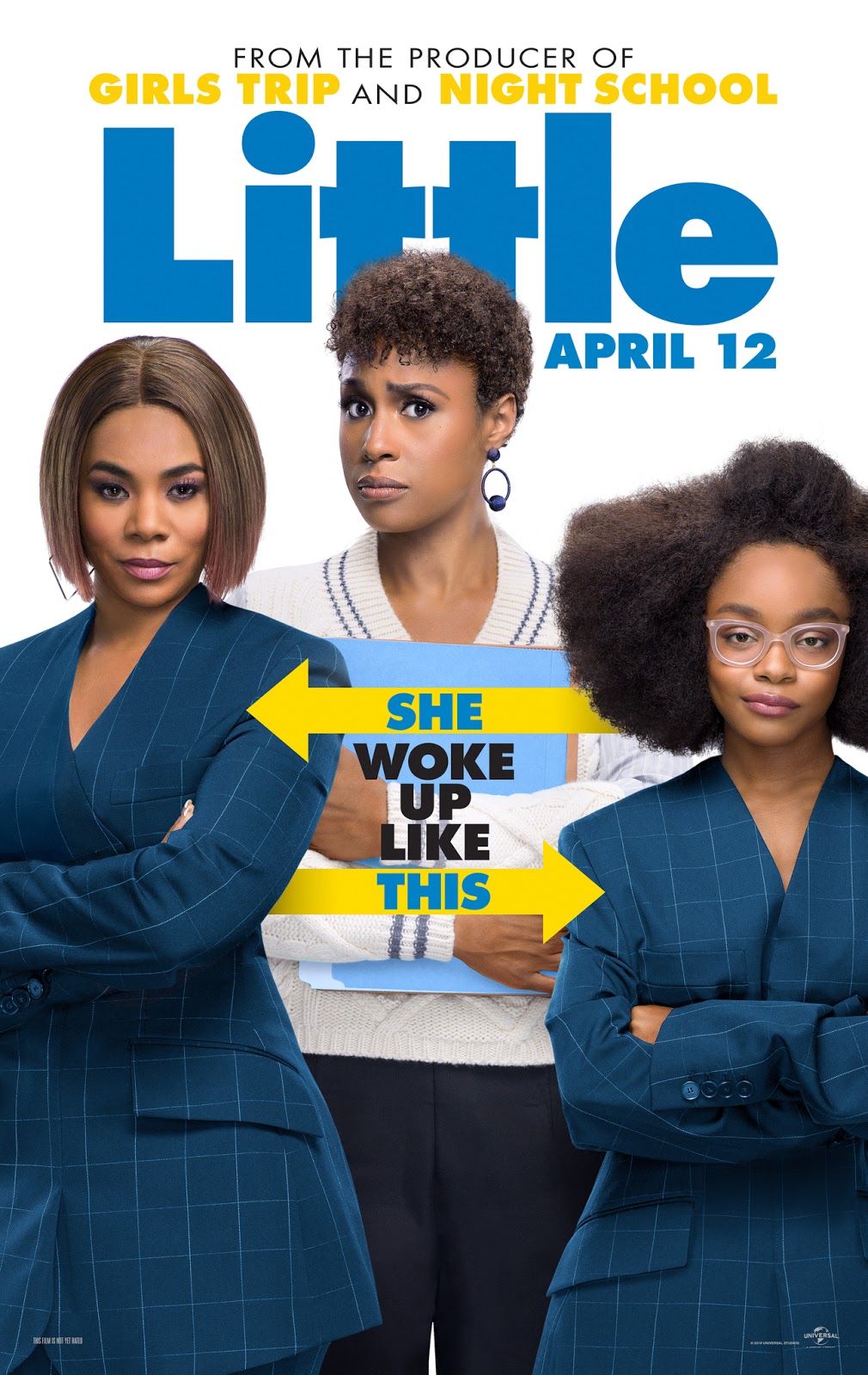
'Little' Uplifts And Unleashes the Inner Misfit

Little film poster.

"Kids are mean," many nonchalantly say as though this resolves the huge bullying problem.
Little opens with junior high schooler Jordan Sanders's triumphant moment. Unfortunately, it becomes a perfect time for public humiliation to strike-- not ala dance spectacle like most films surrounding coming of age teen drama. After Jordan's onstage scientific feat, the mean girl pushes back, physically hurting Jordan and singlehandedly traumatizing her to death.

Jordan (Regina Hall) messes with the wrong child. 
Years later, Jordan--a tech company CEO-- is an insufferable, carb-hating diva that treats everyone in her life as inferior beings. No one is safe from her Cruella De Ville-ish wrath-- her robot HomeGirl, her hotel barista, her bellhop, her employees, random children. Jordan's cruel-heartedness is certainly a colossal jump from the sweet, afro haired, bespectacled science nerd who believed that everyone would admire her hard work. Adult Jordan wraps around the cloak that power grants her. Instead of finding much needed aide (like seeing a therapist, formulating real-life girlfriend relationships, cooking or cleaning for herself, and ending reliance on capitalism for meaningless happiness), she abuses power to make others feel insignificant.

On the opposite spectrum, Jordan's assistant April is eerily similar to Little Jordan. The donut lover surrounds herself in art supplies, dresses with quirky spunk, and doubts her creative abilities. In fact, she mumbles a lot. Preston, her co-worker, encourages her to speak up.  Like everyone else in the company, April is terrified of Jordan. However, April seems to fear herself more.

Jordan is only insecure around Connor-- the firm's biggest client is a rich white guy. He sits in her chair, props his feet on her desk, and announces that he is moving his finances elsewhere unless they can keep him interested/invested. At this, Jordan goes berserk in the staff meeting, screaming at someone to have a good idea. April keeps mum. An on edge Jordan threatens to fire them all and eventually yells out to the donut man's adorable daughter. The daughter retaliates with a wand flicker and shouts, "I wish you were little!"

Black Girl Magic happens.

April (Issa Rae) and Little Jordan (Marsai Martin) aren't too keen on Young Jordan returning to school mostly because April doesn't want to go to jail.
Jordan wakes up to a huge surprise-- reverting to her younger self, an embodiment of her innermost shame-- Little Jordan. Of course, she thinks it unnatural. Everyone sees that she is a nonthreatening girl. Her authority is gone. April comes to the rescue. It leads to a rather farfetched plot involving Children's Services. An agent demands that Little Jordan goes to middle school otherwise the circumstances will be detrimental.

Little Jordan is the exact opposite of Never Been Kissed's Josie Gellar (the overly enthusiastic, twenty-five-year-old journalist disguising as a high schooler versus thirty-eight-year-old Jordan magically stuck in her younger self's middle school body). Little Jordan is cursed into going back to school as opposed to incognito. With the mind of an adult, she develops a hilarious crush on her teacher and finds she has no power over her "peers." Sadly harassed, ridiculed, and humiliated on her first day, she once again faces the unstoppable bullying and links in with the uncool crowd-- three naïve kids who believe that unveiling their talents will make them fit in. It is the same innocence Little Jordan had. Perhaps that need had been buried deep, never fully dissolving. Those of us that have experienced bullying (the straws placed in Little Jordan's massive afro are almost as bad as having spitballs launched at you everyday) can find empathy in Little Jordan's plight. To torment another for the expense of laughter and being a "bigger" person can have weighty consequences emotionally, mentally, psychologically, especially around that seeking age where childhood becomes teenage uncertainty.

After their big climatic fight, April (Issa Rae) and Little Jordan (Marsai Martin) make up and bond.
The three essential characters Jordan, Little Jordan, and April are battling the self-doubts within themselves and take the path to growth respectively. Whereas Little Jordan mentors her new friends, believing that money can resolve their issues, April finds that leadership is a daunting impossibility when the co-workers are conditioned to Jordan's bossiness. Thus, they see April as a pushover and borrowing Jordan's flashy expensive clothes cannot make up for lacking confidence. Eventually, April assertively addresses her boss with the great idea that could save the company....

Brand new, reawakened Jordan (Regina Hall) returns.
Childhood and adulthood role reversal has been told in Big and 13 Going On 30 with touches of Freaky Friday, but Little undergoes a different tactic to convince women to act accordingly. Tracy Y. Oliver and Tina Gordon Chism's screenplay understates that one does not need to become a menacing bully to acquire what is needed to succeed. It is valuing the people around you, to guide those who come after you, and allow them to grow into their strengths. April would have likely not have spoken about her Discover Eyes (Discoverize?) idea for another thirty years. It is not shown who performed the kind deed of buying the app. However, best case scenario theory is that Jordan probably bought it, proving her growth by truly believing that April's creativity could save their company. Secretly, still would have been sweet justice for Jordan to kick Connor's butt though.

Little is a humorously enjoyable film initiated by the youngest producer in Hollywood history-- Marsai Martin. The credits introduce Martin though most audiences know the award-winning actress as Diane Johnson on black*ish. The chemistry between Martin and Issa Rae and between Rae and Regina Hall lights up the screen in absolutely genuine and delightful ways. This charming combination articulately expresses challenges Black women must endure, mostly alone. It is also great that Eva Carlton plays both Caren Greene (Jordan's bully) and Jasmine (Little Jordan's bully), symbolizing that the junior high mean girl will always be replaced by a carbon copy. She will always be there to torment the low self-esteem kids. Teachers like Mr. Marshall (played by Justin Hartley) will never be able to punish spoiled girls like her enough. The love interests start off with promise, especially April and Preston, but fizzle with underdevelopment by the end.

Still, this big screen Blackness is so beautiful and refreshing. All this melanin. For brown and dark brown skinned girls and women with 4C hair and distinctive African features who laugh out loud, are authentic, smart, creative, and bond with other women like them-- this celebrates and uplifts us.

Lastly, Little is popcorn fluff bringing on laughs and blushes, a solid escapism, especially for the Black girls who have been bullied and bounced into adulthood, valiantly holding onto their passions whether it be for science, technology, art, and all the other things that make us special and great. Money cannot buy and manufacture what is natural within.

Friday, March 29, 2019

'Us' Unpacks a Bag of Stimulating Psychological Horror

Us film poster.

Us, writer/director Jordan Peele's follow up to Oscar-winning Get Out, puts the middle class black family in peril twice. It starts with a small television playing a commercial, a hands across America campaign to fight hunger. The charts are red and blue. Red and blue figures joining hands to bring peace and harmony.

Circa 1986, at the amusement park on the beach of Santa Cruz, Adelaide "Adele" is a silent child who wanders off from her father. She holds onto a red apple-- a red apple so deliciously enticing that it dominates the scene with rich, intense purpose. As thunder and lightning strike and the rain falls, she stumbles into a fun house and the madness begins. Although all the mirrors show her reflection, she is stunned to find someone else, an exact replica. Afterwards, she is even more withdrawn.

Young Adele (Madison Curry) puts on a scare worthy acting display that is mostly unspoken. 

It is important to note how young Adele studied her parents, studied the world around her as if plotting to mimic everything. The childlike desire to do this is a natural inclination. In young Adele, however, there certainly appears to be a newness in how she stares, how she interacts. At the therapy office, she is absent of affection, quite robotic and distant when her father pats her shoulder. This behavior further demonstrates how much the environment affects the individual.

In present day, Adele has married a man much like her father-- tall, dark skinned Gabe Wilson. They have two children--Zora and Jason, the youngest a keen, observant boy who dons a mask throughout. Again, masks portray a sense of wanting to hide true self, to retain a mystery.

Gabe (Winston Duke), Adele (Lupita Nyong'o), and Jason (Evan Alex) look out at danger.

The family are at their vacation home for the summer in Santa Cruz. Whilst enjoying a lusciously red strawberry, as inviting as the red apple yet symbolically conveying an adult persona, Adele refuses going to the beach or socializing. They do so at Gabe's urging. At night, after 11:11 PM, The Tethered arrive and the real fright begins. The Tethered are human clones dressed in matching red jumpsuits holding gold surgical scissors, shadows living underground, living beneath the house of mirrors, abandoned and left to fend for themselves, all stark, raving mad and hungry. At the same time, they are able to replicate the activities their human counterparts possess. Interesting too, The Tethered communicate through grunts and sounds, but Adele's, Red, is the only one that can speak.

"It's us," Jason says of the family in their driveway.

The twist sheds compelling light. Adele is actually Red, The Tethered living among humans, having cruelly pulled real Adele inside the mirror as a child. Red just wanted a normal life and decided to take over Adele's. The Tethered can procreate, meaning Zora and Jason are half human, half clone. Adele seeks revenge for the cruel switch. At the same time, she has masterminded the whole entire scheme of world domination with the educated mentality of a child growing up angry and malnourished. She has ultimately become evil. Still, it's not quite clear on how Adele became trapped in the underworld or why it took long for her to rise to the surface with the others. Why this particular summer to wreak havoc? Adele also knew how The Tethered came to being without no one uttering a word to her. Red has always known that Adele would come, but appears flabbergasted that her human half orchestrated a whole plot that stemmed mostly from hatred with beings that are not her species. Moreover, the switcheroo has affected them: Adele's rage manifested beyond her feelings for Red and Red's insertion into humanity gave a false sense of security.

Finally, Lupita is given the freedom to unleash her craft.

Red (Lupita Nyong'o) and her scissors.

The performances are absolutely stellar. Every actor channels believable emotional complexities with or without dialogue, using facial expressions and body motions to pull this narrative forward. Standout Lupita Nyong'o puts on an incredible double performance full of complex range from frightening and vulnerable to sinister and twisted. In her animated eyes, the significant tears are eerily reminiscent of Daniel Kaluuya's Chris in Get Out. Yet the creepy, raspy voice of Red downright cements the phenomenal depth of Nyong'o's talent as an actress, that avidly speaks on her finessing all methods acting allows. After winning an Oscar for Best Supporting Actress in 2012, this is her first starring role. Us definitely showcases why she should have been leading films for years.

Winston Duke brings humor and light to an otherwise dark and dreary story. His bespectacled, Howard educated Gabe is quite the opposite of Black Panther's M'Baku. Gabe evokes the typical middle class father personality, articulating the proper accent to a tee. Gabe is envious of Tony (whose similar to Iron Man/Tony Stark-- in terms of arrogance and wealth)-- his larger house, his high tech Ophelia (aka an advanced Suri), his larger boat, his flare fun. Gabe doesn't covet Tony's white wife, Kitty, always seen to be the idealized trophy of status quo black men like him. He is also infallible, wounded early on, walking with a makeshift crutch during the later parts. With the temporary physical loss, his resourcefulness becomes a reliable strength.

Spoiled, self-absorbed, Kitty (Elizabeth Moss) is shot with such intensity, as though her blue-eyed, blond-haired presence is a thing to marvel and idolize.  

From Virgin to Mad Men to Top of the Lake to The Handmaid's Tale, Golden Globe and Emmy award winning Elizabeth Moss continues delivering exceptional work with a pretty juicy supporting part. Kitty's first appearance voices white women's obsession with youthfulness and their envy of black women's agelessness. Kitty has gotten work done (funny considering that Moss and Nyong'o are the same age). Kitty's doppelganger's scissors can't cut Adele's face because either the struggle to destroy such flawless beauty seems wasted or she knows that Adele is not human, but is confused by Adele speaking. Moss exhibits fine acting elements particularly when Kitty's tethered puts on lipstick and stares at her grotesque reflection.

Jason and his doppelganger both have a fascination with fire. Strangely, however, his double is dog like, a family pet. 

The child actors are undeniably brilliant-- Madison Curry as young Adele, Shahadi Wright Joseph as Zora, and Evan Alex as Jason showed that up and coming Black talent have champions to future thrones. The perfect young Adele adjacent to Nyong'o, Curry's giant eyes, wide opened mouth, and braided hair with white ball barrettes hued in blue cleverly frames a new horror aesthetic. Her passive silence stirs and electrifies. She is able to convey a quietness stemmed from shy, vulnerability and a quietness that is vacant, almost inhuman. Joseph's Zora has the modern teenager attitude to a science. She then grows up overnight, killing any clone endangering her family and it is a bloody, dangerous business. Now this is a black girl heroine. Alex as Jason exemplifies the plight of the little Black boy, often misunderstood, the especially precious child to Adele. He likes to tease and frighten his sister as brothers often do. When he disappears and leaves Adele frantic, he returns and later asks her if she thought he was dead. That question spoken softly from Alex's young child's voice, poignantly addresses that though the Wilsons are privileged, they're still Black and not immune to the brutalities racism provokes.

Other cast highlights: Anna Diop-- a solid choice in playing Adele's worrisome mother who misses her daughter's voice. Howard alum Napiera Groves of As The World Turns makes a small cameo as the therapist pushing Adele into pursuing a creative outlet.

Zora (Shahadi Wright Joseph) shoulders her father, Gabe (Winston Duke) through an apocalyptic morning.

Us shows Black people surviving a massacre, shows white people dying first, dying many times, and no dead black casualties-- an opposition to the history of horror films and real life situations. And the police never showed up! Again, the law enforcement role in Peele's films are an imperative detail in both Get Out and Us. Whereas Chris is frightened when he sees those flashing red and blue lights, the police don't come to the Wilson family's aide and Kitty's request to Ophelia to call them is denied by a specific N.W.A. song. Peele has recently come under fire for acknowledging Black talent and commitment to having that Black talent (which goes virtually unnoticed for years and years) lead his films. He is performing a commendable service that upsets others so much because his passionate words actively followed through on those words.

The gorgeous cinematography-- an appreciative kudos to noir and nostalgic horror with Hitchcockian repetitive rabbits and bird flocks-- operates well alongside Michael Abel's heartstopping score. The excellent music choices heighten scenes to petrifying degrees, especially that profoundly epic The Tethered Vs. Human fight with the haunting, pronounced "I Got Five On It" piano keys. Lord. Even the opening "Anthem" theme (featuring a haunting, harmonious choir) pleases and forces the head to bop shamelessly.
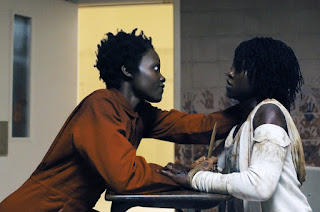
Red in red and Adele in white asks the audience who is truly good and villainous in the scenario. Red wanted to kill Adele of course. Yet she has killed nobody in the film.

Like the hypnotic, lilting sounds silver spoons make against the rim of tea cups, the quick flicking scissors ignites a refreshingly unique source of terror. By bringing in Black Renaissance and Black capabilities in this contemporary age of filmmaking, entering specifically through the horror genre, Peele and Monkeypaw Productions created another great work with Us.