Showing posts with label 2010's Film. Show all posts

Saturday, August 24, 2019

‘Middle of Nowhere’ is an Underrated Powerhouse

Middle of Nowhere film poster. 
On January 16, 2014, I watched Ava DuVernay’s romantic indie drama, Middle of Nowhere (released two years prior) for the first time on an iPhone. My laptop was broken and that iPhone was the sole way to finally see the film, a special AFFRM Rebel member exclusive. On January 13, 2015, the official DVD release day, it took several stores to find a copy and that would jumpstart the second, third, fourth or so viewings on a new laptop. Then, months later, the Lightbox Film Center showed it on a big screen during a celebration of cinematographer, Bradford Young. Each watch is a present unwrapped, especially to an avid film lover desiring to see more humanist depictions of Black lives by Black filmmakers.

Thus, Middle of Nowhere, an obvious personal favorite, is of significant importance often left off Best Black Film lists.

Ruby (Emayatzy Corinealdi) puts her medical studies on hold in order to help her imprisoned husband Derek.
It opens with Ruby, a tough, resilient medical student who travels far by bus to see her imprisoned husband Derek— in for fraud. On the bus, women bond over their missing men, knowing that these short, strict visitations are all they can hold onto until the next one— year after year after year. When Ruby and Derek see each other, the sparks are flying, the love is spoken through their eyes and ready smiles. Afterwards, Ruby speaks on his behalf, constantly overworking and exerting herself to make ends meet and keep an expensive lawyer on Derek’s case. This authentically paints the true depressing reality for marginalized bodies— always over exerting themselves for a bit of freedom. Before the arrest, Ruby and Derek were dreamily living like a queen and king, well above middle class in a huge furnished house with a nicely manicured yard.

Ruby (Emayatzy Corinealdi) and Brian (David Oyelowo) share a dance. 
Aside from prison visits, Ruby is staying devoted to Derek by putting medical school on hiatus and taking extra hospital shifts much to the dismay of her mother, Ruth. Now Ruth is a stern parent prone to yelling and belittling even over the smallest matters. This constant verbal abuse makes for jarring scenes, especially between Ruth and Rosie— Ruby’s sister, a single mother of a precocious little boy. Meanwhile, Derek’s outside life threatens Ruby’s happiness. In comes Brian— a flirtatious bus driver— that has it bad for the married woman, Ruby.

Ruby (Emayatzy Corinealdi) may be flawed in some instances, but she is far from stupid. 
Ruby, painted in pivotal degrees of vulnerable softness and graceful femininity, is one to be desired, fought for. Whether it is by two handsome men, a fretful mother, or a sister with a small son, Ruby is the light hovering around the shadowy places no one wants to remain stuck in. Derek kept a heartbreaking betrayal under wraps, Brian is staying civil to an old relationship, Ruth wants her daughters to still need her, and Rosie searches for love in all the wrong places. From Ruby, Derek wants her forgiveness, Brian wants to be her “next,” Ruth wants her to get her life in order without Derek, and Rosie wants guidance.

Yet Ruby refuses to be a mule to anyone.

One of the most jaw dropping scenes is what transpired between Ruby (Emayatzy Corinealdi) and Derek (Omari Hardwick) on her final visit. 
Although the story plays a bit into the “struggle love” narrative, DuVernay’s poignant writing and abstracted direction segways the overused Black love stereotype into another route altogether. Ruby eventually realizes that she cannot put her life on hold for Derek, wait in the wings for the course of an unseen future that has presently changed the both of them. Everything passed her by whilst working twice as hard to free him. She needs to be in a new, refreshing moment, deserves to find her path without him clouding her purpose. And that moment happens to be her career, her family, and Brian.

Middle of Nowhere is an intriguing trifecta of threes— Ruby’s need to keep an old life together whilst being seductively pulled by another is more than the typical interloper love triangle, Ruby and Rosie’s adulthood with complicated Ruth, and the unhealthy, unresolved generational turmoil from Ruth causes so much conflict that Rosie doesn’t grant her much grandmother time. 

Middle of Nowhere family: Sharon Lawrence, David Oyelowo, Ava DuVernay, Emayatzy Corinealdi, Edwina Findlay, Troy Curvey III, and Omari Hardwick. 
Middle of Nowhere is seamlessly tied together. There is a reason why this poignant picture won African American Film Critics Association Awards, Black Circle Film Awards, Black Reel Awards, Independent Film Awards, dramatic at Sundance Film Festival (DuVernay being the first African American woman to be honored), and the Josephine Baker Award from Women Film Critics Circle Awards. It is also why many still cannot comprehend its exclusion from the main awards circuit of Oscars, Golden Globes, BAFTAs, etc. The memorable music selection includes some Goapele. Bradford Young’s excellent cinematography reveals a tremendous, tender care in lighting Black bodies. Aisha Coley’s casting of Emayatzy Corinealdi, David Oyelowo, Lorraine Touissant, Omari Hardwick, and Edwina Findlay remains top notch. This arrangement of brown and dark brown skin hues with Corinealdi playing a rootable lead makes women like her feel seen and loved, makes their stories valid.

DuVernay’s gorgeous effort is worth watching again and again because it is one of the finest, most masterful examples of Black people falling in love and making sacrifices in order to make love function. It is so very important to champion Black artistry when it is of this quality. Creators like DuVernay fight hard to write, direct, and produce films for us about us and distribution can be their biggest challenge. With this word of mouth in mind, please watch Middle of Nowhere and spread the gospel to family and friends. Tell them that DuVernay has a romantic poet side in addition to award heavyweights Selma, 13th, and When They See Us.


Wednesday, April 17, 2019

'Little' Uplifts And Unleashes the Inner Misfit

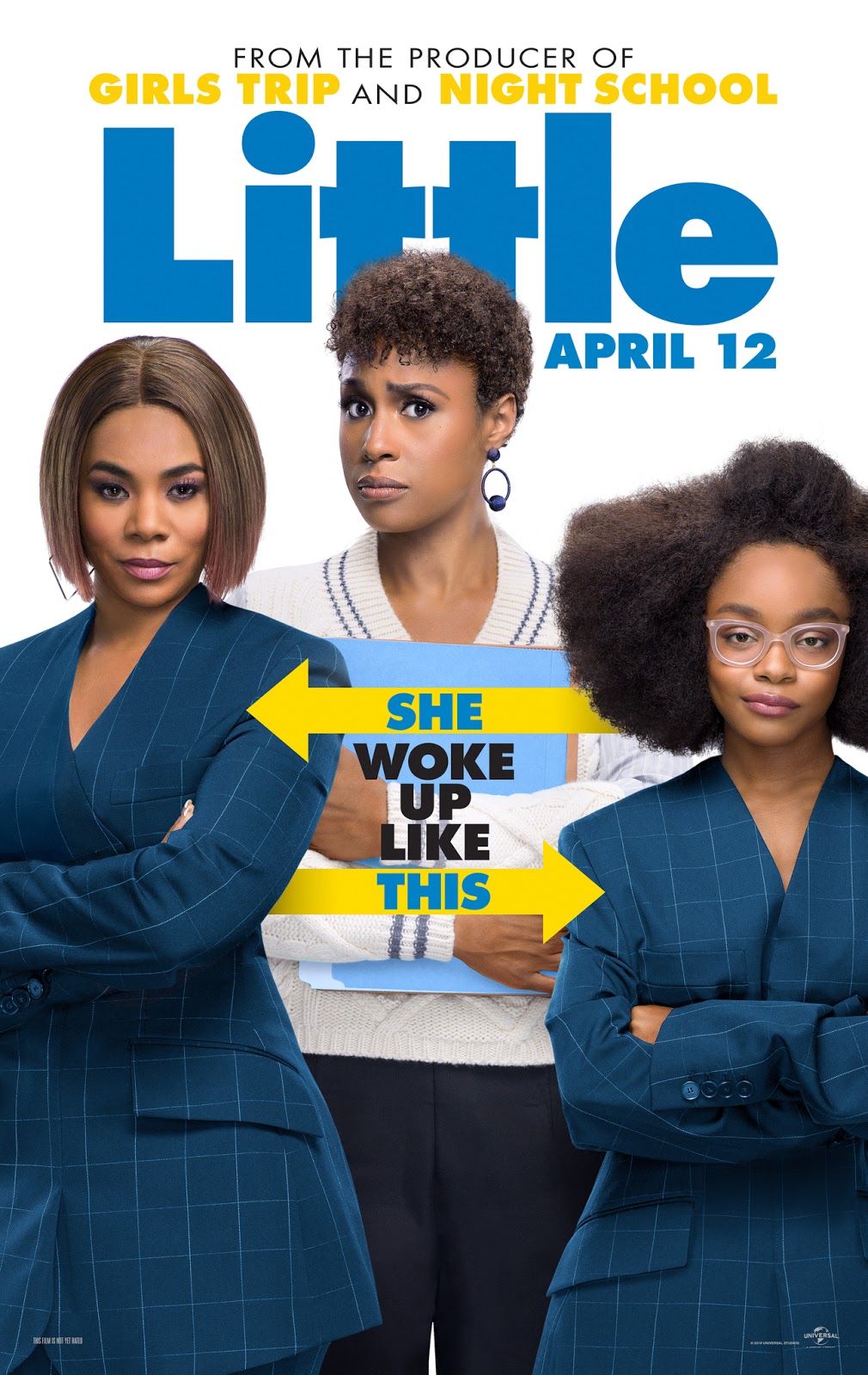
Little film poster.

"Kids are mean," many nonchalantly say as though this resolves the huge bullying problem.
Little opens with junior high schooler Jordan Sanders's triumphant moment. Unfortunately, it becomes a perfect time for public humiliation to strike-- not ala dance spectacle like most films surrounding coming of age teen drama. After Jordan's onstage scientific feat, the mean girl pushes back, physically hurting Jordan and singlehandedly traumatizing her to death.

Jordan (Regina Hall) messes with the wrong child. 
Years later, Jordan--a tech company CEO-- is an insufferable, carb-hating diva that treats everyone in her life as inferior beings. No one is safe from her Cruella De Ville-ish wrath-- her robot HomeGirl, her hotel barista, her bellhop, her employees, random children. Jordan's cruel-heartedness is certainly a colossal jump from the sweet, afro haired, bespectacled science nerd who believed that everyone would admire her hard work. Adult Jordan wraps around the cloak that power grants her. Instead of finding much needed aide (like seeing a therapist, formulating real-life girlfriend relationships, cooking or cleaning for herself, and ending reliance on capitalism for meaningless happiness), she abuses power to make others feel insignificant.

On the opposite spectrum, Jordan's assistant April is eerily similar to Little Jordan. The donut lover surrounds herself in art supplies, dresses with quirky spunk, and doubts her creative abilities. In fact, she mumbles a lot. Preston, her co-worker, encourages her to speak up.  Like everyone else in the company, April is terrified of Jordan. However, April seems to fear herself more.

Jordan is only insecure around Connor-- the firm's biggest client is a rich white guy. He sits in her chair, props his feet on her desk, and announces that he is moving his finances elsewhere unless they can keep him interested/invested. At this, Jordan goes berserk in the staff meeting, screaming at someone to have a good idea. April keeps mum. An on edge Jordan threatens to fire them all and eventually yells out to the donut man's adorable daughter. The daughter retaliates with a wand flicker and shouts, "I wish you were little!"

Black Girl Magic happens.

April (Issa Rae) and Little Jordan (Marsai Martin) aren't too keen on Young Jordan returning to school mostly because April doesn't want to go to jail.
Jordan wakes up to a huge surprise-- reverting to her younger self, an embodiment of her innermost shame-- Little Jordan. Of course, she thinks it unnatural. Everyone sees that she is a nonthreatening girl. Her authority is gone. April comes to the rescue. It leads to a rather farfetched plot involving Children's Services. An agent demands that Little Jordan goes to middle school otherwise the circumstances will be detrimental.

Little Jordan is the exact opposite of Never Been Kissed's Josie Gellar (the overly enthusiastic, twenty-five-year-old journalist disguising as a high schooler versus thirty-eight-year-old Jordan magically stuck in her younger self's middle school body). Little Jordan is cursed into going back to school as opposed to incognito. With the mind of an adult, she develops a hilarious crush on her teacher and finds she has no power over her "peers." Sadly harassed, ridiculed, and humiliated on her first day, she once again faces the unstoppable bullying and links in with the uncool crowd-- three naïve kids who believe that unveiling their talents will make them fit in. It is the same innocence Little Jordan had. Perhaps that need had been buried deep, never fully dissolving. Those of us that have experienced bullying (the straws placed in Little Jordan's massive afro are almost as bad as having spitballs launched at you everyday) can find empathy in Little Jordan's plight. To torment another for the expense of laughter and being a "bigger" person can have weighty consequences emotionally, mentally, psychologically, especially around that seeking age where childhood becomes teenage uncertainty.

After their big climatic fight, April (Issa Rae) and Little Jordan (Marsai Martin) make up and bond.
The three essential characters Jordan, Little Jordan, and April are battling the self-doubts within themselves and take the path to growth respectively. Whereas Little Jordan mentors her new friends, believing that money can resolve their issues, April finds that leadership is a daunting impossibility when the co-workers are conditioned to Jordan's bossiness. Thus, they see April as a pushover and borrowing Jordan's flashy expensive clothes cannot make up for lacking confidence. Eventually, April assertively addresses her boss with the great idea that could save the company....

Brand new, reawakened Jordan (Regina Hall) returns.
Childhood and adulthood role reversal has been told in Big and 13 Going On 30 with touches of Freaky Friday, but Little undergoes a different tactic to convince women to act accordingly. Tracy Y. Oliver and Tina Gordon Chism's screenplay understates that one does not need to become a menacing bully to acquire what is needed to succeed. It is valuing the people around you, to guide those who come after you, and allow them to grow into their strengths. April would have likely not have spoken about her Discover Eyes (Discoverize?) idea for another thirty years. It is not shown who performed the kind deed of buying the app. However, best case scenario theory is that Jordan probably bought it, proving her growth by truly believing that April's creativity could save their company. Secretly, still would have been sweet justice for Jordan to kick Connor's butt though.

Little is a humorously enjoyable film initiated by the youngest producer in Hollywood history-- Marsai Martin. The credits introduce Martin though most audiences know the award-winning actress as Diane Johnson on black*ish. The chemistry between Martin and Issa Rae and between Rae and Regina Hall lights up the screen in absolutely genuine and delightful ways. This charming combination articulately expresses challenges Black women must endure, mostly alone. It is also great that Eva Carlton plays both Caren Greene (Jordan's bully) and Jasmine (Little Jordan's bully), symbolizing that the junior high mean girl will always be replaced by a carbon copy. She will always be there to torment the low self-esteem kids. Teachers like Mr. Marshall (played by Justin Hartley) will never be able to punish spoiled girls like her enough. The love interests start off with promise, especially April and Preston, but fizzle with underdevelopment by the end.

Still, this big screen Blackness is so beautiful and refreshing. All this melanin. For brown and dark brown skinned girls and women with 4C hair and distinctive African features who laugh out loud, are authentic, smart, creative, and bond with other women like them-- this celebrates and uplifts us.

Lastly, Little is popcorn fluff bringing on laughs and blushes, a solid escapism, especially for the Black girls who have been bullied and bounced into adulthood, valiantly holding onto their passions whether it be for science, technology, art, and all the other things that make us special and great. Money cannot buy and manufacture what is natural within.

Friday, March 29, 2019

'Us' Unpacks a Bag of Stimulating Psychological Horror

Us film poster.

Us, writer/director Jordan Peele's follow up to Oscar-winning Get Out, puts the middle class black family in peril twice. It starts with a small television playing a commercial, a hands across America campaign to fight hunger. The charts are red and blue. Red and blue figures joining hands to bring peace and harmony.

Circa 1986, at the amusement park on the beach of Santa Cruz, Adelaide "Adele" is a silent child who wanders off from her father. She holds onto a red apple-- a red apple so deliciously enticing that it dominates the scene with rich, intense purpose. As thunder and lightning strike and the rain falls, she stumbles into a fun house and the madness begins. Although all the mirrors show her reflection, she is stunned to find someone else, an exact replica. Afterwards, she is even more withdrawn.

Young Adele (Madison Curry) puts on a scare worthy acting display that is mostly unspoken. 

It is important to note how young Adele studied her parents, studied the world around her as if plotting to mimic everything. The childlike desire to do this is a natural inclination. In young Adele, however, there certainly appears to be a newness in how she stares, how she interacts. At the therapy office, she is absent of affection, quite robotic and distant when her father pats her shoulder. This behavior further demonstrates how much the environment affects the individual.

In present day, Adele has married a man much like her father-- tall, dark skinned Gabe Wilson. They have two children--Zora and Jason, the youngest a keen, observant boy who dons a mask throughout. Again, masks portray a sense of wanting to hide true self, to retain a mystery.

Gabe (Winston Duke), Adele (Lupita Nyong'o), and Jason (Evan Alex) look out at danger.

The family are at their vacation home for the summer in Santa Cruz. Whilst enjoying a lusciously red strawberry, as inviting as the red apple yet symbolically conveying an adult persona, Adele refuses going to the beach or socializing. They do so at Gabe's urging. At night, after 11:11 PM, The Tethered arrive and the real fright begins. The Tethered are human clones dressed in matching red jumpsuits holding gold surgical scissors, shadows living underground, living beneath the house of mirrors, abandoned and left to fend for themselves, all stark, raving mad and hungry. At the same time, they are able to replicate the activities their human counterparts possess. Interesting too, The Tethered communicate through grunts and sounds, but Adele's, Red, is the only one that can speak.

"It's us," Jason says of the family in their driveway.

The twist sheds compelling light. Adele is actually Red, The Tethered living among humans, having cruelly pulled real Adele inside the mirror as a child. Red just wanted a normal life and decided to take over Adele's. The Tethered can procreate, meaning Zora and Jason are half human, half clone. Adele seeks revenge for the cruel switch. At the same time, she has masterminded the whole entire scheme of world domination with the educated mentality of a child growing up angry and malnourished. She has ultimately become evil. Still, it's not quite clear on how Adele became trapped in the underworld or why it took long for her to rise to the surface with the others. Why this particular summer to wreak havoc? Adele also knew how The Tethered came to being without no one uttering a word to her. Red has always known that Adele would come, but appears flabbergasted that her human half orchestrated a whole plot that stemmed mostly from hatred with beings that are not her species. Moreover, the switcheroo has affected them: Adele's rage manifested beyond her feelings for Red and Red's insertion into humanity gave a false sense of security.

Finally, Lupita is given the freedom to unleash her craft.

Red (Lupita Nyong'o) and her scissors.

The performances are absolutely stellar. Every actor channels believable emotional complexities with or without dialogue, using facial expressions and body motions to pull this narrative forward. Standout Lupita Nyong'o puts on an incredible double performance full of complex range from frightening and vulnerable to sinister and twisted. In her animated eyes, the significant tears are eerily reminiscent of Daniel Kaluuya's Chris in Get Out. Yet the creepy, raspy voice of Red downright cements the phenomenal depth of Nyong'o's talent as an actress, that avidly speaks on her finessing all methods acting allows. After winning an Oscar for Best Supporting Actress in 2012, this is her first starring role. Us definitely showcases why she should have been leading films for years.

Winston Duke brings humor and light to an otherwise dark and dreary story. His bespectacled, Howard educated Gabe is quite the opposite of Black Panther's M'Baku. Gabe evokes the typical middle class father personality, articulating the proper accent to a tee. Gabe is envious of Tony (whose similar to Iron Man/Tony Stark-- in terms of arrogance and wealth)-- his larger house, his high tech Ophelia (aka an advanced Suri), his larger boat, his flare fun. Gabe doesn't covet Tony's white wife, Kitty, always seen to be the idealized trophy of status quo black men like him. He is also infallible, wounded early on, walking with a makeshift crutch during the later parts. With the temporary physical loss, his resourcefulness becomes a reliable strength.

Spoiled, self-absorbed, Kitty (Elizabeth Moss) is shot with such intensity, as though her blue-eyed, blond-haired presence is a thing to marvel and idolize.  

From Virgin to Mad Men to Top of the Lake to The Handmaid's Tale, Golden Globe and Emmy award winning Elizabeth Moss continues delivering exceptional work with a pretty juicy supporting part. Kitty's first appearance voices white women's obsession with youthfulness and their envy of black women's agelessness. Kitty has gotten work done (funny considering that Moss and Nyong'o are the same age). Kitty's doppelganger's scissors can't cut Adele's face because either the struggle to destroy such flawless beauty seems wasted or she knows that Adele is not human, but is confused by Adele speaking. Moss exhibits fine acting elements particularly when Kitty's tethered puts on lipstick and stares at her grotesque reflection.

Jason and his doppelganger both have a fascination with fire. Strangely, however, his double is dog like, a family pet. 

The child actors are undeniably brilliant-- Madison Curry as young Adele, Shahadi Wright Joseph as Zora, and Evan Alex as Jason showed that up and coming Black talent have champions to future thrones. The perfect young Adele adjacent to Nyong'o, Curry's giant eyes, wide opened mouth, and braided hair with white ball barrettes hued in blue cleverly frames a new horror aesthetic. Her passive silence stirs and electrifies. She is able to convey a quietness stemmed from shy, vulnerability and a quietness that is vacant, almost inhuman. Joseph's Zora has the modern teenager attitude to a science. She then grows up overnight, killing any clone endangering her family and it is a bloody, dangerous business. Now this is a black girl heroine. Alex as Jason exemplifies the plight of the little Black boy, often misunderstood, the especially precious child to Adele. He likes to tease and frighten his sister as brothers often do. When he disappears and leaves Adele frantic, he returns and later asks her if she thought he was dead. That question spoken softly from Alex's young child's voice, poignantly addresses that though the Wilsons are privileged, they're still Black and not immune to the brutalities racism provokes.

Other cast highlights: Anna Diop-- a solid choice in playing Adele's worrisome mother who misses her daughter's voice. Howard alum Napiera Groves of As The World Turns makes a small cameo as the therapist pushing Adele into pursuing a creative outlet.

Zora (Shahadi Wright Joseph) shoulders her father, Gabe (Winston Duke) through an apocalyptic morning.

Us shows Black people surviving a massacre, shows white people dying first, dying many times, and no dead black casualties-- an opposition to the history of horror films and real life situations. And the police never showed up! Again, the law enforcement role in Peele's films are an imperative detail in both Get Out and Us. Whereas Chris is frightened when he sees those flashing red and blue lights, the police don't come to the Wilson family's aide and Kitty's request to Ophelia to call them is denied by a specific N.W.A. song. Peele has recently come under fire for acknowledging Black talent and commitment to having that Black talent (which goes virtually unnoticed for years and years) lead his films. He is performing a commendable service that upsets others so much because his passionate words actively followed through on those words.

The gorgeous cinematography-- an appreciative kudos to noir and nostalgic horror with Hitchcockian repetitive rabbits and bird flocks-- operates well alongside Michael Abel's heartstopping score. The excellent music choices heighten scenes to petrifying degrees, especially that profoundly epic The Tethered Vs. Human fight with the haunting, pronounced "I Got Five On It" piano keys. Lord. Even the opening "Anthem" theme (featuring a haunting, harmonious choir) pleases and forces the head to bop shamelessly.

Red in red and Adele in white asks the audience who is truly good and villainous in the scenario. Red wanted to kill Adele of course. Yet she has killed nobody in the film.

Like the hypnotic, lilting sounds silver spoons make against the rim of tea cups, the quick flicking scissors ignites a refreshingly unique source of terror. By bringing in Black Renaissance and Black capabilities in this contemporary age of filmmaking, entering specifically through the horror genre, Peele and Monkeypaw Productions created another great work with Us.

Saturday, August 25, 2018

Poignant 'Night Comes On' A Reflection On Sisterhood and Regret

Night Comes On film poster.
I left Philadelphia's downtown Prince Theatre from watching Night Comes On with an urgent sea of unhinged sadness rushing forward, wiping away spilt tears and trying to regain some semblance of decent composure. This raw, barren film struck such a resonating cord, my own two lost sisters, two dear friends whom I will never see or hear again, floating at the forefront of my mind.

Sisters on board: Abby (Tatum Marilyn Hall) gets Angel (Dominique Fishback) to go to Long Island under false pretenses.
Night Comes On, set in Philadelphia where every scene bears familiarity, begins with Angel's release from juvenile detention. She is about to turn eighteen, the age of consenting adulthood. The first thing on her agenda, however, is not seeing her sister from whom she's been separated for months. Filled with grief and anger over witnessing a violent tragedy, the revenge devil rests on her shoulder, the dark clouded apparatus that cloaks judgment.

The road to nowhere-- sans dreams and ambitions-- seems to be the package for every brown and black girl in America, a tougher plight in the fifth largest city of poverty, tougher still for one with criminal history. Without a nurturing maternal figure to lead Angel down a redemptive path or a sympathetic counselor to heal inner wounds, her lack of self worth muddies her second chance out in the cruel, harsh landscape. She makes heartbreaking choices, allowing her own body to be disrespected, mentally holding onto the visions of pulling other weaponry triggers

Still, Angel is happy to see Abby despite deleting her text messages. They have an awkward exchange. A silence stretched for miles highlights the fragile relationship between young siblings, a thread that can easily sever at the most tremulous times. Yet the biological bond between sisters is felt as Angel goes to Abby's latest foster home. They make small talk. Abby is more excited about Angel's birthday than Angel. Angel is void and distracted, bloodthirsty. She perks up at the mention of their father. Her stern parole officer couldn't give personal information due to circumstances, but she believes that Abby would.  However, Angel underestimates that Abby is perceptive and intelligent. This will later cause major conflict.

Angel then faces more setbacks. Her girlfriend dumps her, leaving Angel in a hopeless, sunken place. During a vulnerable evening, silent and solemn Angel has no one to ask for help. She seeks loneliness and safety among shady places and those that make her invisible. By the wee dawn, all that is lost is lost again.  
Angel constantly reminisces about her mother (Nastashia Fuller)-- a quiet, gentle figure whose demure presence shapes Angel. Sadly, it is likely that the father had been abusing the mother, but she could not leave him. Angel witnessing her death 
Angel and Abby certainly have different personalities. Whereas Abby can make instant friends, Angel is intensely quiet and guarded. They make friends on the bus to Long Island. These girls are typical friendly girls, a clique of jubilance and innocence, a little younger than Angel and older than Abby. Angel stares at them, observing like a spectator in the wrong group. Abby seems right at home.

Angel is upset by Abby's betrayal-- that their whole trip wasn't to see their father at all.

At the beach, however, Angel and Abby showcases how anger dissolves into splendid happiness and bliss. Everything can be forgiven and forgotten. No amount of time apart diminishes the way sisters can mean to each other. Abby is the remaining light in Angel's life, her hope and moral compass. The love conveyed between them a thrilling spectacle frolicking in the water, their brown girl bodies a beautiful contrast against endless blue waters and coarse white sand. Almost reminds one of Moonlight's Juan and Little.

Girls at the beach.

Angel carries Abby on her back.
Throughout, I was caught by the feelings that an older sister has for her younger one, the follower, the one who looks up, which the screenplay expresses vividly well. I recalled countless annoyances, the many mini battles, late night conversations, good times. For ten years, I shared a bunk bed with her. Like Abby, my sister (and our brothers) were eventually in the system, roaming from foster home to foster home. The family would meet on Mondays at juvenile courts in a room with one door. She was finally emancipated at eighteen. We spent time together-- so much catching up, having been separated. We had spats and arguments along the way. She disappeared in 2010, leaving behind no trace. Her absence cuts like a knife.

Meanwhile, my other younger sister on my father's side whom I never met, died two years ago in September. I will always remember her high pitched voice, our long conversations on Facebook, and regret never taking the time to see her in the flesh.

Night Comes On is a medicinal balm soothing the few broken parts inside. Angel and Abby's sisterhood struck a cord-- an art that moved and expressed vicarious feeling difficult to release day by day. It means something profound and sacred to find a tie to one's own personal struggle from that of two characters framing a beautiful picture.

Angel's got a gun.
Jordana Spiro has directed a powerful, significant film with a raw, intelligent screenplay co-written with Angelica Nwandu. The merit lies fully in the dignified performance of Fishback, offering a complex portrait of a girl who realizes at the most pivotal moment that she has something to lose-- her sister, the most important person in her world. Tatum Marilyn Hall in her first role is quite stellar, holding her own against seasoned Fishback, expressing the right emotional notes from heartbreak to disappointment.

Night Comes On is a solid revenge tale with an affectionate twist. Angel faces her demons alone and realizes that the act of pressing forward positively far outweighs the aftermath of an even greater tragedy. Angel can build a new start and become the steady, influential figure Abby can count on. They need each other in order to survive in a remorseless system that chews and spits them out.

Moral of this sentimental narrative: a sister's love will always be eternal regardless if the sister is here on the earth or in spirit.

Monday, April 30, 2018

‘Spoor‘ Is a Powerful Mystery Weaved With Animal Rights Vigilantism

Spoor (Pokot in Poland) film poster.

Janina Duszejko is a heroine unlike any other. An older, joyful spirited woman with bright eyes and long silvery white hair in frequent schoolgirl braids, she has a deep compassion for animals, creates the most enticing bowls of colorful dishes, and teaches English to younglings whilst also taking them into the dangerous, icy cold wild of Klodzko Valley. She is knowledgeable about plants and quite resourceful to all of mother nature’s secrets. When the hunters in town start gruesomely dying off, Duszejko holds the key to the daunting mysteries.

Janina Duszejko (Agnieszka Mandat) with her beloved students.


A distraught Janina putting up signs in hopes of finding her missing dogs.

Now if Okja was the magnificent, under appreciated champion of mass consumptive meat industry, Spoor is the picture that showcases horrific injustice of glorified animal hunting. Like Okja, Spoor also shares graphic senseless violence which humans are conditioned to accept and celebrate. These rush time paced scenes are bloodier, intense, and heartbreaking. Most of the film takes place in infinitely stretched forest, overwhelming the modest population. The story illustrates a man's desire to conquer by killing heart of mother nature, destructive and remorseless beings using guns to shoot anything that moves. Thus, when the body count rises, when hunters turn into victims, the question is not who is performing the vengeance or why this is happening, but the how. And the how is a striking, pivotal element that audiences have to pay immense attention to.

Agnieszka Holland (left) and Kasia Adamik (right) holding onto the Alfred Bauer Prize also known as the Silver Bear Award at the Berlin Film Festival.
Winners of Berlin Film Festival’s prestigious Silver Bear Award and Poland’s choice for Best Foreign Film representation at this year’s Oscars, Agnieszka Holland and her daughter, Kasia Adamik have created an astounding work of art together. Holland, having been previously Oscar nominated for her screenplay of Europa, Europa, has penned and directed episodes of House of Cards, The Affair, Treme, The Killing, Cold Case, and films such as In Darkness, Julie Walking Home, and The Secret Garden. Up next for her is Charlatan and Gareth Jones and TV series’ 1983 and The First. Adamik is not only a storyboard artist, she wears other miscellaneous production hats in forms of writing, directing, editing, etc, working in various Polish film and TV series.

Janina (Agnieszka Mandat) always finds beauty in nature. 

Besides gripping murders, Spoor has two charming love stories of young and old. The cinematography is absolutely stunning— picturesque mountain caps, captivating foliage coated in snow and ice, and again Duszejko’s scrumptious food. The writing by Holland and Olga Tokarczuk is solid-- with humor, suspense, charm, and a pleasant ending.

Spoor is worth the watch for the powerful message alone.

Friday, April 27, 2018

'Alaska Is a Drag' Dishes Flawlessness And Packs a Mean Punch

Alaska is a Drag film poster.
There is something magical about a glittery gold dress fluttering in between fluid shots of Shaz Bennett's lens, a wondrous garment that brings a close family closer, a haunting memory of a mother's spirit captured on a poignant whim. This is an heirloom, a timeless thing that one holds onto for dear life, especially an object that leads a startling roadmap to finding a missing parent.

Alaska Is a Drag is an emotionally gripping brother/sister survivor tale that offers resilient anchors for various plights through life-- a sweet, unquestionable reliance on finding selves whilst leaning on each other for supportive foundation. Leo works at a slimy fish factory with fanciful drag queen dreams and also happens to be a solid boxer. His little sister Tristen is fighting aggressive cancer. Each treatment Leo is Tristen's rock as she grows weaker from the pain. Lucy, their mother has run off to California and George, their father is present in body but sparsely around for them, having troubles of his own. Living in a mobile home, a place filled with sentimental belongings including that mesmerizing gold dress, Leo and Tristen have aspirations of leaving the cold state behind, hoping to high tail it to California and find their mother, believing that perhaps runaway mother has fulfilled her own ambitions. 

Leo (Martin L. Washington Jr.) and Tristen (Maya Washington)
From their hand holds at the hospital to having underage drinks at Jan's nosedive bar to transforming wondrous fielded meadows their makeshift catwalking playground, Leo and Tristen's relationship is a fascinating, tight-knit bond thanks in part to portrayers, Maya Washington and Martin L. Washington Jr.'s believable chemistry. Leo and Tristen take up for each other, Tristen standing up for Leo when Kyle, Leo's bullying co-worker, continues physically and verbally assaulting Leo. 

Leo (Martin L. Washington Jr.) and Declan (Matt Dallas) have a moment.
However, the sweet, infectious sibling love duo is tested once the mysterious Declan starts hanging about, a fellow employee of the fish factory and growing friend to Leo. Declan, seemingly quiet and observant, also defends Leo from Kyle's wrath, letting out a monster's rage. As it then turns out Kyle has a colossal secret that brings the story to its knees. 

One of the most remarkable aspects of Alaska Is a Drag is the dismantling of masculine and feminine traits associated with maleness. The metaphorical crux of it all is Leo competing in a boxing match and a drag queen contest on the same night-- the aggressive athlete versus the flawless beauty. Leo, complex and genuine, is an affectionate, tender brown figure who has always dabbled in his mother's clothes and makeup. Lucy and Tristen have accepted this side of him. At the fish factory, where lies routine of violent cutting and gutting of fish is this roaring, fast paced, smelly, all-testosterone environment, Leo is surrounded by men who don't necessarily regard him. There, a seething Kyle uses hatred of homosexuality as a means to gaining instant alpha male dominance, amped up by a legion of followers that like nothing more than pummeling Leo at any vulnerable opportunity. Leo, though, can defend himself. Armed with champion fighting skills and profound intelligence, he is no punching bag. Abuse is not a pretty aspect in any relationship. Thus, Kyle's cruelty is purely an inherited societal notion that he lashes upon Leo. Before the drag queen contest, fresh after boxing, as Leo puts makeup over his battle scars, it is a glaring reminder of those who can fight back and those who can't. 

Leo (Martin L. Washington Jr.) voguing and belting out his best in his mother's gold show dress-- a dress that she said to him, "you look better than me in it."

Stars Maya Washington (Tristen) and Martin L. Washington Jr. (Leo) serve face and extremely awesome Wonder Twins plus Jem and the Holograms vibes.

Shaz Bennett (far right) directing Matt Dallas (Declan, left) and Martin L. Washington Jr. (Leo, center) in the ring.
Director/writer Shaz Bennett is constantly keeping busy. For Alaska is a Drag, her nominations include AFI Fest's Grand Jury Prize and Gotham Awards Spotlight on Women Filmmakers "Live the Dream" Grant. A former script coordinator for UnReal and writing assistant on The Glades, Bennett is a script coordinator for Bosch and upcoming director of The Problem With Pulling Hair. She is also part of the all women directors team set for Queen Sugar's third season. Her episode, the fifth written by Chloe Hung, will be aired mid-June. 

Alaska is a Drag, still touring around lighting hearts and minds on fire, is a phenomenal first feature resonating deep. This smile inducing, soul warming story with subtle twists and gritty turns, gut wrenching performances (Margaret Cho and Jason Scott Lee have memorable cameos), and pleasing cinematography showcases that the actors underneath Bennett's talented eye and story contain "it factors" hovering beneath spotlight radar.

Like sparkling flecks of a gold sequin dress, Alaska Is a Drag shines bright.

Saturday, January 6, 2018

'Mudbound' Is The Most Important Film Release of 2017

Mudbound film poster.

Some films are good. Some films are terrific. Only few will tug at a person's innermost emotions and grip them in its strong, riveting chokehold like a tough, combative wrestler by very end. And Mudbound is that nitty, gritty fighter film that ignites countless thought.
An intense American historical drama entailing egregious societal infrastructure set in stone for black and white residents of the deep South, Mudbound is a real solid game changer for a Netflix feature. Writer/director/producer, Dee Rees addresses-- with such vital clarity-- this racially fueled class system that has established a gross power imbalance since colonialism and slavery upset the natural selection of the whole entire world, leaving behind a great generational devastation.

For starters, raised by Pappy, a vulgar racist father, Jamie and Henry McAllan are brothers who couldn't be any more different from one another. While younger Jamie is bright, reckless, and charismatic, older Henry is a practical and spineless simpleton. Metaphorically throughout the film, the analogy is crystal clear-- Jamie represents dawning of a needed crucial change-- accepting others regardless of race, status, and creed whereas Henry holds on tightly to white privilege like a stern, stubborn mule, his father's son without crass indecency.

Henry marries a spoiled socialite, Laura and they have two children. Henry, who imposes his male dominance over Laura, makes the decision to waste their money on farmland down in Mississippi, and Laura, who absolutely detests the move, has no authority on the matter. Jamie is fighting on European soil, dropping bombs from the sky, bearing witness to the ugly, violent sides of war. The accumulation of medals and honors do not diminish mental and emotional trauma. Jamie returns to America scarred and hurting, using drinking as a consolatory outlet for his pain.

In Mississippi, the Jackson family are humble brood, led by Hap, a preacher with a passionate, authoritative voice in the church and Florence, a loving, devoted mother who would do anything to break the psychological cycle of a mother she barely knew. Ronsel, their eldest son, goes off to become a soldier, thrown into the same fiery ring as Jamie, but is treated like an equal.

The McAllan's and the Jackson's intersect on this gorgeous piece of muddy land with promises of becoming more than what anyone has ever dreamed. However, the power balance is established the moment Henry rudely interrupts the Jackson's dinner, forcing the master and slave relationship to take repulsive shape, eventually threatening to rupture the mesmerizing strength of Hap and Florence. It is quite fascinating to address the differences between how Henry treats Laura and how Hap sees Florence. Henry and Laura are a union of comfort, a product of society privilege. When it comes to Jamie, Laura comes to life, having bitten the taste of forbidden passion, that real intense ardor that of course, Pappy can see. In Hap and Florence's case, the love and tenderness is a sweet dosed prescription of strong, foundational black romance. Hap sees Florence as an equal, a queen and he respects her.

Under the wary, watchful eyes of town, Jamie and Ronsel return from war, changed, eventually forming an intriguing bond.  

Jamie (Garrett Hedlund) befriends Ronsel (Jason Mitchell) despite the turmoil of white and black mingling beyond silent acknowledgement.
"Have you ever been with a white woman?" Jamie asks Ronsel.

Ronsel smiles with pride, jogs around the answer before diving into the nitty gritty affirmative, then later adding:

"We had to show them who we were."

Ronsel's words about proving his humanity to white women (aka sexually) is a startling revelation about black people's desire to be on equal footing with their oppressor. Since his return, he wishes to make the white men see him as a man, especially considering that he fought on their side during war. European white women had freely dallied with Ronsel and his black cavalry, that is after these men proved their fetishist worth, why doesn't the white men show such appreciative kindness, respect even?

In another power trip, after learning what Florence (Mary J. Blige) can do, spoiled Laura (Carey Mulligan) demands the woman to work for her on a permanent basis.
This mirrors Laura's interpretation of Florence. When Henry fetches the woman to cure his daughters' whooping coughs, Laura doesn't warm up to the idea at first, until she realizes that Florence is indeed useful. Without asking Florence herself, Laura demands that the woman "help" her with the children. Reluctantly, Florence agrees, breaking her own inner promise, sadly repeating the life of her mother.

Henry (Jason Clarke) once again requesting help from Hap (Rob Morgan).
Mudbound is rich, concise, layered complexity. The cast operates like a well oiled machine, perfecting their individual parts with brilliant tenacity, grace, and harrowing conviction. Their gritty Southern twanged voice overs, like vital, melodic poems recited at the podium, are painful, dispirited, joyous stories of strife and happiness, of wanting and valuing change, of simple desires. The watchers must snap fingers and cheer collectively at these performances. Mary J. Blige is utterly wonderful as Florence, valiant, soft, and encouraging, with her expressive facial expressions, vocal ability to being a compassionate wife to a broken mother. Carey Mulligan also holds her own as a privileged woman torn by social duty and captivating passion for things that she cannot have. Jason Mitchell is great at portraying Ronsel's struggles with coming back to a town that doesn't deserve his allegiance-- the ending alone ensures a huge sob fest. Plus Kennedy Derosin plays Lilly May Jackson, the young daughter of Hap and Florence, aspiring to become a stenographer. In one scene, she stands her ground against her laughing brothers who don't believe black people can step out of their station. Florence sternly tells him that Lilly May can become anything she wants to be. That smile shared between mother and daughter as well as the scene of Lilly May reading stenography books are beautiful touches about chasing dreams and receiving the treasure of female support. On Film Comment, Rees explains why she choose this path as opposed to Hillary Jordan's original writing.  

"My grandmother grew up in the small town of Ferriday in Louisiana,” said Rees. “She was born in 1925, and she’d talk about riding on her mother’s cotton sack. They owned their land, but they farmed it, and her parents cultivated cotton. She decided early on that she didn’t want to do that, nor did she want to be a domestic. She said she wanted to be a stenographer, so that was a touch I added in the film, when the Jacksons’ daughter declares her career ambition. In [Hillary Jordan’s] book, she can sing, but I didn’t want it to be the typical ‘little black girl can sing’ thing. I found it more interesting that she had this other ambition.”

Dee Rees for The Undefeated. Photo by Khoolod Mid.
Everyone and their grandparents should watch Mudbound. Yes, it would have been epic to see this in theaters, to witness this resoundingly important piece be on the giant big screen. Still, it's humbling to be at home, to not pause this history, to let every bit of the McAllans and the Jacksons steal eyes and ears. Don't let the Netflix factor fool you or anyone else into believing that this isn't a worthy accomplishment of integrity nestled between the acting, the cinematography, music, and all.

Sunday, September 24, 2017

'Brown Girl Begins' Gives Us The Afrofuturist Heroine We've Been Waiting For

Brown Girl Begins film poster.
At the Urbanworld Film Festival, an extraordinary film debuted.

I never thought a day would come to see a heroine who looked like me, a family member, or a dear friend.

Yes, I had seen the fantastic trailer and drooled at beautiful visuals.

However, three minutes wasn't enough preparation for a splendidly grand feast.

For perhaps the first time, in Brown Girl Begins, with Ti-Jeanne, we witness compelling depth of black women complexity. Her dark brown skin, an embraced anomaly, screamed joyful sentiment. One didn’t need to have bi-racial genes to be a beautiful, fiery leader-- to be Hollywood's only version of black. Her giant, wiry curled hair, out and free or braided elegantly, tall, graceful curved figure was as powerful and strong as any typical long haired spry, tiny white vixen.

In most big budget post-apocalyptic science fictions, the world disposes brown and black people, leaving white to rule as they always have prior. To those filmmakers, it is as though in some strange sadistic way, colonialism has not only taken over and destroyed almost everything possessed throughout history, it survives the future whilst finding new area to thrive and conquer. The lead must be a white man or a white woman. Even though Book of Eli and I Am Legend showed black men as lone valiant protagonists, black women were invisible, unvoiced with the women (sidekick) roles filled by Alice Braga and Mila Kunis respectively.

The past haunts Ti-Jeanne to the point where she refuses forget about what happened to her mom, Mi-Jeanne (Keeka King, left). On the other hand, Mami (Shakura S'Aida, right)) wants Ti-Jeanne to accept her fate.
Brown Girl Begins changes the narrative.

In the year 2049, left behind in the gruesome ghetto conditions, in dystopian Toronto, the fate of desecrated world rests with one girl, a girl with a fearful past that could possibly change the future. Clairvoyant Ti-Jeanne is a skilled natural healer and herbalist who knows every plant's medicinal properties and uses them to make concoctions against the brutal scars inflicting poor, desperate addicts.
However, in order to become even greater, more powerful than ever, it is her destiny to allow Papa Legba to seep his ancient power inside of her own human body and take over.
Due to complicated memories of the past, she doesn't want this.
In a golden afro halo, exceptional makeup including little silver rhinestones on her lipstick, and floating ethereal lavender dress, Ovo (Measha Brueggergosman) is the equivalent of a fairy godmother/guardian angel, assigned to Ti-Jeanne, watching over her and singing in high suspenseful octaves. 
Handsome Tony enters the picture. Instantly, Ti-Jeanne is smitten, falling hard for Mami's new volunteer delivery man. Seeing their idyllic closeness and obvious attraction, with wary eyes and stern tongue, Mami forbids them to stay away from each other.

But alas, Ti-Jeanne listens to her heart. A beautiful montage happens between Ti-Jeanne and Tony: sharing tentative first kisses and brown eyed stares in woodsy abyss, collecting chopped tree branches, and stolen touches of budded love. When Ti-Jeanne and Tony come together, staying at his high towered place, dark brown skin meet over and around dark brown skin, colliding slowly, softly, passionately. These magical, tenderly placed scenes share divine love between these two characters. As it grows and deepens, the arousing, euphoric peace they blissfully experience becomes further tangled as outer threats become greater.

Still, black forbidden love, heartbreakingly poignant and sweetly sincere, is executed brilliantly.

Ti-Jeanne (Mouna Traoré) and Tony (Emmanuel Kabongo) have a bittersweet forbidden love story. 
In the midst of keeping foundational relationship together, however, is the problematic circumstances wrought by horrendous segregation, a glaring "history repeats itself" allegory, but with more technological warfare. The isolated suburbs, floating silver skyscrapers rising from endless rivers, are the dream, a metaphoric picket fence, so close, so in reach. Yet to obtain its valuable resources, protected by an impenetrable spherical fortress and isolated by poisonous waters, is a dangerous risk that has taken lives. Those left behind are barely hanging on, limited by resources, a slave to monstrous addictions.

Suddenly, this world of Ti-Jeanne's inner intimate circle feels contemporary, feels present.

It is adjacent to now-- the Flint water crisis, implanted drugs in poverty stricken  neighborhoods, the white supremacists in Congress sabotaging health insurance...

Ti-Jeanne (Mouna Traoré) and mute Gracie (Hannah Chantée) have a tenderly portrayed relationship of dear sisters and close friends.
Sharon Lewis's remarkable direction is a vivid combination of shaky camera angles, lingering stills, and colorful shots. Her refusal to snuff whittled campaign to give life to Nalo Hopkinson's Brown Girl in the Ring is an inspiration to all filmmakers to not give up, to keep hold of vision, and believe that it will be seen. She had earned the book rights fifteen years ago and worked hard on obtaining a budget, revealing the hardships in finding money to fund this incredible pursuit-- a full-length feature science fiction film starring mostly black actors living in the future, in a winsome story channeling elements of mysticism, fantasy, romance, and drama. Background music choices, which bordered on independent, trip hop like sounds with melodic, serene voices, blended coherently with sensational visuals. And the lighting, which someone mentioned, highlighted brown and black hues beautifully in brightness and shadows.

Moreover, Mouna Traoré was an astounding fire starter, a gem to watch, playing each note of Ti-Jeanne's multi-faceted humanity. Her big doe eyes expressed love for her family, for friends, for her boyfriend, and for her community. To allow that love to transform into grief and sorrow as her balance falls apart, as that balance then manifests into fearlessness and strength, showed that this actress has phenomenal range. She had amazing chemistry with Emmanuel Kabongo, who too portrays a deeply layered character, a man wanting to be a good boyfriend while his honorable intentions are stripped away, peeling and peeling, putting him up to a test that is too difficult to pass.   

Ti-Jeanne (Mouna Traoré) reigns supreme.
Brown Girl Begins unveils profound beauty in a fragile, corruptive society, like an opening flower opening petals upon a barren, bleak landscape. Ti-Jeanne, a reluctant she-ro, is brave, smart, and gifted, restoring balance and hope, bringing prosperous healing to not only her shattered, devastated community, but to an audience who often imagined themselves at the cusp of such a story, but rarely saw fruition, unsown seeds plowed into earth. Well, what seemed like forever is now. It is finally arrived. This wondrously rendered art can be the catalyst to expanding conversations about black women heroes, especially in the science fiction realm.

Thanks to Hopkinson and Lewis, a black girl can see herself in the future saving the world.