Showing posts with label African American Filmmakers. Show all posts

Friday, May 29, 2020

‘A Love Song For Latasha’ Is Gentle Prose That Transcends Black Girl Tragedy

A Love Song For Latasha film poster. 
These days are full of fire and rage fueled by the pain of tragic loss. Black bodies are robbed of living and their murderers often receive no punishment. 

Latasha once saved another Black girl from drowning and that girl became her best friend— one of the film’s narrators. 
Art is one remedy that temporarily soothes the affects worldwide racism has historically created over centuries. And that racism is not always black and white. Back in the 1990’s such a turmoil boiled hotly in South Central part of Los Angeles, California between Black people and the Koreans— majority business owners. A Black girl was heinously murdered by a temperamental Korean grocer. 

That Black girl’s name was Latasha Harlins. 

Latasha’s yearbook photo. 
A Love Song For Latasha honors her memory, often lost in the continued escalating violence of today. History allots a paltry paragraph on her death and not a full bodied in-depth look at her short life. Among images of Black girls swimming and Black girls immersed in dreamy flowers, this hybrid short film humanizes Harlins, sculpting a figure beyond the teenager executed for buying an orange juice. Her story is carefully constructed by her best friend and cousin, the narrating women celebrating their lost youth, sharing the innocent desires of building community centers, becoming lawyers. Although surviving to only the tender age of fifteen-years-old, Harlins was a known heroine in her neighborhood, having valiantly protected the most vulnerable from bullies. A loving, caring girl wanted to give back to her community, save it from harm. She lost so much already in her young life including her mother at age ten, but Harlins still reimagined a greater world, an unfulfilled hope of Black utopia. 

When Black girls hang out, it’s a moment of celebrating each other, of simply being and enjoying each other’s light. Latasha brought so much light to everyone she loved, her friends, her family. 
Black girl with flower crowns dressed in white, tall sunflowers surrounding her. 
Between Adebukola Bodunrin’s dark, haunting animation and depicting the value of Black girl friendships through fictional scenes, writer/director/cinematographer Sophia Nahli Allison brings new information to light about Harlins, breaking away from standard documentary format. The long-awaited justice is found here through the scope of Allison’s caring, tender lens, in visually stunning pictures showcasing a rich, insightful look at burgeoning Black womanhood, at something taken for granted, stolen. Latasha Harlins is more than her death date of March 16, 1991. She was a Black girl who mattered, who had some real poignant dreams. 

Black girl friendships are special. 
A Love Song for Latasha is a piece of our past, our present. A valid resource for future generations, demonstrating the worth of a Black life, a Black girl’s life, Allison reveals why Latasha Harlins deserved to live. 


Thursday, August 29, 2019

‘August 28: A Day In The Life of a People’ Told Through Poetry and Stunning Visuals

A family watching the presidential nomination of Senator Barack Obama is just one of the moments depicted in Ava DuVernay's August 28: A Day in the Life of a People
Last year, Ava DuVernay announced her commission for the National Museum of African American History and Culture, August 28: A Day in the Life of a People, a part fiction, part documentary short film. For one day only, those who were not in Washington D.C or have yet to visit the museum, received a special invitation to watch the twenty-two minute work on DuVernay’s official website. Malik Sayeed’s mesmerizing cinematography operates to Meshell Ndegeochello’s soft, humble musical composition, setting the appropriate tones required for each layered vignette, baring heavy examples on what transpired on a significant date in Black history. 

A book flying in the flooded waters signify the tragic aftermath of Hurricane Katrina.  
DuVernay’s art always ties to the past with a sharp, charged focus that is especially riveting when it comes to how Black bodies are portrayed. She cares about Black humanity, showcases Black strengths and weaknesses. Alongside a stellar cast that perform their tasks with phenomenal diligence and dignity, the exceptional writings of Frances Ellen Watkins Harper, Maya Angelou, Claude McKay, Langston Hughes, and Zora Neale Hurston and some Motown Records  produced medley (The Marvelettes, Please Mr. Postman) intertwine in the most electrifying ways. Images will speak to the viewer, sing to them, haunt them. 

During the many complimentary watches of August 28: A Day in the Life of a People, certain frames stood out so beautifully, so effortlessly like high contrast photographs, like painted portraits worthy of placing on absent walls. Hopefully, another time will come again when individuals can see this loving piece that DuVernay and her dear friends have created together.

On Wednesday, August 28, 1833, The Slavery Abolition Act passed, freeing many Africans in the Britsh colonies, Canada, and the Caribbean. Glynn Turman recites Frances Ellen Watkins Harper.
They walk along the freedom road. 
And a little Black girl carries a brown doll, a carving in her own image perhaps, in their humble basket of belongings. 
On August 28, 1961, Please Mr. Postman by the Marvelettes was the first song played on the radio by Motown Records. It would also go on to reach number one on the Billboard charts. Regina King stars as a woman listening to the record.
This gorgeous shot of her walking down the hall in 1960's getup 
The beautiful brown ladies dancing in sophisticated dress in a tastefully decorated middle class living room, a moment easily passing a Bechdel test.
Don Cheadle is part of the narrative about one of the most heinous acts of racist crime ever conceived. In the wee hours of August 28, 1955, fourteen-year-old Emmett Till was graphically lynched for whistling at a white woman (which turned out to be false). Mamie Till would then give him an open casket funeral to let the world know what the monsters had done to her son.

David Oyelowo and Cheadle passionately speak Claude McKay's If We Must Die.
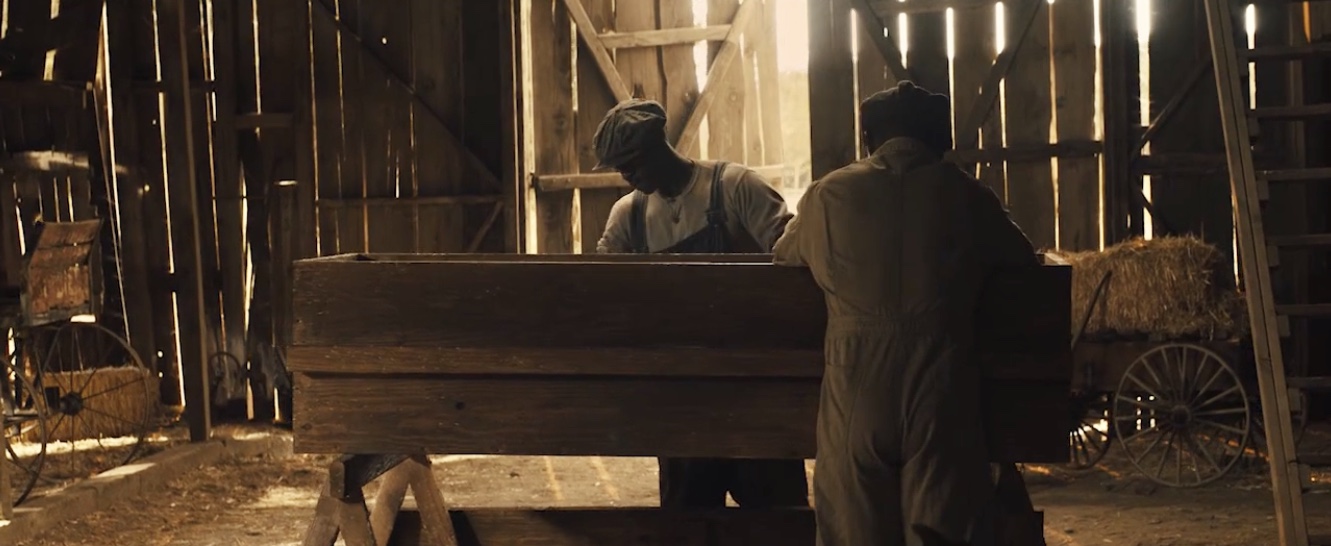
They are building a pine box. Till was shipped back to his mother in a pine box.
On Thursday, August 28, 2008, then-Senator Barack Obama of Chicago made history accepting the Democratic Party presidential nomination. Michael Ealy and Lupita Nyong'o portray a couple watching the moment on television. They embody Maya Angelou-- who would win the Presidential Medal of Freedom from President Obama two years later.

There is such beauty and positivity in this image.
Their rapt daughter is tuned into a defining, unforgettable moment.

On Sunday, August 28, 2005, Hurricane Katrina, a deadly category four, struck New Orleans. Gugu Mbatha Raw portrays a survivor in a water damaged/buried home whilst reciting Langston Hughes' Negro Speaks of Rivers.
Angela Bassett and Andre Holland recite Zora Neale Hurston's Dust Tracks on a Road and How It Feels to be Colored Me, interacting on Wednesday, August 28, 1963-- the day of Martin Luther King Jr.'s profoundly historic I Have a Dream speech, one of the largest political rallies ever recorded in the U.S.

He offers her replenishment back in a trustful time.

They clap as Martin Luther King Jr. is announced to give his speech.


Saturday, August 24, 2019

‘Middle of Nowhere’ is an Underrated Powerhouse

Middle of Nowhere film poster. 
On January 16, 2014, I watched Ava DuVernay’s romantic indie drama, Middle of Nowhere (released two years prior) for the first time on an iPhone. My laptop was broken and that iPhone was the sole way to finally see the film, a special AFFRM Rebel member exclusive. On January 13, 2015, the official DVD release day, it took several stores to find a copy and that would jumpstart the second, third, fourth or so viewings on a new laptop. Then, months later, the Lightbox Film Center showed it on a big screen during a celebration of cinematographer, Bradford Young. Each watch is a present unwrapped, especially to an avid film lover desiring to see more humanist depictions of Black lives by Black filmmakers.

Thus, Middle of Nowhere, an obvious personal favorite, is of significant importance often left off Best Black Film lists.

Ruby (Emayatzy Corinealdi) puts her medical studies on hold in order to help her imprisoned husband Derek.
It opens with Ruby, a tough, resilient medical student who travels far by bus to see her imprisoned husband Derek— in for fraud. On the bus, women bond over their missing men, knowing that these short, strict visitations are all they can hold onto until the next one— year after year after year. When Ruby and Derek see each other, the sparks are flying, the love is spoken through their eyes and ready smiles. Afterwards, Ruby speaks on his behalf, constantly overworking and exerting herself to make ends meet and keep an expensive lawyer on Derek’s case. This authentically paints the true depressing reality for marginalized bodies— always over exerting themselves for a bit of freedom. Before the arrest, Ruby and Derek were dreamily living like a queen and king, well above middle class in a huge furnished house with a nicely manicured yard.

Ruby (Emayatzy Corinealdi) and Brian (David Oyelowo) share a dance. 
Aside from prison visits, Ruby is staying devoted to Derek by putting medical school on hiatus and taking extra hospital shifts much to the dismay of her mother, Ruth. Now Ruth is a stern parent prone to yelling and belittling even over the smallest matters. This constant verbal abuse makes for jarring scenes, especially between Ruth and Rosie— Ruby’s sister, a single mother of a precocious little boy. Meanwhile, Derek’s outside life threatens Ruby’s happiness. In comes Brian— a flirtatious bus driver— that has it bad for the married woman, Ruby.

Ruby (Emayatzy Corinealdi) may be flawed in some instances, but she is far from stupid. 
Ruby, painted in pivotal degrees of vulnerable softness and graceful femininity, is one to be desired, fought for. Whether it is by two handsome men, a fretful mother, or a sister with a small son, Ruby is the light hovering around the shadowy places no one wants to remain stuck in. Derek kept a heartbreaking betrayal under wraps, Brian is staying civil to an old relationship, Ruth wants her daughters to still need her, and Rosie searches for love in all the wrong places. From Ruby, Derek wants her forgiveness, Brian wants to be her “next,” Ruth wants her to get her life in order without Derek, and Rosie wants guidance.

Yet Ruby refuses to be a mule to anyone.

One of the most jaw dropping scenes is what transpired between Ruby (Emayatzy Corinealdi) and Derek (Omari Hardwick) on her final visit. 
Although the story plays a bit into the “struggle love” narrative, DuVernay’s poignant writing and abstracted direction segways the overused Black love stereotype into another route altogether. Ruby eventually realizes that she cannot put her life on hold for Derek, wait in the wings for the course of an unseen future that has presently changed the both of them. Everything passed her by whilst working twice as hard to free him. She needs to be in a new, refreshing moment, deserves to find her path without him clouding her purpose. And that moment happens to be her career, her family, and Brian.

Middle of Nowhere is an intriguing trifecta of threes— Ruby’s need to keep an old life together whilst being seductively pulled by another is more than the typical interloper love triangle, Ruby and Rosie’s adulthood with complicated Ruth, and the unhealthy, unresolved generational turmoil from Ruth causes so much conflict that Rosie doesn’t grant her much grandmother time. 

Middle of Nowhere family: Sharon Lawrence, David Oyelowo, Ava DuVernay, Emayatzy Corinealdi, Edwina Findlay, Troy Curvey III, and Omari Hardwick. 
Middle of Nowhere is seamlessly tied together. There is a reason why this poignant picture won African American Film Critics Association Awards, Black Circle Film Awards, Black Reel Awards, Independent Film Awards, dramatic at Sundance Film Festival (DuVernay being the first African American woman to be honored), and the Josephine Baker Award from Women Film Critics Circle Awards. It is also why many still cannot comprehend its exclusion from the main awards circuit of Oscars, Golden Globes, BAFTAs, etc. The memorable music selection includes some Goapele. Bradford Young’s excellent cinematography reveals a tremendous, tender care in lighting Black bodies. Aisha Coley’s casting of Emayatzy Corinealdi, David Oyelowo, Lorraine Touissant, Omari Hardwick, and Edwina Findlay remains top notch. This arrangement of brown and dark brown skin hues with Corinealdi playing a rootable lead makes women like her feel seen and loved, makes their stories valid.

DuVernay’s gorgeous effort is worth watching again and again because it is one of the finest, most masterful examples of Black people falling in love and making sacrifices in order to make love function. It is so very important to champion Black artistry when it is of this quality. Creators like DuVernay fight hard to write, direct, and produce films for us about us and distribution can be their biggest challenge. With this word of mouth in mind, please watch Middle of Nowhere and spread the gospel to family and friends. Tell them that DuVernay has a romantic poet side in addition to award heavyweights Selma, 13th, and When They See Us.


Monday, November 5, 2018

Survival Steers The Course in 'Little Woods'

Little Woods stars Tessa Thompson (Ollie, right) and Lily James (Deb, left). 
Nia DaCosta's rustic debut, Little Woods is set in a North Dakotan small town. Low income people are desperately clinging despite limited financial resources. Food, drink, hospital visits, and prescriptions are rising to unaffordable lengths-- an honest portrayal of the current horrors in America's faulty health care system.

The politicized strength ex-convict Oleander "Ollie" carries for the white characters is heavy in moral responsibilitya. She is another symbolic testimony that brown and black bodies should carry all burdens even if most of the grievance lies on whiteness. Almost off probation, she sees a kind, decent parole officer-- a shift from the hardened, callous stereotype. Single mom Deb--Ollie's sister-- prepares to take a college placement exam as Ollie pursues a promising job in Spokane. Ollie is always working. She internally fights old demons to clear her conscious, to help those in her community (migrating prepared and packaged food and hot coffee to workers), and keeping the inherited house in order.

DaCosta's gritty screenplay is a subtle nod to William Shakespeare's Othello with a complicated role reversal. Ollie is the favorite daughter, having been willed the house and is on a fulfilling path towards self sufficiency. Deb isn't ready to be left behind.

The brown bodied savior makes for a jarring tale that raises questions about the societal state, the wounds bared and subdued, the freedom close to the horizon, skeletons dangling on the edge of that opened door. Ollie's clever and resourceful, managing to take daring risks that succeed. She fails, however, on several occasions, but cannot break down in crisis. Instead, she charges onward, believing in end goals, her determination driving hard.

Little Woods contains beautiful musical choices that fit comfortably into scenes without intrusiveness. Tessa Thompson is a knight-in-shining-armor as the intelligent caregiver donning non-existent makeup and dowdy wardrobe. The beauty of this character rests in actions. Lily James delivers poise as a rough, struggling parent in a dead end job and co-dependent ex-boyfriend. Together, Thompson and James form a cohesive pair, sharing two points of womanhood and the affection sharing a kinship as strong as blood relations.

Little Woods writer/director Nia DaCosta.
Winner of the Nora Ephrom Award and Heartland Films' Truly Moving Picture honor, DaCosta is a fresh, compelling voice needed during a rather urgent time for new complex stories. While Hollywood continues remaking nostalgic classics and rebooting superhero origin stories, the indie film industry still has a problem showcasing narratives starring people of color. Let's hope that DaCosta moves forward, changing small-mindedness with a cool, collected volume of great, important stories.

Little Woods blossoms with fascinating degrees of profound and endearing promise. 


Monday, February 19, 2018

‘Black Panther’ Gloriously Delivers Wakanda

Black Panther film poster.
Black Panther was indescribably above expectations and is the best Marvel film by far.

Although not the originally slated four hours that anxious fans desperately hoped for, the shorter run time still had plenty of juicy appeal to satisfy the appetite for all things African. This film is definitely not the average Marvel verse. At last, we see ourselves, our ancestral pride stitched in every detail. From the far and wide casting choices of black American, Kenyan, Zimbabwean, Ugandan, Rwandan actors/actresses to the elaborate costumes that pay homage to roots, to the jewelry to the sights of drums and dance and ritual to face painting, hair styles, makeup, fashion, language (both phonemic and hand communication) and scenery. Every ingredient unifies the world of Wakanda, taking audiences to a place they’ve always wanted to go, but rarely realized it could finally happen.


Nakia (Lupita Nyong'o), T'Challa (Chadwick Boseman), and Okoye (Danai Gurira) are now home.
Black Panther starts off with an unexpected betrayal in the past, an act that will unravel and change the course of Wakandan allegiances in the future. Thus, in the present-day, after catastrophic events from Captain America: Civil War, T’Challa embarks home, retrieving Nakia, a bold, brazen woman spy who often leaves him rightfully "frozen," along the way. Upon his most welcomed return, the traditional ceremony of his crowning as King of Wakanda is a joyous occasion with music, dance, and battle.

Like an eloquent black Eve bearing an apple of fruitful knowledge, Nakia, refusing to be wife, offers T'Challa the first taste of forbidden resistance. She wants to share Wakanda to those in need, to generously spread the great wealth of resources all over the world, especially to black people. This is where they differ. T'Challa wants to stick with Wakandan tradition, to remain apart, and continue on with sacred, privileged black utopia. They are on opposing sides, but the love they have for Wakanda and for one another is a delightful. refreshing energy. Their banter, their looks into each other's eyes, their handholding, and their kissing is that splendid, exasperating thing, the first black on black heterosexual love story shown in the Marvel films.

T'Challa is reluctant, but is ready to be a remarkable leader. At the same time, he is not his father. He is tested throughout, challenged to consider exactly where Wakanda's loyalties lie. In his eventual pursuit of Klaue, he faces being surveillanced under the scrutiny of public eye and finding out some disheartening truths about his father, who had once said in the astral plane, "that a father who cannot prepare his son for the future has failed as a father."

The hypocrisy levels definitely tore T'Challas's fatherly love and admiration asunder. There is no question that what the former Wakandan king had did a horrific, inexcusable wrong.

Erik Killmonger (Michael B. Jordan) faces off against T'Challa (Chadwick Boseman).

With his malice lying deep in the feelings of isolation and trauma, Erik Killmonger is such a terrific many layered villain. Beyond the bad seed trope, he is the physical consequences of residual scars of seeing the abandoned body of his dead father like that of the black body grossly depicted in history, in our current landscape, dead and unattended, left without a sliver of compassion and empathy. The desire for revenge rightfully brews in him, gaining substantial ground as he grows up on American soil, experiencing heinous racism and oppression, while desiring a place in his father’s native homeland, the very place that he blames for his tragic childhood. Thus, his extreme politics bear great similarities between of the righteous need to arm civilians with tools necessary to flourish and thrive without fearing white supremacy. He is the Malcolm X to T'Challa's Martin Luther King Jr.

The heart of the film is finding one self conflicted between T’Challa and Erik, finding both sides wrong and right on different political and social parallels. That wherein the genius.


Okoye (Danai Gurira) and her beloved spear taking names in the midst of an awesome car chase.
Black Panther fearlessly passes Bechdel and Ava DuVernay tests with flying emergent colors. The women of Wakanda were an absolute, scene stealing treat! There are no background players and props here. Firstly, the dynamism between the four leading women was a chemistry barely tapped in the Marvel Comics film sphere seeing as most of its core female characters, Black Widow especially, operate alone in a male dominated situations. In Wakanda, levels of trust and friendship went beyond protecting their supreme ruler. Queen Ramonda, Shuri, Nakia, and Okoye are a beautiful, inspiring sentiment, an awesome portrayal of the communal bonds between the black women’s love for each other and their undying allegiance to their country.

Nakia (Lupita Nyong'o) and Princess Shuri (Letitia Wright) are ready to fight for their country.
Queen Ramonda has birthed two amazing individuals who have inherited her goodness, her tenacity, and her courage. Princess Shuya, the computer tech whiz behind Wakanda’s highly advanced superior technology had more than once saved the day behind-the-scenes. She is valiant, witty, sharp, and intelligent, a supreme highlight who had some of the best deep seated one-liners, especially about colonialism. Nakia, the prince’s heart, has love for all people, wanting nothing more than to share Wakanda’s wealth of knowledge and resources to those of the diaspora, but of course, her kind of vigilantism often gets her into trouble. She too is an excellent warrior, her fighting skills a tremendous glory to watch, seen in the visually stunning choreography sequence in the casino scene with her fellow sister, Okoye, the powerful, resilient, staff wielding leader of the impressively elite Dora Milaje. Okoye is fierce and loyal to the throne, which adds to her internal struggles further down the line.

In the forests near the mountains of Gorilla City, Jabari's Tribe, Queen Ramonda (Angela Bassett) and Shuri (Letitia Wright).  

When Nakia, having successfully taken the last of Wakanda’s most precious plant as Killmonger orders it all burned down, is pleaded by Queen Ramonda herself to engulf the advanced Black Panther powers, the powers entrusted in her familial line. Even with her own young daughter standing by, it is Nakia, that Queen Ramonda believes can save them.

Other must see highlights: Nakia's first secret mission of freeing captive women (because of its heartbreaking reminder of "Bring Back Our Girls," a movement to finding the missing kidnapped girls from Chibok in Borno State, Nigeria); Killmonger wisely informing a curator of the Museum of Great Britain that they stole artifacts from Africa (because us knowledged people cannot imagine Africans gifting precious artworks to "The Other" aka colonizers); M'Baku and his people barking over Agent Everett Ross, telling him that he couldn't talk (because white people constantly tend to speak over black people). A sweet Moonlight actor makes a cameo at the end (because this brings to full circle the monumental range of diaspora unleashed in this film, us brown and darker skinned complexions with our broad noses and protruding foreheads and full lips are present together).

Wakanda Ensemble: Forest Whittaker, Daniel Kaluuya, Michael B. Jordan, Lupita Nyong'o, Chadwick Boseman, Angela Bassett, Danai Gurira, and Letitia Wright.

Black Panther does have minor adversaries. It is unsettling that a white C.I.A. operative comes to their country, wears their symbolic garb, and eventually must wield their sophisticated devices to blast down Wakandan vessels. There is no queer representation, which makes one wish that Tessa Thompson's Valkyrie, introduced in Thor: Ragnarok, would fly on down to Wakanda and have her way with a Dora Milaje soldier. Or perhaps in its sequel (oh there has got to be a sequel), Roxanne Gay can be brought into the writing room. The most glaring flaw is that black libertarianism, seemingly the real supposed villain, the conveyed message behind Killmonger's "evil," definitely conjures internalized friction. This idea to save long suffering black people from imperialism (Wakanda has plentiful which Nakia earlier addressed) isn't Wakanda's problem, but what T'Chaka did to Killmonger is. Where was Killmonger's mother? What role did she play in his life, if any? His masculinity was a toxic, misogynistic brand and yet, his desire to arm the most vulnerable people in the world was moving in spite of it.  

However, it is imperative to remember that one fictional superhero movie cannot hold everything, be everything to someone. It would be irresponsible to say the least.

Black Panther has granted us a black director (Ryan Coogler), black writers (Coogler with Joe Robert Cole), a black costume designer (Ruth Carter), a black jewelry designer (Douriean Flecther), a black production designer (Hannah Beachler), a black soundtrack director (Kendrick Lamar), and an almost all black cast from different pockets of the globe. And that stands for something undeniably profound.

T'Challa (Chadwick Boseman) has reassurance from Nakia (Lupita Nyong'o) that he can and will thrive as king of Wakanda.

Overall, Coogler and his team have helm a magnificent picture with a fine, gratifying story that passionately entails the complexities of fights within the black community. He has achieved a finesse that few filmmakers in the comic book verse have by incorporating historical and contemporary problems. The performances are meticulously top notch and powerful, possibly one of the best ensembles of Marvel. With Oscar winners and nominees, Golden Globe contenders, NAACP Awards and Black Reel accolades, and even a Pulitzer Prize nominee in the mix, the stakes were high. From Chadwick Boseman's commanding lead (kudos to his dialect coach), Michael B. Jordan's ruthless aggression to Lupita Nyong'o's ferocious vitality to Danai Gurira's stout loyalty, everyone had came with their A game. Angela Bassett, Forest Whitaker, Daniel Kaluuya, Sterling K. Brown, Winston Duke, and Letitia Wright (who was superb in that must watch Black Mirror episode, "Black Museum') also put in incredible acting efforts.

Black Panther may not have televised the whole entire revolution, but this imperative comic book film drama passionately ignites conversations to take that leap.

Now go see and support the vision of black excellence. Wakanda forever.


Saturday, January 6, 2018

'Mudbound' Is The Most Important Film Release of 2017

Mudbound film poster.

Some films are good. Some films are terrific. Only few will tug at a person's innermost emotions and grip them in its strong, riveting chokehold like a tough, combative wrestler by very end. And Mudbound is that nitty, gritty fighter film that ignites countless thought.
An intense American historical drama entailing egregious societal infrastructure set in stone for black and white residents of the deep South, Mudbound is a real solid game changer for a Netflix feature. Writer/director/producer, Dee Rees addresses-- with such vital clarity-- this racially fueled class system that has established a gross power imbalance since colonialism and slavery upset the natural selection of the whole entire world, leaving behind a great generational devastation.

For starters, raised by Pappy, a vulgar racist father, Jamie and Henry McAllan are brothers who couldn't be any more different from one another. While younger Jamie is bright, reckless, and charismatic, older Henry is a practical and spineless simpleton. Metaphorically throughout the film, the analogy is crystal clear-- Jamie represents dawning of a needed crucial change-- accepting others regardless of race, status, and creed whereas Henry holds on tightly to white privilege like a stern, stubborn mule, his father's son without crass indecency.

Henry marries a spoiled socialite, Laura and they have two children. Henry, who imposes his male dominance over Laura, makes the decision to waste their money on farmland down in Mississippi, and Laura, who absolutely detests the move, has no authority on the matter. Jamie is fighting on European soil, dropping bombs from the sky, bearing witness to the ugly, violent sides of war. The accumulation of medals and honors do not diminish mental and emotional trauma. Jamie returns to America scarred and hurting, using drinking as a consolatory outlet for his pain.

In Mississippi, the Jackson family are humble brood, led by Hap, a preacher with a passionate, authoritative voice in the church and Florence, a loving, devoted mother who would do anything to break the psychological cycle of a mother she barely knew. Ronsel, their eldest son, goes off to become a soldier, thrown into the same fiery ring as Jamie, but is treated like an equal.

The McAllan's and the Jackson's intersect on this gorgeous piece of muddy land with promises of becoming more than what anyone has ever dreamed. However, the power balance is established the moment Henry rudely interrupts the Jackson's dinner, forcing the master and slave relationship to take repulsive shape, eventually threatening to rupture the mesmerizing strength of Hap and Florence. It is quite fascinating to address the differences between how Henry treats Laura and how Hap sees Florence. Henry and Laura are a union of comfort, a product of society privilege. When it comes to Jamie, Laura comes to life, having bitten the taste of forbidden passion, that real intense ardor that of course, Pappy can see. In Hap and Florence's case, the love and tenderness is a sweet dosed prescription of strong, foundational black romance. Hap sees Florence as an equal, a queen and he respects her.

Under the wary, watchful eyes of town, Jamie and Ronsel return from war, changed, eventually forming an intriguing bond.  

Jamie (Garrett Hedlund) befriends Ronsel (Jason Mitchell) despite the turmoil of white and black mingling beyond silent acknowledgement.
"Have you ever been with a white woman?" Jamie asks Ronsel.

Ronsel smiles with pride, jogs around the answer before diving into the nitty gritty affirmative, then later adding:

"We had to show them who we were."

Ronsel's words about proving his humanity to white women (aka sexually) is a startling revelation about black people's desire to be on equal footing with their oppressor. Since his return, he wishes to make the white men see him as a man, especially considering that he fought on their side during war. European white women had freely dallied with Ronsel and his black cavalry, that is after these men proved their fetishist worth, why doesn't the white men show such appreciative kindness, respect even?

In another power trip, after learning what Florence (Mary J. Blige) can do, spoiled Laura (Carey Mulligan) demands the woman to work for her on a permanent basis.
This mirrors Laura's interpretation of Florence. When Henry fetches the woman to cure his daughters' whooping coughs, Laura doesn't warm up to the idea at first, until she realizes that Florence is indeed useful. Without asking Florence herself, Laura demands that the woman "help" her with the children. Reluctantly, Florence agrees, breaking her own inner promise, sadly repeating the life of her mother.

Henry (Jason Clarke) once again requesting help from Hap (Rob Morgan).
Mudbound is rich, concise, layered complexity. The cast operates like a well oiled machine, perfecting their individual parts with brilliant tenacity, grace, and harrowing conviction. Their gritty Southern twanged voice overs, like vital, melodic poems recited at the podium, are painful, dispirited, joyous stories of strife and happiness, of wanting and valuing change, of simple desires. The watchers must snap fingers and cheer collectively at these performances. Mary J. Blige is utterly wonderful as Florence, valiant, soft, and encouraging, with her expressive facial expressions, vocal ability to being a compassionate wife to a broken mother. Carey Mulligan also holds her own as a privileged woman torn by social duty and captivating passion for things that she cannot have. Jason Mitchell is great at portraying Ronsel's struggles with coming back to a town that doesn't deserve his allegiance-- the ending alone ensures a huge sob fest. Plus Kennedy Derosin plays Lilly May Jackson, the young daughter of Hap and Florence, aspiring to become a stenographer. In one scene, she stands her ground against her laughing brothers who don't believe black people can step out of their station. Florence sternly tells him that Lilly May can become anything she wants to be. That smile shared between mother and daughter as well as the scene of Lilly May reading stenography books are beautiful touches about chasing dreams and receiving the treasure of female support. On Film Comment, Rees explains why she choose this path as opposed to Hillary Jordan's original writing.  

"My grandmother grew up in the small town of Ferriday in Louisiana,” said Rees. “She was born in 1925, and she’d talk about riding on her mother’s cotton sack. They owned their land, but they farmed it, and her parents cultivated cotton. She decided early on that she didn’t want to do that, nor did she want to be a domestic. She said she wanted to be a stenographer, so that was a touch I added in the film, when the Jacksons’ daughter declares her career ambition. In [Hillary Jordan’s] book, she can sing, but I didn’t want it to be the typical ‘little black girl can sing’ thing. I found it more interesting that she had this other ambition.”

Dee Rees for The Undefeated. Photo by Khoolod Mid.
Everyone and their grandparents should watch Mudbound. Yes, it would have been epic to see this in theaters, to witness this resoundingly important piece be on the giant big screen. Still, it's humbling to be at home, to not pause this history, to let every bit of the McAllans and the Jacksons steal eyes and ears. Don't let the Netflix factor fool you or anyone else into believing that this isn't a worthy accomplishment of integrity nestled between the acting, the cinematography, music, and all.

Wednesday, August 30, 2017

'Love Jones,' 20 Years, 5 Months Later, A Motion Still Tumbled in Earth

Love Jones DVD cover.
“This here, right now, at this very moment is all that matters to me. I love you and that’s urgent like a mother….”
How can a sis not swoon over grandiose words spoken by teenage crush, Larenz Tate, playing this beatnik brother poet, Darius Lovehall? Trust and believe that is the hardest notion of all, fighting against problematic perceptions of the young black Chicagoan male. Darius is intelligent, eclectic, and charming, the laidback, ear pierced black man whose tiny apartment makes room for an impressive library, listens to the rustic scratchy sounds vintage records make, and understands distinct difference between sadness and melancholy.

Twenty years ago, I wasn’t quite old enough to see Love Jones in theaters, but saw it much, much later. Recently, I rewatched the Sundance Film Festival Audience Prize Winner, hooked to the sweetness of black artists falling in love with each other and their respective practices.

Nina (Nia Long) and Darius (Larenz Tate) giving each other the Kool-Aid smile.
The queen bee eating up spoonfuls of Darius's freestyle scat is gorgeous, talented, fiercely ambitious Nina Mosley. With her crop top blouses (including that amazing outfit at the end), high-waisted denim jeans, and dark lipstick, she defined fashion. An up and coming photographer whose vignette portraits have a Gordon Parks meets James Van Der Vee in the 90s kind of vibe, Nina uses vintage cameras, taking her passion onto the streets, capturing mostly people in love. Big shot magazine editors don't like her style. A man calls her "unpolished" without really defining his criticism. This rejection adds stress to a woman who left her selfish fiance.

Darius and Nina first meet at The Sanctuary, a hip underground nightclub for bohemian sisters and brothers who collectively snap their fingers to open mic visionaries. Darius is part of a black bohemian posse of knowledgeable sophisticates-- Afrocentric vibing Sheila, humble married Savon, cool Eddie, and player Hollywood. The sparks fly immediately, even after a minor fumble at the bar, but Darius walks up to the mic and spills out a raw, sexy poem, Brother to the Night, (A Blues For Nina). Nina's embarrassment is genuine. She doesn't like its sexual components, but she is a tiny bit flattered, putting on a sisterly blush. They meet again and stubborn Darius continues to woe her with sweet, explicit music and dance.

I love that after Nina recites Sonia Sanchez's poetry, Darius believes that Nina will come up with words of her own. He knows it. As well as he knows she is skilled with the camera, he knows that she has other skills up her sleeve, that she too is a poet at heart.

Now growing up, in regards to film watching, I had been mostly exposed to white romances-- white people falling in love, white faces kissing, white bodies thrusting together, the whole nine yards. Hell, my entire middle school sex education was an instructive white people "doing it" cartoon. To see Darius and Nina becoming deeper than two passing strangers: dancing at a reggae spot, passionately making out at her doorstep, dissolving into full fledged intimacy in a beautifully compiled erotic montage. This epic thing of wonder charged with poetic moments of clarity utterly shook and dismantled my whitewashed education. I thought, damn, is this what Hollywood is afraid of? That black people can be fully realized, three dimensional beings that can love the living life out of each other? That they can be hot, sexy, and set the screen on fire without stereotypical exaggeration?

Nina (Nia Long) working with the professional camera.
Darius and Nina have their ups and downs. At the same time, so does the married Savon. Trust is the enemy. Everybody makes mistakes and smashes that needed relationship essential. I understand that Nina wanted to see if she would miss something with Marvin, but his ill-fitting childish behavior obviously wasn't ever going to change. Plus, he would have smothered Nina's independence. Meanwhile, Darius finds Lisa, a new squeeze to warm his bed, but she incites no spark of inspiration. Nina returns to Chicago and is immediately broken-hearted over seeing Darius and Lisa. She turns to Hollywood (eerily similar to Marvin) for affection and fair play turnabout. Savon is lonely after his wife leaves with their son, bringing questionable companions to the posse get togethers. He has a valid outlook on love and relationships, ultimately stating that it's the staying in love that is the most challenging hardship. It's tough seeing his struggle in the marriage. Troubles do not end after "I do." And that's real.

Josie (Lisa Nicole Carson) and Nina (Nia Long).

Ava DuVernay said, “I think that women definitely have a special bond as friends that is hard to describe to men, and we don't often see that portrayed narratively."

That is sort of expressed greatly here. With their amazing girlfriend chemistry, Nina and Josie's onscreen conversations mostly revolve around men and their relationships with them. Apparently, Josie has an active sex life, but her purpose (in this film) is to live vicariously through Nina. However, the taxi cab scene is hilariously memorable, a real game changer in how women discuss male anatomy. When Nina explains that Darius speaks to her down there, it was so much more hysterical than any fake deli orgasm. This was straight fire. Though the male taxi driver overhears and is thoroughly amused, carnal sharing is for the benefit of sisterhood spillage, not for him.

Still, it is a huge missed opportunity to not have the girls celebrating Nina scoring a break (after months of being dismissed) with Vibe Magazine. Would have loved to see these women toasting to that milestone. I appreciated her phone call to Darius and the crushing train scene afterward, but I needed a Nina/Josie girl party. Plus, what the heck did Josie do for a living anyway? She wasn't exactly fleshed out. Also, it is such wasted potential that none of the fine brothers of the posse wanted to engage with her. For example, Hollywood has always wanted Nina-- friend's girl or not. Eddie is a closed book, great deep voice, the host of the soirĂ©es, but without a partner. He and Josie would have hit it off if the chance had been granted. 

On the other hand, Sheila is an amazing, sensational independent woman. She works at Last of the Old Time Record Stores with giant posters of Janet Jackson's Design of a Decade, Eric Clapton's From the Cradle, and funky posters on the front door. She spoke her mind and put characters like Hollywood and Savon in their place if they stepped off. Her side eye expressions put everyone on notice.

Darius and Nina looking like a "One in a Million" couple on the motorcycle.
The film is put together brilliantly, each piece playing its part to utmost perfection-- the acting, the script, the cinematography, the music. From Lauryn Hill’s guitar strumming serenade “The Sweetest Thing” to spoken word sensuality of Meshell Ndegeocello and Mark Miller’s “Rush Over,” the music selection is ridiculously slick, keeping interest flowing from Darius's sexy ode to Nina to Nina's "virgin" popping at Darius in front of the mic. The in between is a lacy groove set of Maxwell, Cassandra Jones, and Duke Ellington designed to never let the mood shift out of a lover's mindset.
Earlier this year, Love Jones received the ABFF (African Black Film Festival) honor for being the Ultimate Black Love Classic.  Omari Hardwick introduced the sweet award to the cast: Bernadette Clarke (Sheila), Theodore WItcher (writer/director), Lisa Nicole Carson (Josie), Larenz Tate (Darius), Leonard Roberts (Eddie), Nia Long (Nina), and Isaiah Washington (Savon).  Bill Bellamy (Hollywood) wasn't present, but they shouted him out. 
Nominated for three Image Awards and four Acapulco Film Festival Awards (winning for Best soundtrack), Love Jones was way above the time of its 1997 release date. Cumulative box office total says nothing about the kind of impact this film made on so many people. The story of Darius and Nina and their surrounding friends stands on the paramount of black romance, standing atop a pedestal so grand that few others can topple its worthy place in nostalgia.

Darius and Nina reuniting in the pouring Chicago rain! 
The Love Jones ending is a special kind of gold that all sisters appreciate. When a grown woman runs out in the pouring rain, risking the world (yes, getting a nice straight press/relaxer wet), that is a sign of true dedication, a willingness to sacrifice everything in the name of love.