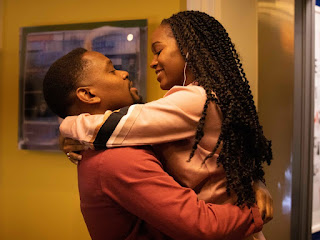
Showing posts with label Pariah. Show all posts

Sunday, July 20, 2025

Chelsea Hamilton and Dr. Madison Montgomery’s Romance Heats Up Faster Than The Speed of Light


Chelsea (RhonniRose Mantilla) isn’t afraid to dive in with young neurologist Dr. Madison Montgomery (Kenjah McNeil). DP: Vincent Steib.

Beyond the Gates continues making soap opera history with its latest story— Chelsea Hamilton and her girlfriend Dr. Madison Montgomery. 

Chelsea, the retired supermodel and newbie purse designer, has explored her bisexual status since the soap’s February debut. Originally, an enthusiastic third for adventurous couples, Chelsea’s the type not to be defined by labels. Craig and Allison, Chelsea’s last polyamorous relationship, saw her choosing to primarily commit to her lesbian side, setting out to separate Allison from her husband for a while. The move seems straight out of the Bill Hamilton playbook, predatory cheating strategies showcasing that the apple doesn’t fall far from the tree. In her personal life, Chelsea can behave similarly like her father— a man who committed adultery for years. 

Yet, Chelsea has the tendency to fall hard and fast—perhaps a trait of her zany mother Dani Dupree-Hamilton? 

Chelsea and Dr. Madison share wine and affection at the pad that Chelsea shares with her cousin and best friend Kat Richardson. DP: Vincent Steib.

After being dumped by Allison just before June’s Pride Month started, Chelsea meets a mysterious woman at the hottest nightclub in town, flirting up a storm. It turns out Madison is a neurologist— her own father’s stroke doctor. Chelsea holds nothing back, becoming a full-fledged seductress of the highest order, ambushing the gorgeous doctor at the hospital, thirsty as heck despite not getting the water her inpatient father needed. Skipping many steps including the crucial angst part, Dr. Madison succumbs to Chelsea anyway— a couch date, the quickest blink-or-you-miss-it love scene, the introduction to the uppity Dupree family, and the “I love you,” hearts in her eyes. Chelsea and Dr. Madison are moving at the speed of light, ultimately symbolizing the unfortunate U-Haul trope. Does this mean that their fast relationship could crash out at the same pace? Sugar can only jolt the adrenaline for so long. What exactly are Dr. Madison’s intentions towards Chelsea? 

While it may seem downright boring in a soap opera— a genre often thriving on pushing wild, outrageous envelopes and overzealous acting decisions— the fascinating parts about Chelsea and Dr. Madison are their Bechdel Test passing conversations. They center topics such as coming out to their respective families and their individual career paths. Chelsea’s extrovert personality could clash with Dr. Madison’s humbleness. These hardworking women share a common passionate drive and of course— a growing ardor for each other. Sure, we’ve missed the longing looks cementing a fresh romance, but we’ve got public handholding, smooches, and dialogue. With a cast this stacked (and talented), it is pure luck to even receive little tidbits of these lovers.  

Allison (Brianna Roberts) lets Chelsea (RhonniRose Mantilla) that she wants her back. It won’t make Dr. Madison (Kenjah McNeil) pleased. DP: Vincent Steib.

A heavily accessorized Chelsea reassures Dr. Madison that she’s locked in. DP: Vincent Steib. 

Chelsea and Dr. Madison’s romance is put to the test by the sudden reappearance of Chelsea’s married ex Allison. This latest development complicates Fairmount Crest’s overwhelmingly saturated landscape of triangles and quadrangles— Kat/Tomàs/Eva, Hayley/Bill/Dani, Dani/Andre/Ashley/Derek, Nicole/Ted/Leslie. A slightly deranged Allison’s urgent desire for Chelsea pinpoints the Beyond the Gates writers’ leniency on interlopers to create a couple’s conflict. If the other dynamics didn’t exist and the overly rushed Chelsea and Dr. Madison were shown more frequently, this Allison angle would be enticing front burner stuff. After all, it is not everyday you see three Black women fighting for each other romantically in daytime. 

Chanel (Reagan Gomez) and Nova (Rutina Wesley) from Queen Sugar.

Max (Chanté Adams) and Esther (Andia Winslow) from A League of Their Own.

Eva (Gail Bean) and Tye (Jerrie Johnson) from Harlem also had a U-Haul relationship. 

Black women falling head over heels with each other onscreen remains a rarity. Television and film have a longstanding preference for interracial LGBTQIA couples from Cheryl Dunye’s classic The Watermelon Woman to Maria Maggenti’s The Incredibly True Adventures of Two Girls Falling in Love. Even this Buzzfeed list contains mainly white or interracial TV lesbian couples. Every now and again, a thoughtful Black woman filmmaker makes slow burned sapphic cinematic masterpieces: dee rees’s Pariah, Wanuri Kahiu’s Rafiki, and Natalie Jasmine Harris’s Pure and Grace are prime examples. Nova and Chanel were short-lived territory in Queen Sugar, Max and Esther briefly steamed up the sadly cancelled in A League of Their Own, and Eva and Tye got engaged in Harlem. Chelsea and Dr. Madison adding to this equation has the opportunity to shift the narrative in a powerful way— to inspire a new normal that other TV/film writers could build off on. 

Madison and Chelsea are having problems with Allison. DP: Vincent Steib.

Beyond the Gates, a soap opera staunchly committed to being a revolutionary force, provides the “love in the afternoon” lunch hour with some gorgeous Chelsea and Dr. Madison interactions. As the two women navigate their journey among the affluent Fairmount Crest community, let’s pray that intriguing twists and turns keep their union strong. Although this may be challenging as we’ve seen the characters interact in the same locations each week, Chelsea and Dr. Madison should be attending the movies together (especially the big D.C. queer film fest), taking trips to the pool, shooting photo booth strips, hopscotching and pushing each other on swings, dancing, sharing ice creams and cakes, throwing down a game of Uno, and all kinds of lovey duvey activities to squeeze into their tight schedules. Interrupt our broadcast shenanigans with a sweet induced drama that’ll make our hearts race and burn. 

Chelsea does have a type though— Dr. Madison and Allison look alike. May the best woman win. DP: Vincent Steib.

The key to crafting groundbreaking material as sensitive and rare as Chelsea and Dr. Madison is to reflect on the viewers at home. Analyze the question— is this a valid, authentically rendered romance that audiences deserve to bear witness to? The brave writers must prove that this story truly represents a Black sapphic love worth vouching for. 


Monday, February 14, 2022

Favorite Black Loves In Cinema


Cane River’s Peter (Richard Romain) and Maria (Tommye Myrick).  

Happy Valentine’s (or Single Awareness Day) to those who celebrate all kinds of love, romance, and self-care joy. 

In the Black cinematic world, there is still movement to be made in ways of a well-crafted story, compelling cinematography, and fine acting. Some films have one or two of the ingredients; barely all three to make the recipe complete. When it comes to heteronormative Black love, putting on the classic Love Jones or Jason’s Lyric (which both feature the incredible Lisa Nicole Carson) sparks up the mood whereas the out of the vault Cane River is a marvel to behold. Even the startlingly passionate Ganja & Hess must be recommended for its daring portrayal of Black vampiric lust despite the unhappy ending for the pair. 

Black LGBTQIA+ films such as Moonlight, Pariah, and Rafiki contain the queer violence that comes from sanctimonious communities that cannot accept such a love. Yet that is only for a moment that that ugly bandaid comes off and the healing slowly begins. Moonlight is exceptionally beautiful for showcasing the bonds between skinfolk and kinfolk, subtleties between love and longing, and the desire for men to be themselves alone and with each other. Pariah and Rafiki have these awestruck profoundly engaging periods of Black women love; joining hands in friendship and embarking on bliss no matter the consequences. Bessie, dee rees other film, highlights the musician’s bisexuality starring Queen Latifah who doesn’t need to don a fat suit. This Bessie role suits her and doesn’t end like her tragic Cleo in Set it Off. Overwhelmingly romantic short films tender and pure are charming gems that share a sweet intimacy with thought-provoking conversations and dancing between women. 

As for the asexual spectrum in film, we have a crucial journey ahead. Characters rarely seek happiness outside finding relationships. Although Alike ends on her burgeoning writing path, throughout Pariah, she has a great desire to explore her sexuality, hidden like a flaming shame from her parents. Selah in Selah and the Spades, however, is high on the adrenaline of power, allowing nothing not even the idea of idyllic teenage sex lure her away from her intense drive— a drive that has Paloma looking at Selah in moments of perpetual longing. On the darker side of asexuality, the rooted misogynoir historically depicted through the white lens. Writer Kira Sterrert brushes up on the mammy beginnings in filmdaze; addressing how Black women behind-the-scenes are finally creating their own corrected promotion:

“The more Black women that are writers, directors, and producers in Hollywood, the more they’ll bring narratives that depict positive and real depictions of Black life as a woman or femme. Black women are more than their bodies or their relation to white people, they are multi-hyphenate and multidimensional — pure magic.”

Here’s hoping for a cinematic future filled with all representations of love created that Black filmmakers create for Black cinephiles (and all other cinephiles) to appreciate in the years to come. 

Recommended Films About Black Love By Black Filmmakers 

Love Joneswritten and directed by Theodore Witcher, 1997. 

Pariahwritten and directed by dee rees, 2011.

Moonlight, written by Tarrell Alvin McCraney and Barry Jenkins and directed by Barry Jenkins, 2016.

Ganja & Hess, written by Bill Gunn and directed by Bill Gunn and Lawrence Jordan, 1973. 

Really Love, written by Felicia Pride and Angel Kristi Williams and directed by Angel Kristi Williams, 2020. 

Rafiki, written and directed by Wanuri Kahiu, 2019. 

The Weekend, written and directed by Stella Meghie, 2018.  

Heaven Reaches Down to Earth, written by Tebogo Malebogo and Petrus van Staden and directed by Tebogo Malebogo.

pure, written and directed by Natalie Jasmine Harris, 2021. 

tender, written and directed by Felicia Pride, 2020. 

Cane River, written and directed by Horace Jenkins, 1982, remastered and released 2018. 

Selah and the Spades, written and directed by Tayarisha Poe, 2019.

Jason’s Lyric, written by Bobby Smith Jr. and directed by Doug McHenry, 1994.  

Middle of Nowhere, written and directed by Ava DuVernay, 2012.  

Bessie, written and directed by dee rees, 2015. 

Boxing Day, written and directed by Aml Ameen, 2021.  

How Stella Got Her Groove Back, written by Terry McMillan and Ronald Bass and directed by Kevin Rodney Sullivan, 1998. 


Wednesday, April 24, 2019

The First Time I Saw Myself Onscreen

Adepero Oduye in Pariah.
My single mother wasn't the affectionate and maternal sort like Clair Huxtable, let alone affluent and married. So the television raised me on exclusive beauty, slowly and subliminally forcing me to admire fictional characters that looked nothing like me. I grew up watching an endless amount with a preference for soap operas and addressed that in prelude to last year's series on Best TV Couples here. I didn't go to the cinema until around age seventeen, but always had a Halle Berry haircut (though my hair didn't like perms at all, lasting for a week or two before unapologetic nappiness returned). Every boy in school desired Halle Berry. Unfortunately, I (and most of the other Black girls) didn't resemble her at all.

On Saturday mornings, Lisa Turtle (Lark Voorhies) taught me about funky style and fashion on white centric Saved by the Bell.
Her outrageously fabulous wardrobe and dreams for fashion school truly resonated with me. 
When last summer Ava Duvernay asked the question, "when did you first see yourself depicted on screen?" I simmered on the thought for a while, remembering the biracial and non-black women still heralded, still put on higher pedestals in all forms of media. I do recall childhood animated icons: Punky Brewster's Cherie, Jem and the Holograms' Shana Holsford, and The Magic Schoolbus's Keesha Franklin (the later two having been recently turned into racially ambiguous characters). Yet I couldn't hold onto them forever.

Although I didn't watch Felicity, it was special seeing Tangi Miller in those memorable "Oh What A Night" WB commercials. She would the only Black woman, essentially playing the role of spokesperson for our notably absent presence on the network. 
The teenager years were absent of Black girls. I escaped into the WB network (didn't have cable) and eating disorders, wishing to banish the newfound curves alongside my "problematic" short hair and distinctive face that looked like countless masks in the Africa sections of museums than anything on TV or film. It felt entirely wrong to be dark skinned with a broad nose, plump cheekbones, thick lips, and size 0 fantasies. Yet Tangi Miller's sepia skin, dark brown eyes, and long box braids in the commercials between consumptions of Buffy the Vampire Slayer, Angel, and Roswell soothed a great inner belonging. She was in the Seventeen and Teen Vogue magazines, but never graced the covers. Always the support, the sistah girlfriend to Keri Russell's lead, Miller lingered in my mind, my spirit, constantly reminding me that we deserve to fit somewhere. Funnily enough, at the time, she was also dating Angel's J. August Richards. I imagined them as the Black King and Queen of the WB, that they clung to each other on a network lacking the very definition of inclusivity.

Adepero Oduye in Pariah.
Thus, the first time I saw myself depicted on screen was poignantly nestled in Adepero Oduye's performance in Pariah as Alike, the shy writer coming to terms with her sexual identity. I remembered racing down to the Neon Movies-- the only art house theater in Dayton, Ohio-- to watch a film that many heralded online, knowing full well that Black films, especially Black films with strong leads directed by women (Night Comes On and Fast Color) tend not to stay in theatres long.

Oduye's character not only looked similar to my physical (skin tone, prominent African features), she didn't wear makeup, loved English, wrote poetry, rode public transportation, and was constantly ridiculed by her peers for not appearing feminine enough. I sought solidarity in Alike hiding her true self, admiring the authenticity shining through Oduye's performance. She began my search for other similar multifaceted characters, for finding those that don't fit the European gaze, their expectation of Blackness, whilst also looking for validation in gifts they could offer the world.

In addition to Oduye, Whoopi Goldberg and Akosua Busia in The Color Purple, Alva Rogers in Daughters of the Dust, Mouna Traore in Brown Girl Begins, Karidja Toure in Girlhood, Samantha Mugatsia and Sheila Munyiva in Rafiki, Dominique Fishback and Tatum Marilyn Hall in Night Comes On, and Marsai Martin in Little all come to mind as to how I see myself portrayed in both past adolescence and current adulthood on the film screen.

Awkward Black Girl, one of the best web series' ever, conveyed my experiences in the workplace. Plus, Issa Rae's expressions are on point.
Whether it's having a deep dark brown skin complexion like Issa Rae or Lupita Nyong'o, an impressionable gap between teeth like Uzo or distinctive negroid facial features and kinky hair like Viola Davis and Danai Gurira, finding these parts on another person in Hollywood has become a new source of unexpected joy. The representation of Black beauty-- the unapologetic, unambiguous African ancestral pride-- is taking phenomenal shape and putting us all on notice in a big, unforgettable way.

Tuesday, September 5, 2017

Revisiting 'Pariah,' A Must See That Transcends Time

Pariah film poster.
Still, some years later, I find myself returning to something amazingly profound, a work that comes back, hugging close like an old friend.

Pariah is an astounding, vibrant piece of finely weaved storytelling with thoughtfully spoken artistry. This independent film centers on Brooklyn high school teen, Alike (pronounced ah-lik-e) an exceptionally good student and aspiring poet from a hard working middle class family. In her underground world, the shy girl hangs out with bold, outspoken, Laura, who has already proudly come out and lives with her sister.

Alike, however, is much too afraid of such honesty and chooses to entrap herself with dual identities- switching from hood gear to chic fashion, she is trying to do right by parents, Arthur and Audrey, but it's her little sister, Sharonda that begins suspecting the truth first.

Laura (Pernell Walker) and Alike (Adepero Oduye) test out a certain kind of package.

Filled with hilarity, wit, and compassion, viewers follow Alike’s course of adolescence as she tries unsuccessfully talking to women, tests out her first strap on with Laurie’s aide, writes poetry in a colorful composition notebook, and privately shares her talents with the encouraging English teacher.

All the while Audrey is desperate to make Alike appear more feminine and attractive to boys and wishing Alike to stop hanging around Laura, someone she clearly detests. Yet Arthur turns a blind eye, seeming not to give a care about his overbearing wife’s feelings and accepts Alike "flaws" and all.

Mother and daughter Aubrey (Kim Wayans) and Alike (Adepero Oduye) don't see eye to eye.
Fed up with Laura, an interfering Audrey wants Alike to be friends with "normal" girl, Bina. But unbeknownst to Audrey, Bina shows the kind of interest in Alike that would have had her head spinning. A smart, intelligent, and worldly artistic individual, she shares a lot of compelling ideas and music with Alike, striking up a friendship that soon blossoms into a refreshing first love.

Spending time at clubs and critiquing each others writings, things were so blissful.

However, her immediate discarding of their relationship the morning after was quite detrimental and heartbreaking.

Alike breaks down, guttural and hurt by the strange 180, but sadly has no one to tell and transforms that anguish into poetry.
Bina (Aasha Davis) shows Alike (Adepero Oduye) mixed signals.

Once Alike finally confesses to her parents, hell breaks loose tenfold.

In the very turbulent scene, Sharonda pleas with Alike not to get in between the battle of their parents who are loudly arguing about her sexual orientation, but valiant Alike bravely wages on and puts up with an emotionally distressed Audrey who then verbally attacks and violently beats her revulsion into Alike.

After that climatic horror, things change.

With a condoning mother seeing lesbianism as a treacherous disease deemed unlovable, Arthur is the exact opposite. A man harboring his own secrets, he seemed to have always known that Alike was a unique case. Not due to her escalating intelligence and her disdain for pretty clothing. Their relationship is much closer and because of this, it makes his understanding of Alike’s lifestyle believable.

In Laura’s own story, she also has a mother disgusted by her choices. Looking disgusted, she makes no move to be affectionate and slams the door in Laura’s face even as Laura expresses joy over passing the GED. This makes her friendship to Alike all the more genuine. Their mothers' intolerance for their lifestyle is another common factor.

Though she is an active flirt and very popular with the ladies, it’s perfectly clear that Laurie needs constant companionship and love and once she sees Alike having fun with Bina, her jealousy comes clawing out. 

A worthy note of mention, Dee Rees has done an exceptional job of not only showcasing strong female relationships, but also revealing the blunt shift that occurs when weakened and severed, especially the natural bond of a mother and daughter.

Alike (Adepero Oduye) knows the world is her oyster.

Adepero Oduye’s portrayal is touching, riveting, and beautiful as she plays a character struggling with the great divide, breaks free from timidity, and falls in love. Breathing sophisticated complexion into Alike, Oduye is divine poetry in motion, expelling words articulately and with tenderly, perfected bravado. From the moment she tearfully tells her mother she loves her and that end scene on the bus, Oduye showcases Alike’s proud acceptance into a promising future that only she can control.

Now this is the kind of African American role that the Academy is deadest against honoring. A woman who doesn’t allow herself to repressed by negativity and has the strength to move forward to better opportunities with talent driving her. To the conservative viewer- it’s crucial. Not only is this young African American woman smart and gifted, she happens to be gay.

Definitely robbed of an Oscar nod, here's hoping that Oduye nabs another pivotal role that garners attention from the snubbing Hollywood elite.

The rest of the cast played their parts commendably, especially the incredible Kim Wayans, a famed comedian utterly unrecognizable in a very dramatic role. The polar opposite of Monique's character in Precious, Wayans was marvelous as the cruelly ashamed, Bible clinging mother.

In terms of story holes, Pariah does have its little flaws.

Alike delivers two powerful poems like a heavenly prophet. Thirsting for more, especially with Bina making suggestions to open mic nights and poetry clubs, there was an expectancy to seeing Alike come further out of her shell and share her gifts to an audience that actually wants to hear fresh talent onstage.

Alas no such scenes came into play.

What of Laura and Alike's relationship?

Do they come together as a couple and bond even further?

What secrets was Arthur keeping under tabs?

A scene of him on the phone and then changing into a silk black shirt while chatting to Alike seemed oddly questionable. With them being so close, one imagined that he would voice his affair to Alike.

Now if it were with another man, Audrey would never be the same...


Pariah's writer/director Dee Rees with stars Kim Wayans and Adepero Oduye.

I greatly appreciate the woman’s voice and their courage to tell such a profound story. Hoping that Dee Rees continues on the path of enlightening women and minorities to come forth and share their creative vision, bring their enriching narratives to independent screens and beyond. Let the age old statistics of white men being sole judge and victor be a thing of the past.

It's been high time for segregation in the film honor system to be buried. 

Women have more than breasts to bare, they have vocal hearts and fervent souls to unleash and set free.

Pariah passionately illustrates that though the uncertain future can be filled with failures, heartbreak, and disappointments, there are rewards despite the ugly, gritty turmoil that comes and goes.

That wherein lies life's bittersweet poetry.

*This post, although edited, first appeared here and was cross posted here.