Showing posts with label Pure. Show all posts

Sunday, July 20, 2025

Chelsea Hamilton and Dr. Madison Montgomery’s Romance Heats Up Faster Than The Speed of Light


Chelsea (RhonniRose Mantilla) isn’t afraid to dive in with young neurologist Dr. Madison Montgomery (Kenjah McNeil). DP: Vincent Steib.

Beyond the Gates continues making soap opera history with its latest story— Chelsea Hamilton and her girlfriend Dr. Madison Montgomery. 

Chelsea, the retired supermodel and newbie purse designer, has explored her bisexual status since the soap’s February debut. Originally, an enthusiastic third for adventurous couples, Chelsea’s the type not to be defined by labels. Craig and Allison, Chelsea’s last polyamorous relationship, saw her choosing to primarily commit to her lesbian side, setting out to separate Allison from her husband for a while. The move seems straight out of the Bill Hamilton playbook, predatory cheating strategies showcasing that the apple doesn’t fall far from the tree. In her personal life, Chelsea can behave similarly like her father— a man who committed adultery for years. 

Yet, Chelsea has the tendency to fall hard and fast—perhaps a trait of her zany mother Dani Dupree-Hamilton? 

Chelsea and Dr. Madison share wine and affection at the pad that Chelsea shares with her cousin and best friend Kat Richardson. DP: Vincent Steib.

After being dumped by Allison just before June’s Pride Month started, Chelsea meets a mysterious woman at the hottest nightclub in town, flirting up a storm. It turns out Madison is a neurologist— her own father’s stroke doctor. Chelsea holds nothing back, becoming a full-fledged seductress of the highest order, ambushing the gorgeous doctor at the hospital, thirsty as heck despite not getting the water her inpatient father needed. Skipping many steps including the crucial angst part, Dr. Madison succumbs to Chelsea anyway— a couch date, the quickest blink-or-you-miss-it love scene, the introduction to the uppity Dupree family, and the “I love you,” hearts in her eyes. Chelsea and Dr. Madison are moving at the speed of light, ultimately symbolizing the unfortunate U-Haul trope. Does this mean that their fast relationship could crash out at the same pace? Sugar can only jolt the adrenaline for so long. What exactly are Dr. Madison’s intentions towards Chelsea? 

While it may seem downright boring in a soap opera— a genre often thriving on pushing wild, outrageous envelopes and overzealous acting decisions— the fascinating parts about Chelsea and Dr. Madison are their Bechdel Test passing conversations. They center topics such as coming out to their respective families and their individual career paths. Chelsea’s extrovert personality could clash with Dr. Madison’s humbleness. These hardworking women share a common passionate drive and of course— a growing ardor for each other. Sure, we’ve missed the longing looks cementing a fresh romance, but we’ve got public handholding, smooches, and dialogue. With a cast this stacked (and talented), it is pure luck to even receive little tidbits of these lovers.  

Allison (Brianna Roberts) lets Chelsea (RhonniRose Mantilla) that she wants her back. It won’t make Dr. Madison (Kenjah McNeil) pleased. DP: Vincent Steib.

A heavily accessorized Chelsea reassures Dr. Madison that she’s locked in. DP: Vincent Steib. 

Chelsea and Dr. Madison’s romance is put to the test by the sudden reappearance of Chelsea’s married ex Allison. This latest development complicates Fairmount Crest’s overwhelmingly saturated landscape of triangles and quadrangles— Kat/Tomàs/Eva, Hayley/Bill/Dani, Dani/Andre/Ashley/Derek, Nicole/Ted/Leslie. A slightly deranged Allison’s urgent desire for Chelsea pinpoints the Beyond the Gates writers’ leniency on interlopers to create a couple’s conflict. If the other dynamics didn’t exist and the overly rushed Chelsea and Dr. Madison were shown more frequently, this Allison angle would be enticing front burner stuff. After all, it is not everyday you see three Black women fighting for each other romantically in daytime. 

Chanel (Reagan Gomez) and Nova (Rutina Wesley) from Queen Sugar.

Max (Chanté Adams) and Esther (Andia Winslow) from A League of Their Own.

Eva (Gail Bean) and Tye (Jerrie Johnson) from Harlem also had a U-Haul relationship. 

Black women falling head over heels with each other onscreen remains a rarity. Television and film have a longstanding preference for interracial LGBTQIA couples from Cheryl Dunye’s classic The Watermelon Woman to Maria Maggenti’s The Incredibly True Adventures of Two Girls Falling in Love. Even this Buzzfeed list contains mainly white or interracial TV lesbian couples. Every now and again, a thoughtful Black woman filmmaker makes slow burned sapphic cinematic masterpieces: dee rees’s Pariah, Wanuri Kahiu’s Rafiki, and Natalie Jasmine Harris’s Pure and Grace are prime examples. Nova and Chanel were short-lived territory in Queen Sugar, Max and Esther briefly steamed up the sadly cancelled in A League of Their Own, and Eva and Tye got engaged in Harlem. Chelsea and Dr. Madison adding to this equation has the opportunity to shift the narrative in a powerful way— to inspire a new normal that other TV/film writers could build off on. 

Madison and Chelsea are having problems with Allison. DP: Vincent Steib.

Beyond the Gates, a soap opera staunchly committed to being a revolutionary force, provides the “love in the afternoon” lunch hour with some gorgeous Chelsea and Dr. Madison interactions. As the two women navigate their journey among the affluent Fairmount Crest community, let’s pray that intriguing twists and turns keep their union strong. Although this may be challenging as we’ve seen the characters interact in the same locations each week, Chelsea and Dr. Madison should be attending the movies together (especially the big D.C. queer film fest), taking trips to the pool, shooting photo booth strips, hopscotching and pushing each other on swings, dancing, sharing ice creams and cakes, throwing down a game of Uno, and all kinds of lovey duvey activities to squeeze into their tight schedules. Interrupt our broadcast shenanigans with a sweet induced drama that’ll make our hearts race and burn. 

Chelsea does have a type though— Dr. Madison and Allison look alike. May the best woman win. DP: Vincent Steib.

The key to crafting groundbreaking material as sensitive and rare as Chelsea and Dr. Madison is to reflect on the viewers at home. Analyze the question— is this a valid, authentically rendered romance that audiences deserve to bear witness to? The brave writers must prove that this story truly represents a Black sapphic love worth vouching for. 


Saturday, June 15, 2024

A Quiet, Symbolic ‘Grace’ Goes Against The Grains Of Sanctimonious South


Grace film poster.


Grace—the latest coming-of-age effort after writer/director Natalie Jasmine Harris’s debutante short film, Pureadds another effective gem to a promising filmmaking oeuvre. 

Grace (Jordan Wells) embodies her name in every way. DP: Tehillah De Castro.

As a carefree, ordinary girl named Grace approaches her milestone birthday and upcoming baptism, she succumbs to the joyful pleasures of youth alongside her sister and Louise, a childhood friend. The charisma between the triad presents a natural friendship depiction. The lines of love are drawn in its unadulterated forms— affectionate sibling biology and the kindred camaraderie. What happens when those invisible lines are unexpectedly blurred? Can an innocent heart stay ruled by a strict upbringing or will it surpass the safe, platonic road? 

Big Mama’s teachings on the Deep South stage heightens Grace’s burgeoning sexuality dilemma. It’s where the unsettling righteousness bellows beneath the exterior of precious girlhood. Between the delightful smiles and the singsong handclap games, the devout undertones disturb the humble peace. 

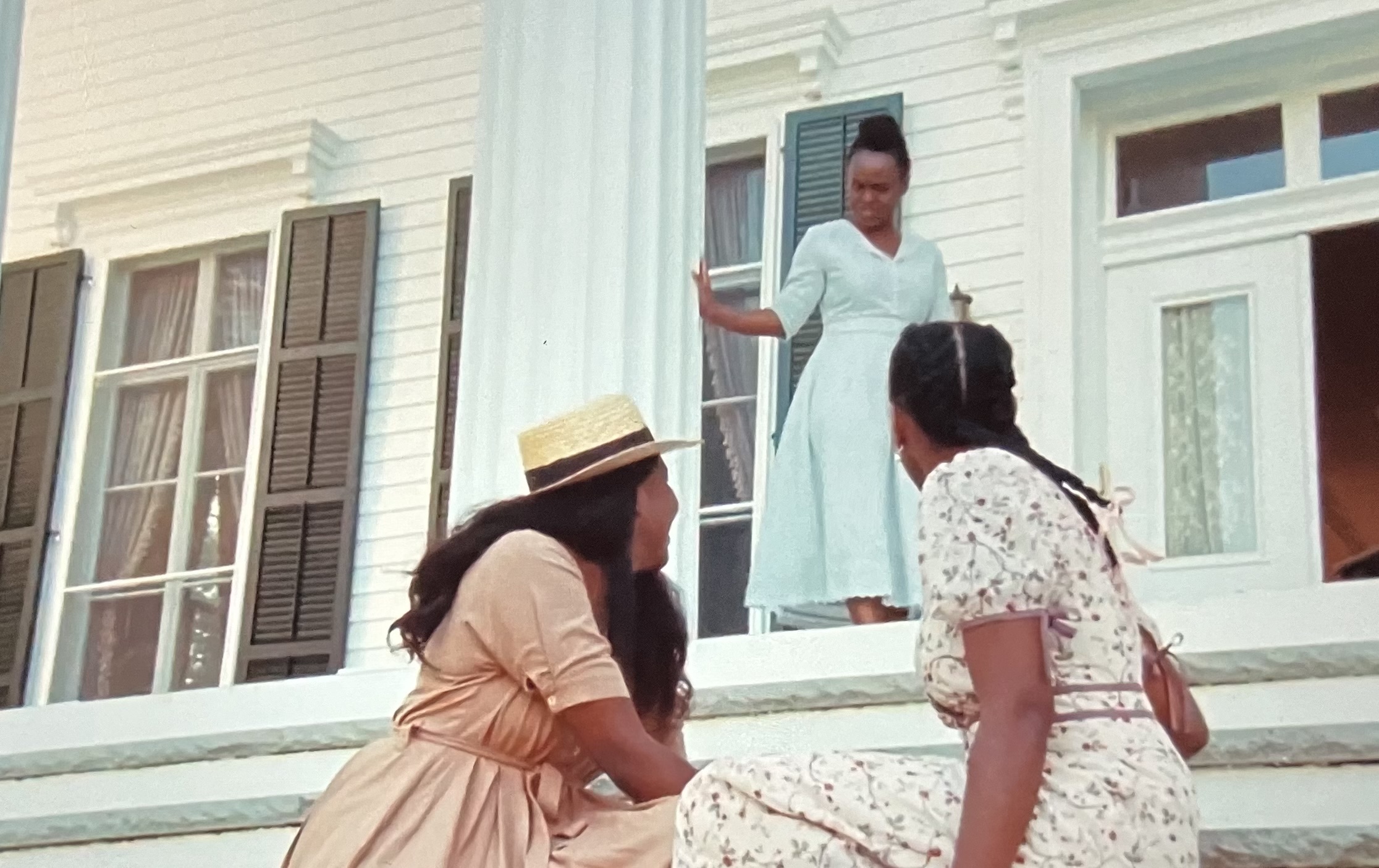
Louise (Alexis Cofield) stands on the porch, smiling down on Grace (Jordan Wells) and her sister (Mikayla Lashae Bartholomew). DP: Tehillah De Castro.

Among the pastel colored walls and the elegant white curtains parted on large, charming windows, Grace feels the pressure to be good, to follow Big Mama’s respectable example. Inside the American Gothic styled house, intentional cross patterns are repeated cues upholding the Bible structure. Although no men occupy this makeshift Black feminine utopia, an ominous presence operates as a patriarchal beacon, the judgment ensuring that all young girls must eventually submit to their duties as wives, to suppress any other “unlawful” inklings. 

Moreover, Grace’s baptism will bring the ultimate test. 

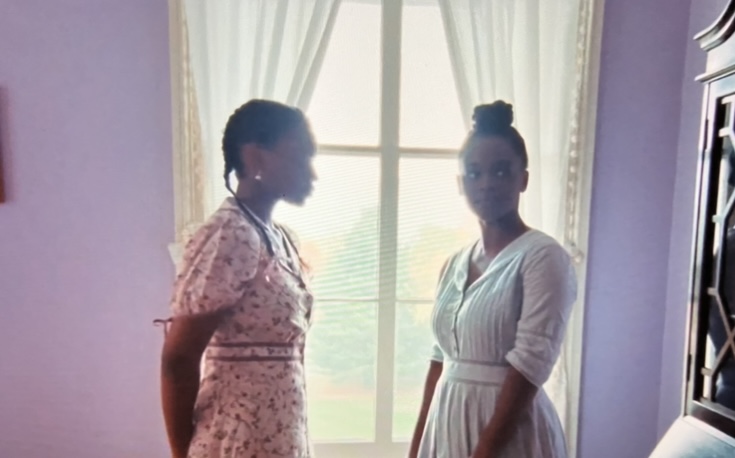
Grace and Louise strike a cord. DP: Tehillah De Castro. 

In the trajectory of Juliana Kasumu’s Losing Joy, Allie Morgan’s Sisters, Mz Roth’s code switch, Harris’s Pure, and many other Black sapphic films eloquently helmed by Black filmmakers, Grace sheds profound light on soft queer films highlighting multifaceted experiences. These brave creators are not rehashing the same, copy/paste narratives that we’re accustomed to seeing in regards to how Black women, girls, and femmes are portrayed. 

By centralizing blackness through an authentic lens, the characters must battle the fights (both internal and external) that come with the global impact of the dominant heterosexual landscape. These are the directors that deserve to invent original stories and adapt the inherent literature (Alice Walker, Toni Morrison, Maya Angelou, Gloria Gaynor, Paule Marshall…) for us to devour, to engage. Since their films asks and answers questions long raised in Black community, they need our support the most. 

The most metaphorical shot in the film. DP: Tehillah De Castro.

A straightened haired Grace rejects Louise. DP: Tehillah De Castro.

After premiering earlier this year at the Sundance Film Festival, Grace has been shown around various other film festivals such as Inside Out Toronto, Newfest Pride, and the upcoming Frameline and BlackStar Film Festival. Grace —a word meaning simple elegance— is a must see for embracing its definition beyond the leading character. Every element (small or large) enriches the layered, impactful narrative: tightly knitted frames containing vital symmetries and subtle performances by a talented cast led by its director, some period costumes (which Harris designed) call to mind Julie Dash’s Daughters of the Dust— the white dresses nodding to the film’s costume designer Arline Burks Gant, and the house right down to the object placements, an appropriate foundation for stern religious order. 

Overall, Grace is cinematic magic without spells being cast onscreen. While the visual feast thoughtfully conveys a Black girl grappling with her awakened identity, its story teaches the notion that being true to oneself is more so a blessing than a sin to be cleansed away. 


Monday, February 14, 2022

Favorite Black Loves In Cinema


Cane River’s Peter (Richard Romain) and Maria (Tommye Myrick).  

Happy Valentine’s (or Single Awareness Day) to those who celebrate all kinds of love, romance, and self-care joy. 

In the Black cinematic world, there is still movement to be made in ways of a well-crafted story, compelling cinematography, and fine acting. Some films have one or two of the ingredients; barely all three to make the recipe complete. When it comes to heteronormative Black love, putting on the classic Love Jones or Jason’s Lyric (which both feature the incredible Lisa Nicole Carson) sparks up the mood whereas the out of the vault Cane River is a marvel to behold. Even the startlingly passionate Ganja & Hess must be recommended for its daring portrayal of Black vampiric lust despite the unhappy ending for the pair. 

Black LGBTQIA+ films such as Moonlight, Pariah, and Rafiki contain the queer violence that comes from sanctimonious communities that cannot accept such a love. Yet that is only for a moment that that ugly bandaid comes off and the healing slowly begins. Moonlight is exceptionally beautiful for showcasing the bonds between skinfolk and kinfolk, subtleties between love and longing, and the desire for men to be themselves alone and with each other. Pariah and Rafiki have these awestruck profoundly engaging periods of Black women love; joining hands in friendship and embarking on bliss no matter the consequences. Bessie, dee rees other film, highlights the musician’s bisexuality starring Queen Latifah who doesn’t need to don a fat suit. This Bessie role suits her and doesn’t end like her tragic Cleo in Set it Off. Overwhelmingly romantic short films tender and pure are charming gems that share a sweet intimacy with thought-provoking conversations and dancing between women. 

As for the asexual spectrum in film, we have a crucial journey ahead. Characters rarely seek happiness outside finding relationships. Although Alike ends on her burgeoning writing path, throughout Pariah, she has a great desire to explore her sexuality, hidden like a flaming shame from her parents. Selah in Selah and the Spades, however, is high on the adrenaline of power, allowing nothing not even the idea of idyllic teenage sex lure her away from her intense drive— a drive that has Paloma looking at Selah in moments of perpetual longing. On the darker side of asexuality, the rooted misogynoir historically depicted through the white lens. Writer Kira Sterrert brushes up on the mammy beginnings in filmdaze; addressing how Black women behind-the-scenes are finally creating their own corrected promotion:

“The more Black women that are writers, directors, and producers in Hollywood, the more they’ll bring narratives that depict positive and real depictions of Black life as a woman or femme. Black women are more than their bodies or their relation to white people, they are multi-hyphenate and multidimensional — pure magic.”

Here’s hoping for a cinematic future filled with all representations of love created that Black filmmakers create for Black cinephiles (and all other cinephiles) to appreciate in the years to come. 

Recommended Films About Black Love By Black Filmmakers 

Love Joneswritten and directed by Theodore Witcher, 1997. 

Pariahwritten and directed by dee rees, 2011.

Moonlight, written by Tarrell Alvin McCraney and Barry Jenkins and directed by Barry Jenkins, 2016.

Ganja & Hess, written by Bill Gunn and directed by Bill Gunn and Lawrence Jordan, 1973. 

Really Love, written by Felicia Pride and Angel Kristi Williams and directed by Angel Kristi Williams, 2020. 

Rafiki, written and directed by Wanuri Kahiu, 2019. 

The Weekend, written and directed by Stella Meghie, 2018.  

Heaven Reaches Down to Earth, written by Tebogo Malebogo and Petrus van Staden and directed by Tebogo Malebogo.

pure, written and directed by Natalie Jasmine Harris, 2021. 

tender, written and directed by Felicia Pride, 2020. 

Cane River, written and directed by Horace Jenkins, 1982, remastered and released 2018. 

Selah and the Spades, written and directed by Tayarisha Poe, 2019.

Jason’s Lyric, written by Bobby Smith Jr. and directed by Doug McHenry, 1994.  

Middle of Nowhere, written and directed by Ava DuVernay, 2012.  

Bessie, written and directed by dee rees, 2015. 

Boxing Day, written and directed by Aml Ameen, 2021.  

How Stella Got Her Groove Back, written by Terry McMillan and Ronald Bass and directed by Kevin Rodney Sullivan, 1998. 


Sunday, October 10, 2021

Queerly Beautiful “Pure” Disrupts Black Cotillion Tradition


Pure film poster.

The Black cotillion aesthetic is gaining explorative steam in various art forms: Jacqueline Woodson’s Red At the Bone novel employs past and present weaved with the events of the Oklahoma massacre during Melody’s introduction to Black societal perfection. The California African American Museum’s recent exhibition Rights and Rituals: The Making of African American Debutante Culture discusses the history behind ensuring that young Black girls were not torn between mammy and Jezebel stereotypes. Yet armed with a fresh faced cast and Khalea Ross Robinson’s picturesque cinematography, writer/director Natalie Jasmine Harris’s exceptional debut Pure daringly shifts a straight arrow legacy into the postmodern queer territory era, letting its main character—a gorgeous dark skinned Black girl named Celeste— own her destiny in this exceptionally brave short film. 


Amir (Jacob Daniel Smith) and Celeste (Mikayla Lashae Bartholomew) know how to have fun striking a pose. 

In the practice dance, quiet, intelligent Celeste (excellently portrayed by newcomer Mikayla Lashae Bartholomew) is escorted by Amir (Jacob Daniel Smith), her best friend. While all the girls embrace their purposely razor straightened hair, she seems to be the one who secretly wants her ancestor’s dreams preferred. Septum pierced Amir turns out to be of the LGBTQIA+ variety— i.e. kindly similar to Melody’s best friend Malcolm in Red At The Bone— and Celeste too has one leg dangling out the closet, questioning the plight of budding, hormonal desires that overshadow the piety that debutantes must possess. Although not the typical social butterfly, a slight shyness shrouds Celeste like a warm coat. She is invited to a house party by Joy (a fellow debutante played by Josca Moore) and attends with Amir, her eyelids popping with the magical glitter that rivals a lightning bug’s iridescence. 

Debutante Jamia Glenn being escorted through a gilded oval frame at the Pasadena Alumni Chapter of Delta Sigma Theta Sorority in the Golden State Room at the Statler Hilton Hotel, Los Angeles, May 1964, reproduction of a Harry Adams photographic print. 

African American woman, head and shoulders portrait, ca. 1899-1900, reproduction of a silver gelatin print, courtesy of Library of Congress, Prints and Photographs Division. 

Rights and Rituals: The Making of African American Debutante Culture layout and space.

Ethel Thomas designed the cotillion dress worn by Anne Bradford Luke, fall 1952, courtesy of Anne Bradford Luke. Estelle Williams designed Deborah Beavers-Watford, 1967, courtesy of Deborah Beavers-Watford. A cotillion dress worn by and courtesy of Denise Burnett, 2019. 

Couples dance at the Los Angeles Links Ball, November 1964, reproduction of a Harry Adams  photographic print. 

While Rights and Rituals: The Making of African American Debutante Culture nods to the pioneers Fannie Barrier Williams (co-founder of the National Association of Colored Women NACW) and W. E. B. DuBois— earlier advocates for Black women who are unfairly discriminated and educationally behind the rest. The pictures, the videos, and the audio disclose the classic debutante tradition— the perfect postured Black girl wearing gorgeous white ball gowns and long satin gloves, straightened hair, the father/daughter dance, the male chaperones— the young girls only dance with men, fathers or father figures and young men who may be potential husbands. The exhibition reveals the Cinderella story that grooms girls for lives sequestered in grace and piety, positioning high enough in society, maintaining a certain sophisticated air.

Well, this is 2021. Young Black girls don’t have to follow these stern rules anymore.

Twice Celeste dances with Joy. The first dance is outside the strict, stuffy ballroom, at Joy’s house party with charged, pulsing energy from both the pumping music and Celeste’s uncertainty. Plus, this less judgmental audience presents no real fear, no hesitance to just be. Yet Celeste’s uncertainty must be riddled in debutante conviction, the need to please an invisible someone, an invisible moral code. After the intense moment of Joy sensually pressing Celeste, each provocative movement slow and teasing, the undeniable heat between them leads to an authentic, consensually shared pleasure— their first kiss a secret to the audience. In that incredible, jaw-dropping second dance, the one where Celeste leads and Joy follows right in front of critical eyes. They all seem to fade away, any enraged anger, any shocking disappointment, goes to dust. There is no “don’t do this here” or the running from truth. Celeste and Joy dance together freely, smiling and laughing, fondly choosing each other, breaking an old historical notion. 

Celeste (Mikayla Lashae Bartholomew) is ready for her closeup. 

Pure is an eloquent reminder that Black women are the greatest masters of telling narratives about Black women experiences— that they are the best fits to telling humanistic stories that fulfill a specific need in the films being made today. In its compelling honesty, Celeste has that same strength similar to Kai, the dance hopeful in Miss Juneteenth, who wants to break out of family tradition and individualize herself from family duty or Selah from Selah and the Spades who would do anything to win or Summer from Jinn who fights under the wings of religion. Celeste is a phenomenal part of this enriched movement, a championing movement that allows Black girls to value their power, to be a voice of reason to themselves and the others around them. Uniquely still, Celeste is the bold, self-assured Black girl who confidently wears a gay pride t-shirt, rides her bike in a cotillion ball gown, and asks her lover to dance.

Celeste joins a range of intriguing Black girls in film: Jinn’s Summer and Miss Juneteenth’s Kai (top), Pariah’s Alike and Selah and the Spades’ Selah (middle), Pure’s Celeste and Rafiki’s Ziki and Kena (bottom).

Behind Dee Rees and Wanuri Kahiu, Natalie Jasmine Harris also has a key queer story worth sharing in the Black women loving Black women rarity. 

In Pariah—the recently added Criterion Collection gem celebrating its ten year anniversary— and the critically acclaimed Kenyan Rafiki, there is a special fire in seeing queer Black women stand up for themselves, make clear that they are not heteronormative in the face of strict, sanctimonious principles and community validation. The most wonderful thing about Pure is that the short doesn’t employ the violence that happens to the Black woman for expressing her sexuality and the hope rests fully in the recently announced full-length version. Another hope is that the stars are able to return— Mikayla Lashae Bartholomew is an utterly charming star force on screen and her charismatic chemistry with humorously engaging Jacob Daniel Smith and the sharp Josca Moore make the film pleasingly believable. The dying Hollywood industry needs fresh, bold faces and exciting new stories in this remake era. Black women desperately crave seeing themselves tenderly depicted, leading rich, layered inclusive cinema especially in terms of identity— monoracial identity has been severely lacking.

Joy (Josca Moore) makes her interest in Celeste (Mikayla Lashae Bartholomew) quite clear on the darkly lit dance floor. 

Pure, a soft, gentle promise of an evolving Black queer film future, is told brilliantly by Harris, the DGA prize winner for Best East Coast African American Student Filmmaker. A burgeoning filmmaker slowly rising on the scene having also won the 2021 Gotham Projects Lab and the 2021 Outfest Screenwriting Lab, Harris is definitely the one to watch. She has a few other treats up her producing sleeve— for starters the first Black queer short for filmmaker Terrance Hayes called “Pritty: The Animation.” Thus, we should all look forward to anything with her name attached.

Celeste (Mikayla Lashae Bartholomew) riding her bike in full debutante attire. 

The lovely, poignant Pure is currently playing alongside some other incredible shorts at the Neon Movies in Dayton, Ohio in the Top Shorts program on October 11, 2021, 7:30pm and has other upcoming live/virtual dates all over the globe here.