Showing posts with label Black Woman Lead. Show all posts

Saturday, July 4, 2026

“Is God Is’ Effectively Traces The Subtle Passages Of Pattern Male Violence


Is God Is film poster. 

Is God Is masterfully unpacks the narrative on societal protection of all male rage degrees and the women whose bloodthirsty desires to break that cycle with their own kind of violence. If the system refuses to give justice to victims, why not take action? 

Racine (Kara Young) and Anaia (Mallori Johnson) are sisters who hold on to each other tightly, delicately. DP: Alexander Dynan.

Ostracized twin daughters Racine and Anaia survive a gruesome fire as little Black girls, living as scarred adults together in a society that would already disrespect and demonize them sans the scars. Passive and quiet Anaia accepts any form of love that comes her way, preferring to a wallflower’s background, hiding her disfigured face in shadows. Volatile Racine’s a fighter through and through, smothering a simmered testiness that boils and boils. Despite varying personalities, these two sisters have a deep, intimate bond, a pulsing heartbeat that echoes scene to scene. Even during disagreements, their undeniable love for each other remains true.  

Racine and Anaia are employed as janitors, the low tiered, bottom feeding pole job operating in the nocturnal hours, cleaning around cubicles when the higher paid staff are away, usually never to see them. 

Jody (Vivica A. Fox) aka “God” asks a favor to ask her daughters. DP: Alexander Dynan.

Racine and Anaia’s mama Jody summons them at a crucial time. The unemployed sisters take a road trip— Racine excited and Anaia reluctant— and arrive in matching old-fashioned floral dresses, a girlish look that seems an opposition of who Racine is at her core and what Anaia wishes to be yet was robbed of. They’re in for a shock at the state of dying Jody, their “dying God.” She is propped up on a bed, face bandaged, brutally burnt flesh buried beneath a simple cover. The in and out pumping ventilator breathes for her, the attending nurses collective “ooo chile” sighs and tapping nails paint this specific Black authenticity as Jody reveals to Racine and Anaia what their devilish father did to them. 

Now Jody’s testimony spins a shockingly familiar story, a smooth, real charmer of a man who knew how to be a romantic sweet talker. Even with a restraining order against him, he manages to enter Jody’s tidy home, play at tender lover before putting his violent hands upon the woman who dares reject the kindness he has worked so hard to manufacture. We hear about this everyday. An ex lover, a husband, a boyfriend, an obsessive in-law, men at bars, gas stations, everywhere killing women for ending things or for saying no. A woman believing a flimsy piece of paper could keep her safe discovers that it cannot. The strangulation in the bathroom, purposefully bringing the girls into the bathtub, lighting that fatal match, walking away and whistling as the girls all scream with their mama— chilling and surreal. A deviant act of trying to annihilate his own family.

“Make your daddy dead,” Jody says as though her favor means getting the sugar she’s forgotten at the grocery store. 

Of course, Racine and Anaia debate over the task, Racine a bit perplexed and Anaia outright disgusted, the “no” in her eyes. Eventually, Racine warms up to the idea. Anaia needs more convincing. 

Divine (Erika Alexander) stands by a man who has long since abandoned her and their child. DP: Alexander Dynan.

The first stop on the revenge road trip is Divine, their father’s religious ex-girlfriend who doesn’t seem to know she’s an ex-girlfriend. Divine has converted her home into a church, a toxic place otherwise known for implementing manipulation tactics such as forced forgiveness and strategic Bible thumping, poisoned trappings that encourages people to stay with their abusers labeling it “God’s will.” Divine speaks in holier than thou sermons, in volcanic rhymes and rhythms that are more laughable than graceful. Divine’s son Ezekiel illustrates all the patterns of a pathetic mama’s boy, standing behind her, groveling and humming at her every word as though he’s a permanent backup singer. 

Racine and Anaia stay throughout these outrageous antics, soon astonished by Divine’s three strikes. First, she admits to supporting their father during Jody’s trial, believed him to be a genuine person capable of love, and still waits on his return— twenty years later! Talk about hard pills to digest in an introductory sitting from a ex stepmother. The church may lead people astray, turn the most burgeoning mind into ignorant mush, and this evidence bleeds into the next generation of spineless souls. False spirituality does not turn off a demented conditioning. Furthermore, did Divine’s brain stunt at the hands of their father? She has the mental capacity of a teenage girl. 

Having had enough, Racine successfully steals their father’s wallet out from the obnoxious time portal altar Divine has conceived of his belongings. The sisters flee, driving off to their next destination as Divine screams at them, hilarious and sad at the same time. 

Chuck (Mykelti Williamson) who originally thought Racine and Anaia were assassins, tries to convince them to stay off the beaten path. DP: Alexander Dynan.

Racine and Anaia next visit Chuck Hall, the lawyer who foolishly represented their father. While a fixated Divine believes that he will return someday, a tongueless Chuck suffers predicts that their father will come back to murder him. Chuck sees what Jody sees— an evil monster. Yes, it was colossally wrong to get paid to destroy Jody’s family life—lawyers represent horrific offenders all the time— and Chuck deals with the consequences in his own way. Instead of obtaining therapy to help medicate his obvious psychological distress, Chuck prefers violence initiated onto him. Perhaps, ever since the father thrusts Chuck’s head upon that steering wheel, it unleashed a sickly desire to feel the taste of blood between his teeth again. Apparently, according to scientific matters, pain and pleasure operates on similar stimuli. 

Still, Racine and Anaia look uncomfortable around this silent man who scrawls messages on a whiteboard. Chuck appeals to their sanity in hopes of saving them, already noting that Racine holds the same maddening expression as her father, a bloodthirsty hunger that would inject fear way before she lays hands on anyone. Out of the male characters in the film, Chuck appears the most regretful, the most sincere in a world of untrustworthy men. Yet, would Chuck be this person if he hadn’t been attacked by his own client? Would he have advised the girls if his tongue stayed intact? 

Racine and Anaia leave Chuck’s with an address, a bit more disturbed on the numbers their father performed on these complicated individuals, leaving behind a thread of red flags. Divine and Chuck stay trapped in differing disillusionment states, not realizing that they’ve already served a purpose like Jody, Racine, and Anaia. 

Racine and Anaia come closer to their destination until a masked motorcyclist destroys the sisters’ car. The motorcyclist chases them around, this very presence promising only violence. The revelation behind the helmet sends a crystal clear message, “blindly shield the male ego by any means necessary” even if it is a problematic figure they’ll never ever meet. 

The many facets of Angie (Janelle Monàe)— wife, mother, survivor, victim blamer, victim. DP: Alexander Dynan.

Angie, the fed up wife, dutifully plans a secret escape from her pristine glass house— the cleverer maneuver to leave behind monstrous humans. The timing could not be any more perfect. Angie’s spoiled twin sons, Scotch, the active aggressor and Riley, the quiet introvert are turning eighteen. Her money has been stacked. A new job and identity wait for her elsewhere. She understands that filing for divorce from such a husband is simply not possible. Yet, her facade has its noticeable cracks. Maybe she played a particular role for the husband not knowing what terrors he had in store. She’s doesn’t exude warm and nurturing vibes to Scotch. Despite an abrasive softness towards Riley, Angie isn’t mournful to him either. She’s not tossing any sentimental glances to her sons, her eyes are not filled with tears. In fact, she’s all hurry and rush, sentencing the whole house and its occupants to guilty. She no longer feels obligated to stay in a nightmare. 

Fresh from the Greyhound bus, however, Racine and Anaia await Angie on the road, halting the plan. Throughout the messy confrontation, Angie makes a mistake in boasting that her calculated scheme is leagues above Jody’s restraining order. Honestly, both women were correct to take precautionary steps. Jody thought the law would keep her and her daughters safe (which they should have) and Angie thinks a fresh restart will be her rescue. Angie keeps pushing the wrong buttons, her high and mighty persona bristling through icy words that fire up Racine’s anticipatory anger. If only she understood the girls terrible upbringing post-fire, if only she related to Jody a bit more… Angie’s privileges shines bright in the faces of poor, scarred girls. Racine and Anaia could have benefitted from the riches, accessing a stronger educational foundation, wielding better jobs, flawless skin, achieving dreams beyond the station that disfigurement pigeonholed them in. Yet, Angie, housing no genuine compassion for their plight, wants what’s best for herself. And the girls do not like that. 

In the middle of the plot’s near final stage, Racine (or Jody) cannot hold an imperative discussion regarding Anaia’s pregnancy reveal— finances, hospital bills, daycare, postpartum health, and other preparations. This unplanned, life-altering event adds more weight to Anaia’s tragic narrative, accepting conditions in an eagerness for love in any form even if it offers another shard to her fragile psyche. She is not thinking about the perplexing notion of single Black motherhood, the underlying conditions beneath the embedded madness within her problematic extended family. Motherhood is not akin to a sweet fairy tale ending on a chaste Disney kiss. We learn the hard, brutal way that most men expect more than a kiss to be happy. Anaia was practically sleeping with her enemy, a lustful man who couldn’t tolerate looking at her face. Boring a child sans a job and a supportive circle only leads to more eventual trauma, not something to be romanticized or celebrated. Black women lead in high fatality rates. Anaia’s baby sticks a poorly constructed band aid on a wound that’ll continue to keep bleeding. 

Riley (Justen Ross) and Scotch (Xavier Mills) believe their father has sent Racine and Anaia (unbeknownst to them their half sisters) to strip for them as an early birthday gift. DP: Alexander Dynan.

Racine and Anaia reach the last stage of the road trip, dedicating themselves to infiltrating the testosterone packed home, doing as their “God” asks. Racine preys on Scotch’s lust while naive Anaia confides in Riley, a boy who seems more like her than the twin who shared a womb. Back to back violent symmetries temporarily pin the sisters against each other, an unfortunate encompass right before their evil father returns. Scotch embodies their father. Riley’s perceived dormant side explodes out of the grief. Again, Anaia fails another test, her trusting personality fast becoming a liability. The battle between Anaia, Racine, and their father completes the God’s desire, the girls’ expressions wildly transforming hit after hit as though possessed by another entity. Were they no different than their brothers, Ezekiel, Scotch, and Riley? Their father?  

The end is of a great burning metaphor, a startling reminder of Racine and Anaia’s whole path to destruction began by their father’s fateful match.  

Overall, Is God Is received great positive reviews including a ninety-seven percent score on Rotten Tomatoes, having potential to be a box office smash or at least a sleeper hit. Original Black women led films helmed by Black women filmmakers rarely receive universal audience support. If there’s no built in expectations due to this sequel/prequel/remake/biopic culture and no huge big name attached, the odds are already stacked against it. The word of mouth backlash spreading from reactionary Black male filmgoers didn’t help either, much preferring to advocate for positive images of themselves, narratives controlled by their favored patriarchal gaze directors. The topic of Black Femicide has become a daily occurrence yet most Black men collectively speak out and/or make profane jokes against murdered Black women who have nonblack partners. They will scream “choose better” as though men won’t put on “nice guy” acts for years and years in order to retrieve certain benefits. 

Is God Is held up a mirror to their faces. That triggered glass reflects their fathers, grandfathers, brothers, uncles, best friends, barbers, and maybe themselves. to see ingrained behavior that a little therapy could have tried healing. Globally, the world puts a mask over such violence, especially if the offender is rich and affluent. People fight under comments on posts defending complete strangers, watch, listen, and read a known abuser’s work and proudly wear their face on t-shirts and buttons— demonstrating how far complacency goes, an easy acceptance of “genius” over individual harm. Divine and Angie clearly believed in the father’s changed behavior, bought into him being worthy of their love, and finding out that the costume falls off. 

The father (Sterling K. Brown) represents the pattern Black male violence that we cannot hide from. DP: Alexander Dynan.

Aleshea Harris wrote and directed the heck out of Is God Is, based on her award-winning play with Moses Sumney crafting a thought-provoking score. The film also contains one of the most engaging ensembles ever cast in a feature-length film. Everyone understood their assigned role perfectly and breathed authentic life into respective characters. Kara Young (double Tony winning actress in Mariama Diallo’s Hair Wolf and a small memorable part in Diallo’s first feature-length film Master) and Mallori Johnson (the best part of short-lived Kindred) lead with raw, extraordinary performances. Vivica A. Fox, Erika Alexander, and Janelle Monaé play incredible stepping stones into the man’s journey towards destruction. Sterling K. Brown is incredibly impressive as a vicious antagonist— the whistling, the smiling, even down to way he walked exhibited terror. Josiah Cross (brilliant in A Thousand and One), Xavier Mills, and Justen Ross performed their parts exceedingly well, echoing exactly the ranges of anger inhabiting young Black men. Mykelki Williamson’s Chuck was another phenomenal highlight, playing a character who had no voice, relying on body language and facial expression skills. 

Anaia and Racine apply each other’s makeup before parading around their own half brothers. DP: Alexander Dynan.

The limited run of the brave, heartbreaking Is God Is was well worth watching twice in the theater, strikingly poignant and deep on both encounters. This remarkable film stitches together intense thriller with a unique love story between sisters, heavy, relatable drama that dissects generational trauma at its crux. The harmful seeds implanted in the male mind continues to be coddled and protected with women always paying the ultimate price for risking their hearts. 


Saturday, October 28, 2023

‘Our Father, The Devil,’ Teaches Of Untold Hells On Earth

Our Father, The Devil film poster.

Our Father, The Devil simmers a slow burning masquerade that loosens its secrets seam by seam, ultimately revealing two people attempting separate paths of redemption. Yet, questions arise between the parallel twists and shocking turns. Can a person truly be redeemed after committing heinously evil acts many years ago? How much are they willing to risk in order to achieve a clean slate? And is an apology ever enough to begin the process of forgiveness? 

Marie (Babetida Sadjo) is a lovely dark-skinned chef donning a septum piercing, epic lip stick shades, and banged box braids. She’s rootable from the start. DP: Tinx Chan.

The film opens on beautiful, elusive Marie Cissé having a solitary drink. She represents the idyllic dream— a quiet existence in the French mountainside, respect from Sabine, her boss as a talented head chef for a nursing facility, and the keys to a befitting kingdom via Jeanne, a dear, supportive mentor. Marie has a whiny friend in fellow co-worker Nadia. In the sweet secluded cabin in the woods, high above a cliff and majestic scenery (an important heirloom in Jeanne’s family), Marie enjoys the solitude and tells no one about it. However, Marie’s resplendent bliss becomes threatened by the sudden appearance of Father Patrick, a charming priest who has swept the entire staff and residents under his religious thumb. Every move he makes—from his walk to the way he carries a spoon— triggers Marie. 

Furthermore, Marie, the African immigrant, has grown accustomed to French colonialism. Her body already seems to belong to the surrounding whiteness. A co-worker undermines Marie’s cooking, Sabine refuses to give much needed vacation, and a persistent bartender aims to seduce. Whereas Nadia believes Marie just needs a man, Jeanne respects Marie’s potential and rich, delicious cooking. At the same time, Jeanne encourages Father Patrick’s influence unknowing that the enigmatic man stirs discomfort. Marie’s desperation for temporary escape grows and grows until she decides to do something unexpected about it. 

All the prayer and time in the world cannot change a victim’s inherent trauma, Father Patrick (Souleymane Sy Savane). DP: Tinx Chan.

The narrative shifts towards the former mouse, the former soldier snatching back her power from the once horrendous cat. The metaphor weighs heavy here. Father Patrick believes his past can be buried beneath sacred black and white cloth. In glaring reality, Marie, sees the monster that forever scarred her. Trauma— the reason for Marie’s closed off personality, her steel guardedness— impacts her newfound motivation. After what has been done to her as an innocent child, how could she trust a single soul? How could she give this man an ounce of remorse? And can she heal with the blood stains permanently imprinted on her mind? 

The gifted cabin symbolizes another form of pleasure, albeit sadistic—  a place to enact revenge where no one can discover them, let alone suspect foul play. Father Patrick’s pleading tries to convince and tug on Marie’s vulnerable nature, for a moment seeming quite believable. The terrible fact about surviving trauma is that certain elements remain burned in the brain. They may be far from whence they hailed. Time may have passed. Marie may have carved herself a healthier situation.

But she was not going to forget what was done to her or her family. 

Our Father, The Devil is brilliant from its effective title to the fiery direction and story, a feature length debut by Ellie Foumbi, also an actress starring in early Nikyatu Jusu shorts, Suicide By Sunlight and Say Grace Before Drowning and Abbesi Akhemie’s The Couple Next Door. Nominated for Best First Feature at this year’s Independent Spirit Awards and Best Film at the Africa Academy Awards, Foumbi’s strong, vital voice deserves a seat at the Directors To Watch table. Someone needs to put out a bulletin, alert the media radar. Her fresh, bold narrative delivers far better material than most films wallowing in the same rehashed storylines with the same overpaid actors. 

To feel or not to feel remorse for your prisoner— and rightfully so, Marie does not give a chuck for a while. DP: Tinx Chan.

The cast is also excellent, especially the dynamic Babetida Sadjo as Marie, a woman confronted by an ugly past that could potentially mar her brightening future. Souleymane Sy Savane as Father Patrick rendered a character reinventing himself as a close ally to sainthood. In one moving scene, a tear glides down his eye and for a split second, a hardened Marie could have almost succumbed as easily as the community she partly distances herself from. Sadjo and Sy Savane play off each other beautifully— raw, harsh, and severe. Brilliant acting masterclass work with Tinx Chan’s intense cinematography pushing Foumbi’s emotional story forward.

Overall, Our Father, The Devil sends guttural shivers through the heart and mind. It’s thrilling, mysterious, sensuous, and difficult, but leaves an unforgettable impression.


Tuesday, May 9, 2023

‘Nightwatcher,’ Greatest Vulnerabilities Reveal A Black Girl’s Greatest Weapon


Leila (Arséma Thomas) has a very special gift. DP: Alexander Mejía.

Octavia Butler’s Kindred seems to arrive in the surprising form of Amira Hasib’s 2018 short film, Nightwatcher. Newcomer Arséma Thomas (who portrays Queen Charlotte’s young Lady Agatha Danbury) stars as Leila, a Black woman with the phenomenal ability to leave situations that frighten her. However, unlike Dana whose shifts from past and present occur the moment she moves into a new home, Leila appears to have had the adapted the skill since childhood— and it happens a whenever she needs saving. 

A passive Leila (Rylee King) quietly takes the abuse. DP: Alexander Mejía.

In the schoolroom, Leila endures cruel teasing from two giggling girls and a teacher who does little to reprimand the bullies. Leila’s friend and classmate Lance tells Leila to ignore them— an early instruction to be complacent, to simply say or do nothing. A conditioned Leila must be on her best behavior even when all around her is civil disobedience and undermined chaos. She internalizes her frustration, her agony, and her despair. To stand up for herself against her attackers (the innocent white girls) potentially categorizes Leila as disrespectful, wild, and unruly. 

“Please just ignore them,” Lance (Destin Hopkins) repeats. DP: Alexander Mejía.

Lance cannot protect Leila either. The collateral damage thrown his way means a more severe punishment for him and a cry out for feminism (and it’s problematic lack of intersections). Despite Lance’s soft and tender nature, if he blasted the two girls, they would paint him as a violent catalyst— an instigator. 

Thus, in these few minutes alone, only two kids are allowed a carefree existence (under the disguise of prejudice) while Leila and Lance withhold any disciplinary reaction. Once class is dismissed, Leila runs out into the bathroom and the two bullies give chase with a concerned Lance hot on the trail. As the torturers play an even naughtier game, daringly raising scissors near the bubblegum they’ve stuck into Leila’s hair, Leila suddenly vanishes into thin air. 

An unsmiling Leila takes a look at her reflection. DP: Alexander Mejía.

Leila stretches her hair against her cheek. DP: Alexander Mejía.

The mirror repeatedly reinforces an acknowledgment.  

Leila is beautiful, lovely, precious.  

The colonized globe wants everyone to hate their reflections and mimic all things European. It takes time for a persuaded mindset to relearn history; to prioritize self over prevalent media representation. Often, the first people that harm us are not the pictures on television or in books— it’s our peers in the classroom. Leila’s crushing experiences are eerily similar to endless Black girls. This still exists today and will exist tomorrow. 

Older Leila (Arséma Thomas) is pleased with her appearance— straight haired bob and impeccable makeup. DP: Alexander Mejía.

At a mundane party, an adult Leila practices her powers in the mirror; hoping to return home. The disappearance act only works in genuinely frightening situations— not as an operative excuse to flee boring life events. That small isolated moment grants a taste of Leila’s carefree spirit. Perhaps she has been practicing for years, testing out her powers for other possibilities. Still, she deserves inside joking as a coping mechanism in light of her supernatural abilities relying on pure vulnerability, on being extremely scared. 

Meanwhile, Leila surrounds herself with good friends Lance and Kailey. Instead of hanging out at Leila’s place, however, Kailey has other plans: a man who can afford an expensive Uber XL to pick her up from random parties. 

Leila and Michelle (Sydney Thomas) hide out in a dull party’s bathroom. DP: Alexander Mejía

Older Lance (Jashawn Richardson), Michelle (Sydney Thomas), and Leila (Arséma Thomas) leave out the party. DP: Alexander Mejía.

Once Kailey’s ride comes and she ditches her friends for a boyfriend rendezvous, Leila and Lance walk alone in the night together. If only the generous boyfriend had paid for Leila and Lance to get home too— even though, yes, that’s a tough ask in this society, in this economy.

Leila and Lance are stopped before heading home. DP: Alexander Mejía. 

The man berates them and acts like a cop. DP: Alexander Mejía.

Unfortunately, Leila and Lance are immediately pursued. The white male stranger tells a story of a nearby robbed liquor store, believing they fit the description. He does not allow them to leave. The situation escalates, the man impermissibly searching and pushing Lance on the ground. The man— conditionally convinced of guilt and wrongdoing— does not buy their stories or that their IDs are genuine. A horrified Leila moves her body, seeming prepared to launch an attack of her own. Instead, Leila grabs hold; causing both she and Lance to disappear together. 

Leila pulls off her wig and breathes. Maybe she remembers wanting to flee the party earlier. Lance probably would not have made it home. DP: Alexander Mejía.

Lance is still shaken by the event. DP: Alexander Mejía.

Nightwatcher— found on Thomas’s Wikipedia page versus IMDb and Letterboxd— showcases the various racist encounters that Black people face every single day, no matter their age. People would write off girls putting gum in another’s hair as “something kids do,” write off bullying as though bullying does not impact emotional/psychological development in addition to Leila’s temporarily destroying physical presentation. Moreover, the harmful neighborhood watch, police, and “do-gooder” bystanders cause trauma.  

Pratt Institute alum writer/director Amira Hasib demonstrates tenacious skill in Nightwatcher— a piercing dedication to the many Black girls and women in the tragically ongoing Say Her Name movement. A story begins with ferocious laughter at a Black girl’s expense and ends on a Black woman’s tearful note echoes the daily struggle, that familiar sad rite of passage. Hasib candidly depicts Leila’s presence as one to be tolerated or extinguished. Yet, Leila’s bravery lies in the supernatural force ensuring that the latter does not become an option for her or Lance. She can be afraid, she can let fear overcome her senses, her entire being. Although Lance implies that Leila can save others, the question becomes could her consciousness bear the heavy burdens of trauma after trauma— hers and those that she rescues? Then, the lingering memories would perhaps overload her mind, destroy any remaining fragilities. She is human too. 

Hasib’s unique fifteen-minute narrative should have been a remarkable basis for that Kindred series— something that Mrs. Butler would applaud. Leila is the modern-day Dana— just a Black girl surviving and trying to thrive in a society that still reminds her and her friends that they will always be treated differently. 

Leila and Lance reflect on the rooftop. DP: Alexander Mejía.

The cast shines in their limited yet powerful screen time: Rylee King (who utters not a single word) and Arséma Thomas both portraying Leila at specific moments where they are made aware of the Black stigma; Destin Hopkins and Jashawn Richardson as two Lance’s, a little worried boy who encounters the most horrifying experience as a Black young adult male. The saturated colors, especially the pleasing pinks and purples of Alexander Mejía‘s commendable cinematography build up Leila’s complicated world. Plus, perfectly lit Black skin impresses every scene. 

The evocative, thought-provoking Nightwatcher inches between realistic drama and subdued science fiction; keeping in mind that Black people are rarely allowed an opportunity to be innocent in the eyes of those who do see color first and human last— if ever at all. 

Leila’s purpose is both a beautiful sentiment and a profound poem embodying authentic Black love. 


Saturday, February 25, 2023

A Tale of Two Teen Pregnancies


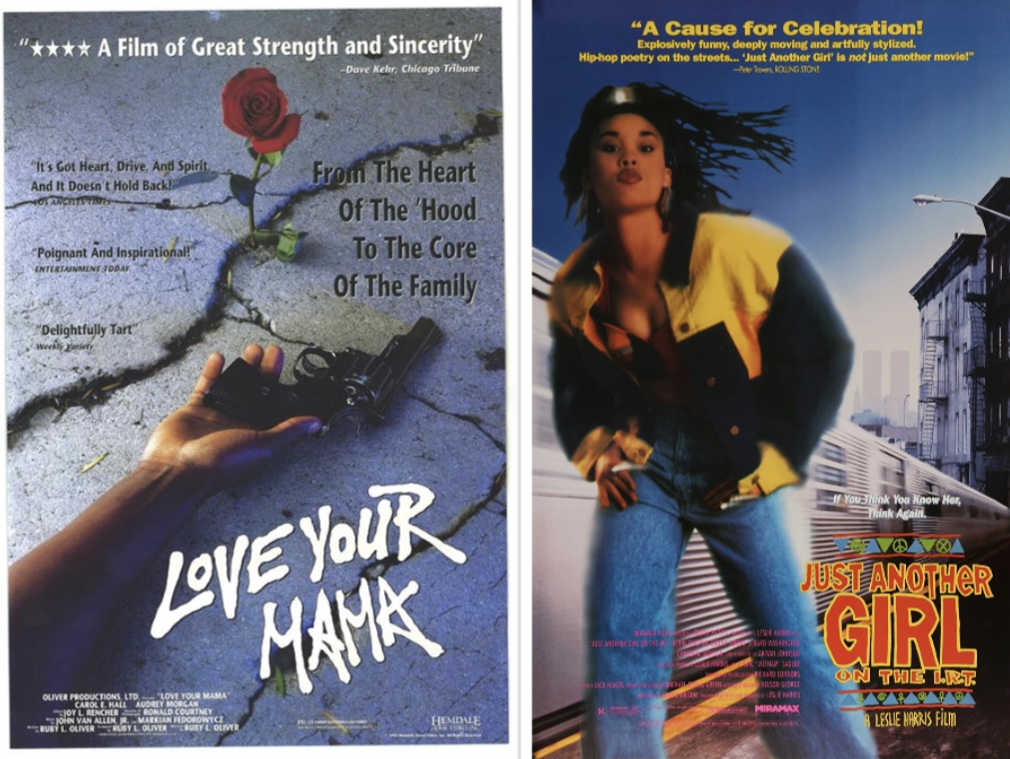
Love Your Mama and Just Another Girl on the I. R. T. film posters.

Duality may have been a major theme of A Tale of Two Cities by Charles Dickens. Yet, a specific duality runs a deliberate course through Ruby Oliver’s Love Your Mama (1989) and Leslie Harris’s Just Another Girl on the I. R. T. (1992)— two parallel Black teenagers facing pregnancy. This occurrence existed around prior in my own life— my grandmother giving birth to children since she was thirteen, two girls my senior year of high school balancing school and motherhood (one of them married her high school sweetheart). The stigma is unlike any other. At a vulnerable age where the slightest mar can harm an image, the frowned upon teenage pregnancy could make a girl’s life extra traumatic and beyond complicated. Not the boy/man, just her life seemed altered, in jeopardy. She believes the biggest danger is her parents’ finding out when the reality of attempting to hide a pregnancy can present the most dangerous affect on their still very young bodies and unprepared state of mind. 

Leola (Carol Hall) and her friend Barbara (Jacqueline Williams)—a single mother who repeats senior year in Love Your Mama. Barbara manages to get Zeke and the Boys to play for the senior dance. Leola has a massive crush on Zeek which leads to consequences. DP: Ronald Courtney.

Chantal (Ariyan Johnson) and Natete (Ebony Jerido) run into Denisha (Monet Dunham), a high school dropout at the subway in Just Another Girl on the I. R. T. DP: Richard Connors. 

On the yearbook staff and desperately praying for a loan to attend college, Leola is a smart, adept high schooler living in Southside Chicago’s projects hoping to open up a daycare. Often, she hangs out with Barbara—a girl repeating her senior year due to having a child of her own. 

On the other hand, fourth-wall-breaking Chantal is a bright, sassy teen with a potty mouth and fabulous fashion sense living in the Brooklyn projects, raising her siblings as her parents work most of the time. She aims to complete high school early and attend college to become a future doctor. Chantal and Natete are super close friends that also hang out with Denisha— a former classmate who dropped out due to pregnancy. 

Thus, Leola and Chantal bear witness to the difficult struggle of balancing educational pursuits and other personal betterment goals with early motherhood, limited support. There are no parties, no socializing, no late nights for Barbara and Denisha unless baby related. 

Some typical teenage sexual scenarios convince girls to make a boy feel better. Zeek (Norman Hoosier) suggests Leola (Carol Hall) temporarily remedy his grief. DP: Ronald Courtney.

Tye (Kevin Thigpen) demands sex from Chantal (Ariyan Johnson) because her behavior at the party implied promiscuity to him. DP: Richard Connors.

Leola’s mother struggles to make ends meet with four children and an alcoholic cheating husband that the whole neighborhood knows about. After the husband decides to quit his job, it affects the family and causes Leola’s mother to take drastic (illegal) action. Leola sees firsthand that certain men waste women’s youth, resilience, and courage, even squander a woman’s good nature just because he can. Her mother will never leave her husband, using religion as a key to staying in a detrimental situation. Thus, Leola remains focused on her goals to open a daycare even as her younger brothers decide to take on a criminal route to life, disappointing their mother in the process. 

Meanwhile, Chantal works at a corner store after school and returns home to babysit her younger brothers as her dad sleeps before his shift. Her mom and dad have alternating schedules— one works while the other rests. Yet, when is Chantal allowed to get true rest between school, employment, and babysitting her own siblings? Chantal and Natete sneak off to a party where Denisha has also joined them, getting her mother to babysit. Chantal ditches her date to dance with other people, gaining the attention of Tyrone nicknamed Tye. 

Leola’s mother (Audrey Morgan) instills constant wisdom in Leola (Carol Hall). She believes boys will not make it out, but girls can. DP: Ronald Courtney. 

Chantal’s mother barely has five minutes to look in Chantal’s direction, much less give her any sound advice. DP: Richard Connors.

Leola and Chantal’s introduction to sex almost mirrors each other in that they are both unromantic experiences sorely made by the urgent request of a male. Leola’s first time is a stolen moment caused by a vulnerable situation— being alone in a teenage boy’s room. As soon as the door is closed, Zeek puts down the telephone book (perhaps that had been his goal all along) and immediately situates himself into Leola’s personal space, reasserting his sadness over his grandmother’s passing. He doesn’t deliver any poetic sentiments or flowery gestures (despite being a musician) that suggest any genuine desire for Leola. He has centered only his own need. And Leola (maybe feeling her crush reciprocated) does not deny him, let alone recognizes the manipulative ploy. 

Tye seemed very kind at first— taking Chantal to nice restaurants, picking her up in his jeep. Yet, also alone in his bedroom, Tye turns completely enraged when Chantal refuses to sleep with him sans a condom. He exhibits toxic masculinity— an ignorant disbelief that somehow it is belittling to be asked (much similar behavior to those who do not like request for STD tests prior to). He deliberately brings up her behavior at the party, that of which drew him to her. Chantal then complies and the couple have numerous encounters afterward. 

Despite their riff, Barbara (who knows firsthand what it’s like as a single teen mother) offers to pay the balance for Leola’s abortion. DP: Ronald Courtney.

However, Leola cannot go through with the procedure. DP: Ronald Courtney.

Chantal takes several pregnancy tests— they all come to the same conclusion. Weeks later, Chantal lies to Natete about receiving her period, trying to buy herself time for the things she’s mentally unprepared for. DP: Richard Connors.

Chantal likely knows that her friendship with Natete cannot survive because pregnancy means the end of certain pasttimes. DP: Richard Connors.

Other than Tye, a counselor is the only one who knows about Chantal’s pregnancy. She would be their savior during the labor. DP: Richard Connors.

The male reaction to the pregnancies are not surprising. Zeek asks Leola to marry him even though he clearly does not love her. While Leola does not exactly love Zeek either, she did harbor an earlier crush on him. He never knew she existed— according to Barbara. Whereas when Chantal tells Tye, Tye blows up and claims that the baby must not be his fully knowing well that he was Chantal’s first lover. In Tye’s incomprehensible mind, it still goes back to Chantal’s behavior at the party, eluding her old boyfriend to dance with every guy. Tye equates dancing to being a tease, a maneater. In a follow up scene, he softens (only a tad) to convince Chantal to have an abortion. 

A calm Zeek softly tells Leola that they will get through it together. DP: Ronald Courtney.

An outraged Tye berates Chantal in various public places— the girl’s bathroom, the library, and the great outdoors— to make a decision. DP: Richard Connors. 

Fortunately, Leola does not have to face her pregnancy alone. Barbara financially supports her abortion, but in the fifth hour Leola changes her mind, the nurse comforting her about the hard choice. Her mother then takes it further, being quite kind despite the pregnancy not being what she had in mind for her daughter’s future. Leola ultimately drops out, fearing what others will say about her. Teen pregnancy shame exists and no one wants to walk that walk, especially Chantal. She refuses to tell Natete, keeping the pregnancy a secret. Tye has his uncle give him money for an abortion in New Jersey. Chantal blows it all alongside Natete at the mall, but ultimately steps away from the friendship, withholding her inner distraught about pregnancy. Isolated and melancholic, Chantal puts effort in maintaining a facade— buying the same clothes yet larger, buying pads, hiding her increasing weight in a girdle. So alone in this choice, time passes and passes, she doesn’t even know how far advanced the pregnancy is until going into labor.  

Leola and her daughter on the playground. DP: Ronald Courtney.

Leola and her mama after the opening of Leola’s daycare. DP: Ronald Courtney.

Chantal also gives birth to a girl— and at Tye’s apartment where conveniently his mom is not home. DP: Richard Connors. 

Chantal and Tye choose to co-parent in the end. She attends community college. DP: Richard Connors. 

Love Your Mama and Just Another Girl On the I. R. T. are low budget cinema rich in very intelligent narrative highlighting the cons of teenage pregnancy, especially the impact on Black girls— and its essential pros. The films could have served well as educational resources versus what was actually given: outdated videos on sexual how to and heavy promotion of abstinence. Those learning devices did little to protect girls and women from sexual situations, from escaping coercion and peer pressure. Ruby Oliver and Leslie Harris shed light on the options granted if Leola and Chantal did not want their children. Outreach facilities/clinics and counselors are always available to help. They know that becoming a mother means leaving behind your freedom, the last of your girlhood tendencies as your body significantly changes. A baby alters life plans, but that doesn’t mean your dreams die completely. Although Chantal almost goes the terrible route, she undergoes an extreme change of heart at the right moment. Whereas Leola’s labor is unseen, Chantal goes right into it, including an afterbirth (which is almost never depicted onscreen). Leola and Chantal eventually take a positive outlook on their situations, facing challenges head on, and have managing a strong support system in a society determined to leave girls like them in problematic governmental programming.

They may read like Public Service Announcements, mainly the unpolished Love Your Mama, but the heartfelt stories about Leola and Chantal handle their weight in sensitive material with precious care. 


Thursday, March 24, 2022

‘Solace’ Courageously Examines A Quiet Black Girl’s Eating Disorder


Solace film poster.

Tchaiko Omawale’s candid feature-length debut Solace strikes home hard. It focuses on Sole, a seventeen-year-old Black girl, who uses food and art as a coping mechanism after her father’s death. Instead of staying in New York City with a teacher who truly cares about her well-being, Sole is sent to live with her judgmental maternal grandmother Irene in Los Angeles. 

Sole (Hope Olaide Wilson) in her new bedroom in Los Angeles. 

Solace resonates with a personal history that still carries through my daily life. Sole reminds me of many weekends spent in my bedroom not eating in hopes of maintaining an extremely underweight frame. This mindset was a mixture of admiring the frail girls on the WB network and the hope to not have the same body types as my maternal side of the family. Still, I binged on snacks primarily candy like a high junky craving munchies whilst dreaming of flattened breasts and flattened stomach. Several scenes have Sole’s fingers blindly reaching inside snack bags and robotically stuffing chips, crackers, etc. into her mouth, eating and eating out of pain, out of boredom no matter the hour. Despite this constant snacking, Sole is obsessed with her figure and the figure of her thinner neighbor, Jasmine. 

Sole has trouble seeing eye to eye with Irene (Lynn Whitfield). 

Irene wants Sole to go out more— especially with the local church girls— although Irene herself is not the typical Christian values woman. 

As Sole often scrummages the cabinets for midnight cravings, the rough tension escalates between her and Irene. A headstrong, determined Sole anxiously yearns to return home and false church lady Irene desperately wants to build a relationship with her granddaughter. Sole sees right through Irene’s phoniness right down to the strange relationship between Irene and her special friend, Pastor Clay. It also doesn’t help that Irene makes negative comments on Sole’s eerie eating habits and labels her “fat.” 

Guedado (Luke Rampersad) and Jasmine (Chelsea Tavares) are two broken spirits that draw Sole into their world of drugs, alcohol, clubbing culture, and kissing experimentation. 

Jasmine falls asleep in Sole’s arms. 

Positioned between Sole’s story is an abstracted nude Black woman wrapped in clear plastic, trying to break free from the barrier. This avant-garde break may metaphorically imply the mental trappings that overwhelm the physical self so much that it interferes in the way of daily existence. This body cries out in despair, in agony. Most importantly, she is fighting to escape alone. 

“If you’re silent about your pain, they will say you enjoyed it,” Zora Neale Hurston said in How It Feels To Be Colored Me, a quote that highlighted my personal struggles, that extends towards Sole’s quiet pain. 

Meanwhile, Sole prefers becoming intimately close with her neighbors Jasmine and Guedado instead of Irene’s church friends’ daughters (which includes Martha played by Pariah’s Sahra Melllesse aka Alike’s accepting younger sister, Sharonda). Sole needs their help for winning an art project that would fund her return to New York. Eventually, however, the trio are an inseparable triangle with a curious Sole attracted to both Jasmine and Guedado— both affecting her in different ways. Yet between the jarring opposite magnets pulling the lost, vulnerable Sole in deeper and deeper, her eating disorder overwhelms any possible high or munchy craving. 

At the same time, the chain smoking Irene—pissed at her granddaughter for choosing the eccentric neighbors over her own family— is getting in good with her friend Pastor Davis. The film does not stray away from the notion of older people having sex, lingering on every curve of hypocritical Irene’s body and every indented line of Clay’s. Whilst in the throes of passion, Irene giggles, hoping Sole doesn’t hear them. 

The trio successfully shoot in front of Pastor Clay’s church— that is until he comes down and threatens to call the cops. 

Winner of the Best Ensemble Cast Award at the Los Angeles Film Festival and Narrative Feature Audience Award at the New Orleans Film Festival, Solace deserves more praise and attention for responding to the quiet underbelly of Black girls suffering from constant body criticism. Ours is much different than that of others. 

When Sole reaches a startling breaking point, Irene is there to pick up the shattered pieces. 

Solace made me feel seen and understood. This powerful film addressed an inner battle to make a resolution to my past body issues. Black girls and women much like Sole have to be encouraged to break through this glaring cycle of hatred, of not valuing what is before us. Although societal standards still vouch for European ideals, Omawale’s important film instructs Black women to embrace the distinctive shape of their bodies, to accept their appearances in all its facets. Haven’t we been punished enough already in this world? 

Furthermore, Solace is an experimental expression that not only discusses the Black female body, it blends together grief in a coming of age narrative, sexuality/sexual politics, and art form.