Showing posts with label Saint Omer. Show all posts

Monday, July 14, 2025

A Parisian Dream for Chéryl in ‘Jane Austen Wrecked My Life’


Jane Austen Wrecked My Life’s side character Chéryl (Annabelle Lengronne) inspired thoughts. DP: Pierre Mazoyer.

Shakespeare & Co.—one of my favorite places to visit in Paris— is a whole dreamy, otherworldly realm. This charming bookstore contains organized book sections and beguiling stairs leading towards sweetly bound mysteries, overall presenting the best place to lose oneself. My old supreme goal was to have a published book in fiction and my framed picture included among the famous authors wall. Long ago, the bookstore even held an unorthodox residency— spend nights at the bookstore and write a required piece to include in their collection of past residents. 

Bookseller Agathe (Camille Rutherford) is the main character. DP: Pierre Mazoyer.

The shop’s an excellent other character in former employee Laura Piani’s feature length debut, Jane Austen Wrecked My Life. The film dotes on Agathe, a burgeoning writer who doesn’t feel confident enough in her abilities, a trait we have in common. She’s confidently shelving books or reading the anonymous letters posted on the mirror for limerant bookworms and returns home to a pretty flat she shares with her sister and nephew. Unbeknownst to her, Félix, a coworker nicknamed “Breadcrumber,” secretly enters Agathe’s work into the selective Jane Austen Writers Residency. 

She gets in. 

Wearing a cozy purple sweater with fetching dangled earrings touching her neck, Chéryl (Annabelle Lengronne) writes, a cup of tea nearby. DP: Pierre Mazoyer.

At the prestigious Jane Austen Residency located in a rustic French countryside that takes a ferry ride and an eventful car ride, Agathe is joined with other writers including Chéryl, a poet. None of the residents are given backstories except Oliver, an Austen ancestor and his aunt and uncle that run the pleasant house for the occupants. Apparently, Oliver personally read and chose the winners. Chéryl must have been an exceptional candidate out of many. She likely wrote her application as opposed to Agathe. That is not to say that Agathe has no merit or right to be among the chosen few. 

The reclusive Agathe comes out of her shell, befriending the residency creators and a few residents. Agathe and Chéryl hit it off by playing a game steeped in astrology culture and romance. As Agathe is conflicted by her newfound desire for Félix and her tormented affliction for Oliver, Chéryl’s book holds the key to such a predicament. The ladies later have drinks and sing karaoke at an establishment. Chéryl seems an open extrovert personality who loves exploring the earthiness around her with nonjudgmental perspective. 
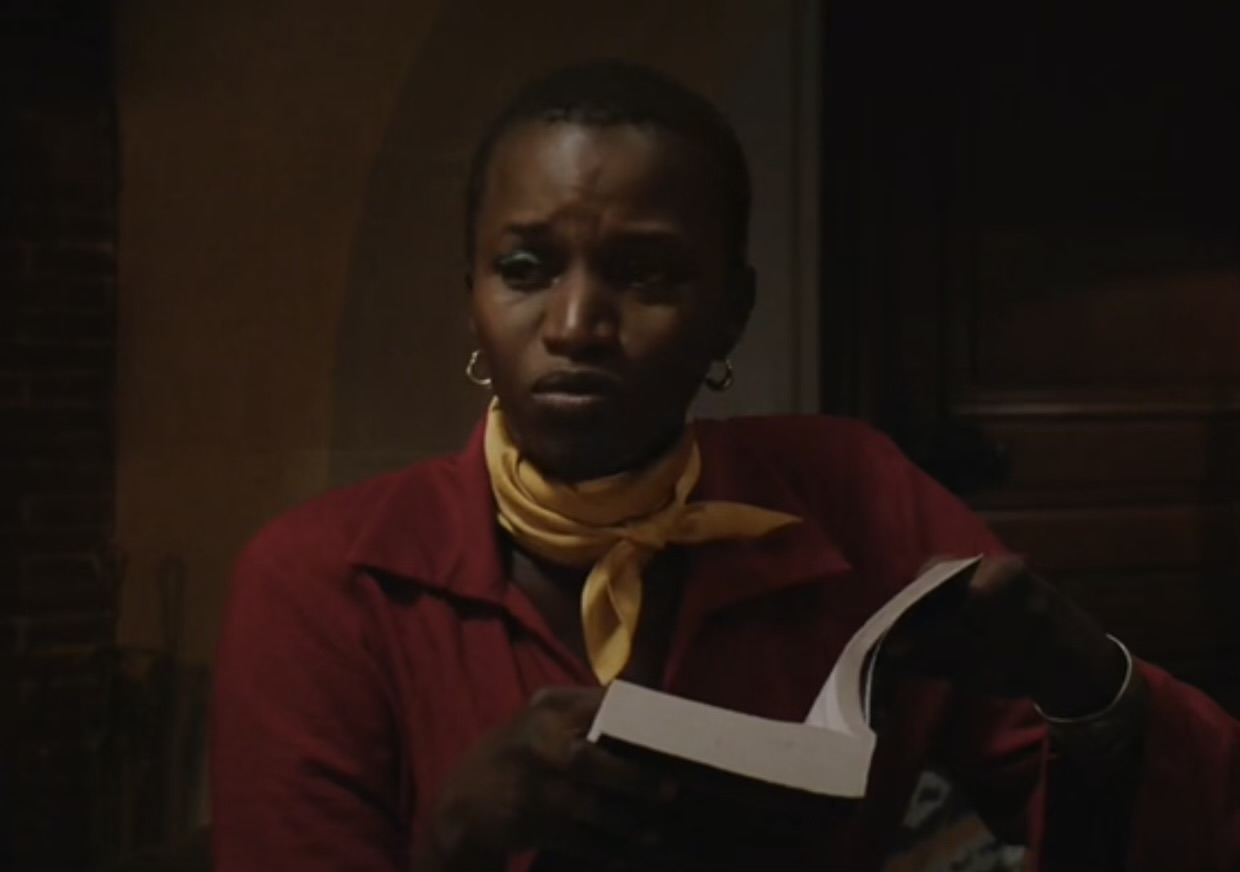
Chéryl passes along the birthday information Agathe requires— another way to employ the character as a guiding point for Agathe’s conflicted heart. DP: Pierre Mazoyer.

An opened up Agathe has drinks and sings karaoke with Chéryl. DP: Pierre Mazoyer.

The residency hosts a special period soirée where the writers are invited to don clothing worn during Austen’s time. The lovely Chéryl helps prepare Agathe as though she’s her personal servant while the other ladies dress themselves in the background. The moment certainly draws back to historical contexts— Olympia by Èdouard Manet in the Musee D’Orsay (the other museum in Paris as famous as the Louvre) came to my mind, this performative act of kindness and servitude that further relegates the purpose of Chèryl’s character. At the soirée, Agathe dances twice with the surprise visitor Fèlix and Oliver. Chèryl doesn’t receive the honor of dancing with anyone and there’s barely a shot of her full attire. Like Bridgerton, a period show containing beautiful dark-skinned background characters, Chéryl is relegated to be a part of the scenery. 

A corseted Chéryl (Annabelle Lengronne) assists Agathe (Camille Rutherford) with her apricot colored dress. DP: Pierre Mazoyer.

Including lacing it up in the back. Hopefully, Agathe did the same for Chéryl. DP: Pierre Mazoyer.

A closeup of Madeleine the servant from Édouard Manet’s 1863 painting Olympia.

Agathe makes a decision that would devastate anyone who knows the difficulties of applying to residencies (especially abroad opportunities where odds are less than one percent). This leaves us on the abrupt end of Chéryl, the unsubtle incompleteness of the poet’s story. In my imagination, she has finished the requirements necessary for the residency, wishing goodbye to all the attendants and taking her own ferry back to her Paris. She too must work at a place where books live and breathe, a place as wondrously magical as Shakespeare & Co. Maybe she has a flat filled with plants, stuffed notebooks, and autumn sweaters, patterned tea cups and tea pots and lidded jams sit on her clean (or cluttered) counters, and a purple collared black cat awaits. She finds a healthy rhythm between the virtuous recluse and modern day freethinker, her heart yearning for prose alone. Her mailbox would be packed to the brim with love letters, love letters as precious as the ones posted on the Shakespeare & Co. mirror. 

Chéryl (Annabelle Lengbonne), Beth (Liz Crowther), and Agathe (Camille Rutherford). DP: Pierre Mazoyer.

I recommend Jane Austen Wrecked My Life for the delicious cinematography, the terrific score, and its ode to bookworms and sheltered writers. While Agathe and Oliver’s story had my romanticist insides swooning from the sensuous dance to the Mr. Darcy line, my heart still mourned for Chéryl’s potential, for what could never be told, only envisioned. Her talented, scene-stealing portrayer Annabelle Lengronne (known for her award-winning turn in Léonor Serraille’s Mother & Son) deserved more light to shine bright in, a story as vivid and rich as Alice Diop’s Saint Omer. In another world, we could definitely see the English professor / novelist Rama hitting it off with Chéryl, the poet, discussing modern Black women writing around Parisian landscapes as imperative as bookstores like Shakespeare & Co. 


Friday, March 17, 2023

‘Saint Omer’ Is a Certified Masterpiece


Saint Omer film poster.

Alice Diop’s exceedingly honest feature-length debut Saint Omer explores a modern day tale of mothers killing daughters— physically, spiritually, and emotionally— and colonialism’s role in its manifestation. 

Successful author and professor Rama’s alive and passionate in the classroom; her active energy differing from the restrained behavior she displays around her family. After abandoning her usual couple travel with her husband Adrian for a solo mission, Rama becomes wholly invested in the court case proceedings of the eccentric Laurence Coly. Rama plans to use the Medea myth to tie into her next novel— Medea being Jason’s scorned ex who kills their children in revenge. 

At this modern-day witch-hunt trial, only three Black women are present— a mysterious woman seated in the front, Rama, and Laurence. 

The defendant Laurence’s brown attire purposefully disappears against the mahogany wall. This color choice seems a clever move on her part, to don a natural and neutral earth tone despite being in a setting where many biased eyes would see a villain. Brown is beyond the skin complexion, it is embedded deep in history as not someone in which to align. Thus, the prejudiced remarks from the prosecutor to Laurence’s former professor further stain her character. 

Laurence Coly (Guslagie Malanda) blends into the walls. DP: Claire Mathon. 

Since childhood, Laurence has been trained to sink into the background, to almost dissolve until completely invisible. Her ancestral foundation, her hopes and dreams, and even her own body— are tucked away to appease others. This fault lies in her parents. Her father— though also a lover of literature and philosophy like her— still envisioned greatness. He may have paid her way, but his capitalistic mindset expected a return on his investment. Odile, Laurence’s mother and primary guardian, also expects her to advance as a French Black girl, not as a Senegalese Black girl. Odile ensured that Laurence never learn Wolof and perfect French— the official language of Senegal and consequential proof of colonialist rule over other dialects still in use. Instead of embracing her heritage, Laurence is sternly advised to articulate well and become a lawyer. 

However, Laurence shares similarities to Rama— a love for literature and philosophy. Yet, Laurence remarks on the ease in which she places her baby daughter near the sea, unsure and enigmatically hoping that the court will tell her. However, the daughter’s secret birth and dreary circumstances makes the pity for Laurence begin. All alone in an unfamiliar European city, Laurence falls victim to Luc Dumontet, an old married man— fifty-seven to her twenty-something age— grooming perhaps. With a daughter near Laurence’s age, that doesn’t stop him from keeping Laurence in his artist studio and having an affair with her. Therefore, Laurence once again is sentenced to hiding, an instinct that she has forcibly been accustomed to. Her physical imprisonment ensures that no one ever sees her except the one in control. So many tragic situations befall women like Laurence, financial, sexual, and emotional abuse, the weight of depression, feeling lost, ashamed, having no therapeutic outlet. She was a silent, internalized bomb ready to explode. 

Luc, the author of Laurence’s greatest misery, always refused to understand her humanness because he (an artist) was not seeing her the way she deserved to be seen. From the time he met and dominated her vulnerability, he was selfishly attending to his own desires while ignoring hers. He plays the heartbroken, mourning father on the stand, his false narrative ringing no bit of truth. 

Rama (Kayije Kagame) blends in the crowd. DP: Claire Mathon. 

In between jury placements and scathing testimonies, Rama’s own life comes to light, her upbringing with a passive mother whose perpetual silence cuts an open wound to young Rama. The mother’s internalized emotion naturally begins killing the spirit of the girl, slowly like a poison— the medieval woman’s method for death. Their moments sequester in a dark eeriness— a fragile mother/daughter relationship retaining shadowed interactions in the present. This trial is the reason Rama cannot participate in the shared care of her mother, but she also does not disclose to her family except Adrian. Yet, this secret journey certainly takes an unexpected ride towards her past as Laurence’s testimony unleash memories trapped within Rama, memories of being uncared for, feeling unloved and un-nurtured. 

Rama’s impending pregnancy casts constant doubt, fears that her mother’s behavioral patterns may become a generational inheritance, an ingrained possibility. It is definitely a valid concern, considering that studies indicate mental health issues can be passed down. Rama already few outlets to address her internalized pain and struggle. Work comforts and eases her inherent stress, the words of popularized whiteness, cultures that exclude hers. In Laurence— a softer, resilient version of the Medea type destined to harm— Rama sees elements of herself and possibly her mother. The sabotage includes drinking beer— and history shows that alcohol can be harmful to a fetus. An educated and astute Rama must know that. As a stoic Laurence keeps composure each passing trial day, Rama continues breaking and breaking until she realizes that her pain cannot remain quiet any longer. Rama represents what Laurence could have had if her desires were appreciated and supported whereas Laurence is where Rama’s future could be if not given proper postpartum treatment. 

Saint Omer showcases the psychological war on Black women that often starts at home, a war of which so many would rather turn a blind eye to than try to rescue them from a certain annihilation. Whether Rama decides to write the metaphorical Medea novel or not, she appears to be another person capitalizing on the lonely, friendless Laurence. Laurence’s parents hoped to. She failed her father. Meanwhile Odile proudly buys newspapers covering the trial, disillusioned to Laurence facing real consequences including the death penalty for a capital offense. Luc used Laurence terribly, even failing to properly acknowledge her depression and denying their poor daughter. Perhaps Rama intends to break the cycle, depict Laurence in a light far removed from martyrdom. 

Kayije Kagame, Alice Diop, and Guslagie Malanda at the 79th Annual Venice Film Festival. The triumphant Saint Omer won the Golden Musa, the Edipo Re Award, the Luigi de Laurentiis Award for a Debut Feature, and the Grand Jury Prize.  

Saint Omer hits the right keys of cinematic masterpiece beginning with Alice Diop’s incredible direction and a remarkable screenplay co-written by Diop, Amrita David (who also does the film’s editing), French novelist Marie N’Diaye (author of the exceptional novel Self Portrait in Green), and script coordinator Zoé Galeron. Clare Mathon (cinematographer of Marti Diop’s incredible Atlantics and Céline Sciamma’s exceptional Petite Maman and Portrait of a Lady on Fire) sets a rich, evocative tone with her sharp, pointed lens that challenges viewers to pay attention to every last visceral detail. Guslagie Malanda and Kayije Kagame’s dynamic performances as Laurence and Rama believably portray the complex nuances of Black women’s specific experiences in contemporary France. You simply cannot survive on the brain food of intelligence alone, not as a Black woman existing in any part of the world. Both display a deep understanding and knowledge in their characters’ dispositions, their differences and similarities despite never physically interacting. There’s a promising kinship that is almost forbidden, a mental/emotional pull, as though if these two were to touch or speak to the other, a certain trespass would form— and these actresses brilliantly evoke that tension. At the end of awards season, Malanda and Kagame were just as invisible— extremely deserving of awards nominations— as onscreen Laurence and Rama. 

A highly crafted and authentically made feature, Saint Omer’s compelling commentary on Black women’s carrying the burdensome weight of motherhood, grief, and colonialism will be remembered for years to come.