|
| Miss Juneteenth film poster. |
Strangled, crushed dreams are often the reality of American life, especially Black American life. They can work forever and ever and still not accomplish what they most desire.
In a time of too many redundant Hollywood remakes and revisits, Miss Juneteenth is a satisfying original story desperately needed in all the theaters right now. It combines the beauty pageant arena and the history of June 19th— the day the last remaining slaves in Texas were set free years later— in a sweet, hearty serving, a unique structural setup weaving its way into a fascinating contemporary story about love, hardship, and triumph.
 |
Turquoise (Nicole Beharie) and Ronnie (Kendrick Sampson) are an estranged couple coming back and forth tied by history, mostly their fourteen-going-on-fifteen-year-old daughter, Kai.
|
Turquoise Jones, a former Miss Juneteenth beauty queen, is surrounded by failure. The hardworking former stripper manages Wayman’s BBQ, a bar/restaurant and is in/out of a complicated marriage with Ronnie, a car mechanic still chasing the unattainable like a fly trying to catch honey. Yet residual hope lie in Kai, their fourteen-year-old daughter— the testament of moving along her own inner inhibitions. As history repeats itself in a downward spiral, it is also a heavy burden to pressure a new generation into something most unwanted.
 |
| Kai Marie Jones (Alexis Chikaeze) has big dreams of her own. |
Kai, fixated by the exciting world of dance, is reluctant to follow in Turquoise’s footsteps. She faces her mother’s disapproval full on— disapproval of dancing and boyfriends (Turquoise rightly housing bad associations for both). The push and pull dynamic between Turquoise and Kai is a strong bond more loving and perhaps healthier than Turquoise and Pastor Charlotte, her sanctimonious, part-time alcoholic mother. There are charged moments that almost trigger Turquoise’s compulsive frustration like Charlotte. Turquoise is able to refrain and channel through calmly and rationally, concentrating only on the pageant, determined to break the generational cycle.
 |
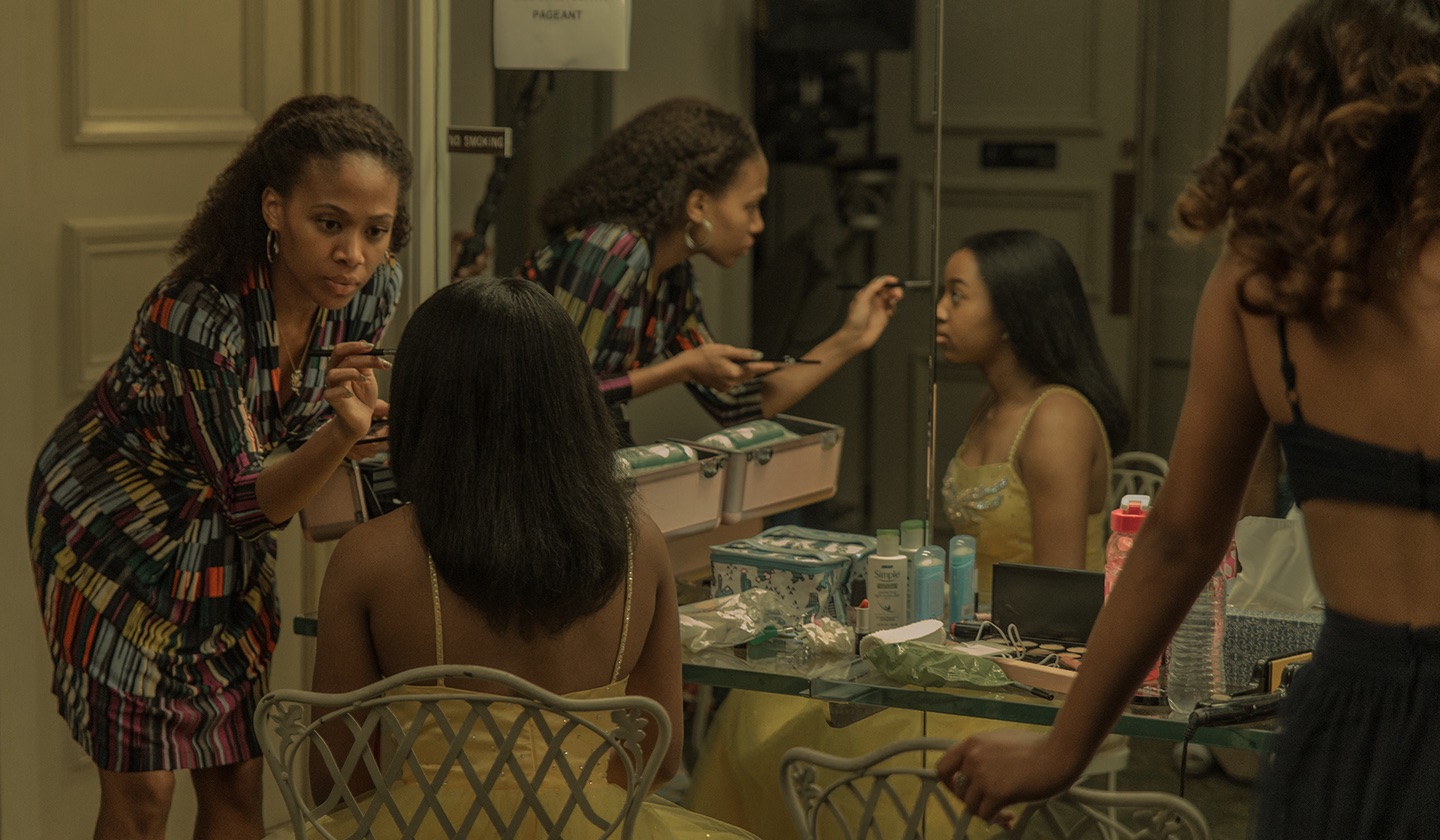
| Turquoise (Nicole Beharie) giving makeup and confidence boosting to Kai (Alexis Chikaeze). |
Turquoise often reflects on the day that should have started her life far away from Charlotte. In that cherished memory, she is a young, beautiful Miss Juneteenth winner, pageant waving in a soft yellow dress and the sparkling tiara. Unfortunately, she could not escape the tragedy that befalls Black girls— teen pregnancy and the severest fall from grace narrative. Black teen moms do not get the MTV coverage or news outlet media that celebrates them. Black teen moms can suffer in silence, working harder to provide for their families, doing things they never would have to in order to survive. Although she and Ronnie were in the early honeymoon phase of love then (and still trying to salvage something), early motherhood put college on the shelf.
Many people encounter Turquoise in town, speaking on her squandered potential.
Yet Turquoise sees Kai only as a blessing, the most important part of herself and she will do anything in her power to ensure that her daughter does not repeat certain mistakes. In Kai’s boyfriend, Turquoise sees Ronnie and in dancing, her old days as a stripper fresh after winning a beauty pageant.
 |
| Miss Juneteenth pageant contestant Kai (Alexis Chikaeze) at the center of it all— in a significant yellow dress. |
Channing Godfrey Peoples’ impressive debut illustrates the validity of Black girls, their range and glory, their eclectic talents, their very existence with Maya Angelou’s famous poem, “Phenomenal Woman,” providing a commendable backbone. This brilliant script devises the perfect way to bring Turquoise and Kai together, glueing their family unit further together. Other positive women relationships include Turquoise and Betty Ray— her lovely, humorous co-worker and even pageant head, Mrs. Washington, Turquoise’s former mentor whose disappointment overshadows any lasting genuine affection. Turquoise cares for Charlotte, she takes steps back, always placing Kai ahead of anything else. Although pageant culture itself sets up the same faults as the ones absent of true inclusivity, between choosing the right silverware, correcting posture, straightening kinky hair, and cattiness of other girls and their parents/guardians/mentors, the pleasing factor is that the winner receives a full ride to a any Historical Black College/University of her choosing.
 |
Cast surrounded by writer/director: Nicole Beharie (Turquoise), director Channing Godfrey Peoples, Kendrick Sampson (Ronnie), and Alexis Chikaeze (Kai).
|
Miss Juneteenth leads by the multifaceted Nicole Beharie (American Violet, Shame, and 42). Her layered complexity as a past beauty queen and sacrificial mother overcoming an ugly past is rendered with raw ferocity and tenderness that only a gifted actress could inhibit. With hopefully more nominations and trophies to come, the long overdue Beharie has already won the Gotham Independent Award for Best Actress against current awards season favorite Frances McDormand. If not, it does not matter— her performance was a highlight in a turbulent year and that is enough for most.
Texas born newcomer Alexis Chikaeze in her first major film role delivers astounding promise as the illustrious Kai Marie Jones— “Queen of Everything.” Her exquisitely crafted chemistry with Beharie makes the film all the more authentic and beautiful as though these two Black women were meant to partner together and create a believable mother/daughter dynamic. Meanwhile, Kendrick Sampson, having shown impressive range in How to Get Away With Murder and Insecure holds his own as a down-on-his-luck father grasping tightly onto his own bright, simple dreams that continue slipping through his hands, failing over and over to keep his family afloat as everyone in town ridicules him behind his back. He in himself is a familiar, heartbreaking tragedy played well by Sampson.
 |
| Turquoise (Nicole Beharie) telling Kai (Alexis Chikaeze) the good news. |
It is great to see a film that takes passing the Bechdel Test to phenomenal heights and cinematography that lights Black characters with a purpose beyond just looking good. The warm, saturated color scheme coordinates alongside Rachel Dainer-Best’s costume design, Emily Rice’s music selection, Courtney Ware’s editing, Olivia Peebles’ production design, and of course Peoples at the forefront of a mostly phenomenal women crew.
Miss Juneteenth is worth watching again and again, especially with close girlfriends and teenage girls seeking validation tied to an imperative history lesson. They may say “winning is not everything,” but sometimes while claiming or losing the victory prize, an even better, unexpected treasure comes instead.