Showing posts with label Foreign Language Film. Show all posts

Monday, July 14, 2025

A Parisian Dream for Chéryl in ‘Jane Austen Wrecked My Life’


Jane Austen Wrecked My Life’s side character Chéryl (Annabelle Lengronne) inspired thoughts. DP: Pierre Mazoyer.

Shakespeare & Co.—one of my favorite places to visit in Paris— is a whole dreamy, otherworldly realm. This charming bookstore contains organized book sections and beguiling stairs leading towards sweetly bound mysteries, overall presenting the best place to lose oneself. My old supreme goal was to have a published book in fiction and my framed picture included among the famous authors wall. Long ago, the bookstore even held an unorthodox residency— spend nights at the bookstore and write a required piece to include in their collection of past residents. 

Bookseller Agathe (Camille Rutherford) is the main character. DP: Pierre Mazoyer.

The shop’s an excellent other character in former employee Laura Piani’s feature length debut, Jane Austen Wrecked My Life. The film dotes on Agathe, a burgeoning writer who doesn’t feel confident enough in her abilities, a trait we have in common. She’s confidently shelving books or reading the anonymous letters posted on the mirror for limerant bookworms and returns home to a pretty flat she shares with her sister and nephew. Unbeknownst to her, Félix, a coworker nicknamed “Breadcrumber,” secretly enters Agathe’s work into the selective Jane Austen Writers Residency. 

She gets in. 

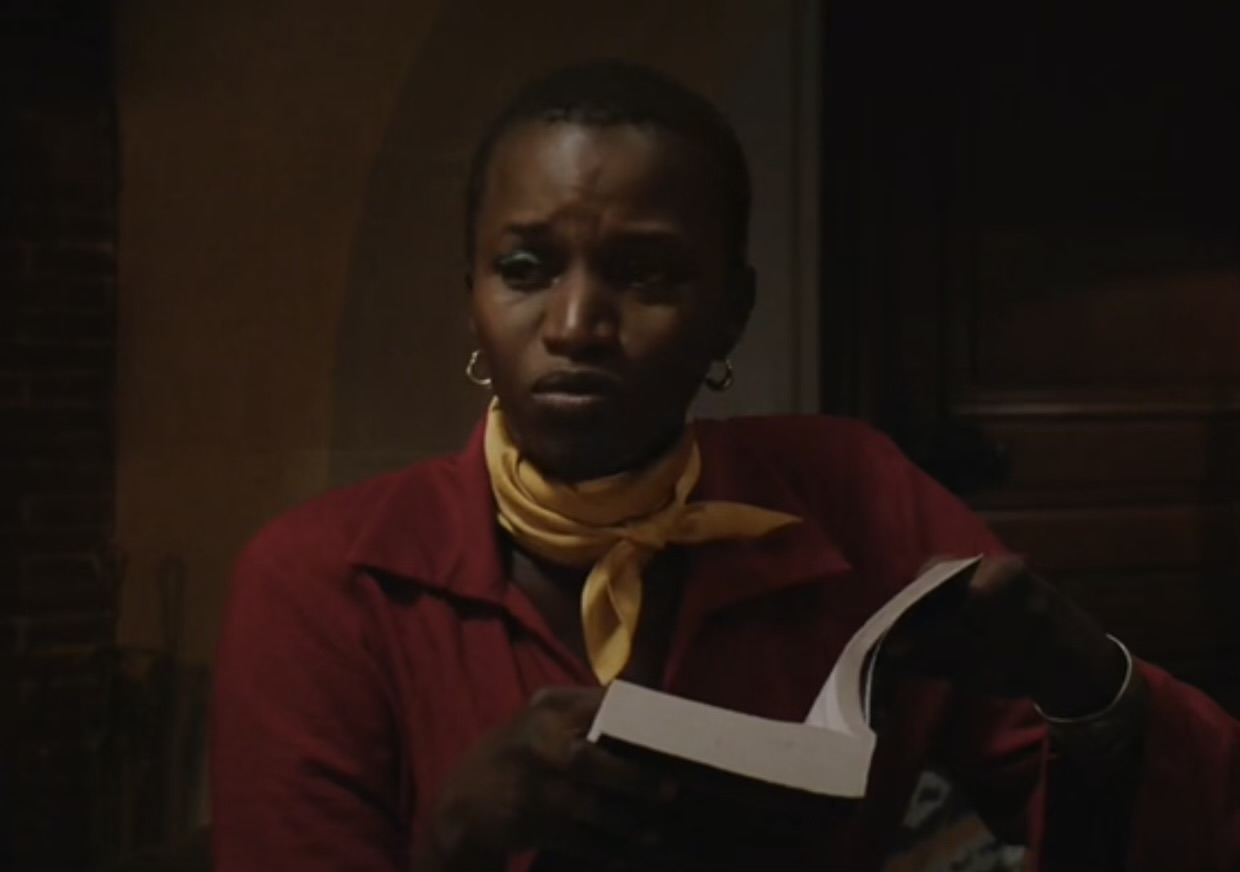
Wearing a cozy purple sweater with fetching dangled earrings touching her neck, Chéryl (Annabelle Lengronne) writes, a cup of tea nearby. DP: Pierre Mazoyer.

At the prestigious Jane Austen Residency located in a rustic French countryside that takes a ferry ride and an eventful car ride, Agathe is joined with other writers including Chéryl, a poet. None of the residents are given backstories except Oliver, an Austen ancestor and his aunt and uncle that run the pleasant house for the occupants. Apparently, Oliver personally read and chose the winners. Chéryl must have been an exceptional candidate out of many. She likely wrote her application as opposed to Agathe. That is not to say that Agathe has no merit or right to be among the chosen few. 

The reclusive Agathe comes out of her shell, befriending the residency creators and a few residents. Agathe and Chéryl hit it off by playing a game steeped in astrology culture and romance. As Agathe is conflicted by her newfound desire for Félix and her tormented affliction for Oliver, Chéryl’s book holds the key to such a predicament. The ladies later have drinks and sing karaoke at an establishment. Chéryl seems an open extrovert personality who loves exploring the earthiness around her with nonjudgmental perspective. 

Chéryl passes along the birthday information Agathe requires— another way to employ the character as a guiding point for Agathe’s conflicted heart. DP: Pierre Mazoyer.

An opened up Agathe has drinks and sings karaoke with Chéryl. DP: Pierre Mazoyer.

The residency hosts a special period soirée where the writers are invited to don clothing worn during Austen’s time. The lovely Chéryl helps prepare Agathe as though she’s her personal servant while the other ladies dress themselves in the background. The moment certainly draws back to historical contexts— Olympia by Èdouard Manet in the Musee D’Orsay (the other museum in Paris as famous as the Louvre) came to my mind, this performative act of kindness and servitude that further relegates the purpose of Chèryl’s character. At the soirée, Agathe dances twice with the surprise visitor Fèlix and Oliver. Chèryl doesn’t receive the honor of dancing with anyone and there’s barely a shot of her full attire. Like Bridgerton, a period show containing beautiful dark-skinned background characters, Chéryl is relegated to be a part of the scenery. 

A corseted Chéryl (Annabelle Lengronne) assists Agathe (Camille Rutherford) with her apricot colored dress. DP: Pierre Mazoyer.

Including lacing it up in the back. Hopefully, Agathe did the same for Chéryl. DP: Pierre Mazoyer.

A closeup of Madeleine the servant from Édouard Manet’s 1863 painting Olympia.

Agathe makes a decision that would devastate anyone who knows the difficulties of applying to residencies (especially abroad opportunities where odds are less than one percent). This leaves us on the abrupt end of Chéryl, the unsubtle incompleteness of the poet’s story. In my imagination, she has finished the requirements necessary for the residency, wishing goodbye to all the attendants and taking her own ferry back to her Paris. She too must work at a place where books live and breathe, a place as wondrously magical as Shakespeare & Co. Maybe she has a flat filled with plants, stuffed notebooks, and autumn sweaters, patterned tea cups and tea pots and lidded jams sit on her clean (or cluttered) counters, and a purple collared black cat awaits. She finds a healthy rhythm between the virtuous recluse and modern day freethinker, her heart yearning for prose alone. Her mailbox would be packed to the brim with love letters, love letters as precious as the ones posted on the Shakespeare & Co. mirror. 

Chéryl (Annabelle Lengbonne), Beth (Liz Crowther), and Agathe (Camille Rutherford). DP: Pierre Mazoyer.

I recommend Jane Austen Wrecked My Life for the delicious cinematography, the terrific score, and its ode to bookworms and sheltered writers. While Agathe and Oliver’s story had my romanticist insides swooning from the sensuous dance to the Mr. Darcy line, my heart still mourned for Chéryl’s potential, for what could never be told, only envisioned. Her talented, scene-stealing portrayer Annabelle Lengronne (known for her award-winning turn in Léonor Serraille’s Mother & Son) deserved more light to shine bright in, a story as vivid and rich as Alice Diop’s Saint Omer. In another world, we could definitely see the English professor / novelist Rama hitting it off with Chéryl, the poet, discussing modern Black women writing around Parisian landscapes as imperative as bookstores like Shakespeare & Co. 


Thursday, December 8, 2022

‘Decision to Leave,’ A Dark Romantic Mystery Is Best Film of 2022


Decision to Leave film poster. 


Decision to Leave will probably burn your whole entire soul alive.

The titillating, cat and mouse story filled with many dangerous twists and turns keeps you on the edge of your seat, nerves shivering, breaths coming out in charged pants. You must pay attention to every last detail that transpires between Jang Hae-joon— the smart, married cop and Song Seo-rae—the widowed murder suspect. As their surveilling roles push and pull against the other in some strangely riveting magnetism, the provocative game between them intensifies into an emotional fire threatening to forever haunt them both.

And my goodness, you want it to. The chemistry is that smoldering. 

Inspector Hae-joon (Park Hae-il) is trying to decide if Seo-rae (Tang Wei) purposefully pushed her husband off a mountain. DP: KIM Ji-yong/MUBI.

The first murder mystery in Busan, South Korea leads Hae-joon, a former smoker and insomniac with a poetic sensibility and knuckle cracking proficiency, into solving the case of a dead man fallen down from a mountain. The hungry bugs have already started devouring the deceased’s flesh, fluttering in his wide, opened eyes. Naturally, the wife Seo-rae, a Chinese caretaker of elder women who see her as a long lost granddaughter, is the best possible suspect for the crime. Very demure and subdued, not the grieving picture of a widow, Seo-rae is already not wearing her wedding ring and going right back to work. She pointedly reveals that she is not a benevolent person, that she is a wise being of the sea. The sea will eventually become the most devastating element of their acquaintance. Although Hae-joon proclaims to be a sea person too, his actions speak mountainous volumes. 


From the seat of his parked car, an attentive Hae-joon watches Seo-rae’s tender movements during stakeouts. He grows more and more intrigued by the striking young woman who feeds an outdoor cat, studies Korean soap operas, and consumes ice cream for dinner. As he calls her or she calls him, he imagines being at her side, seeing her close up, observing her responses to him. The obsession is a most believable slow building turmoil that begins bleeding into his sixteen-year relationship to Ahn, a genius power plant worker he visits once a week in the town of Ipo. Around Seo-rae, Hae-joon experiences pleasant sleeps in his car, waking up blissful and behaving kinder than usual to his coworkers. 

However, whilst having sex with Ahn— who believes Hae-joon is occupied in another case— Hae-joon’s mind concentrates on the mysterious Seo-rae, primarily her x-ray. Post coital, he lies to Ahn about the situation, switching the roles of Seo-rae and her dead husband. This casual fib will only twist on him later. Coincidentally enough, Ahn talks about her co-worker June quite often (even June’s crush/jealousy). Hae-joon is too preoccupied with Seo-rae to understand, let alone focus on these subtle red flags from his wife. Thus, Ahn is openly comfortable discussing June’s obvious desires and a closed off Hae-joon pretends that his simmering passion for Seo-rae does not exist. Not speaking on it means not acknowledging, not acting on it. 

Many light flirtatious interactions between Seo-rae and Hae-joon come into play in both police stations— Buran and Ipo. DP: KIM Ji-yong/MUBI. 

The cop is sinking further down the rabbit hole and only Soo-wan, his male partner notices. Hae-joon slips up in his task, leaving Seo-rae free to do her sleuthing on him. Soo-wan believes Seo-rae guilty and Ahn remains in the dark. Seo-rae is an isolated woman with no outlet in which to reveal her innermost thoughts and feelings except using her phone as a recording diary/translator. Her motives are purely secretive, adding layers to the intrigue of her character, a character who is adept, calculating, quick yet not immune to falling into the complications of desire, of love. She is seemingly playing this poor, sopping detective. At the same time, she is learning from him, becoming educated beyond learning Korean. He excites her, shows a tenderness rarely bestowed on her by a man. The key to everything is in shared technology— the phones that come and go as evidence, the cyber translations from Chinese to Korean, the earbuds, the tracking/surveillance. Also, Hae-joon sneakily catching Seo-rae’s whispers to her cat and reading transcripts of her Apple Watch voiceovers are simply too endearing— he gets a euphoric rush from realizing she thinks of him as he thinks of her. 

Old women are sadly used in this particular narrative as scapegoats. Seo-rae’s thirst for killing began with her dying mother who tells Seo-rae about her Korean heritage in the Homi Mountain. Unfortunately, it is a capital offense to aide in death despite Seo-rae’s mother requesting the fentanyl. A desperate Seo-rae marries in order not to be deported and endures brutality including her maniacal abuser’s initials tattooed on her flesh alongside his many bruises. It seems other than her late mother, no one else has since cared for Seo-rae, loved her unconditionally. Until, she becomes a successful caretaker. The key to Hae-joon figuring out the first mystery was Seo-Rae’s Monday patient, a dementia woman who adored and trusted Seo-rae mainly because Seo-rae brilliantly executed the part of youthful, gentle caretaker. Who would ever suspect her of containing malicious or evil intentions? The spell Seo-rae had placed on Hae-joon seemed to be broken. A beautiful, naive, tragic figure could be capable of harm— of deceiving and killing elder women and putting his job in jeopardy— a smart, dignified cop.

Seo-rae enjoys the meal Hae-joon prepares her in a scene that earlier mirrors him cooking for his wife who too cherishes his culinary talents. DP: KIM Ji-yong/MUBI.

Decision to Leave is not as sexually explicit as other Park Chan-wook films. It almost appears rather tame. Instead, he finds other devices to create his signature eroticism. The uncharted lust practically spills from the seams moment upon moment that these two characters interact. When Hae-joon sniffs Seo-rae’s perfume, purchases expensive sushi for her to eat at the police station (which pisses off his erratic partner), prepares her a Chinese meal late at night, fights a man with sweaty hair and heavy panting as she witnesses him from her car, or rubs lotion onto her calloused hands during a rainy walk, he is showing an unprofessional interest. Things heat up further as Hae-joon unexpectedly undoes his belt— only to put on his holster as Seo-rae observes him. Once Seo-rae calmly breathes and recites sweet words to help him sleep in bed, that alone is a deeper intimacy than what holistic Ahn grants him. On top of everything— Hae-joon and Seo-rae keep staring at each other in that manner of no one else existing but the two of them. Eye connection is frequently a strong indication of attraction, of longing. A serious thing too, when considering how often Hae-joon drips solution in his tired eyes. 

Once Hae-joon— a man who constantly needs to be in the shoes of the dead— figures out Seo-rae is not the perfect victim, the crushing tide is brilliantly conducted. As a hurt, disillusioned Hae-joon decides that he can no longer associate with Seo-rae due to his damaged pride from her betrayal, Seo-rae’s genuine feelings grow deeper at this point. Yes, she has committed crimes to save herself from further misery and harm. How could he possibly understand what she— a foreigner in a new country still struggling to speak the language— was going through? Hae-joon foolishly believes it would be so simple for Seo-rae to just walk into his police station and tattle on a former immigration officer? Women are not always believed. 

After thirteen months apart, Hae-joon and Seo-rae meet again at the fish market in Ipo, their respective spouses by their sides. Despite the awkwardness, clipped dialogue, and silent communication, Hae-joon and Seo-rae’s desire for each other remains an undeniable cord drawing them in. The way their eyes connect or try not to, the way he suddenly smiles— it is all so wonderfully orchestrated, the perfect forbidden fate. In this pivotal, electric scene, Seo-rae— now a tour guide and no longer a caretaker/nurse— is already subtly giving Hae-joon clues to her next crime. 

The temptation is too great: Hae-joon remains stoic in Seo-rae’s presence. DP: KIM Ji-yong/MUBI.

At the second murder mystery, this time Hae-joon— who has been nursing depression from his incurable broken heart— will not let Seo-rae get away so easily. He tries a sterner approach with Seo-rae, determined to not let his feelings entangle. His inquisitive female partner, however, does not believe Seo-rae guilty of killing her second husband— a man threatening to tell Ahn of Hae-joon’s emotional affair. Seo-rae recorded Hae-joon’s “shattered” confession, words that signified his love for her, something that he does not argue or deny. Yet, Hae-joon’s determination in seeing justice done employs him to turn the tables on the inner workings of his great attachment to Seo-rae. When he cuffs their hands together and she strokes his fingers, he cannot reject her. It is eerily poignant that Seo-rae tells Hae-joon that she purposely cleaned the crime scene, thinking of his sensitivity to blood. 

Clever symbolism runs rampant throughout the film. The blue-green colors of water/sea continuously appears: the wallpaper in Seo-Rae’s home, fetanyl pills, evidential dress, bucket to bury the dead bird (which both Hae-joon and Seo-rae have taken feathers from), and the filtered light in Hae-joon’s bedroom as Seo-rae breathes alongside him. Then, there’s the sushi. In his first scene with Ahn, Hae-joon admits to loving cooking and not eating any old sushi. With Seo-rae, however, he orders sumptuously enticing sushi at their impromptu interrogation— Shima— which Seo-rae eats alone prior to her heartbreaking plan. In his fierce determination to treating her like a regular suspect, he orders generic food and she is notedly disappointed. Shoes are the next big beacon— Hae-joon wears the comfortable hiking variety for the more energetic paced cases in Busan— especially necessary for climbing steep mountains and chasing bad guys. In low-crime Ipo, he wears loafers. When Seo-rae is at his Busan home, she is donning house slippers, a signifier of the intimacy between them. In Ipo, she is wears heels and has her hair down as opposed to her earlier ponytails. Finally, chapstick and mints— typical precursors to kissing and kept in Hae-joon’s endless pockets— are found twice by Seo-rae. She knows his content pockets just as he remembers her phone password. She applies the balm on her lips and then his in the manner that echoes him applying lotion to her calloused hands. Their final face to face meeting has Seo-rae replacing his chapstick with her own lips, a purely poetic exchange that reads more like a bittersweet goodbye to possibility. So well done! 

At home in Ipo, Ahn— who believes Hae-joon not only is having an affair with Seo-rae, but also may have conspired to kill the second husband—leaves with June. Perhaps, in some fashion, June is the man Ahn has always wanted. In that instance, we have these four people who behave similarly to each other. Hae-joon and Seo-rae sometimes act as mirrors or polar opposites. Ahn and June are two peas-in-a-pod science nerds. However, only a few are courageous enough to confront the issue of moving towards the right destiny. Unfortunately, Seo-rae realizes that she must make the sacrificial choice not just freeing him, but herself as well. She is a criminal. He is a cop. So, the two most imperative women in Hae-joon’s life leave him. Ahn knows that he has been lying to her about Seo-rae and Seo-rae believes that she is a reminder of his lost pride in being a dignified policeman. 

Seo-rae and Hae-joon finally have it out in Ipo. While he is pragmatic in his choices, she is cryptic, confusing him completely. Is that because of the language barrier or another secret battle altogether? DP: KIM Ji-yong/MUBI.

Among the metaphorical repetitions and jarring parallels, the award-winning Decision to Leave (South Korea’s fitting choice for the Foreign Language Oscar for next year’s ceremony) is a wild, intimate ride from start to finish. Park Hae-il and Tang Wei’s charismatic performances are certainly the brilliant highlights of a mesmerizing, moralistic screenplay Chan-wook co-wrote with Jeong Seo-kyeong. KIM Ji-yong’s gorgeous cinematography— their first IMDb credit— just stays on your distraught mind long after the credits roll. The poignant music and sharp, gritty sounds too truly set the tone, lure your every sensory into this fascinating escapism.

Although the tragic conclusion breaks the heart to smithereens, the beautiful, dark Decision to Leave defines fierce yearning in its more sinful form, giving off a cautionary alarm to the predicaments a corrupted person can coax the innocent into if they’re not careful. Seo-rae bravely calls out the hypocrisy of the cop’s violent profession and the cop’s need for a stable home life with a docile partner instead of someone like her— a survivor only drawn to conducting violence for either those who wronged her or those suffering souls needing a way out. Seo-rae’s affect on Hae-joon alters him as much as he changes her, deepening a harrowing connection that cannot ever be given the necessary space needed to thrive. Hae-joon and Seo-rae are a pairing so vital, that it still hurts how they ended— as a guttural, unresolved case as cruel as the crushing deep sea. Ultimately, this ironic masterpiece of a film depicts two lonely people who found each other too late, whom under different circumstances may have been quite happy together. 


Wednesday, April 8, 2020

‘Fig Tree’ Is A Poignant Autobiographical Tale

Fig Tree film poster. 
With the Western obsessive “happily ever after” and “that love like our grandparents’ had” narrative, it takes ample courage and grit to tell a tragic coming of age love story. Set in Ethiopia around 1989, a friendship is tested in ways that Romeo and Juliet cannot compare. This situation is more gender and religion than family vendetta. The circumstances are more dire, stakes raised higher. Fig Tree‘s Mina and Eli have a beautiful relationship, but as such most things cannot always stay tied together like knotted ribbons. 


Eli (Yohannes Musa) and Mina (Betalehem Asmamawe) up in their fig tree. 


Smart, Jewish Mina shifts between tomboyish in her straight back braids and American shirts and shorts and maturing womanhood in an olive green checkered dress. Eli is a Christian, sweet-faced apple of his mother’s eye. Mina and Eli live together (her family is purposely hiding Eli). They are best friends, often running off to rendezvous beneath and around their fig tree. In that mystical meeting place, they can climb above those gnarly branches and be safe from the pop up soldiers kidnapping boys for war. Against the backdrop of this unfair civilization, their love is an urgent one, as urgent as their need to leave the country. Yet the process of leaving takes time and careful forgery. 


While Mina (Betalehem Asmamawe) smiles in every picture, her grandmother (Weyenshiet Belachew) keeps her face the same seemingly vacant expression.  Perhaps because she has had a hardened life or has forgotten joy. Later, however, she tells Mina that she was in love once. 

Mina has a closer relationship to her stern grandmother, but a tense one with her mother who abandoned them to live in Europe— they have to travel ways to call her. Meanwhile, Rata, Mina’s older brother— a returned veteran with a disability—is supportive of the war effort. In fact, he wishes to return to the frontlines. It is the grandmother and Rata who are quick to snuff out Mina’s outspokenness and show her that there are consequences to being “disrespectful” to authority. 


When Mina (Betalehem Asmamawe) spied the soldiers in the window during class, she does not hesitate to do what is right. 


The cast is led by the phenomenal Betalehem Asmamawe, making her acting debut. She carries this film on her shoulders as a young girl breaking through adolescence whilst simultaneously fighting the horrific system in the only way she can. Mina is brave, resilient, and passionate— emotions Asmamawe was able to evoke in every scene. 

Aäläm-Wärqe Davidian’s gut wrenching piece of work, based on her own life, daringly casts a shadow over the evil consequences of war, especially in its severity of stealing young boys unprepared for adult battles. She shows love and fear of Eli’s life through the eyes of Mina, his young love and his mother who has had a nightmare of his death. These two women make ultimate sacrifices in order to protect him only to be sabotaged. Winner of the TIFF Eurimages Adentia Award, the Atlanta Jewish Film Festival Jury Prize for Emerging Filmmaker, and a skew of honors for cinematographer Daniel Miller, Fig Tree deserves every last win and nomination. Hopefully this encourages Davidian to pen and direct more features, more stories from her poignant perspective. Her voice is unique and transformative, a pleasant evidence that there are emerging women creatives in Ethiopia determined to make an impact. 


Eli (Yohannes Musa) and Mina (Betalehem Asmamawe) are a calm before the storm. 


Fig Tree— a history lesson and love story all at once— is a must see and tissues will be needed. For Davidian's haunting story will leave audiences pining for a better, just world. 


Friday, November 9, 2018

'Burning' Is a Shocking Thriller To the End


Burning film poster.
Recent fiction major grad, Jong-su works part-time whilst coping with writer's block and caring for the family property while his father is in jail for assault. He runs into former neighbor Hae-mi on a lunch break. Though it takes Jong-su moments to remember, the two have an awkward liason. Hae-mi is aloof, adventurous, and unpredictable as opposed to Jong-su's coy, meek personality. Before she goes to Africa (on a vapid, imperialist mission), she has Jong-su watch her cat, Boil. And the mysterious Boil eventually unravels a key moment.
Jong-su (Ah-In Yoo) runs around daily to inspect greenhouse.
Burning sets up a slow building tension that escalates to an unsettling disturbia. Hae-mi returns with a new friend, Ben. A jealous Jong-su can see their relationship has evolved to a much more intimate capacity, leaving him as a third wheel oddity. His curiosity of the rich, elusive Ben is worthwhile. Ben's sleek insinuation into the lives of two spacy young adults, using them both for sheer amusement like objects on a gameboard raises valid suspicion. Ben soon introduces Hae-mi and Jong-su--whom awkwardly stand out-- to his sophisticated socialite friends. Two worlds collide for Ben with Hae-mi and Jong-su merely setting the stage to entertain his fickle pleasures.

A striking visual of a young boy watching a burning greenhouse.
Burning contains exciting and jarring twists and turns that'll leave hypothetical guesses til the end. Director and co-writer Lee Chang-dong states:
"The leaping holes in the chain of events -the missing piece from which we can never know the truth- alludes to the mysterious world we live in now; the world in which we sense that something is wrong but cannot quite put a finger on what the problem is."
The character triad is a compelling and complicated weave and the chosen actors have crafted the relationships well enough. From glazed stares to pout lips, Ah-In Yoo finesses the quiet introverted Jong-su driven to a simmering madness. Jong Seo-Joen--in her first major role-- plays the naive, storytelling Hae-mi in an airy, effervescent manner despite Hae-mi's flawed, off putting insensitivity about a culture different than her own. Steven Yeun brilliantly oozes charm, sensuality, and danger into narcissistic Ben downright to the creepy laughter and bored yawns. He emotes such cynical precision that is almost frightening in Ben's loving fascination with setting fire to greenhouses. Yoo commiserates, entailing Jong-su's own past as a reluctant firestarter.

Nudity still conveys a strong attribution to male gaze. Whenever Hae-mi is nude (which happens on two separate occasions), her lithe body is the lure and attraction to the males. For example, after Jong-su, Ben, and Hae-mi smoke pot, Hae-mi takes off her blouse and languidly spins around topless. Jong-su's bare form, however, suggests a more constructive narrative. Although he frequently masturbates, especially in Hae-mi's room, his later nude finale conveys power, guilt, rebirth. At the same time, his nakedness is not humorous or self-deprecating as American cinema often ostrasizes male Asian bodies.

Jong-su (Ah-In You), Hae-mi (Jong Seo-Jeon), and Ben (Steven Yeun) revel in the view and smoke pot together on Jong-su's family property.
Burning references classic white male American literature (nodding to William Faulkner and F. Scott Fitzgerald) yet doesn't forsake Asian aesthetics for the Western gaze in this adaptation to Haruki Mumokari's short story, Barn Burning. The cinematography is an excellent backdrop to the intense drama, a thrilling chain of events leaves behind unhinged skepticism throughout twisted narrative. The minor fault is that some sequences are either stretched too long or not given substantial weight.
"So I creep--yeah." TLC came to mind during Jong-su's (Ah-In Yoo, left) amateurish surveilance of Ben (Steven Yeun, right).
Overall, Burning is sensational escapism and utterly deserves the honor of representing South Korea for the Academy Awards Best Foreign Language Film category. It would be an even greater triumph if Yeun and/or Yoo receive awards nods for delivering complex performances-- dismantling the stereotype that Asian actors are not expressive.

With fire symbolically scorching broken histories, abandonment, and evidence, turning structural bodies into char and ash, Burning will stun and disturb throughout suspenseful clarity.

Monday, April 30, 2018

‘Spoor‘ Is a Powerful Mystery Weaved With Animal Rights Vigilantism

Spoor (Pokot in Poland) film poster.

Janina Duszejko is a heroine unlike any other. An older, joyful spirited woman with bright eyes and long silvery white hair in frequent schoolgirl braids, she has a deep compassion for animals, creates the most enticing bowls of colorful dishes, and teaches English to younglings whilst also taking them into the dangerous, icy cold wild of Klodzko Valley. She is knowledgeable about plants and quite resourceful to all of mother nature’s secrets. When the hunters in town start gruesomely dying off, Duszejko holds the key to the daunting mysteries.

Janina Duszejko (Agnieszka Mandat) with her beloved students.


A distraught Janina putting up signs in hopes of finding her missing dogs.

Now if Okja was the magnificent, under appreciated champion of mass consumptive meat industry, Spoor is the picture that showcases horrific injustice of glorified animal hunting. Like Okja, Spoor also shares graphic senseless violence which humans are conditioned to accept and celebrate. These rush time paced scenes are bloodier, intense, and heartbreaking. Most of the film takes place in infinitely stretched forest, overwhelming the modest population. The story illustrates a man's desire to conquer by killing heart of mother nature, destructive and remorseless beings using guns to shoot anything that moves. Thus, when the body count rises, when hunters turn into victims, the question is not who is performing the vengeance or why this is happening, but the how. And the how is a striking, pivotal element that audiences have to pay immense attention to.

Agnieszka Holland (left) and Kasia Adamik (right) holding onto the Alfred Bauer Prize also known as the Silver Bear Award at the Berlin Film Festival.
Winners of Berlin Film Festival’s prestigious Silver Bear Award and Poland’s choice for Best Foreign Film representation at this year’s Oscars, Agnieszka Holland and her daughter, Kasia Adamik have created an astounding work of art together. Holland, having been previously Oscar nominated for her screenplay of Europa, Europa, has penned and directed episodes of House of Cards, The Affair, Treme, The Killing, Cold Case, and films such as In Darkness, Julie Walking Home, and The Secret Garden. Up next for her is Charlatan and Gareth Jones and TV series’ 1983 and The First. Adamik is not only a storyboard artist, she wears other miscellaneous production hats in forms of writing, directing, editing, etc, working in various Polish film and TV series.

Janina (Agnieszka Mandat) always finds beauty in nature. 

Besides gripping murders, Spoor has two charming love stories of young and old. The cinematography is absolutely stunning— picturesque mountain caps, captivating foliage coated in snow and ice, and again Duszejko’s scrumptious food. The writing by Holland and Olga Tokarczuk is solid-- with humor, suspense, charm, and a pleasant ending.

Spoor is worth the watch for the powerful message alone.