Showing posts with label 2024 Film Release. Show all posts

Saturday, June 15, 2024

A Quiet, Symbolic ‘Grace’ Goes Against The Grains Of Sanctimonious South


Grace film poster.


Grace—the latest coming-of-age effort after writer/director Natalie Jasmine Harris’s debutante short film, Pureadds another effective gem to a promising filmmaking oeuvre. 

Grace (Jordan Wells) embodies her name in every way. DP: Tehillah De Castro.

As a carefree, ordinary girl named Grace approaches her milestone birthday and upcoming baptism, she succumbs to the joyful pleasures of youth alongside her sister and Louise, a childhood friend. The charisma between the triad presents a natural friendship depiction. The lines of love are drawn in its unadulterated forms— affectionate sibling biology and the kindred camaraderie. What happens when those invisible lines are unexpectedly blurred? Can an innocent heart stay ruled by a strict upbringing or will it surpass the safe, platonic road? 

Big Mama’s teachings on the Deep South stage heightens Grace’s burgeoning sexuality dilemma. It’s where the unsettling righteousness bellows beneath the exterior of precious girlhood. Between the delightful smiles and the singsong handclap games, the devout undertones disturb the humble peace. 
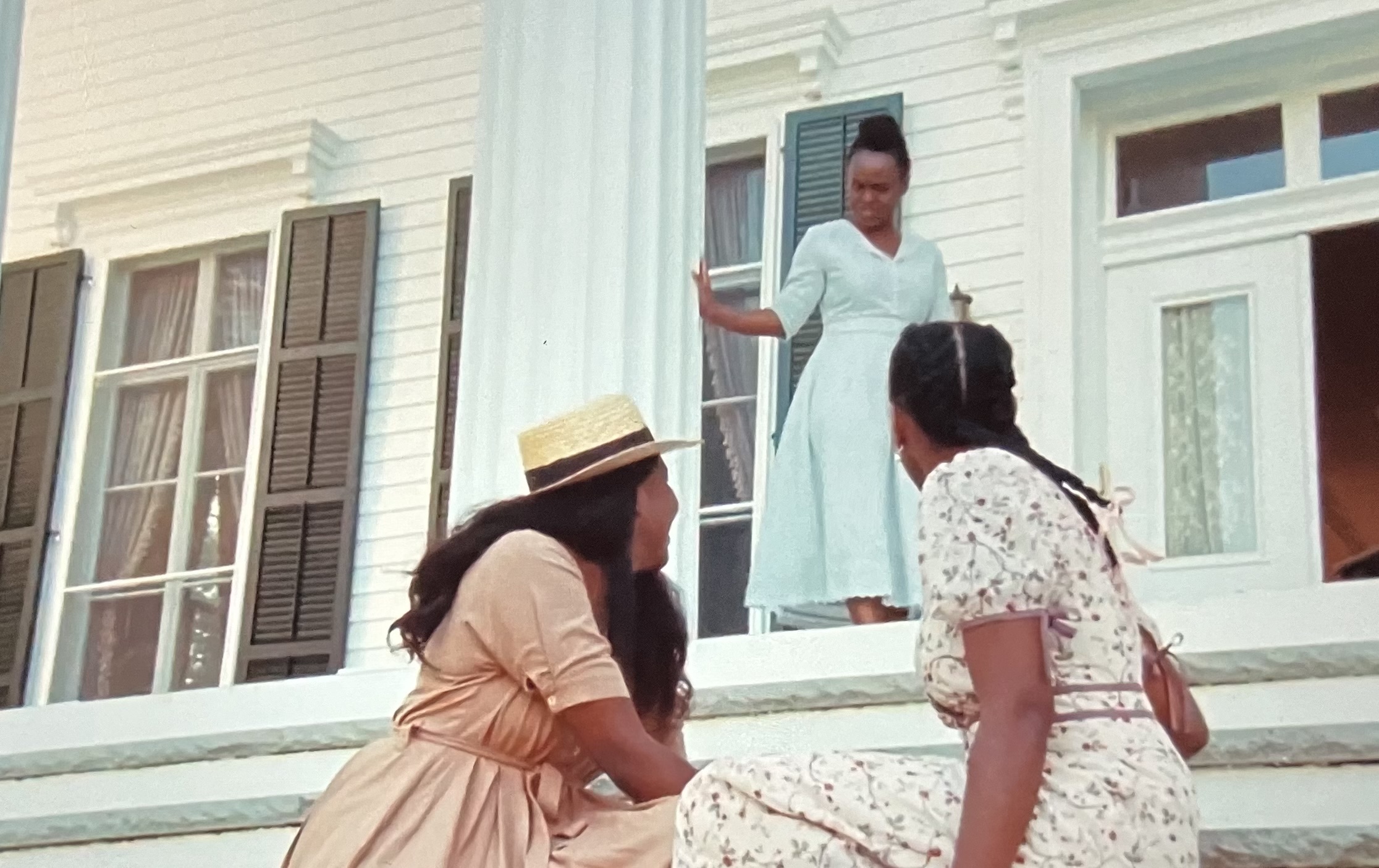
Louise (Alexis Cofield) stands on the porch, smiling down on Grace (Jordan Wells) and her sister (Mikayla Lashae Bartholomew). DP: Tehillah De Castro.

Among the pastel colored walls and the elegant white curtains parted on large, charming windows, Grace feels the pressure to be good, to follow Big Mama’s respectable example. Inside the American Gothic styled house, intentional cross patterns are repeated cues upholding the Bible structure. Although no men occupy this makeshift Black feminine utopia, an ominous presence operates as a patriarchal beacon, the judgment ensuring that all young girls must eventually submit to their duties as wives, to suppress any other “unlawful” inklings. 

Moreover, Grace’s baptism will bring the ultimate test. 
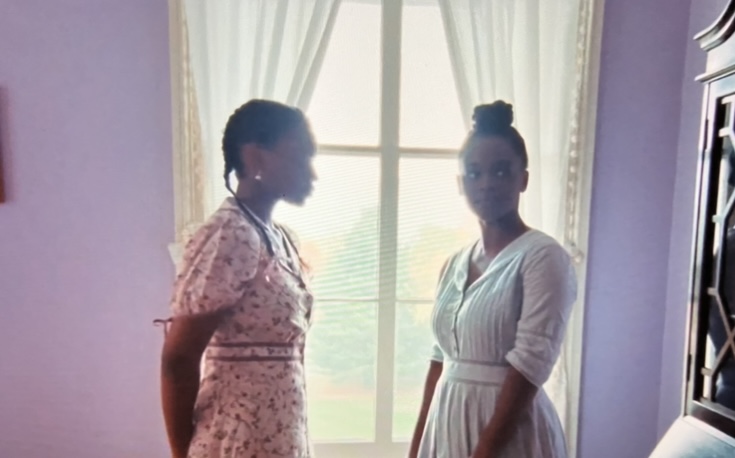
Grace and Louise strike a cord. DP: Tehillah De Castro. 

In the trajectory of Juliana Kasumu’s Losing Joy, Allie Morgan’s Sisters, Mz Roth’s code switch, Harris’s Pure, and many other Black sapphic films eloquently helmed by Black filmmakers, Grace sheds profound light on soft queer films highlighting multifaceted experiences. These brave creators are not rehashing the same, copy/paste narratives that we’re accustomed to seeing in regards to how Black women, girls, and femmes are portrayed. 

By centralizing blackness through an authentic lens, the characters must battle the fights (both internal and external) that come with the global impact of the dominant heterosexual landscape. These are the directors that deserve to invent original stories and adapt the inherent literature (Alice Walker, Toni Morrison, Maya Angelou, Gloria Gaynor, Paule Marshall…) for us to devour, to engage. Since their films asks and answers questions long raised in Black community, they need our support the most. 

The most metaphorical shot in the film. DP: Tehillah De Castro.

A straightened haired Grace rejects Louise. DP: Tehillah De Castro.

After premiering earlier this year at the Sundance Film Festival, Grace has been shown around various other film festivals such as Inside Out Toronto, Newfest Pride, and the upcoming Frameline and BlackStar Film Festival. Grace —a word meaning simple elegance— is a must see for embracing its definition beyond the leading character. Every element (small or large) enriches the layered, impactful narrative: tightly knitted frames containing vital symmetries and subtle performances by a talented cast led by its director, some period costumes (which Harris designed) call to mind Julie Dash’s Daughters of the Dust— the white dresses nodding to the film’s costume designer Arline Burks Gant, and the house right down to the object placements, an appropriate foundation for stern religious order. 

Overall, Grace is cinematic magic without spells being cast onscreen. While the visual feast thoughtfully conveys a Black girl grappling with her awakened identity, its story teaches the notion that being true to oneself is more so a blessing than a sin to be cleansed away. 


Monday, May 6, 2024

In A Fairer World, ‘Origin’ Would Be A Vital Best Picture Nominee


Origin film poster. 

For the past few years, Black women filmmakers are reaching this great postmodern renaissance. They’re crafting incredible stories that put Black women’s experiences at the center of the cinematic picture— A. V. Rockwell’s A Thousand and One, Raven Jackson’s All Dirt Roads Taste of Salt, Chinonye Chukwu’s Till, and etc. Now Ava DuVernay’s latest picture Origin adds more crucial fuel to this poignant hot fire— a biopic unlike any other. 

Isabel (Aunjanae Ellis-Taylor) spends hours going over her research as most writers do. DP: Matthew J. Lloyd.

Isabel Wilkinson is in a crisis. 

The Pulitzer Prize winning author struggles to write a new book in a country continuously steeped in racial turmoil. She’s often reading books, jotting notes, and traveling around the world for research purposes, trying to meet deadlines— the film candidly illustrating the stages of a writer’s lifestyle. She interviews individuals who either agree and/or engage with her philosophies or those who take offense to her bold comparisons. 

Either way, Isabel stops at nothing to form research that she believes wholeheartedly in. 

Isabel relays some of her thoughts to her cousin Marion (Niecy Nash-Betts). DP: Matthew J. Lloyd.

Isabel puts in the work, uncovering unsettling truths centered around a system older and greater than racism and sexism alone— the original separation tactic that keeps certain people at the bottom while those on top cannot be toppled—caste. The threaded connections are woven into many cultural tapestries, so complex and nuanced, that Isabel herself becomes stunned yet fascinated by the roots of her vital discoveries. It’s an intelligent Black woman’s intense emotional labor— performed in the most beautiful countries. Isabel does what needs to be done. She pursued her theories and hypotheses with stunning perseverance and clarity, asking the right questions and receiving the answers needed to form her book. 

Stylistically similar to I Will Follow, Middle of Nowhere, and Selma, Ava DuVernay’s Origin meshes poetic elements together, soft vulnerable moments spliced between harsh violence and heavy memories. Origin is also a refreshing change from the typical green-lit Hollywood biographies— often formulaic and filled with false exaggerations. They love placing special emphasis on Black women musicians as though that’s their main contribution to society— next to mammies and slaves of course. 

The actress bringing Isabel to cinematic life is Aunjunae Ellis-Taylor, whose compassionate rendering of a woman’s desire to find truth through writing in the face of strife and grief demonstrated remarkable skill to the acting craft— a phenomenal masterclass. The myriad of emotional range and could overwhelm any eye. Yet Ellis-Taylor proves that she was fit for this part. Other performing highlights include criminally under-praised Audrey McDonald’s Miss character— her words regarding the racist school principal stuck well past the credits ended. Niecy Nash-Betts as Isabel’s cousin Marion provides a gentle backbone, a necessary reprieve from the cruel histories revealed through Isabel’s documentary work. 

Isabel travels place to place, a collector of valid information. DP: Matthew J. Lloyd. 

Origin should have been given a real chance to thrive. The message delivers pivotal and necessary knowledge, especially imperative in a world shackled by the permanence of this global foundation. It goes beyond isms, divulging a deeply embedded injustice system that cannot be ignored much longer. 

Some folks believe art has no real ability to change the world.

Ava DuVernay’s film starts a dialogue that disproves it.