Thursday, August 29, 2019

‘August 28: A Day In The Life of a People’ Told Through Poetry and Stunning Visuals

A family watching the presidential nomination of Senator Barack Obama is just one of the moments depicted in Ava DuVernay's August 28: A Day in the Life of a People
Last year, Ava DuVernay announced her commission for the National Museum of African American History and Culture, August 28: A Day in the Life of a People, a part fiction, part documentary short film. For one day only, those who were not in Washington D.C or have yet to visit the museum, received a special invitation to watch the twenty-two minute work on DuVernay’s official website. Malik Sayeed’s mesmerizing cinematography operates to Meshell Ndegeochello’s soft, humble musical composition, setting the appropriate tones required for each layered vignette, baring heavy examples on what transpired on a significant date in Black history. 

A book flying in the flooded waters signify the tragic aftermath of Hurricane Katrina.  
DuVernay’s art always ties to the past with a sharp, charged focus that is especially riveting when it comes to how Black bodies are portrayed. She cares about Black humanity, showcases Black strengths and weaknesses. Alongside a stellar cast that perform their tasks with phenomenal diligence and dignity, the exceptional writings of Frances Ellen Watkins Harper, Maya Angelou, Claude McKay, Langston Hughes, and Zora Neale Hurston and some Motown Records  produced medley (The Marvelettes, Please Mr. Postman) intertwine in the most electrifying ways. Images will speak to the viewer, sing to them, haunt them. 

During the many complimentary watches of August 28: A Day in the Life of a People, certain frames stood out so beautifully, so effortlessly like high contrast photographs, like painted portraits worthy of placing on absent walls. Hopefully, another time will come again when individuals can see this loving piece that DuVernay and her dear friends have created together.

On Wednesday, August 28, 1833, The Slavery Abolition Act passed, freeing many Africans in the Britsh colonies, Canada, and the Caribbean. Glynn Turman recites Frances Ellen Watkins Harper.
They walk along the freedom road. 
And a little Black girl carries a brown doll, a carving in her own image perhaps, in their humble basket of belongings. 
On August 28, 1961, Please Mr. Postman by the Marvelettes was the first song played on the radio by Motown Records. It would also go on to reach number one on the Billboard charts. Regina King stars as a woman listening to the record.
This gorgeous shot of her walking down the hall in 1960's getup 
The beautiful brown ladies dancing in sophisticated dress in a tastefully decorated middle class living room, a moment easily passing a Bechdel test.
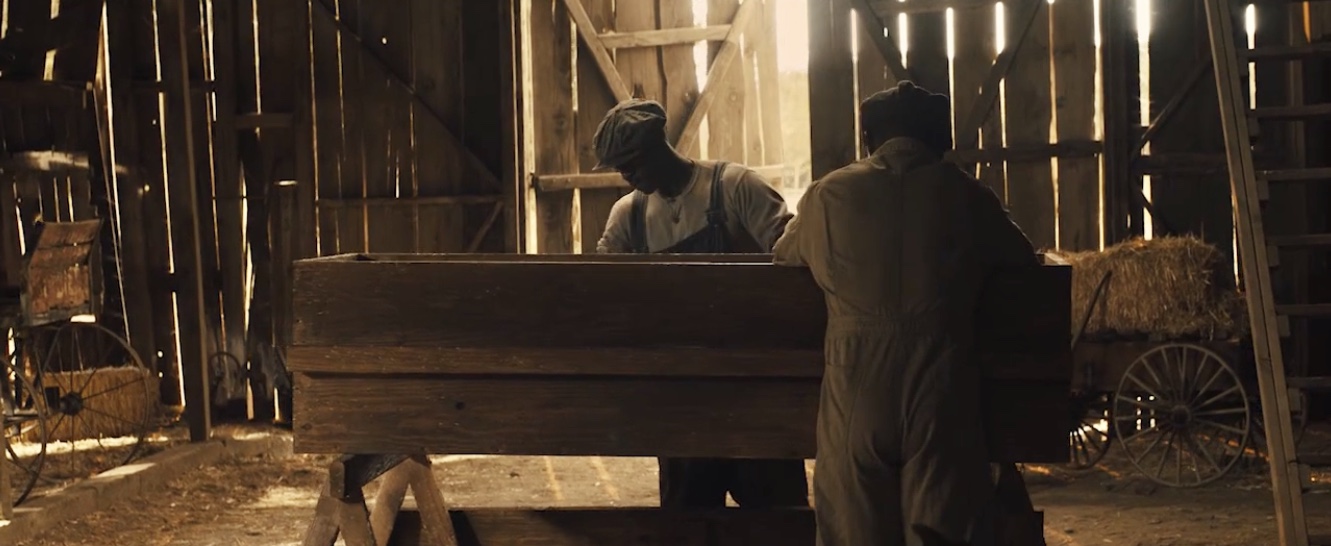
Don Cheadle is part of the narrative about one of the most heinous acts of racist crime ever conceived. In the wee hours of August 28, 1955, fourteen-year-old Emmett Till was graphically lynched for whistling at a white woman (which turned out to be false). Mamie Till would then give him an open casket funeral to let the world know what the monsters had done to her son.

David Oyelowo and Cheadle passionately speak Claude McKay's If We Must Die.
They are building a pine box. Till was shipped back to his mother in a pine box.
On Thursday, August 28, 2008, then-Senator Barack Obama of Chicago made history accepting the Democratic Party presidential nomination. Michael Ealy and Lupita Nyong'o portray a couple watching the moment on television. They embody Maya Angelou-- who would win the Presidential Medal of Freedom from President Obama two years later.

There is such beauty and positivity in this image.
Their rapt daughter is tuned into a defining, unforgettable moment.

On Sunday, August 28, 2005, Hurricane Katrina, a deadly category four, struck New Orleans. Gugu Mbatha Raw portrays a survivor in a water damaged/buried home whilst reciting Langston Hughes' Negro Speaks of Rivers.
Angela Bassett and Andre Holland recite Zora Neale Hurston's Dust Tracks on a Road and How It Feels to be Colored Me, interacting on Wednesday, August 28, 1963-- the day of Martin Luther King Jr.'s profoundly historic I Have a Dream speech, one of the largest political rallies ever recorded in the U.S.

He offers her replenishment back in a trustful time.

They clap as Martin Luther King Jr. is announced to give his speech.


Saturday, August 24, 2019

‘Middle of Nowhere’ is an Underrated Powerhouse

Middle of Nowhere film poster. 
On January 16, 2014, I watched Ava DuVernay’s romantic indie drama, Middle of Nowhere (released two years prior) for the first time on an iPhone. My laptop was broken and that iPhone was the sole way to finally see the film, a special AFFRM Rebel member exclusive. On January 13, 2015, the official DVD release day, it took several stores to find a copy and that would jumpstart the second, third, fourth or so viewings on a new laptop. Then, months later, the Lightbox Film Center showed it on a big screen during a celebration of cinematographer, Bradford Young. Each watch is a present unwrapped, especially to an avid film lover desiring to see more humanist depictions of Black lives by Black filmmakers.

Thus, Middle of Nowhere, an obvious personal favorite, is of significant importance often left off Best Black Film lists.

Ruby (Emayatzy Corinealdi) puts her medical studies on hold in order to help her imprisoned husband Derek.
It opens with Ruby, a tough, resilient medical student who travels far by bus to see her imprisoned husband Derek— in for fraud. On the bus, women bond over their missing men, knowing that these short, strict visitations are all they can hold onto until the next one— year after year after year. When Ruby and Derek see each other, the sparks are flying, the love is spoken through their eyes and ready smiles. Afterwards, Ruby speaks on his behalf, constantly overworking and exerting herself to make ends meet and keep an expensive lawyer on Derek’s case. This authentically paints the true depressing reality for marginalized bodies— always over exerting themselves for a bit of freedom. Before the arrest, Ruby and Derek were dreamily living like a queen and king, well above middle class in a huge furnished house with a nicely manicured yard.

Ruby (Emayatzy Corinealdi) and Brian (David Oyelowo) share a dance. 
Aside from prison visits, Ruby is staying devoted to Derek by putting medical school on hiatus and taking extra hospital shifts much to the dismay of her mother, Ruth. Now Ruth is a stern parent prone to yelling and belittling even over the smallest matters. This constant verbal abuse makes for jarring scenes, especially between Ruth and Rosie— Ruby’s sister, a single mother of a precocious little boy. Meanwhile, Derek’s outside life threatens Ruby’s happiness. In comes Brian— a flirtatious bus driver— that has it bad for the married woman, Ruby.

Ruby (Emayatzy Corinealdi) may be flawed in some instances, but she is far from stupid. 
Ruby, painted in pivotal degrees of vulnerable softness and graceful femininity, is one to be desired, fought for. Whether it is by two handsome men, a fretful mother, or a sister with a small son, Ruby is the light hovering around the shadowy places no one wants to remain stuck in. Derek kept a heartbreaking betrayal under wraps, Brian is staying civil to an old relationship, Ruth wants her daughters to still need her, and Rosie searches for love in all the wrong places. From Ruby, Derek wants her forgiveness, Brian wants to be her “next,” Ruth wants her to get her life in order without Derek, and Rosie wants guidance.

Yet Ruby refuses to be a mule to anyone.

One of the most jaw dropping scenes is what transpired between Ruby (Emayatzy Corinealdi) and Derek (Omari Hardwick) on her final visit. 
Although the story plays a bit into the “struggle love” narrative, DuVernay’s poignant writing and abstracted direction segways the overused Black love stereotype into another route altogether. Ruby eventually realizes that she cannot put her life on hold for Derek, wait in the wings for the course of an unseen future that has presently changed the both of them. Everything passed her by whilst working twice as hard to free him. She needs to be in a new, refreshing moment, deserves to find her path without him clouding her purpose. And that moment happens to be her career, her family, and Brian.

Middle of Nowhere is an intriguing trifecta of threes— Ruby’s need to keep an old life together whilst being seductively pulled by another is more than the typical interloper love triangle, Ruby and Rosie’s adulthood with complicated Ruth, and the unhealthy, unresolved generational turmoil from Ruth causes so much conflict that Rosie doesn’t grant her much grandmother time. 

Middle of Nowhere family: Sharon Lawrence, David Oyelowo, Ava DuVernay, Emayatzy Corinealdi, Edwina Findlay, Troy Curvey III, and Omari Hardwick. 
Middle of Nowhere is seamlessly tied together. There is a reason why this poignant picture won African American Film Critics Association Awards, Black Circle Film Awards, Black Reel Awards, Independent Film Awards, dramatic at Sundance Film Festival (DuVernay being the first African American woman to be honored), and the Josephine Baker Award from Women Film Critics Circle Awards. It is also why many still cannot comprehend its exclusion from the main awards circuit of Oscars, Golden Globes, BAFTAs, etc. The memorable music selection includes some Goapele. Bradford Young’s excellent cinematography reveals a tremendous, tender care in lighting Black bodies. Aisha Coley’s casting of Emayatzy Corinealdi, David Oyelowo, Lorraine Touissant, Omari Hardwick, and Edwina Findlay remains top notch. This arrangement of brown and dark brown skin hues with Corinealdi playing a rootable lead makes women like her feel seen and loved, makes their stories valid.

DuVernay’s gorgeous effort is worth watching again and again because it is one of the finest, most masterful examples of Black people falling in love and making sacrifices in order to make love function. It is so very important to champion Black artistry when it is of this quality. Creators like DuVernay fight hard to write, direct, and produce films for us about us and distribution can be their biggest challenge. With this word of mouth in mind, please watch Middle of Nowhere and spread the gospel to family and friends. Tell them that DuVernay has a romantic poet side in addition to award heavyweights Selma, 13th, and When They See Us.


Wednesday, August 7, 2019

Is Nova Bordelon a Heroine or Foe?

Queen Sugar's Nova (Rutina Wesley) has come far-- far to become probably the most hated character on the show.
Nova Bordelon isn't an evil Black woman. Her intentions are not especially cruel or heinous. She, however, is a multifaceted character not original to Natalie Baszile’s Queen Sugar novel, a fine example of a layered, flawed addition. Sometimes this works. Other times not.
"Nova came directly from Ava DuVernay’s imagination. She was designed to be a reflection of the leaders of the Black Lives Matter (BLM) movement: black queer women. It was a subtle allusion to the movement that anyone familiar with its roots could know and appreciate. Generally speaking, the show’s has since stopped being so subtle."
In season four, seven women directed episodes chart the journey of Nova a fiction weaved into fiction, whose current actions are considered both hurtful and powerful. The hurtful elements are from Nova's newfound bestselling memoir, "Blessings and Blood." She has included much of her family's private traumas-- Aunt Vi's abusive relationship with Jimmy Dale, Blu not being Ralph Angel's biological son, Charlie's many schemes like paying off Davis's former prostitute, and Darla's drug addiction. Despite the little yet important triumphs Nova's family has overcome in their respective personal lives, at the end of it all, Nova had no permission to tell the world. In fact, she made sure to give Charlie, Ralph Angel, and Aunt Vi the manuscript well after her book was sent to print. Nothing, not even Charlie "Miss Connections" could not rescue the "dirty" laundry from airing.

Despite Nova's questionable actions, it is undeniable that Rutina Wesley was made for this complex role.
While Nova's intentions for "Blessings and Blood" might seem selfish and vindictive, she thought her family’s struggles could be a resourceful tool for those going through the same situations—domestic violence, drug abuse, coercion. The stories are not juicy tidbits that appeal to gossip rags. Nova's poignantly written novel is specifically directed for Black readers. She has already accumulated a glowing New York Times review and was shortlisted for the National Book Award. Yet simultaneously, however, perhaps Nova should have opted to write a creative fiction versus a memoir that puts the Bordelons in jeopardy. Everyone in town knows who these characters are-- even Darla isn't disguised cleverly enough. Only one person champions Nova’s book-- Micah, her nephew fresh from a vacation in Paris.

Chantal (Reagan Gomez-Preston) and Nova (Rutina Wesley) were once a solid (albeit short-lived) example of beautiful Black women falling in love, but it looks like the ship has sailed away once again.

Dr. Octavia Laurent (Cree Summer) started Nova (Rutina Wesley) on exploring her sexuality, but Octavia's dominance in Nova's personal life diffused the reunion.
Nova's book tour, which takes her away from the toxic environment that she herself is responsible for creating, began with old flame Chantal on her last night in Saint Jo. Although it appears that a flirtatious Chantal may want to pick up where they left off, Chantal is livid that Nova only wants a booty call (with Chantal coming over to Nova versus the opposite) and no emotional/mental healing. On the road, Nova eventually gets her physical needs met with her former college professor, Dr. Octavia Laurent, but quickly ends things when she's sabotaging future opportunities. In Philadelphia, Nova runs into Calvin-- the white former police officer that started it all-- "keep the colors in the lines" indeed. She lays down the law with him, stating that she wants a connection before the physical intimacy can resume between them (coughs for Chantal). Nova's treatment of brown/Black women mirrors Ralph Angel's disposability factor behavior of last season. Brown/Black women are sexual objects while the non-black figure is uplifted/wooed (Ralph Angel with Vivien NgĂ´'s Trinh Phan and Nova with Greg Vaughan's Calvin).
"If Nova is truly chasing “freedom,” she had it and (more importantly) she KNEW she had it with Chantal. It’s these kind of missed moments of continuity that make me wonder if Queen Sugar’s rotation of writers and directors and, subsequently, showrunners, are impacting the characterizations we’re seeing on screen."
The overwhelming community displeasure for Nova definitely started back in season one-- Nova stealing money from Charley and simultaneously judging her sister's actions on broadcast radio. Nova would often depict herself as the good one, the one on high moral ground, the liberator of the Black community. Nova worsened in season three when she became involved with Remy, Charley's ex (a bad story line that took ample heat). Her queer identity was gradually lost, swept aside for another sister against sister parallel that reaches its boiling point in this current fourth season.

Back in the good ole days. Will these sisters ever be this close again?
Thus, Nova has made colossal mistakes, especially for "research." She isn't a villain. Yet her finding Jimmy Dale to "get his side of the story" breaks a feminist code, an unspoken rule that breaches believing women's abuse stories. Nova seeking out Aunt Vi's abuser explicitly conveys that Nova doesn't completely side with Aunt Vi's truth. That is huge. A writer's work shouldn't stand above family, above integrity. Nova comes from a well-loved family too-- a beautiful gift when many Black families are continuously healing from broken, scarred, and violent places. Nova's work essentially re-traumatizes Aunt Vi, Charley, Ralph Angel, and Darla-- these four people who are moving forward, staying strong and positive.

Nova's "Blessings and Blood" may be helping others see a mesmerizing light in her talented voice, but it certainly isn't understood through the bleeding hearts of her family.

Tuesday, July 30, 2019

'Emily of New Moon': An Old Promising Television Series Disrupts An Imaginative Romanticist Book Series

Twenty-one years ago, Emily of New Moon the television series debuted.

I came across the late 90's Emily of New Moon on a random Sunday morning and was quite surprised learning much later that this was an adaptation of noted author L. M. Montgomery. I have always appreciated Montgomery's well known Anne of Green Gables since discovering her around age sixteen (my mentor had gifted me a boxed set). This Emily character was brand new to me. And being a passionately enthralled writer in love with love and all its delicious facets, I have more in common with dreamy, starry-eyed orphan Emily than the cheerful, red-haired orphan Anne.

I recently completed reading the Emily of New Moon book trilogy (Emily of New Moon, Emily Climbs, and Emily's Quest) and binged the entire television series (over a single weekend no less). The television series strangely navigates away from the source material, seemingly dismissing Montgomery's beautiful, albeit magical prose around the end of season one.

Here are several reasons why the award-winning adaptation is severely flawed and has few saving graces:

Stern Aunt Elizabeth Murray (Susan Clark).

Number One: Aunt Elizabeth is killed off in the beginning of season two.

This glaring travesty partly happens due in part to portrayer Susan Clark leaving the role for personal reasons. A devout soul cannot help wishing that showrunner Marlene Matthews had simply recast the role. Aunt Elizabeth is the story's essential antagonist. From the beginning, Aunt Elizabeth opposes Emily's writing (and reading of novels). By the end, she eventually becomes a true champion, encouraging Emily to continue writing and read those whimsical stories to her. It is heartbreaking to not to get this incredible character journey depicted onscreen, to fully capture the moment Emily and Aunt Elizabeth no longer clash over Emily's undeniable destiny as a famous woman writer. In losing Aunt Elizabeth, the series lost an integral element that could not find itself in the absence of Montgomery's most crucial conflict.

Emily's love for Teddy blossoms wildly as her writing dreams soar in all three novels. Whereas in the show, Teddy (Shawn Roberts) professes his love to Emily (Martha Macissac) despite his mother being the catalyst wedging them apart. They have a long, endearing first kiss in the final season though in the books they do not.

Number Two: Teddy Kent is insipidly romantic to the point of sickening disbelievability.

While it is certainly true that in the book trilogy Teddy and Emily's love story trickles slower than molasses (endless simmering looks, terrible misunderstandings, and near marriages to others by both), the show itself turns Teddy into an incorrigible Romeo. He makes endless demands on Emily whilst also declaring his love so freely and concretely. The books paint their young yearning in clandestine tones, childhood friends growing older and closer, smoldering the reader with anticipation for their next meeting. Yet the show ostentatiously grabs hold, taking away what makes them so utterly profound and almost forbidden.

For example, Blair Water is under a severe quarantine. Teddy shows up out of nowhere to tell Emily that he loves her. Then he disappears in the fabric of this episode, seeming to be an apparition, an oddly placed piece that doesn't fit among the panic of sick and dying people. He would do this again in the finale-- come to Emily's sickbed, express his love, and not have another scene onscreen with her ever again.

Yet, however, despite all that push and pull, Teddy and Emily have the sweetest kisses here and there (not presented in the book): innocent cheek pecks from the season one, episode four's "The Disappointed House" (my personal favorite) to their first full blown kiss in season four, episode three's "Rites of Passage." Thus, their kisses do make up for the books' incredulous loss.


Number Three: Mr. Carpenter flees with a suddenly present wife. 

In the books, former alcoholic Mr. Carpenter is one of Emily's biggest, most devout champions. He staunchly encourages Emily to pursue her writing, giving her honest criticism every step of the way. Usually older male and young girl relationships are hard pills to swallow (especially Emily's disturbingly inappropriate relationship with Dean Priest). Mr. Carpenter stayed in his lane as a teacher, as prime motivator, and attentive reader. Although the television series touches on Emily's intimate relationship with her dearest champion, he is then written to be a fickle idiot, chasing after Emily's Scottish relative Cousin Isabel (see number four) and leaving Blair Water forever to repair a marriage. Not sure if the actor was unable to continue on in the role, but this again would have been another sign to recast.

Along with Aunt Elizabeth, Uncle Wallace (Jeremy Ackerman) also dies (he too is alive in the books). Aunt Ruth (Anna Cameron) and Aunt Laura (Sheila McCarthy) were at odds with Emily staying in Shrewsbury with Aunt Ruth.

Number Four: The addition of Ian Bowles,* his mother, Uncle Malcolm, and Cousin Isabel Murray were unnecessary.

Montgomery had already created many full fledged characters. There was no need for adding new ones-- ugh the whole Scottish Murray clan was so bad. Plus, the plot for others including Rhoda Stuart's family (awful characters and Rhoda herself should have been gone by mid-season two) to usurp New Moon inexcusably dragged on.

Another brutal plot was bringing in Robbie, a biracial boy Uncle Malcolm adopts. Robbie is ostracized and accidentally dies thanks to nasty Cousin Isabel. It was a terrible realization that most of these beloved characters (with the exception of Emily who does fetishize Robbie's skin color) showed their racism, their white privilege. This whole episode, an empty, half-hearted dialogue on race, was essentially forgotten like most of that intolerable third season. The writers did not have what it took to reach inside the jaw of this content and tug at the jugular.

In the future look for a piece on the horribly triggering Ian and his toxic abuse on poor, naĂŻve Aunt Laura. This storyline made the series focus on adults than the teens (I believe that was the age target, quite unclear).

Number Five: Perry Miller not going to Shrewsbury High School and introducing disowned rich boy Jack as the replacement New Moon chore-boy were not wise decisions.

By season three's end, the show suggests that Perry will be attending high school with Teddy, Ilse, and Emily. They compete for the scholarship launched by the visiting queen (uninteresting plot choice too-- in Emily's Climb Aunt Ruth does let Emily stay with her for three years, Teddy receives an art scholarship, and Ilse's dad pays for her schooling). However, Perry bails at the start of the last season, joining the army instead (bad character development that feels cheap and inauthentic). In fact, this whole situation is maliciously savaged. Perry returns and like Rhoda Stuart has sex with a stranger. Both incidents desperately attempting to provide lessons in adolescence are insignificant and awkwardly out of place.

One highlight is creating a deep, meaningful bond between Emily (Martha Macissac) and Aunt Laura (Sheila McCarthy)-- hinted in the books, vividly realized in the television series. Aunt Laura is like an adult child slowly becoming free after laudanum addiction and an unhappy marriage (a blackmailed marriage at that)-- troubling sights for a show that doesn't seem to truly know its audience.

Number Six: The finale does not wrap up the show successfully. 

Basically Emily gives Teddy her first novel to read over. In the Emily's Quest, it is actually Dean who reads the novel and tells her that he doesn't like it (which was an ugly manipulative criticism seeing as it turned out Dean hated that writing seemed a stronger love than her feelings for him and Dean wouldn't compete with anyone or anything for Emily's devotion). Thus, in the episode, Teddy is brushing her off to the point of being ridiculously out of character. Then Emily falls down the steps— also taken from the final book— and is overwhelmed with flashbacks.

The final season, only seven episodes long, were all disjointed, rushed, and had a "red flag" feeling to the writers' stories. They didn't have the desire to retain Montgomery's magic and charming spirit. It reeks of how television series are not prepared for a sudden cancellation notice. Perhaps that is what transpired to a work that began with genuine intentions. Great details were left out in exchange for darker depressing content like Aunt Laura's miscarriage and Ian's suggested suicide.

I may have hated Emily of New Moon's television finale (most finales always fail to earn admiral respect), but credit must be given to what it is due. The best parts were Emily and Ilse's remarkably engaging friendship brought to rich, colorful life— all of its purity, sweetness, roughness, and humor delivered brilliantly by Martha Macissac's rebellious writer Emily and Jessica Pellerin's fiery, potty-mouthed Ilse. Emily is the narrator, she is constantly writing, constantly imagining utilizing her second sight gift— wonderful indeed. Christopher Deidrich's score enhances the clairvoyant mysteries and intrigues floating so vibrantly around Emily's small yet invigorating Prince Edward Island existence. Overall, the show felt womanistic. The women characters were more realized and centered, passionately declaring a valiant independent and daring outlook than most other shows would allow them to have. Women were writing and directing episodes as well— a solid kudos.

Also, whatever happened to Pandora, Emily's precious cat that she fought so hard to keep? She too disappeared in season two— the start of unhinged disasters.

Still, Marlene Matthews managed to obtain some heart and soul. We have to commend her for that.


Saturday, July 20, 2019

Happy Birthday, Sandra Oh: Fem Film Rogue Icon Spotlight

On this day, fun and edgy Sandra Oh, newly cemented American, was born.
Although a star of the underrated HBO series Arli$$, Sandra Oh's screen presence took off in a memorable co-starring turn as Dr. Cristana Yang in Shonda Rhimes hit show, Grey's Anatomy. Oh's sharp, sarcastic Yang had a heart of gold beneath a seemingly icy exterior that few could crack. Later, the gorgeous, multi-talented actress would star in films like the Oscar winning Sideways, Tammy, and Catfight. She has also lent her voice to The Proud Family, Robot Chicken, American Dragon: Jake Long, and She-Ra Princess of Power.

Oh is an actor's actor with a deep appreciation for theatre. Maybe Broadway and a Tony will be calling her name too.
Oh's first starring film was the Canadian feature The Diary of Evelyn Lau, a dark drama based on real-life Canadian poet/novelist, Evelyn Lau. This film essentially broadcasts Oh as a phenomenal actress, her performance layered in tremendous depth and authenticity leading a heartbreaking-turned-triumphant story. Also, Lau, whose birthday was July 2, and Oh are both Cancers born in the same year.

Grey's Anatomy put Oh on the map. She won her first Golden Globe for Best Actress in a Supporting Role (second Asian actress after Yoko for Shogun to win this honor), a SAG (both singular and as part of the ensemble cast), a People's Choice Award for Favorite TV Character We Miss The Most, and was nominated for five consecutive Emmys and four Image Awards.

Sandra Oh sleek white business suit in Time 100.
In other women directed film and television, Oh shines bright. Beyond the exception of Rhimes, brilliant writer/director Mina Shum, also an Asian-Canadian, has had Oh star in several prominent films centering Asian identity in Canada-- Double Happiness, Long Life, Prosperity, and Happiness, and Meditation Park. She was also in the late Audrey Wells' Guinevere and Under the Tuscan Sun. In the latter, Oh plays the pregnant girlfriend to Kate Walsh's character (Walsh was on Grey's Anatomy before receiving her own spin-off series, Private Practice). Oh, however, has taken major notice, starring as the titular Eve in the juicy cat and mouse thriller, Killing Eve helmed by the amazing Phoebe Waller-Bridge. Since then Oh has been listed on the Time 100 list and picked up a second Golden Globe (the first Asian descent actor/actress to score two, let alone host the awards show), another SAG Award, a Critics Choice Award, and a second Emmy nomination. In fact, she has received two Emmy nods for both Killing Eve and guest hosting Saturday Night Live (here's hoping she wins one or both).

As for Oh's Emmy nominated Saturday Night Live guest hosting, she was absolutely terrific-- putting forth humorous performance after performance that murders ugly Asian stereotypes, on this ill-perceived notion that Asian actors are incapable of expressing emotion (completely false). Yes, Cristina Yang and Eve have moments of hilarity, but seeing Oh be plain funny in various sketches, become many characters in an hour was a bonafide treat. The woman is talented and deserves quality roles worthy of her impressive dexterity.

Sandra Oh happily receiving her second Golden Globe.
Up next, Oh's second season of Killing Eve just ended. She will be lending her voice for the animated superhero series Invincible (which co-stars the awesome Steven Yeun).

Still hoping for that Sandra Oh and Lucy Liu (the first Asian descent actress to host Saturday Night Live) buddy film someday. They both starred in 3 Needles, but shared no scenes together. 

"It's an honor just to be Asian," -- Sandra Oh with her parents and others.
Best Sandra Oh quotes:
"I grew up never seeing myself on screen. It's really important for me to give people who look like me a chance to see themselves. I want to see myself as a hero to any story. I want to see myself save the world from a bomb."
"I think the roles in television are better for women right now. At this point, I don't want to continue doing the same things I've been doing in film because it's very limited."
"Hollywood likes to put actors in boxes, and likes to put Asian actors in really small boxes."
"I did not start acting until I was 10. I started dancing when I was four, though. My parents were not the ones who brought me to acting. I brought myself, and when I found it, I could never go back. I was very fortunate because although I loved dance [ballet] with all my heart, I knew I was not good enough to be a professional dancer. I knew I loved performing. Still, nothing beats being on stage for me; I prefer the stage."

"First of all in Canada, someone like me can be a star, a leading lady. In the U.S., much more difficult. They always want to keep you in the supporting roles. It is also debatable if there is even a star system in Canada, or an indigenous film industry. Canada is still at the mercy of the U.S. film industry. In Canada, it is very difficult to make a living as an actor...In the U.S., there is more drive towards a certain kind of broad reaching success, and with that comes much more stress and sacrifice. In Canada, even if you are very successful, you can lead a very normal and healthy life. Maybe not much glamour or wealth or world reaching success, but quite normal."
I grew up never seeing myself on-screen, and it's really important to me to give people who look like me a chance to see themselves. I want to see myself as the hero of any story. I want to see myself save the world from the bomb.
Read more at https://www.brainyquote.com/authors/sandra_oh
I grew up never seeing myself on-screen, and it's really important to me to give people who look like me a chance to see themselves. I want to see myself as the hero of any story. I want to see myself save the world from the bomb.
Read more at https://www.brainyquote.com/authors/sandra_oh


Wednesday, July 17, 2019

Tyrion Was A Trash Hand to the Dragon Queen, Period

In Game of Thrones, it doesn't seem like Tyrion's (Peter Dinklage) intention to fail dastardly as Daenerys' hand. But fail he did.
Tyrion "Sure Monologues A Lot" Lannister has been a thorn to some sides since murdering Shae at the end of season four, a sweet, spirited character everyone nastily reduces to as "whore." Tyrion would continue referring her as the woman he loved without remembering telling her to leave (an overused "cruel to be kind" noble act typically reserved for male heroes) and then strangling her before letting her have a word in. A man this toxic shouldn't be a hand including to a woman like Daenerys Stormborn, Mother of Dragons, Breaker of Chains, Targaryen. He sabotaged her from the day of his kidnapped arrival in Meereen.

Tyrion has to get rid of Jorah (Iain Gain) out of the way. Luckily for Tyrion, Daenarys still hasn't forgiven Jorah for betraying her.
It is easy for smooth talking Tyrion to swoop in and advise Daenerys to banish the treasonous Jorah again. However, Jorah saves her life and she flees with Drogon, leaving Meereen to the responsibility of Tyrion, Grey Worm, and Missandei. The plan is conceived by Daario Naharis and Tyrion feels more than capable with his buddy Varys. In his undeserved role as temporary ruler, he unchains the other two dragons, coaxes Grey Worm and Missandei to lie and drink wine, and issues a pact with the Good Masters. The latter falls through completely, upstarting a war on the vulnerable city. Daenerys returns just in time and finally obtains enough ships to return home. However, she has little to say on Tyrion's failure as temporary ruler. This alarming red flag swept beneath the rug of male writers/directors. They have forgotten that Daenerys can be quite outspoken and angry if things don't go accordingly for her.

An uncomfortable Tyrion doesn't like the way Daenerys uses her dragon children to intimidate people.
Tyrion really starts screwing up again once Daenerys, her dragons, advisors, and army reach Dragonstone, having advised her to allow Daario to keep the peace in Meereen (wonder how that's going). His plan to take Casterly Rock falls through because Cersei is one step ahead, bombing the Unsullied ships and clearing out the food. They also lose the added forces of Terrell's, Greyjoys, and Dorne, all wiped out and destroyed on the sea. This domino effect begins to take its toll on Daenerys who already has to deal with a visiting Jon Snow. Tyrion is supposedly happy to see Jorah again (a big side eye) and wished him a good journey with Jon and the Wildlings to the North. When they're in trouble, however, Tyrion advises Daenerys not to help them. Did he not inform her that she needed allies? How will she win any support if she left them to die? Plus, Jorah is there. Team Daenerys loves Jorah (save for the whole icky Jorah in love with Dany thing). Unfortunately, Daenerys loses a dragon on this rescue mission. So maybe Tyrion was right on another level.

Also apparently Tyrion is in love with Daenarys. Big gross.
The biggest ruin of his political approaches is Tyrion constantly believing in Cersei, a woman who has tried to have him killed since his birth. He actually, really, truly, genuinely believes that his nasty sister will help him. He asks her for mercy three times. And each time, she does not grant him a damn olive branch. Shame. Shame. Shame. First at the Dragonpit meeting, he leads the discussion and she refuses to provide forces to aide Daenerys and Jon Snow fight the blue-eyed undead alongside the North. Secondly, he talks to her privately in hopes of changing her mind. She does, but it's all a fluke, a funny little hoax to make him feel accomplished. Only Jaime comes to help. Thirdly, before Missandei is horribly executed, he pleads with Cersei otherwise with the worst opening ever, "your people hate you." Talk about the wrong way to negotiate.

Season eight may have been awful (sexist, racially insensitive, various character assassinations, etc), but Peter Dinklage and Emilia Clarke both scored Emmy nominations out of this mess. 
Later, Tyrion outs Varys as a traitor and his friend is burned alive. He then betrays Daenerys again, freeing his brother and having Ser Davos (a man whose son he killed seasons ago) arrange an escape for Jaime and heartless Cersei. That plan fails (ha ha, not sorry). Daenerys kills most of King's Landing including Cersei and Jaime. This pisses Tyrion off. Of course, he must commit one final act of sabotage-- the kiss of death. The show ends with Tyrion being another man's hand (he stays winning). After all, white men always get rewarded in life despite all their big, costly failures and treasons. Plus, murderer Jon Snow/Aeron Targaryen lives out his life sentence at the Night's Watch with his direwolf, Ghost. Certain characters, primarily male, get redemption arcs (Theon Greyjoy, Jaime, and even Tyrion) except Daenerys. She is ultimately destroyed by two men: a former sworn enemy and a nephew by blood (also count in the writers too). It sucks that Tyrion is likely (fictionally speaking) out there being hand by morning and desperately trying to carry out the Lannister line in a brothel by night. His intentions will be to name his kids after Jaime and Cersei (because she is not that evil).

All in all, Daenerys would have been much better off with a hand whose last name was not Lannister.


Monday, July 15, 2019

The Problem With Dracarys

From the start of season three, Daenerys (Emilia Clarke) and Missandei (Nathalie Emmanuel) had a compelling dynamic on Game of Thrones.
It seemed only yesterday that in Astapor Daenerys commanded Master Kraznys to give Missandei to her for "a bargain well struck." Moments after the "deal" was done (a dragon "exchanged" for eight thousand Unsullied and a translator), Daenerys tells Missandei that she belongs to her and that she must never lie.

Five seasons later, before a gruesome execution on the hit HBO fantasy drama Game of Thrones, Missandei's last word is "dracarys," the order Daenerys issues to her dragons to breathe fire. It is a false declaration of feminism, a false defining moment of female friendship from two characters who had abruptly stopped sharing intimate scenes altogether.

Daenerys brings Missandei to her camp.
On the path to the Iron Throne, sworn enemies Cersei Lannister and Daenerys Targaryen had no sisters and terrible fathers. Since becoming Queen Regent, Cersei surrounded herself with militant men like the barbaric The Mountain and eccentric Qyburn. For years, she has also orchestrated putting women characters like Lady the innocent direwolf, Margaery, Olenna, Ellaria, and Tyene to death. Meanwhile, on her journey, Daenerys has killed mostly powerful male figures and has the intelligent Unsullied commander Grey Worm, Jorah the Andal, her three dragons, and of course, Missandei, her longest running female confidante in her camp. Like predecessor Irri-- viciously murdered by Doreah, Daenerys' betrayer in Qarth during season two--Missandei was a monumental asset, offering a gentler voice of reason. Yet she also knows when fighting is absolutely necessary.

From season three to five, Missandei introduced Daenerys to the people throughout their travels and kept the queen's confidence. Daenerys returned the favor, braiding Missandei's hair, giving the young girl love advice on the whole complicated Grey Worm situation, and holding her hand during a grisly assassination attempt by the Sons of the Harpy. At one significant point, Daenerys even asks Missandei her honest opinion on important political matters:
 "You are as fit as anyone I know. You know why I'm here. And you know who will suffer the most if this all falls apart. So what do you think?" Daenerys asked.
 "I can only tell you what I have seen, Your Grace. I have seen you listen to your counselors. I have seen you lean on their experience when your own was lacking and weigh the choices they put before you. And I have seen you ignore your counselors, because there was a better choice. One that only you could see."- Missandei responded, Game of Thrones season five, episode five's Kill the Boy

Daenerys and Missandei talking about the Unsullied.
However, throughout seasons six, seven, and eight, Daenerys begins sharing major screen time with Tyrion Lannister (her future backstabbing hand) and Jon Snow (future betrayer/queenslayer) while Missandei is either relegated to background propping, standing or sitting quietly, or not present at all.

Missandei and Daenerys have a certain grace when posing despite the power imbalance between their characters. 
For a time, it appeared that Daenerys wasn’t necessarily threatened by the presence of other women until meeting Cersei and Sansa Stark, both seeing Daenerys as a usurper. In The Long Night, season eight, episode three, Sansa retorts to Tyrion about his loyalty to Daenerys and Missandei intervenes saying, "without the Dragon Queen, there would be no problem at all. We'd all be dead already." While that is true, the remark also thinly implies that Missandei will die because of her blind allegiance to Daenerys. Sansa and Tyrion's subtle looks to each other at Missandei's statement also reveal that these two are the primary reasons that Daenerys will fail. After all, Sansa told Tyrion about Jon's true lineage and Tyrion convinces Jon to kill Daenerys.

Before Drogon saves the day, Daenerys and Missandei are surrounded by Sons of the Harpy.
In season eight, episode four's Last of the Starks, Missandei wearing a completely different outfit from being kidnapped demonstrates the depth of storytelling flaws: continuity. Missandei's kept slave collar then ends the essence of her character. After six seasons of pure, staunch loyalty and a tender heart, she doesn't receive a fiery burial scene, a memorial ground for her displaced body like many beloved fallen individuals. Grey Worm tossing this meaningless plot into the flames is an allegory for the terrible writing that propels him and Daenerys to emerge into waging violence as a grief mechanism.
“When I saw that she gets captured and she dies in chains, I just felt the weight of that and what that really means,” Nathalie Emmanuel said in Vanity Fair. “I was heartbroken for her, really. . . . I think the fact that she died in chains when she was a slave her whole life, that for me was a pungent cut for that character, that felt so painful.”
Thus, David Benioff and D. B. Weiss purposely added Missandei's "dracarys" for something they believed would achieve a cheap sentimental attempt-- something for the female audience to grasp. They give no deep consideration to both women's feelings on being present in the coldness of judgmental Winterfell, the closeness to Daenerys achieving her ultimate goal of acquiring the Iron Throne, and Missandei's newfound desire to return home.
"I would’ve loved some more scenes with me and Missandei," said Emilia Clarke on if a season eight were reshot/redone in New York Times.

Missandei and Daenerys final one on one scene (if you don't count the Dothraki behind them or Jon Snow's interruption) was in season seven, episode four's The Spoils of War.
By having The Mountain execute Missandei, the only woman (and only female of color representation on the show overall) in Daenerys' circle, Cersei severs a notably strained link to Daenerys and intersectional feminism. For the Breaker of Chains to have her former slave friend die in chains remains an ugly, crushing blow. Supposedly, it is not a stretch that if Daenerys could take down the richest man in Qarth for the death of Irri (among other Dothraki and kidnapping her baby dragons), then burning down the entire King's Landing for Missandei pretty much keeps her in character? Absolutely horrible.

Dracarys indeed to this unbelievably ridiculous story line progression that stinks of male stupidity on what truly defines feminism and feminist friendships.

Burn it all.