Showing posts with label L. A. Rebellion. Show all posts

Thursday, April 25, 2024

‘A Different Image’ Breaks Down The Stigmatized Roles Ingrained In Our Mindsets


A Different Image promo image.

Alile Sharon Larkin’s A Different Image addresses the theory that some men will set women up to believe in a false friendship— a scheme that has existed since the dawning of time. They disguise their true intentions in order to become closer to another goal altogether.

That’s the unfortunate case between Alana and Vincent. 

Alana (Margòt Saxton-Federella) at rest. DP: Charles Burnett.
  
Alana draws a neighborhood boy (who later shockingly disrespects her). DP: Charles Burnett.

The stylish Alana, a talented visual artist and office receptionist, lives faraway from her family, enjoying her secluded, mix-patterned space decorated in vintage photographs of Black people and an eclectic array of objects relating to African diaspora. Her independent vibe is carefree and spiritual, the wonderful traits creatives usually exhibit. 

Alana also enjoys a camaraderie with Vincent, a young man in her class. They eat lunch together, do yoga, and read books— platonic activities. Diane, a nosy co-worker, believes that Alana and Vincent are bound to become an item soon. When dismissing the notion, no guile is in Alana’s response. No mischievous eyes or blushing smile that suggests anything more than stern disinterest. Alana buys into her friendship with Vincent one hundred percent because that is all that she hopes to obtain from him. She even requests that he give her an African name, instilling trust in such a meaningful task. 

Yet, this brings up the paradoxical question— can men and women be just that? 

What if the other falls in love and wants more? 

Vincent (Adisa Anderson) scopes out a woman (Bella Dilworth). DP: Charles Burnett. 

Ralph (Michael Bruce) encourages Vincent to act on his desires. DP: Charles Burnett.

Vincent is already seduced by societal’s masculine expectations. He often stares at the billboards and adult magazines featuring fit, beautiful women, a natural part of patriarchal conditioning that has men viewing women’s bodies as lust objects. A crude young boy who objectifies Alana while she’s drawing him signifies how early this misconduct starts. 

Although Vincent seems to want to stay on the right track, he is bitten hard by societal expectations, drawn not to seeing women beyond sexual relief. It’s displayed in how he looks at them once they past him by, his body language is suspect. Plus, his hands begin lingering too long on Alana, computing how much she lets him get away with. 

It also doesn’t help that testosterone heavy friend Ralph eggs Vincent to “do something” with Alana. Ralph— the scandalous devil on Vincent’s shoulder— believes Alana is leading Vincent on, that her friendship is only a facade that must be preyed on. Ralph presents a problematic advisor, pushing the agenda even further, conflicting Vincent’s already troubling mindset.  

Ralph is too busy with Alicia (Mandisa Oliver) to help Vincent move— again a demonstration of his deplorable character. DP: Charles Burnett.

Alana crashes on Vincent’s floor. DP: Charles Burnett.

At the climax, Alana’s trusting nature becomes her downfall to Vincent’s compromised mental state. The fault is not hers. Alana did not cause Vincent’s predatory nature to unveil itself. He is a manifestation of both his environment and the constant voice in his head (Ralph) promoting destructive behavior, unleashing the need to assert dominance. When Alana realizes that she cannot be vulnerable around Vincent, that he does not comprehend a women’s multifaceted personhood, let alone their emotional integrity and consent, the perceived friendship is tainted and unsafe. Vincent does give Alana an African name, but the bond between them has been severed, especially since he doesn’t offer a genuine explanation for his violation. She can forgive him. 

Yet, forgetting what he did…

Furthermore, Alana lives alone in an unfamiliar place, isolated with little friends. If anything, it’s easier to believe that she will eventually cut ties with Vincent. She may find another who respects her boundaries or searches for positive girlfriends. At least she has art to express her innermost emotions in the meantime— the best form of therapy and happiness. 

A conflicted Vincent tries to play cards. Does he understand that what did to Alana was wrong? Is that what guilt looks like? DP: Charles Burnett.

A guarded Alana in deep thought, perhaps unsettled by both the burden of her own naivety and trying to move past Vincent’s corrupt behavior. DP: Charles Burnett. 

Images are the first things we understand before words and definitions. Beneath certain pronounced cues delivering outdated gender norms, subliminal messages can have lasting effects as demonstrated in Vincent’s character. 

A Different Image harbors between short film and feature-length, containing the moralistic edge apparent in most L. A. Rebellion works. A few renowned members provided aid to writer, producer, and director Alile Sharon Larkin— Charles Burnett as cinematographer and Julie Dash on continuity. The actors played their roles well— Margòt Saxton-Federella in her only part and Adisa Anderson (Daughters of the Dust) present a conflict that still exists today. It’s a familiar story about society’s mental interference, women’s roles in a limited man’s imagination, and that women must still have to be careful about “wolves in sheep’s clothing.” 


Sunday, February 5, 2023

‘Emma Mae,’ A Cautionary Warning To Stop Caping For the Wrong Ones


Emma Mae film poster.

Jamaa Fanaka (1942-2012)—a filmmaker part of the celebrated L. A. Rebellion pioneers at UCLA and one of the few Black members of the Directors Guild of America— made an interesting piece theatrically released as Emma Mae, retitled Black Sister’s Revenge; starring Jerri Hayes, a theater student at UCLA around the same time as film student Fanaka. 

A smiling Emma Mae (dressed in Sunday church fashion) beside her aunt straight off the bus. DP: Stephen J. Posey.

The sisters are not too pleased by the looks of their country cousin. DP: Stephen J. Posey. 

The revolutionary, commendable Emma Mae has all the makings of a great leader and civil rights activist. She knows how to organize a group and garner attention via her passionate speeches and combative fighting skills (a great foreshadowing). Unfortunately, she performs her mightiest acts in the name of a lover who just does not feel her same ardor. This telltale narrative also sheds light on the real life ways that Black women (especially dark skinned Black women) protest for the men who do not love us, who degrade our skin, hair, and features that mirror their own, and will foolishly embarrass us for the sake of knowing our weaknesses, our gullibility. 

Emma Mae struggles to walk in heels with her overstuffed suitcase as her mother’s family moves ahead of her. DP: Stephen J. Posey.

We meet Jesse in the credits kissing up on his true preference in the beginning. DP: Stephen J. Posey.

When Mississippi hailed Emma Mae gets off the bus in California with her light skinned, reddish-brown Afro haired aunt, her waiting family is initially shocked— perhaps more by Emma Mae’s complexion and mannerisms than anything else. Her cousins reluctantly take Emma Mae out with them and their respective boyfriends. At a party, most of the young crowd (the problematic men who are obviously blind) believe Emma Mae is ugly despite her smooth, flawless skin and straightened hair. Colorism is so high here, giving indication that Wallace Thurman’s Blacker the Berry may have played a significant role in these people’s psyches. After all, Emma Lou Morgan was too a dark skinned girl born from a light skinned mother and a fairer toned family much like Emma Mae’s— except Emma Mae’s kin grow to love her in a way that Emma Lou’s refused to.

Her cousins laugh at Emma Mae every chance they get. DP: Stephen J. Posey. 

Initially, Emma Mae comes across as a dumb country bumpkin, not knowing anything from tacos to dancing. She cannot tell that Jesse holds no genuine affection for her because he plays the cards most men utilize in order to retrieve the things needed most from their victims— sex and money. Emma Mae has fallen prey to the conditions of heartfelt vulnerability. She is expected to fall hard for the first man who pays her a shallow compliment. She beats up other women and cops, runs away with Jesse (a relative stranger), raises money for his bail, and takes his public chastising. This behavior is similar to Thurman’s Emma Lou who’s taken by her handsome lover who recklessly cheats and uses her as a cash cow; a mindset placing Black women at the very bottom of the “true love” barrel. In modern society, Black women are upholding Black men, protesting in their name and honor, caping for those who wouldn’t consider them a beautiful, incredible prize, much less protect them in the face of generational disdain. 

Sarah Nugdalla’s article on Burning the Cape addresses this “Black” first, other labels second struggle:

“Highlighting the issues facing marginalised Black lives is often seen as “divisive” to Black solidarity and cause for the delegitimisation of the movement. However, in order to progress in a movement that represents an all-embracing Black liberation, the gender struggles existing at the heart of Black solidarity are in need of interrogation and call for intra-movement critique.”

Under the manipulative spell of a toxic love and naive to an extreme fault, Emma Mae leaves her family in order to fight against injustice— injustice for Jesse who has repeatedly demonstrated unlawful disrespect. Emma Mae sacrifices her time, energy, and money to the cause (sadly Jesse), speaking the right words with intense conviction. She mirrors that protestor urging for her Black man’s life to matter whilst ignoring the other shady wrongdoings in her community, encouraging the group to join her in raising money for Jesse’s bail— from washing cars to breaking the law— actions that Jesse himself would never reciprocate for her. Even those following Emma Mae know that Jesse is no good, but allow Emma Mae her deluded fantasies, egging on her every effort despite actions becoming increasingly desperate and flagrant, including risking her very freedom. 

Sometimes Black women like Emma Mae are shoved too far in the wrong direction. Also renaming the film Black Sister’s Revenge makes little sense considering that Emma Mae discovers Jesse’s treachery in the last few minutes. She was played a fool a majority of the runtime— doing the most with no real benefit to herself— only a cruel, selfish man. She did not craft a sinister plan to get even, let alone conceive a juicier scheme to have Jesse suffer. Yes, some immense satisfaction happens at her rightful humiliation of Jesse, beating him in the public eye. It’s not enough to warrant that title change. A naive country girl can rob a bank, but she cannot avenge her reputation.  

Emma Mae falls asleep waiting in vain for a released Jesse— who is not thinking about his hero at all. DP: Stephen J. Posey.

Moreover, Emma Mae’s breasts definitely prescribes to Pam Grier’s countless nudity in Jack Hill’s blaxploitation films— this male gaze-y fascination with the Black woman’s fuller shape, almost showcasing exhibitionistic Sarah Baartman vibes. In a particularly strange Emma Mae scene, the three men see Emma Mae’s anatomy as she runs downstairs, pulling down her blouse over her bra-less form— as opposed to fully dressing upstairs without eyes upon her. While those men are not ogling Emma Mae, it seems unnecessary to show her in this way, drawing mind to Black Girl playwright J. E. Elizabeth Franklin’s rightful critique of the male producers desiring to see Billie Jean’s “young girl” breasts and getting their wish in the form of her changing into a bra. Thus, an earlier scene has Emma Mae sharing a bedroom with her youngest cousin and stripping her clothes in front of her. The girl, of course, comments, “you got some big ones.” Insert eye roll. The conversation eventually becomes an imperative woman to girl recourse on the female body, suggesting that society still prefers smaller bust women— duly noted in too many films. Yet is Emma Mae’s exploitation necessary to get that specific point across? 

Very symbolic to place Emma Mae by an etching of Angela Davis— the comfortable representation of Black woman’s beauty prevalent at this time. DP: Stephen J. Posey.

Emma Mae is Jerri Hayes’s only feature film credit. Coincidentally, she played Black Girl’s Billie Jean at the Neighborhood Theatre in San Francisco, California. Hayes makes everyone root for Emma Mae’s deserved respect and admiration. Essentially, it is not difficult to imagine her portraying the more commendable womanist journey of Billie Jean either— a girl committed to her dancing abilities than jumping ridiculous (almost caricaturist) hoops for a man. Both parts require certain facets of a Black women’s strengths and weaknesses— her compassion, dedication, and voice to address the wrongs in society and her dangerous inclination to fight first, ask questions later. If only other filmmakers saw the promising Hayes and put her in works that demonstrated her tremendous skill set like Fanaka who wrote the script specifically with Hayes in mind. 

During a Q&A at BAM Cinema in 2017, Hayes spilled insightful behind-the-scenes tea: 

“I was born in Alabama... Jamaa allowed us to use our creativity. I really directed myself most of the time— that’s the way he wanted it. There was improv. I even wrote dialogue— the monologue when Emma Mae was leaving home... that was my real mother on the wall. Since I lost her at a very early age and she was always a big part of my life, I asked Jamaa if I could put it in the film and he said ‘yes.’ Jamaa took a chance on me. I’m not a film actress. I’m stage... it was a student film. Very low budget. He could not always go back and shoot again. He took the best of what he had and went with it.”

Emma Mae leaves the mess behind. DP: Stephen J. Posey.

While red flags aplenty abundantly wave throughout a film funded by the American Film Institute and the National Endowment of the Arts and featured hundreds of extras appearing for no pay, Emma Mae serves as a message to women everywhere not to fall for the BS, kick butt if need be, and put your good, loving family first. No man is ever worth your dignity. 


Thursday, January 26, 2023

‘Rain (Nyesha)’ And Other Nods to Melvonna Ballenger

Still of Evlynne Braithwaithe as the woman from Melvonna Ballenger’s Rain (Nyesha), 1978. 

Melvonna Ballenger, a Communications graduate of Howard University, was another exceptional Black woman studying at the UCLA to become a filmmaker, befriending the likes of Alile Sharon Larkin, Stormé Bright Sweet, Zeinabu irene Davis, Jacqueline Shearer, and Julie Dash during the incredible occurrence otherwise known as the L. A. Rebellion.

Rain (Nyesha)—made as her “Project One” MFA assignment and accessible on the UCLA Film & Television Archive YouTube channel— showcases Ballenger’s commendable filmmaking promise as a twenty-four-year-old film student. She voices over the black and white short which combines the grainy moving image with experimental poetry and sound; centering on a hard working Black secretary who dreads the weary weather that invades her otherwise mundane daily routine. After some heartfelt complaining and reluctantly getting out of bed, the single Black woman draws a white robe over her white chemise and wanders about her sparse, immaculate apartment. She turns on the radio knobs, switching on station after station. In a perfect, utterly charming coincidence, they each play songs about rain including Lena Horne’s Stormy Weather, Nancy Wilson’s rendition of Don’t Rain on My Parade, and The Dramatics classic In the Rain

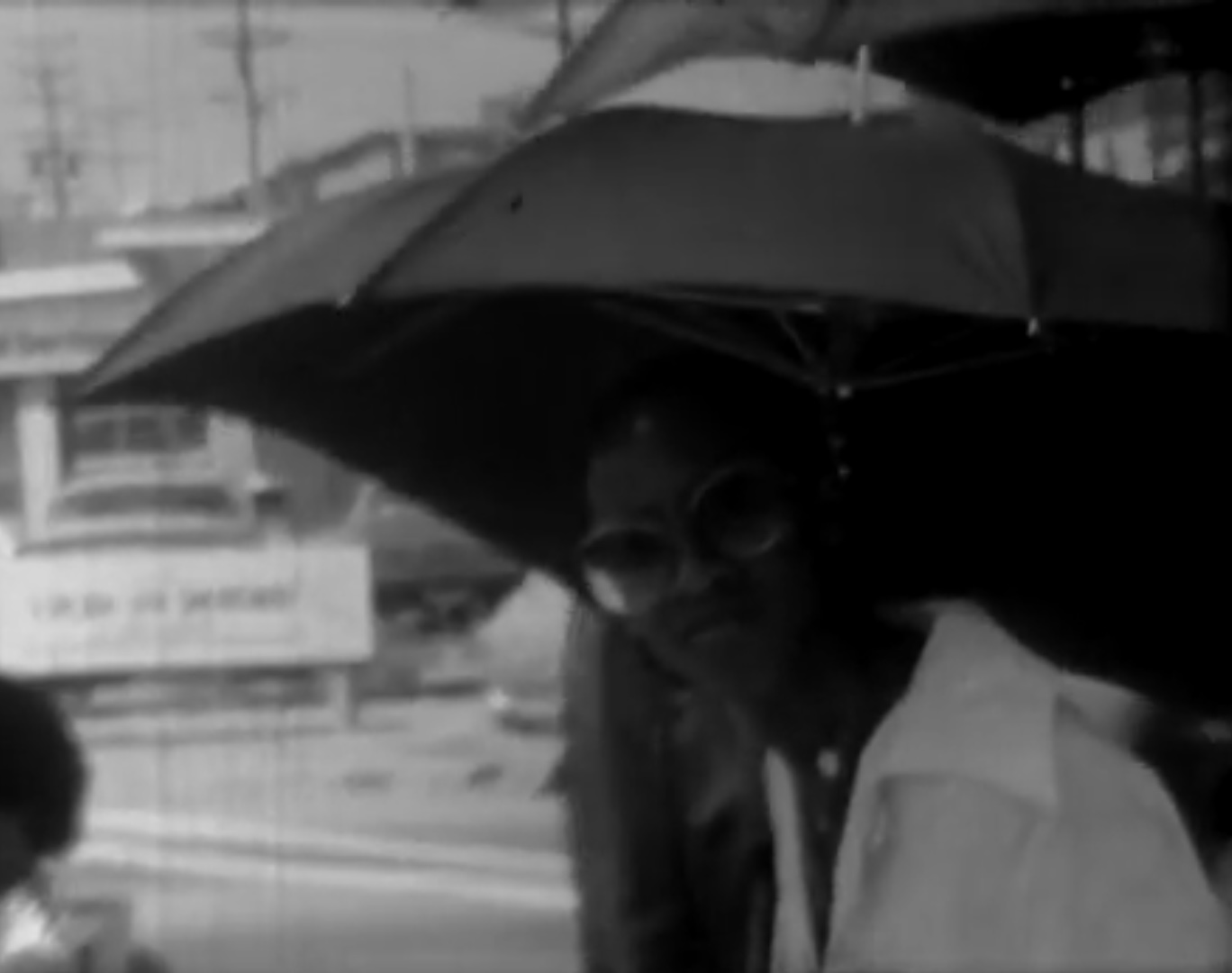
Our umbrella wielding girl misses her bus. However, in missing the bus, fate intervenes.  

In her wait, the bespectacled woman meets the bespectacled man; their almost matching sunglasses a form of sameness. 

Haitian filmmaker/actor Bernard Nicholas portrays the man whose poetry soon meshes with the woman’s, an exchanging of mental prose eloquently blending together, a voice over another voice. The urgent need for human connection becomes an apparent matter, a tie to the threads absent in their individual lives. 

Once leaving the place she desperately longs to stay, en route to work on the smooth backdrop of John Coltrane’s After The Rain, the office typist encounters an Afro haired street activist (who slightly reminisces the great poet Gil Scott Heron in his actions) demanding liberation for all. His cause becomes her cause, a precious serendipitous moment echoes the Black person’s right to exist at the edge of the Black Is Beautiful movement. She lives, travels, and works alone, finds supreme pleasure in her own company (a woman should value herself enough to celebrate her bliss, especially a Black woman existing in a society lying to her on a daily basis). Yet, the man initiates their contact in a respectful manner, tenderly, a real chivalrous sort who respects her and requests her part in the revolution, expressing that it is theirs to share. 

Her typing job of their joint manifesto…

…also becomes his duty as well. 

At sixteen minutes long, Rain (Nyesha) is a much more provocative Black romance/activism piece than many seen over the years. The film paints a beguiling, straightforward portrait, honest and authentic, a genuine caring spirit in its two central characters. Unfortunately, this remains to be Ballenger’s solely available work. While she later did the cinematography on former school mate Alile Sharon Larkin’s Dreadlocks and the Three Bears (1983), performed script continuity on Rain (Nyesha)’s Bernard Nicholas’s short film Gidget Meets Hondo (1980), and sound mixed on Gay Abel-Bey’s Fragrance (1991), Ballenger unexpectedly passed away at the young age of forty-eight on June 25, 2003. At that time, for twenty years, she had been preparing for a compelling project described in full detail from the Los Angeles Archive Collective

Nappy-Headed Lady began production in 1980 and according to notes found with the donated materials, ‘will portray a young black woman growing up in the 1960s who rebels against her parents’ desire to have her hair straightened.’ Intent on mixing documentary footage from the period to ‘connect the protagonist’s struggle with the nationwide Black movement,’ the scripted scenes were shot on 16mm black and white film over several shoots in the Springs of 1980 and ‘81.

The Archive retains 43 items related to this project, among them the following unconformed audio elements: ‘Hair Washing takes 1, 2, 3, 4,’ ‘Health Spots (Immunization),’ ‘Swimming pool scene,’ ‘Inside kitchen,’ ‘Shower scene,’ ‘Telephone conversation,’ ‘TV noise, commercials,’ ‘wild sound,’ and a ¼ inch audio cassette tape of sound effects. The only clue to how the film may have eventually looked exists as a work-in-progress edit on a DVD transfer of a ¾ inch tape, and is available to scholars via an appointment with our Archive Research and Study Center on the UCLA campus.

This incomplete version of the film, which was assembled in 1985 likely as a work sample created in the hopes of securing completion funds, hints at what the narrative portions of the story would have depicted: a teenager’s struggle to keep her ‘natural’ against her parent’s wishes, her father’s heat-soaked beat as a mail delivery man in Los Angeles, a nurse’s argument with her supervisor about her ‘unprofessional’ Afro.”
We film cinephiles missed out on what would probably have been a remarkable, deserved-to-be-made film, especially for that time when most starred straight haired Black women protagonists (if they existed)— a noticeable presentation shift from the main character of Rain (Nyesha)

Julie Dash, Alile Sharon Larkin, Stormé Bright Sweet, and Melvonna Ballenger. L. A. Archivist Collective. 

Alile Sharon Larkin, Stormé Bright Sweet, Melvonna Ballenger, and Julie Dash. L. A. Archivist Collective. 

Nappy-Headed Lady’s intriguing scene titles “swimming pool” and “shower” would likely divulge on the intimate knowledge of Black women’s psychological displeasure of water when not surrounded by the ideals of hair washing. This Wizard of Oz Wicked-Witch-of-the-West effect (Dorothy throws water on the villain and the villain melts) mirrors our overzealous reactions to what water physically does to our strands: destroys hairstyles, promotes shrinkage and potential dryness, and temporarily alters curl patterns. Oh yes, the hair dilemma is the real struggle. Imagine a Black woman character sitting poolside, refusing to swim without a protective cap or never having learned to swim due to the generational instruction to avoid water situations that do not involve shampoo and conditioner. In the shower, on a non-wash day, she would twist her body in all kinds of ways so that the spray does not touch her head. 

This film is apparently thirty-minutes in length and maybe worth making an appointment to UCLA. 

Still from Ballenger’s unfinished film, Nappy-Headed Lady. L. A. Archivist Collective

Another still from Nappy-Headed Lady. L. A. Archivist Collective.

With the jazzy renaissance that Rain (Nyesha) brings, Melvonna Ballenger delivered a quiet, satisfying narrative that has all the makings of a Black romantic classic. It simmers deeply in a poet’s soul— the repeated refrains about the woman author’s misery for the weather’s precipitation and the man’s desire for equality and peace slowly meld into a resolution that suits both parties.