Showing posts with label Alile Sharon Larkin. Show all posts

Thursday, April 25, 2024

‘A Different Image’ Breaks Down The Stigmatized Roles Ingrained In Our Mindsets


A Different Image promo image.

Alile Sharon Larkin’s A Different Image addresses the theory that some men will set women up to believe in a false friendship— a scheme that has existed since the dawning of time. They disguise their true intentions in order to become closer to another goal altogether.

That’s the unfortunate case between Alana and Vincent. 

Alana (Margòt Saxton-Federella) at rest. DP: Charles Burnett.
  
Alana draws a neighborhood boy (who later shockingly disrespects her). DP: Charles Burnett.

The stylish Alana, a talented visual artist and office receptionist, lives faraway from her family, enjoying her secluded, mix-patterned space decorated in vintage photographs of Black people and an eclectic array of objects relating to African diaspora. Her independent vibe is carefree and spiritual, the wonderful traits creatives usually exhibit. 

Alana also enjoys a camaraderie with Vincent, a young man in her class. They eat lunch together, do yoga, and read books— platonic activities. Diane, a nosy co-worker, believes that Alana and Vincent are bound to become an item soon. When dismissing the notion, no guile is in Alana’s response. No mischievous eyes or blushing smile that suggests anything more than stern disinterest. Alana buys into her friendship with Vincent one hundred percent because that is all that she hopes to obtain from him. She even requests that he give her an African name, instilling trust in such a meaningful task. 

Yet, this brings up the paradoxical question— can men and women be just that? 

What if the other falls in love and wants more? 

Vincent (Adisa Anderson) scopes out a woman (Bella Dilworth). DP: Charles Burnett. 

Ralph (Michael Bruce) encourages Vincent to act on his desires. DP: Charles Burnett.

Vincent is already seduced by societal’s masculine expectations. He often stares at the billboards and adult magazines featuring fit, beautiful women, a natural part of patriarchal conditioning that has men viewing women’s bodies as lust objects. A crude young boy who objectifies Alana while she’s drawing him signifies how early this misconduct starts. 

Although Vincent seems to want to stay on the right track, he is bitten hard by societal expectations, drawn not to seeing women beyond sexual relief. It’s displayed in how he looks at them once they past him by, his body language is suspect. Plus, his hands begin lingering too long on Alana, computing how much she lets him get away with. 

It also doesn’t help that testosterone heavy friend Ralph eggs Vincent to “do something” with Alana. Ralph— the scandalous devil on Vincent’s shoulder— believes Alana is leading Vincent on, that her friendship is only a facade that must be preyed on. Ralph presents a problematic advisor, pushing the agenda even further, conflicting Vincent’s already troubling mindset.  

Ralph is too busy with Alicia (Mandisa Oliver) to help Vincent move— again a demonstration of his deplorable character. DP: Charles Burnett.

Alana crashes on Vincent’s floor. DP: Charles Burnett.

At the climax, Alana’s trusting nature becomes her downfall to Vincent’s compromised mental state. The fault is not hers. Alana did not cause Vincent’s predatory nature to unveil itself. He is a manifestation of both his environment and the constant voice in his head (Ralph) promoting destructive behavior, unleashing the need to assert dominance. When Alana realizes that she cannot be vulnerable around Vincent, that he does not comprehend a women’s multifaceted personhood, let alone their emotional integrity and consent, the perceived friendship is tainted and unsafe. Vincent does give Alana an African name, but the bond between them has been severed, especially since he doesn’t offer a genuine explanation for his violation. She can forgive him. 

Yet, forgetting what he did…

Furthermore, Alana lives alone in an unfamiliar place, isolated with little friends. If anything, it’s easier to believe that she will eventually cut ties with Vincent. She may find another who respects her boundaries or searches for positive girlfriends. At least she has art to express her innermost emotions in the meantime— the best form of therapy and happiness. 

A conflicted Vincent tries to play cards. Does he understand that what did to Alana was wrong? Is that what guilt looks like? DP: Charles Burnett.

A guarded Alana in deep thought, perhaps unsettled by both the burden of her own naivety and trying to move past Vincent’s corrupt behavior. DP: Charles Burnett. 

Images are the first things we understand before words and definitions. Beneath certain pronounced cues delivering outdated gender norms, subliminal messages can have lasting effects as demonstrated in Vincent’s character. 

A Different Image harbors between short film and feature-length, containing the moralistic edge apparent in most L. A. Rebellion works. A few renowned members provided aid to writer, producer, and director Alile Sharon Larkin— Charles Burnett as cinematographer and Julie Dash on continuity. The actors played their roles well— Margòt Saxton-Federella in her only part and Adisa Anderson (Daughters of the Dust) present a conflict that still exists today. It’s a familiar story about society’s mental interference, women’s roles in a limited man’s imagination, and that women must still have to be careful about “wolves in sheep’s clothing.” 


Thursday, January 26, 2023

‘Rain (Nyesha)’ And Other Nods to Melvonna Ballenger

Still of Evlynne Braithwaithe as the woman from Melvonna Ballenger’s Rain (Nyesha), 1978. 

Melvonna Ballenger, a Communications graduate of Howard University, was another exceptional Black woman studying at the UCLA to become a filmmaker, befriending the likes of Alile Sharon Larkin, Stormé Bright Sweet, Zeinabu irene Davis, Jacqueline Shearer, and Julie Dash during the incredible occurrence otherwise known as the L. A. Rebellion.

Rain (Nyesha)—made as her “Project One” MFA assignment and accessible on the UCLA Film & Television Archive YouTube channel— showcases Ballenger’s commendable filmmaking promise as a twenty-four-year-old film student. She voices over the black and white short which combines the grainy moving image with experimental poetry and sound; centering on a hard working Black secretary who dreads the weary weather that invades her otherwise mundane daily routine. After some heartfelt complaining and reluctantly getting out of bed, the single Black woman draws a white robe over her white chemise and wanders about her sparse, immaculate apartment. She turns on the radio knobs, switching on station after station. In a perfect, utterly charming coincidence, they each play songs about rain including Lena Horne’s Stormy Weather, Nancy Wilson’s rendition of Don’t Rain on My Parade, and The Dramatics classic In the Rain. 

Our umbrella wielding girl misses her bus. However, in missing the bus, fate intervenes.  

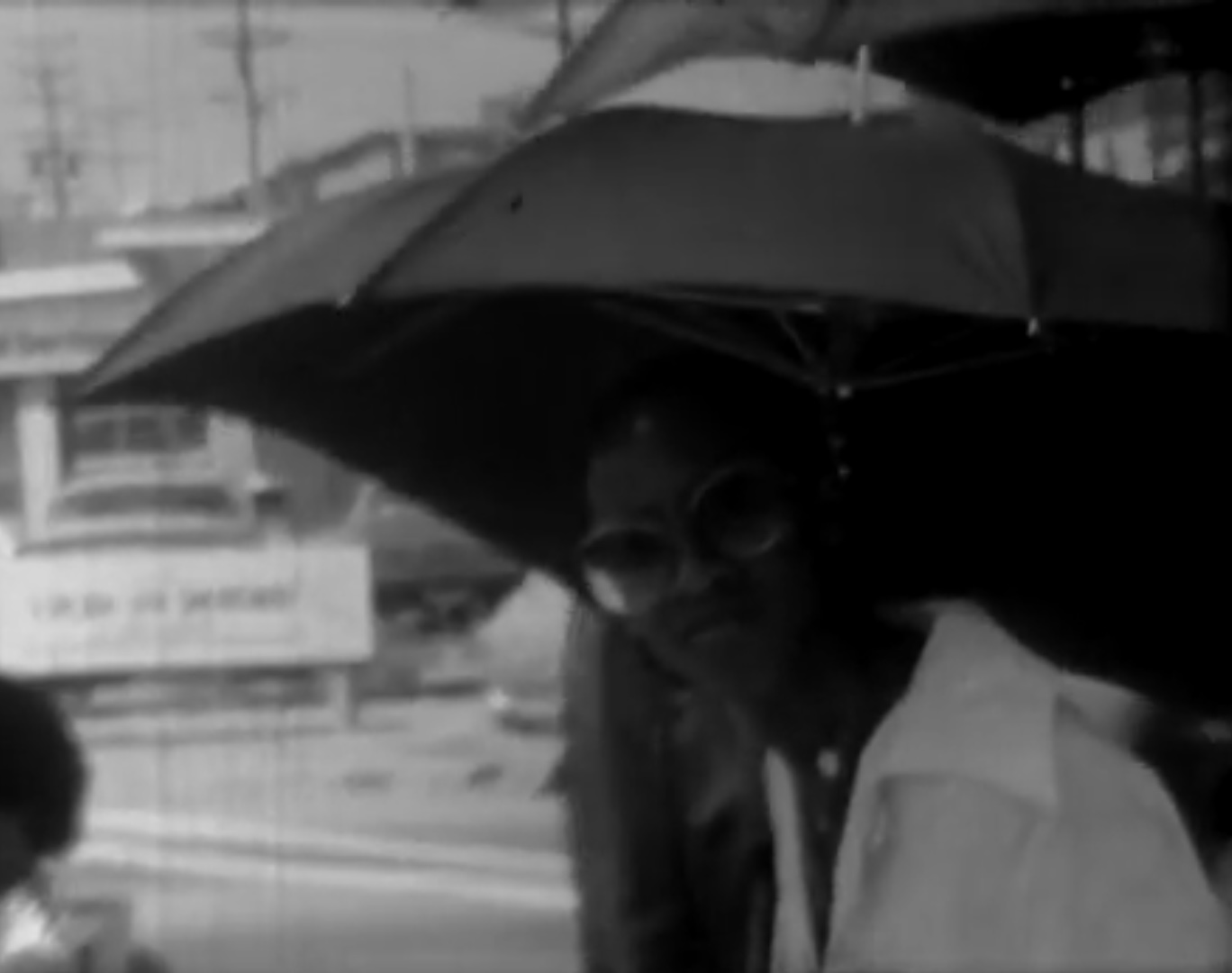
In her wait, the bespectacled woman meets the bespectacled man; their almost matching sunglasses a form of sameness. 

Haitian filmmaker/actor Bernard Nicholas portrays the man whose poetry soon meshes with the woman’s, an exchanging of mental prose eloquently blending together, a voice over another voice. The urgent need for human connection becomes an apparent matter, a tie to the threads absent in their individual lives. 

Once leaving the place she desperately longs to stay, en route to work on the smooth backdrop of John Coltrane’s After The Rain, the office typist encounters an Afro haired street activist (who slightly reminisces the great poet Gil Scott Heron in his actions) demanding liberation for all. His cause becomes her cause, a precious serendipitous moment echoes the Black person’s right to exist at the edge of the Black Is Beautiful movement. She lives, travels, and works alone, finds supreme pleasure in her own company (a woman should value herself enough to celebrate her bliss, especially a Black woman existing in a society lying to her on a daily basis). Yet, the man initiates their contact in a respectful manner, tenderly, a real chivalrous sort who respects her and requests her part in the revolution, expressing that it is theirs to share. 

Her typing job of their joint manifesto…

…also becomes his duty as well. 

At sixteen minutes long, Rain (Nyesha) is a much more provocative Black romance/activism piece than many seen over the years. The film paints a beguiling, straightforward portrait, honest and authentic, a genuine caring spirit in its two central characters. Unfortunately, this remains to be Ballenger’s solely available work. While she later did the cinematography on former school mate Alile Sharon Larkin’s Dreadlocks and the Three Bears (1983), performed script continuity on Rain (Nyesha)’s Bernard Nicholas’s short film Gidget Meets Hondo (1980), and sound mixed on Gay Abel-Bey’s Fragrance (1991), Ballenger unexpectedly passed away at the young age of forty-eight on June 25, 2003. At that time, for twenty years, she had been preparing for a compelling project described in full detail from the Los Angeles Archive Collective: 

“Nappy-Headed Lady began production in 1980 and according to notes found with the donated materials, ‘will portray a young black woman growing up in the 1960s who rebels against her parents’ desire to have her hair straightened.’ Intent on mixing documentary footage from the period to ‘connect the protagonist’s struggle with the nationwide Black movement,’ the scripted scenes were shot on 16mm black and white film over several shoots in the Springs of 1980 and ‘81.

The Archive retains 43 items related to this project, among them the following unconformed audio elements: ‘Hair Washing takes 1, 2, 3, 4,’ ‘Health Spots (Immunization),’ ‘Swimming pool scene,’ ‘Inside kitchen,’ ‘Shower scene,’ ‘Telephone conversation,’ ‘TV noise, commercials,’ ‘wild sound,’ and a ¼ inch audio cassette tape of sound effects. The only clue to how the film may have eventually looked exists as a work-in-progress edit on a DVD transfer of a ¾ inch tape, and is available to scholars via an appointment with our Archive Research and Study Center on the UCLA campus.

This incomplete version of the film, which was assembled in 1985 likely as a work sample created in the hopes of securing completion funds, hints at what the narrative portions of the story would have depicted: a teenager’s struggle to keep her ‘natural’ against her parent’s wishes, her father’s heat-soaked beat as a mail delivery man in Los Angeles, a nurse’s argument with her supervisor about her ‘unprofessional’ Afro.”
We film cinephiles missed out on what would probably have been a remarkable, deserved-to-be-made film, especially for that time when most starred straight haired Black women protagonists (if they existed)— a noticeable presentation shift from the main character of Rain (Nyesha). 

Julie Dash, Alile Sharon Larkin, Stormé Bright Sweet, and Melvonna Ballenger. L. A. Archivist Collective. 

Alile Sharon Larkin, Stormé Bright Sweet, Melvonna Ballenger, and Julie Dash. L. A. Archivist Collective. 

Nappy-Headed Lady’s intriguing scene titles “swimming pool” and “shower” would likely divulge on the intimate knowledge of Black women’s psychological displeasure of water when not surrounded by the ideals of hair washing. This Wizard of Oz Wicked-Witch-of-the-West effect (Dorothy throws water on the villain and the villain melts) mirrors our overzealous reactions to what water physically does to our strands: destroys hairstyles, promotes shrinkage and potential dryness, and temporarily alters curl patterns. Oh yes, the hair dilemma is the real struggle. Imagine a Black woman character sitting poolside, refusing to swim without a protective cap or never having learned to swim due to the generational instruction to avoid water situations that do not involve shampoo and conditioner. In the shower, on a non-wash day, she would twist her body in all kinds of ways so that the spray does not touch her head. 

This film is apparently thirty-minutes in length and maybe worth making an appointment to UCLA. 

Still from Ballenger’s unfinished film, Nappy-Headed Lady. L. A. Archivist Collective. 

Another still from Nappy-Headed Lady. L. A. Archivist Collective.

With the jazzy renaissance that Rain (Nyesha) brings, Melvonna Ballenger delivered a quiet, satisfying narrative that has all the makings of a Black romantic classic. It simmers deeply in a poet’s soul— the repeated refrains about the woman author’s misery for the weather’s precipitation and the man’s desire for equality and peace slowly meld into a resolution that suits both parties. 


Sunday, August 27, 2017

Black Women Filmmakers of the 1970's And Where They Are Now

Barbara O (who played the wonderful Yellow Mary in Daughters of the Dust) is the title woman living simply above mountaintops.
Lightbox Film Center shared six pieces from four black women writer/directors. Julie Dash (Daughters of the Dust), Alile Sharon Larkin, Fronza Woods, and the late Jacqueline Shearer (Eyes on the Prize) were granted rare showing, some 16mm films seen for the first time in years. These profoundly significant works made it important to know who these four women pioneers were, why they mattered, and where they are now. Unfortunately, they have paltry IMDb biographies. The information is further scarce on Woods and Shearer. No good quality photographs of them exist on the internet.

The black nun writes profusely.
Diary of an African Nun, a black and white picture, eloquently rendered a great Alice Walker short story. Pious Ugandan nun is indebted to her white sisters, the ones who inspired quiet marital bliss. She is comforted by cold showers, picturesque window views, and writing daily prose. The narrative, however, grows darker as she reveals pangs of being an "exotic stranger," a fascinating relic to travelers who question her nunnery decision. Among dangling rosary beads and hinged cross, she writes and speaks with soft tenderness, a vision of black woman innocence draped in demure black and white cloth. Suddenly, an escape from a Gothic religious horror, the camera pans creepily onto that hanging cross, zooming onto white savior version of Jesus, the tormented angles of his body, the sorrowful downcast eyes, the nails in his feet. As the black nun narrates, the music is stilted, passionate as the fire of her voice, articulating her agency, the push and pull of freedom and caged bird.

Linda Martina Young embodies Nina Simone's Aunt Sarah, Saffronia, Sweet Thing, and Peaches in Dash's Four Women (1977).
Four Women uses hauntingly raw albeit controversial Nina Simone ballad. Linda Martina Young, a light skinned dancer, plays all four characters. While Saffronia is yellow and Sweet Thing is tan, Aunt Sarah and Peaches are black and brown respectively. The solitary dancer moved to piano keys trembling underneath inherited pain following struggles of black women archetypes/colorism. In each segment, she changes clothes, hats, and hairstyles, signifying time periods. As sophisticated the choreography and luscious the cinematography, it couldn't escape problematic flaws of using this one sole body to portray what Nina specifically conveys.

While What Happened, Nina Simone?, directed by Liz Garbous, a white woman was heavily praised, Cynthia Mort's Nina was a fabricated, grossly ingenuous mess featuring Zoe Saldana in black face. Everyone wrote about the disgrace including Nina's daughter Simone and MacArthur Fellow Ta-Neshi Coates. Now Adepero Oduye (inspired by Coates' essay) and Gabourey Sidibe have joined in the fray. In her second directed short, To Be Free, Oduye plays Nina. Sidibe's version of Four Women, called The Tale of Four, stars Ledisi as Aunt Sara, Meagan Kimberly Smith as Saffronia, Dana Gourrier as Sweet Thing, and Aisha Hinds as Peaches. Playwright Christina Ham takes the song to heightened degrees. She plays Peaches, who meets the other three at 16th Street Baptist Church in Birmingham.

Moreover, though Dash's Four Woman presents a stunning visual, but it falls flat in terms of the meaning behind this powerful song.

Out of the four black women filmmakers, New York City born Julie Dash has the most concrete biography. She is present in social media, including an active Twitter account. With Daughters of the Dust, released in 1991, Dash is the first African American woman to have a film released in the United States- a little late than never. A member of the L.A. Rebellion, during her years at UCLA, she joined other filmmakers such as Haile Gerima, Zeinabu irene Davis, and Barbara McCullough for the right to show and make black centric films. She directed music videos for Tracy Chapman, Tony! Toni! Tone!, and Adriana Evans. She has been nominated for many awards including the Sundance Film Festival Grand Jury Prize and a Directors Guild Award for Outstanding Directional Achievement for Primetime Movies Made for Television-- another black woman first. Her films have won NAACP and Black Reel Awards. Daughters of the Dust has been restored, remastered, and rereleased, earning a well-earned place in the Library of Congress.

Still keeping busy, Dash is currently working on Traveling Notes for a Geechee Girl and directed Queen Sugar's ninth episode of season two (coming up in October).

Despite what IMDb and Google would have a researcher believe, Angela Burnett, who played intelligent Ruby in Alile Sharon Larkin's Your Children Come Back to You (1979), is niece of renowned L.A. Rebellion filmmaker Charles Burnett and costume designer Gaye Shannon-Burnett- not their daughter.
Your Children Come Back to You strongly nailed everything that is still wrong with American society. The little girl protagonist embodied overused adjective "woke." In a poverty stricken ghetto rife with trash and struggle, lives a single pregnant mom raising this feisty precocious child. She is frank, way above her years. Her wild imagination places Africa with positive symbolism, implanted by her father who left his young family for Africa. A wealthy married sister is obsessed with adopting her brother's niece, believing that welfare is an improper place to raise a child.

"Are you adopted, Auntie?"

The little girl recites an allegorically layered story to her spoiled, disillusioned aunt, that specifically addresses this question asked three times. It goes (paraphrasing): once upon a time there was a Mother (Africa) whose children were stolen from her (ala slavery). She wept and wept, grieving each loss. The thieves instilled their way of thinking (colonialism) into the children. Whilst forcing them to work hard, they gave them new names, new religions, new languages. Eventually, however, some of the children (adults) come back to her (Africa), one by one, remembering the gift of life (ancestral heritage) that she gave them.

The outraged aunt immediately wanted her niece away from this school too, glaringly revealing her self-hatred, ignorance. Now in America, it is easy to manipulate children, to persuade them into buying fictional accounts-- "Christopher Columbus was great," "treasure our founding fathers of George Washington, Thomas Jefferson," and so forth. Conditioned individuals, like the aunt, believe everything they were ever told and strive to live as closely to white people as possible. With fancy house containing polished silver and glass, the little girl knew that her aunt allowed herself to be adapted, to allow being rich in materialism to outweigh hereditary affluence.   

Your Children Come Back to You is an exceptional piece that sound be shown widely. It has a terrific message, asking the audience, who do you want to be-- the aunt, the mother, or the child?

In addition to winning film awards from the Black American Cinema Society, Black Filmmaker Foundation, and runner up prize from FILMEX, Chicago hailed Alile Sharon Larkin is an author, artist, and award winning educator, having taught early education to college. Dreadlocks and the Three Bears Productions, her production company, "creates Afrocentric and global multimedia and arts experiences for children and families." She continued making more shorts including The Kitchen, A Different Image, and a children's animated film, Dreadlocks and the Three Bears.

A still from Fannie's Film (1979).
In Killing Time, a satirical soliloquy, a brown actress contemplates suicide. When the film opens, she appears already gone, lying on her bed, eyes closed, body still, phone off the hook. A second flashes, she is up like a charged battery, sweeping through a chain of motion, trying on different clothes, flopping back and forth on wanna be deathbed. She plans this death like a stage set, wanting it to be theatrically creative. Her hilarious inner monologue is sarcastic deadpan, a drone pitch of someone defeated, purposeless. There is no explanation to her misery. Suicide is a strange road to take humor on, but between burning undergarments in the oven, deciding an exacto blade is too messy, and ripping crisp white pants ruins a jump off the fire escape, Woods does so with morbidly fascinating delivery.

Frannie's Film, lighthearted and sweet, centers on a charming elder cleaning woman who absolutely loves her role at an all white gym. Fannie is not the average well-to-do black custodian. She talks about her upbringing with glee as the camera focuses in and out on her wiping down a mirror, giving her visibility and invisibility at once. In the same breath, she can be candid about simplicity of marriage. Her independence is a source of pleasure, where she has everything she needs, and is fulfilled, rustic voice singing "Amazing Grace."

Fronza Woods, according to Women Make Movies, is "a Detroiter turned Manhattanite." In addition to her only two short films (a huge, crushing loss), she worked as an assistant sound engineer on The Brother From Another Planet (which stars Emmy winner Joe Morton) and taught as an Associate Professor of Film at University of Wisconsin, Milwaukee.

She lives in France and has co-translated several books on aesthetics with Simon Pleasance.
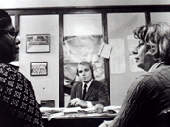
This tiny cap of Jackie Shearer's A Minor Altercation (1977) seems to be only proof the short film existed.
Brilliant A Minor Altercation is the longest at half an hour long. In a girl's bathroom at a Boston high school, a white girl, angry that she didn't get into a computer class, instigates a melee with a black student, who the counselor coerced into taking the class. They are both suspended for fighting. Furthermore, the larger complex issue is how both families discuss the matter in their respective homes. The women operate on soothing levels, wanting their daughters to stay at the school, but the fathers want opposite, the angry white father going as far as using the "n" word to state a racist point.

Both mothers decide to head up to the school, three days before they're supposed to, in order to discuss the matter-- primarily a concern of the guidance counselor. Of course the guidance counselor is not present. The early arriving black mother is faced with atrocious disrespect whereas the later white mother is cooed and prodded, even allowed to go into the principal's office first.

A Minor Altercation  is another that should be shown in classrooms. The discussion about how families discuss race/racial problems operates on different wavelengths.

Boston native Jackie Shearer was a graduate of Brandeis University. She also founded a documentary company and worked for her hometown radio and TV stations. As a documentarian, Shearer wrote and directed episodes of Eyes on the Prize and produced/directed American Experience's episode, Massachusetts 54th Colored Infantry.

On IMDb, rests this sole personal statement in her barren biography:
Much to my own relief, I found that there was nothing for me to be ashamed of in the story of Blacks and their participation in the Civil War. Black soldiers hadn't been the unwitting dupes I had once imagined them to be. It was these men who were the bedrock of abolitionism, not well-intentioned, benevolent whites as history has claimed.
Shearer sadly passed away at the age of 46 of colon cancer four days before her birthday.