Showing posts with label Bridgerton. Show all posts

Sunday, July 26, 2026

‘This Tempting Madness’ Torments The Unreliable Heroine With Unusual Degrees Of Pain And Suffering


This Tempting Madness film poster.


Based on a jarring true story, This Tempting Madness opens on Mia dramatically falling. The back of her body suspends in a slow moving arc towards a terrifying bottom, her voluminous hot orange dress spreading out its lush folds in flowery fashion, powerless to cushion against the devastating plight. Without warning, her vulnerable front faces the full brunt of impact. She screams “no!” as sounds of her cracking bones strike against surface after surface, sending bloodcurdling chills down the apprehensive watcher’s spine. Was she violently pushed or had she accidentally lost footing and tripped? Is it not any wonder that she manages to miraculously cheat certain death?

However, Mia surviving these cataclysmic bodily injuries isn’t the sole surprise. Her memory exists in startling fragments that cause ruptured behavioral changes— severe mood swings coming from somewhere deep within. Moments contain a kind, sweet wife and attentive mother standing by her husband Jake’s side. Others showcase an ambitious woman reaping the benefits of her privileged upbringing, either callously putting an often anxious Jake on edge or threatening anyone in her vicinity with intended violence.

Mia’s brother Ajay (Suraj Sharma) seems to be her only friend. DP: Andrew Davis.

Mia’s tied to her family, primarily Ajay, her older brother, a constant, loyal presence at her side. Every time she awakens, pained and grinding teeth, Ajay is there assuring her that she’ll be alright. Yet, Mia only prioritizes Jake. Despite having a damaged mind struggling to grasp normality, Mia becomes a full out menace, crying, whining, and screaming about Jake, believing wholeheartedly in an unproven innocence. 

Furthermore, in a world ruled by patriarchal cruelty, Mia’s mental capacities dissolve into a delusional territory where men can do no wrong. Has all such histories been replaced by the overwhelming compulsion to remain at a husband’s side? Does she not realize that their behaviors alter like clockwork more often than not? An irrational, gravely injured Mia appears to be overcompensating for a happily ever after romance as her own flashbacks give hints that she and Jake do not exemplify a love match. Their chilly relationship lacks warmth and affection including a cold Mia pleasuring herself with a scowling Jake watching. Somehow a daughter was created from this arrangement.  

The film blends mystery, thriller, and medical horror, the best parts navigating through Mia’s reset after trauma, the ways that words and sounds trigger reactions that sometimes frighten her family. The young woman has much to process—being in considerable pain and danger, wearing a metal brace to hold up her chin, prone to excess bleeding as her deranged husband blames her for his own failings. Jake seems to reserve a certain hatred for Mia and her family, has likely hated her for quite some time and tries to convince Mia that the incident was her fault.  
  
Although the story begins on a descent, it ends by arousing more questions than generating any real answers. Were we supposed to root for a woman’s revenge on her abusive husband or a broken, depressed man desperate to escape a family obsessed with success? 
 
Mia finally sees her man in jail and tells him straight up that she believes in his innocence. DP: Andrew Davis.

This Tempting Madness had been on the watchlist since last year’s announcement and hot orange dress scene. Unfortunately, the film proved to be even more limited in theater screenings than Me, You, and Tuscany and Is God Is. No nearby major outlets or small art houses played it. The neon color saturations and unique sound design—among the film’s most solid strengths— would have alone enhanced this cinematic experience. The first time viewing on an iPad robbed an allowance of a big screen and surround speakers. Independent films with a raw, stark edge face greater challenges, especially when helmed by new women filmmakers. Sadly, that struggle will continue if they seek directing a second picture, typically another barrier for them to break through. 

With a certified fresh Rotten Tomatoes seventy-seven percent score, This Tempting Madness has its highlights. Director/co-writer Jennifer Montgomery’s feature-length debut spins an unusual narrative whilst unearthing a stellar performance out of her lead actress Simone Ashley. Cinematographer and co-writer Andrew Davis’s skilled camera work includes multiple point of views on Mia’s fall and the spectacular underwater visuals. Rebekka Karijord’s music composition that understands the complications necessary to fit scene moods. Thus, it must be the actor’s dream of having a physically demanding part whilst demonstrating the many emotional facets that Mia expresses throughout— disorientation, frustration, rage, humility, grace, genuine and forced happiness. Ashley’s complexity exhibits a broad range of psychological depths just by sheer body language. Her tenacious ability to showcase the necessary talents to reveal her character’s unreliable narrative proves what we have been saying all along in regards to her bare presence in the last few seasons of Bridgerton, her own starring season two appearance limited her character’s overall arc and voice. Suraj Sharma (star of Ang Lee’s Oscar winning triumph Life of Pi) also has a commendable supporting role as Ajay, a character who sticks so close to his sister and seems to be hiding his own dirt. 

Mia gives Hitchcockian psycho energy as she wields a knife for self-defense. DP: Andrew Davis.

This Tempting Madness is a must see for its calculated build up of eerie atmospheric tension in the realms of Mia’s mind, the pushes and pulls that affect an off balanced psyche. 


Sunday, April 19, 2026

‘You, Me, and Tuscany’ Chronicles The Life of A Traveling Black Girl Still In Mourning


Me, You, and Tuscany film poster. 

Kat Coiro’s Me, You, and Tuscany provides a refreshing escape to gorgeous scenic Italy, a dream for Anna (The Little Mermaid’s Halle Bailey) and a livelihood for Michael (Bridgerton season one’s Regé-Jean Page). Ryan and Kristin Engle’s co-written screenplay fights against a formulaic nature— as far as romantic dramedies go. One saving grace examines how holding onto grief can have not only a suitcase, it has a passport too. A mourner prefers to travel everywhere with infinite sadness and sometimes infinite sadness mixed with questionable choices. Anna has been doing the most as an Atlanta born, New Yorker, trying out people’s lives for size as a house sitter— employment that screams temporary and unsettled. After the passing of her mother (played in flashback photographs by Joy Bryant aka Cherish the Day’s Chef Sunday St. James), Anna breezily floats through daily routines, masking her pain in charades. 

And there’s consequences to internalizing pain. 

Brash decision maker Anna (Halle Bailey) takes in the sights. DP: Danny Ruhlmann.

When the opportunity comes for Anna to take her act on a bigger scale— in Tuscany—she sees it as kismet. Anna’s late mother already purchased her a plane ticket and the poor girl has five hundred dollars burning a hole in an otherwise nonexistent wallet. The poetic sentiment is that, yes, broke and broken Anna has no real luxuries or grand wealth. There’s this eccentric belief that impoverished people don’t deserve nice things, that they should be grateful for what they can afford— don’t go above and beyond, a notion historically reserved for Black people. Anna—a few credits shy off graduating culinary school— needed a carpe diem moment and seized a courage missing from herself, choosing to fly solo on the other side of the world and taste the fantasy she and her mother had originally planned. The best parts are Anna strolling around in lovely outfits, cherishing the countryside, breathing it all in, expressing pure joy and contentment. Her contagious excitement saturates every scene, making it all the more believable that an entire family could fall in love with her. She’s an utterly radiant gem even when lying through her teeth. 

Anna (Halle Bailey) and Michael (Regé-Jean Page) with the fresh fare for the family restaurant. DP: Danny Ruhlmann.

Enter Michael— the British born man who adores his adopted Italian family— is a “Mr. Steal Your Sandwich” with a touch of a “Mr. Steal Your Girl” type. He’s attractive on the eyes with a deep English accent that’s sure to boil over fine olive oil and quite serious about family, wine, and Mario’s Let Me Love You— a twenty-two-year-old R&B ballad. Sadness lingers about Michael too, wielding around him like a protective shield—a key similarity that he and Anna have in common. Although he lost his biological parents way before her, grief never ever truly fades. Michael’s initial distrust of Anna gradually dissolves over the three day course. 

However, Michael is farther along in life than Anna, staying on an impressive vineyard, operating the vast lands with a pet pig on deck— so he’s financially sound and probably well traveled. Anna has only just begun to follow her passion, a flower on the verge of blossoming. Power imbalance situations are not best in reality. They’re quickly falling for each other through significant glances, lingering touches, and speak briefly on grief. They don’t have heavier conversations, primarily on their current life positions. Michael had scoffed at Anna being at house sitter and Anna made fun of his intense demeanor. 

Despite the youthful appearance of Anna and Michael’s portrayers Halle Bailey and Regé-Jean Page, there is a twelve year age gap between them. Consider great films such as Kathleen Collins’s Losing Ground, leading lady Seret Scott (Sara) was fifteen years younger than Bill Gunn (Victor) and twelve years younger than Duane Jones (Duke). Ever After, one of cinema’s best Cinderella adaptations features Drew Barrymore’s Daniela and Dougray Scott as Prince Henry, a ten year age gap between the actors. Every Jane Eyre adaptation must have a gap (personal favorite is the Ruth Wilson and Toby Stephens version, thirteen year age gap). Small potatoes compared to the twenty-five-year gap for Charade or the eighteen years in Pretty Woman. Bailey and Page do have chemistry, but the screenplay does not warrant enough to be memorable beyond its time. 

Anna (Halle Bailey) and her dear friend Claire (Aziza Scott) eating good in Matteo’s dime. DP: Danny Ruhlmann.

“Don’t call me from no Italian jail!” exclaims Claire, a real friend. DP: Danny Ruhlmann.

Side character girlfriends are usually single women living vicariously through the main girl (i.e. every character Lisa Nicole Carson Nicole Carson plays in the 90s). Claire (Aziza Scott), a happily married soon-to-be mom, works at a prestigious hotel where she’s obviously given Anna help whenever possible. Claire is reminiscent of Courtney Taylor’s Grace in The Invitation— funny and blunt one-liner deliverer yet stays behind while bestie puts herself in potential overseas danger. Grace calls Evie to ensure she’s okay (in vampire territory) and Claire provides the same for Anna (nothing supernatural but real-life monsters are present). Anna also gets a sassy male soundboard for the remainder of the film (and he has more scenes than Claire). Maybe we could get a Claire prequel, Me, You, and the Caribbean Cruise— let’s see how Anna’s dearest friend scored her own bae. Claire’s “convenient” pregnancy bars her from an ending similar to Evie and Grace (the best part of a terrible film), robbing us of her in-person meeting with Anna’s new “family.”

Anna and Michael sweetly run across the endless fields. DP: Danny Ruhlmann.

Matteo is the main gripe— the epitome sufferer from clunky writing. He’s the catalyst for Anna’s decision making and also prodigal son and short term villain? First, Matteo’s failed seduction attempt at the hotel bar turns into Anna’s encouragement to follow her dreams. It also turns out he’s been gone for a little over a year yet the family acts as if he’s been gone for decades. Then again, maybe that’s how close-knit families tend to behave. Anna lost her mother in the same time frame and hid her grief behind drifting nowhere. Still, Matteo returns home, issues Anna two ultimatums within a day. Meanwhile, Matteo’s ex-fiancée is conveniently all over him— and this storyline goes into predictable territory. Also, Matteo’s behavior at the races makes a person wonder why did the family miss this obnoxious jerk so much? His only saving grace was allowing a reluctant Anna to bestow her dormant kitchen talents even though he had never tasted her food before. 

The other pitfall is that the film cannot escape its obvious all-white production (having sole Black producer Will Packer on the press run circuit didn’t help matters). Anna and Michael’s characters feel as though they can be played by anyone. The dialogue is too cliched and unnatural. Claire calling Anna’s situation a little too Get Out seemed not only a big red flag, but an authentic reality to the situation at hand. Anna and Michael are in fact the only two brown people in Tuscany and Matteo’s family are too ready to invite Anna into the fold within three days. The timeline is simply not believable. 

Still, the highlights involve Anna coming into her own, becoming a culinary cook that her mother would have been proud to see. Oftentimes, an unfamiliar environment can either bring out the need to be another person (as Anna sought out to do) or enrich the potential longing to break out of them. Anna’s self reflection, her realizing her strengths was almost stronger than the instant romance between her and Michael. 

In her first ever woman-directed feature-length film (and hopefully not her last—please Black women directors), Halle Bailey continues to prove her star power. She’s able to be sweet, rebellious, innocent, and saucy while an uplifting poster girl for natural hair wearers— locs are always impeccably styled on every film set. Other solid cast decisions include the hilarious Stella Pecollo as Matteo’s sister Francesca (although could easily read as a Bridesmaids Melissa McCarthy knockoff), Stefani Cassini as Matteo’s observant, advice-wielding grandmother Nonna, and the aforementioned stellar Aziza Scott as Claire. 

Anna is no longer afraid of getting her edges wet. DP: Danny Ruhlmann.

Overall, Me, You, and Tuscany plays it a little safe and expectant. The film contains funny, relatable, and charming moments, some titillating pleasures for those desiring unrealistic fantasies that chick flicks promise. The cinematography gives a gratifying look at rich, splendorous Italian scenery through Anna’s wide expressive eyes and the soundtrack includes a catchy Leela James song in addition to a lovely callback of Page and Bailey both singing Mario. It’s definitely directed towards the spirited Black girls and Black women who dare to freely roam the earth as time and money are both limited, obtaining knowledge in all the ways that guarantees valid and valuable experiences. Stay to witness Anna’s therapeutic journey through seeing a new culture up close and personal and building community with the people around her. Of course, remain seated for the hilarious end credit scenes adding another barrel of laughs. 


Friday, July 4, 2025

Viscountess Kate & Viscount Anthony Moments From Bridgerton Season Three, Part II (Spoiler Heavy)


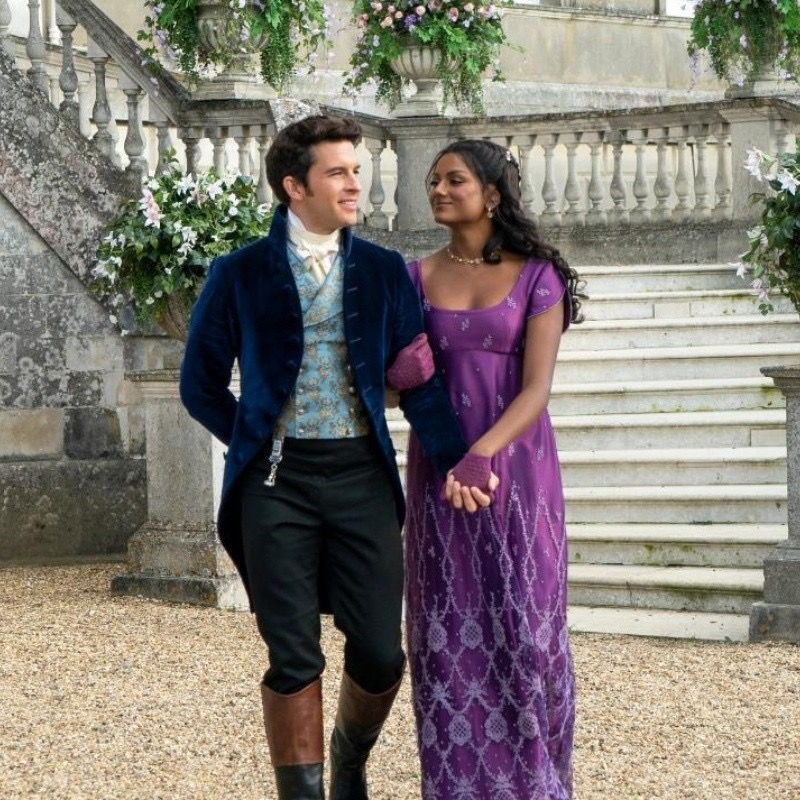
Kate (Simone Ashley) and Anthony (Jonathan Bailey)’s short-lived return takes endless missteps. DP: Alicia Robbins. 

A year before the Benedict centered fourth season debuts, this long awaited second part sheds light on more moments that Viscount Anthony Bridgerton and his lovely wife Viscountess Kate Bridgerton’s shared in Bridgerton season three. The viscount and the viscountess have nineteen minutes across the two episodes: Tick Tock and Joining of Hands, more than the paltry eight minutes depicted here.

Kate in her trademark contemplative state. DP: Alicia Robbins.

Writers are often instructed to “show, not tell.”

Kate and Anthony vocalize accounts without the production giving them the necessary screentime. For example, in Tick Tock, season three’s fifth episode, Kate and Anthony take a grand carriage ride back to the Bridgerton family home, returning from another extended offscreen holiday. Kate’s expecting their first child despite their sparse love scenes always showing Anthony giving his wife oral penetration as opposed to the usual way that pregnancy is achieved. Now this bears no disregard on the emphasis of women’s gratification being the pinnacle pleasure hallmark as male-dominated films and television programs historically placed a man’s desire above all else—consent or not. Yet, it’s questionable choices to have their most intimate moments tucked away, left onto the watcher’s imagination as opposed to using these two gifted actors with phenomenal chemistry to depict these acts on camera. Otherwise, the behind-the-scenes decision making seems to invent that their child came from a stork or happens to be immaculately conceived. 

An insatiable Anthony wants what he wants whenever he wants unfortunately things couldn’t become too steamy as…

Newton, nation’s favorite corgi, was watching. DP: Alicia Robbins.

Furthermore, in season three, episode seven’s Joining of Hands, Anthony talks to Colin about his nervous jitters and drinking profusely before his second wedding— a wedding yet to be seen. A flashback would have helped move the eldest brother’s thoughts along, but of course, this wasn’t Kate and Anthony’s season anymore. We are no longer supposed to care about them, invest in the fragmented puzzle pieces of their happiness, of just how their nuptial bliss came about. Were there lilies filling and smelling up the place— in a church or outside someplace? Did it happen around morning or near evening? What did they wear? Had Kate and Anthony wrote their own vows? What did they say to each other? Where was the barely mentioned Mary— Kate’s stepmother? 

Kate and Anthony being pure and affectionate. DP: Jeffrey Jur.

The laziest, most offensive writing involves Kate recounting her sister Edwina riding horses and marrying a scholar (as she DID in the book). Anthony senses his wife’s displeasure and suggests that they take a third holiday— to India. While completely understanding that Anthony adores his wife, it’s unbelievable that he would shirk his familial obligations and present a dangerous opportunity to a pregnant woman. All the money in the world (during that particular time period) would not protect Kate from the dangers of extended boat travel. The Bridgerton series as a whole takes extreme liberties disregarding the appropriate history, hair, fashion, and music— but this eccentric direction feels an aggressive slight to remove Kate and Anthony, to not even let them linger in the background. 

Overall, Simone Ashley and Jonathan Bailey delivered the smoldering gold that keeps us connected to Kate and Anthony’s love story. Yet season three presence reemphasizes downplaying a great couple deserving to be championed onscreen and off. Sure, there are promising moments worth rewinding— a dance, smooches, Kate hosting her first function as viscountess, a game of charades, Newton appearances, and vulnerable conversation. It’s simply not enough for a couple of this excellent caliber— a couple with many potential storylines that twenty plus minutes sporadically sprinkled across a few episodes will not cut. 

Shondaland should invest in a Kate and Anthony spin off series like yesterday. 


Thursday, July 3, 2025

Supporting Two Entities Through The Storms Ahead


Simone Ashley and Jonathan Bailey promoting a show that barely promoted them and their season.

Last night, I dreamed about meeting Jonathan Bailey and Simone Ashley (Netflix Bridgerton’s Viscount Anthony Bridgerton and Viscountess Kate ‘Kathani’ Bridgerton) backstage during two simultaneous awards shows— the upstairs SAG Awards and the downstairs NAACP Image Awards. I thought, “how strange that the minority artists are being celebrated below, a similar arrangement happens in the visual arts.” 

Jonathan Bailey stars in Jurassic Park Rebirth with the actress known for taking roles meant for minorities— Scarlett Johannessen. DP: John Mathieson.

Simone Ashley’s scenes were cut from F1, IMDb credit removed. Pictured with would-be costar Damson Idris. The Walk In Magazine Instagram.

The dream simply signifies Bailey and Ashley’s separate career trajectories. Two people will star in a piece together (cruel cuts withholding true depth nonetheless) and then move onto other avenues, someone potentially having more shining opportunities. It will not always be both on top at the same time. 

Yet, it seemed a perfect coincidence for Bailey’s Jurassic Park Rebirth to arrive in theaters after Simone’s F1...

Bailey has starred in endless back to back projects Showtime’s Fellow Travelers, the Wicked two parter, and an extended London theatre revival of Henry V. Whereas L’Oreâl ambassador Ashley has a minor part in the theatrical live-action The Little Mermaid remake and two Amazon Prime releases: The Night Before Christmas in Wonderland and Picture This, and a few coffee commercials and magazine covers. Controversy spread over the net regarding her cut scenes from last weekend’s number one box office film F1. 

“Ashley’s appearance in F1 amounts to a blink-and-you’ll-miss-it moment—no dialogue, no arc, no explanation. [Joseph] Kosinski, who also directed Top Gun: Maverick [cutting Manny Jacinto] called the decision routine and praised Ashley as ‘incredible,’ saying he hopes to work with her again. But to many, the praise feels hollow. Ashley spent months promoting a film that ultimately erased her.”

Ashley has the chops and the vocals to become a superior A list actress, needing the time, investment, and the opportunity as Viola Davis eloquently put years ago. Ashley has yet to find a bigger break than Bridgerton— a show still keeping her as lowly seen and heard as possible. In fact, they rarely promote her returns and title her character as Kate Sharma instead of Kate Bridgerton (you won’t catch them slipping up a “Penelope Featherington” post-season three) Lancôme spokesperson Lupita Nyong’o, an actual Oscar winner, also has more pictorial spreads than film credits. For many talented women of color actresses, it appears far easier to value their gorgeous dark skin in fashionable couture than have them play a humanized character for more than thirty minutes onscreen. 

Kate (Simone Ashley) and Anthony (Jonathan Bailey) were not given the proper love story. Hopefully their portrayers will find behind-the-scenes people who truly care about them in other projects. DP: Jeffrey Jur.

We’re remaining supportive to Jonathan Bailey— an out and proud gay man who’s seen as a serious actor (featured on Variety’s Actor On Actors interview with Naomi Watts) and may score a future ETO (Emmy, Tony, and Oscar). On the other hand, Simone Ashley hailed by Time, Hollywood Reporter, and Forbes deserves more than word of mouth praise— she deserves physical accolades too. Unfortunately, her roads will be met with tumultuous pitfalls of minimized roles or parts removal altogether because she is not white or lighter skinned. How can she and other minority actresses of her grace and magnitude succeed if the behaviors from big shot heavyweights never change from an ancient industry standard—preferring to shut out darker skinned actresses? 

Well, thankfully Simone Ashley started her own production company. Maybe that’s the most solid step to take in order to shift her own career’s direction. 


Sunday, May 19, 2024

Viscountess Kate & Viscount Anthony Moments From Bridgerton Season Three, Part I (Spoiler Heavy)

Kate smelling flowers of Bridgerton writer BS. DP: Diana Olifirova. 

Bridgerton season three, part one has finally dropped after a hiatus of over two years. Unfortunately, the most alarming detail is that the popular pairing of Anthony and Kathani Sharma-Bridgerton and their pet Newton have an extremely shortened presence despite Duchess Daphne Bridgerton-Hastings (absent here) having five solo appearances during their season. 

Thus, the unequal attention to Kanthony’s romance continues to reveal itself in nonsensical ways. 

Kate (Simone Ashley) and Anthony (Jonathan Bailey) are ready for Francesca’s presentation to the Queen in Out of the Shadows written by new showrunner Jess Brownell and directed by Tricia Brock. DP: Diana Olifirova.

It was always a problem that the writers underdeveloped Kate, giving her no flashbacks, no in-depth backstory, much less a satisfying relationship arc with both younger sister Edwina and her stepmother Mary. 

Bridgerton’s underwhelming, lackluster third season does little to mend those errors. 

Kate and Anthony appear only in the first episode Out of the Shadows— criminal. After Violet expresses that she will find a dowager house soon, Kate has the idea for her and Anthony to extend their honeymoon— which at the end of season two was a six-month tenure. We have no reflections regarding that honeymoon either, let alone a glimpse into what their wedding had been. This lazy plot device removes Kate and Anthony onscreen at an attempt to get their fans to lean into other less satisfactory pairings— pairings that don’t have that fiery charisma carried by talented actors whose very body language has the same momentum as any dialogue the team has neglected to pen. 

Violet (Ruth Gemmell) and Kate (Simone Ashley) have a lovely conversation in the garden. DP: Diana Olifirova. 

Newton (Austen) has a cameo scene, but does not interact with his mom and dad. DP: Diana Olifirova.  

At least we see that married life did not slow down love’s momentum. 

No longer traumatized older siblings taking on parental responsible ties too early and putting societal duties first, Anthony and Kate are saturated in pure bliss, constantly holding hands and stealing alone time whenever possible, crying tears of pleasure as opposed to tears of pain and sorrow. Their intimate bond has grown and strengthened, a testament to every obstacle thrown in their direction. Although the limited writing still does not offer them deeper, lengthier conversations with each other, their utmost devotion—showing a unified grace— is beautifully depicted primarily due to Simone Ashley and Jonathan’s Bailey’s commitment to portraying believable characters. 

As stated in a previous essay, the happily ever after shouldn’t necessarily end at marriage. There are plentiful scenarios to create for Kanthony— beyond pregnancy too. 

Viscount duties? Where? Anthony doting on his irresistible wife because nothing else matters more to him. DP: Diana Olifirova. 

As Bridgerton continues to suffer from too many side plots— as it happened in season two— and lessens the amount centered on the titled family, the series crumbles, especially when muting one of the best pairings in a streaming series. There should have been more interactions between Kate and her new world— a season three highlight included her talk with Violet. It was nice seeing her become less an outsider and more a vital part, as the pall mall game had demonstrated that she belonged. Kate and Eloise scenes were missed, plus she could have been a friend to Penelope. Kate deserves more Bechdel in general— where is her family anyway? Where do she and Edwina and Mary stand currently? The writers act as though it’s difficult to give her more than two lines. 

Moreover, Anthony’s scenes with his siblings are another joy— Anthony/Gregory, Anthony/Benedict, and Anthony/Hyacinth are some of the most poignant familial bonds in the series. He has been extremely instrumental in the first two seasons, decreasing his role was not the wisest decision. 

Kanthony’s sole dance sequence— featuring the kiss heard from around the world— was exquisitely done! DP: Diana Olifirova. 

Kate continues to have the most beautiful intimacy apparel. DP: Diana Olifirova.  

Kate’s study scene was beautifully shot. The first image alone is perfect for a romance novel cover. DP: Diana Olifirova.  

Overall, the eight minutes of Kate and Anthony were simply not enough. How the writers, producers, and the editors greenlit this catastrophic treatment to devoted fans is beyond the pale! The dishonest promotion— having them everywhere— sold an impressionable dream that wasn’t even fully realized. Why would anyone suggest, “oh, let’s waste this rare chemistry and see if it can be mimicked by our stacked cast?” If you have an ensemble, you have to highlight its strongest components— not make the colossal mistake of purposely omitting them to center weaker legs. As Bridgerton pairings experience promotion from season one to Queen Charlotte to the latest coupled actors, we will never forget that eventual movie star Simone Ashley and future Emmy nominee Jonathan Bailey (watch Fellow Travelers!) were never granted similar photo shoot campaigns. 

The behind-the-scenes travesties show up onscreen and it’s just not a pretty sight going into next month’s part two. 


Thursday, March 16, 2023

Provocative ‘The Confessions of Frannie Langton’ Heats Up Brit Box


The Confessions of Frannie Langton miniseries poster.

Although the classics have always enthralled me, especially those written by Jane Austen and the Brontë sisters, unsettling feelings still arise whenever thinking about what people of color were doing then, mainly Black people— those who were not even allowed to read, much less think for themselves, or gain a certain independence. Plus, these authors write exotic/foreign characters as lesser than, as unintelligent savages. It becomes a complicated uneasiness being swept up in the Bridgerton phenomenon (and Shonda Rhimes other fizzled period drama Still Star Crossed), enraptured by the color blind casting. At the same time, the glaring omission of racism is undeniably bothersome made worse with the Queen Charlotte prequel coming out by the most oblivious author.

A young Frannie (Caelan Best) with her mother (Mina Andala)— the first of Frannie’s many secrets. DP: Julian Hohndorf.

Thus, The Confessions of Frannie Langton, a four-part miniseries all directed by Andrea Harkin and based on the showrunner Sara Collins’ own 2019 novel, does not gloss over the often romanticized English nobility. A pleasure can still be a guilty one whilst simultaneously be informative about the abhorrent realities. There is no sugarcoating the experiences of a woman bearing witness to bodies used as cruel scientific experiments, as people made their hatred apparent with verbal insults and cold-hearted stares. 

In the 1800’s, Frannie Langton, daughter of a dark-skinned mother and Englishman, is forced to live with Madame Marguerite Benham, a young French wife and George Benham, her cruel older husband on the orders of John Langton. An instant attraction forms between Frannie and Marguerite, then igniting into a shockingly explicit affair— the two women becoming more than each other’s lady’s maids. Frannie often forgets herself, wanting to run away with Marguerite, shower her with all love and affection when queerness back then must be a secret no matter the country. Resources were limited for LGBTQIA+ identities unless knowing where to look. Although a privileged white woman, Marguerite has no freedom and prefers the clandestine affair. Of course, Frannie and Marguerite are so obviously improperly attached in the eyes of a jealous Hep— Marguerite’s close friend and perhaps the first scandalous teacher to Marguerite.

Adult Frannie (Karla-Simone Spence) and Marguerite (Sophie Cookson). DP: Julian Hohndorf.

Hep’s envy forces Frannie out in the cold and Marguerite has no courage to save her lover. 

Sal, the unambiguous Black leader of a kinky S&M brothel, highlights Frannie’s treasured mixed heritage, believing that clients would desire Frannie. This acknowledgement certainly addresses the colorism conversation remaining in existence today— that the closer blackness is to whiteness, the more admirable and rewarded that person will be. Yet, the fiery independent Sal presents quite attractive qualities too, her kindheartedness, her grit and spirit, and a fashionable beauty commanding any room. Sal could have easily left Frannie suffering, her body near collapsing from the laudanum high Marguerite has introduced. Sal instead offers the poor woman a home, unconventional and ill-regarded, but a far better situation than unsafe street corners. Their friendship begins, Frannie regarding Sal as a confidante, eventually shedding the truth about her and Marguerite. 

Without ever meeting her, Sal realizes just what kind of woman Marguerite is. 

Sal (Amarah-Jae St. Aubyn) visits Frannie (Karla-Simone Spence) in prison. Thankfully, they have a fireplace to keep our girl warm. Still, if only Frannie never left that brothel… DP: Julian Hohndorf.

Marguerite symbolizes the detrimental harm behind arranged marriages. How else explain her alarming addiction to laudanum— the tincture of the opium- driving women to excessive sleeping? In addition, Marguerite harbors a bisexual nature, having had intimacies with Hep, Frannie, and even her old friend Laddie Cambridge. Everyone indulges the pampered Marguerite, drawn into her lustful appetites, but she uses and disposes people quite selfishly, giving little regard to feelings. While Hep seems unable to forget their time together and Laddie will eventually fail at resisting her, Frannie remains convinced that their love will prevail. By returning to the Benham House, Frannie writes her own death certificate for a woman who would never do the same in return. Coincidentally, Hep’s jealousy of Frannie offers her an ammunition in a way that Frannie’s disappointment in Marguerite and Laddie’s plot twist cannot. 

During Frannie’s spectacle of a court case, George and Marguerite’s deaths are not the only “crimes” on trial— Frannie’s past and sensationalist love for Marguerite are also on the line. The all-white male jury represents the unfair justice system set in place. Whether evidence proved her innocence or character witnesses shined a positive light in Frannie’s favor, she was always bound to be denied true respect. Frannie may be sought after in a brothel— a place to hide fetishes. In public, however, her “tainted” ancestry prevented any real hope for equal treatment. 

Paddie, one of Marguerite’s past lovers, did not deserve Frannie’s allegiance— showing the strength in her character and the weakness in his. DP: Julian Hohndorf.

The Confessions of Frannie Langton bravely defies and challenges the imprudent naysayers who despise race conversations and consider them “too woke,” that works such as Sara Collins’ stains a genre where bodice ripping fantasies should focus on the romance factor and nothing heavier. Their negative critiques are saturated in racial discomfort, a preference that racism is not discussed in order to prevent them from deeply thinking/acknowledging about the realities of this particular time. From period pieces Amma Asante’s Belle film (based on a true story) to Bridgerton (which will focus on a white couple in its third season as opposed to earlier interracial pairings), the contemptuous come out to downplay and downvote, to smear the work that Collins actually researched for both her novel and series. Racial discourse is already being dismantled in the American South due to those believing withholding certain truths absolves white guilt and will guarantee an ignorance about the affects of colonialism to future generations. 

“It’s politically expedient not to face up to the full history. It’s very important to acknowledge that, to present stories that are authentic about the experience that people like my ancestors went through. It’s one way of paying tribute to them.... There are issues that we touch on in Frannie that have somehow reared their ugly heads in contemporary society again— for example the intelligence and distinction between races... it’s important that we indulge the fantasy elements, but we don’t lose sight of the power and the value and importance of truth telling,” creator Sara Collins on “the importance of telling the actual lived experiences of Black people in period dramas” to Washington Post. 

The truth behind George and Marguerite’s deaths causes Frannie’s trial to take an astonishing turn. Her testimony mirrors a holy confessional. DP: Julian Hohndorf.

Frannie makes mistakes as most people do. At her first, Frannie’s loyalty to Marguerite is genuine and freely given until turned into a twisted obligation. Sure, Frannie then crosses the unthinkable line— the most capital offense to a society that places pure whiteness above all human hierarchy. She cannot get away with her crimes whereas the remorseless John Langton can inflict his lecherous horrors on Black bodies without any penalty. Only John is allowed to abuse and wield power, not Frannie. 

The Confessions of Frannie Langton candidly examines the pros and cons of love in a period drama— Frannie’s fragmented daughter’s love for her mother, her romantic love for Marguerite, her friendship love for Sal, and the ancestral tie to Laddie (who certainly does not deserve it)— and the sacrifices she must make in order to finally obtain spiritual closure. 


Tuesday, October 25, 2022

Deconstructing The Fairytale Myth: That ‘Happily Ever After’ Means No More Stories Can Be Told About a Couple


Recently, when asked about Kate and Anthony’s future and requests for a possible spinoff based on the Netflix streaming series, award-winning Bridgerton producer Shonda Rhimes said the following problematic statements:

“I don’t know what story could be told. The beauty of this show is that we get to tell a complete love story from beginning to end with a happy ever after every season. We don’t have to manufacture reasons why a couple can’t be together, we let them have their actual happy moment. And so, there are no spinoffs to be had because we’d have to find some way to break the couple up, and that feels very artificial..... maybe we could just watch them sit together.”

As previously stated in essays Part 1 and Part 2, the second season of Bridgerton focused on a lackluster triangle rather than the leads themselves— Anthony Bridgerton and Kathani Sharma-Bridgerton. That in itself was terribly bad manufacturing on their part. Thus, fans deserve a deeper continuation on their couple’s journey of love, a love that does not stop at an unseen wedding or an implied six month honeymoon. If these writers can devote extra time to the Featherington drama purposely cuts into the main reason for adapting The Viscount Who Loved Me, then spare moments for those that the protagonists lost. 

A lot of excitement exists for Bridgerton’s first returning couple and so much can be built from Anthony and Kate’s union. 

This notion that “happily ever after” ends where a story could potentially go is absolute nonsense. Rhimes, so accustomed to having her couples experience short lived happiness anyway, obviously requires more lessons in discussing all factors of romance. In her previously produced shows, she always makes it seem that there only two phases— the loving buildup and then surprise death/breakup. Although she doesn’t write on certain shows, especially Bridgerton, her trademark is branded throughout. She thrives on drama as explosive and destructive as it can be managed. Perhaps adapting Julia Quinn’s novels offers her own personal tropes a challenge. Except, it seems such limitations cannot allot her the ability to expand beyond her normal storyline approaches. 

In these interviews, Rhimes cringes at this lack of authority, not being able to permanently hurt these fictional characters. However, she can have them experience pain in multiple ways. We saw Kate’s brutal humiliation over and over: Anthony setting up that nasty trick with Thomas Dorset at the races, Edwina being fine with it, Kate being cruelly sidelined as Anthony proposed to Edwina right in front of her, Anthony repeatedly speaking of his lust for Kate which rightfully confused her, and Edwina rolling out of character to viciously maul Kate and Lady Mary (supposed loving mother of both daughters) not doing anything about it. Also some members in Anthony’s family had the tendency to be either overly harsh with him or make unfunny jokes at his dispense. 

Furthermore, the “maybe we could watch them sit together” is insulting. Most of Kate and Anthony’s love story comprised of nonverbal interactions. She knows this. The audience knows this. To say that you would rather create more quiet moments between them and not necessarily work on giving them any dialogue is a huge red flag— a sign of lazy, uninventive writing. It is not smart or wise to backburn a charming, charismatic pairing that has yet shown us all that they can be. 

In Quinn’s The Viscount Who Loved Me, the story truly begins after Kate and Anthony are married. Lots of juicy tidbits can be taken from there. Room can be made for finally divulging Kate’s childhood traumas, Anthony apologizing onscreen for hurting Kate the way he did (maybe a pseudo moment triggers Kate’s memory of Anthony’s proposal to Edwina), Kate’s first pregnancy encouraging Anthony’s heartbreaking flashbacks to his grieving mother’s agony, and etc. The possibilities beyond “just breaking them up” are endless. Heck, a spin off has the promise to center Kate and Anthony’s growth, vulnerability, grace, and humility together. Bridgerton is not an adaptation acquired by Disney. The characters still have internalized issues to deal with, to channel through. That doesn’t end because they’re wearing wedding rings. Or have lots of great sex. Already, many women of color see themselves in Kate, especially South Asian women who rarely have the opportunity to have this kind of beautiful brown woman media representation on a popular series. Imagine how even more thrilling it could be with her leading a whole series and incorporating her heritage further— which should have been properly conducted in season two. 

Jonathan Bailey and Simone Ashley are incredible, top tier actors that can render scripts into gold (even when the scripts are not that). They deserve the opportunity to showcase the internal workings of a marriage, all its complex nuances in addition to the intimate pleasures and joys. If these show runners and writers still refuse to give them any more depth worthy of their talents, they will come to regret it. After all, both have big projects set for the future. It would be nice if the series appreciated them as others strike an otherwise very hot iron. 

So please, get a clue, Shonda Rhimes & Co. You’re all becoming increasingly out of pocket and out of line. 


Sunday, August 14, 2022

The Curiously Uneven Symmetry of Kate Sharma & Lady Danbury


Bridgerton’s Kate (Simone Ashley) and Lady Danbury (Adjoa Andou) shared a few similarities. DP: Jeffrey Jur.

Kate Sharma and Lady Danbury could have been a formidable pair. 

The Bridgerton writers seemed to build parallels between the two— Kate having more substantial scenes with Lady Danbury than her own stepmother, Lady Mary is key. Yet Lady Danburry’s constant contradictions to Kate slightly spoiled whatever they had in mind. 

Lady Danbury suggests some gentlemen for Kate’s dance card. An uninterested Kate, however, never wears a dance card the entire season. DP: Jeffrey Jur.

During their head clashing introduction in Capital R Rake, after coyly hiding the evidence of her secret morning ride, Kate smugly informs Lady Danbury that she taught Edwina every wifely requirement including pianoforte, dancing, and French. Kate then cheekily inquires about the preparation of the despicable tea. It comes off as insulting. After all, it is the household staff preparing such trivial matters as tea and cake. Then again, Lady Danbury rudely inquires Kate’s advanced age and Kate responded with a forced smile. These two women were playing chess, testing each other’s wills under the demure impression of English respectability. Lady Danbury sees Kate as an unexpected opponent, more so than a spinster making a grand debut. Kate sees Lady Danbury as the resourceful influence to solving her family’s problems and what she hopes her future independence to mirror. So where did it all go wrong? 

Kate pleads with Lady Danbury to keep her secret. DP: Jeffrey Jur.

Lady Danbury is surprised that Kate is dead set against finding a match of her own. DP: Jeffrey Jur.

Later, Lady Danbury scolds Kate for lying about her reasons for coming to London and claims that few can outwit her. A desperate and grateful Kate pleads for Lady Danbury to keep her secret. Although it appears that the lonely Kate has a confidante at last, Lady Danbury advices her to reconsider being alone. At the conservatory ball, Lady Danbury quickly puts Kate in her place when Kate makes several minor mistakes. This seems like payback for Kate’s unladylike manner and her diabolical scheme.

Kate and Lady Danbury are pleased that Edwina is announced the season’s diamond. DP: Jeffrey Jur.

When Edwina is announced Queen Charlotte’s diamond, Kate and Lady Danbury find common ground as co-conspirators. 

In Off To The Races, Kate intentionally leaves Anthony’s name off the suitor’s list due to his desire for no love match. Kate is looking out for Edwina’s best interests in addition to her own, obviously vicariously living through Edwina. In fact, Kate believes the poetic Lord Lumley perfect for Edwina. By insinuating that love matches are extremely rare, Lady Danbury candidly informs Kate that foolhardy romanticism has no place in their society. Marriage is a social contract, blah, blah, blah. Lady Danbury is trying to dominate Kate’s hope for Edwina. She is inserting politics over the pure human inclination for what the heart wants. Thus, at the races, Lady Danbury plots with Lady Violet to persuade Anthony into changing his mind about finding love while Lady Danbury aims to sway Kate’s influence, noting that Kate’s naivety is an advantage. Perhaps Lady Danbury—seemingly unknowing about the traumas that ail Anthony— believes that a man’s mind can be easily persuaded. Yes, Lady Danbury may have allowed Kate to leave Anthony off the soirée guest list, but she’s the first to allow him to speak false nothings to Edwina. 

In Off to The Races, Kate (Simone Ashley) shares that Anthony is not about finding love to Lady Mary (Shelley Conn), Edwina (Charithra Chandran), and Lady Danbury (Adjoa Andou). Lady Danbury severely tells Kate that marriages are usually nothing more than business contracts. DP: Jeffrey Jur.

During this fiery soirée, the next conversation between Kate and Lady Danbury is an iron battle. Kate admits to watching Lady Danbury’s powerful, influential independence. Lady Danbury snaps that she has known love, lived an excellent life due to that, and that Kate will never become anything like her. Thus, if Lady Danbury has experienced this rare love match for herself, why not help Kate obtain that for Edwina? Lady Danbury heard Anthony quite clearly. She knew what he was about. Yet, like Edwina, Lady Danbury saw a good name, title, and fortune. Why not fight for someone such as Lord Lumley for Edwina’s hand? From that point on, no other suitor mattered more than Anthony. While Lady Danbury and Lady Violet are busy planning to put another couple together, for they had succeeded well with Simon and Daphne last season, they’re the ones who see the sparks flying between Kate and Anthony. Yet, Lady Danbury is fresh out of advice for Kate— the woman not looking for love. Maybe that’s why Lady Danbury holds her tongue.  

Lady Danbury encourages Kate to change her behavior. DP: Jeffrey Jur.

Kate only cares about seeing her sister married, no dreams of her own. DP: Jeffrey Jur.

In Victory, Lady Danbury witnesses that Kate and Anthony are falling in love. It is especially evident as she watches them dancing at the Heart and Flowers Ball. Also, what did she think of them at the earlier pall mall game? Did she not notice Kate and Anthony chasing their balls together? Did she not see the mud on their clothes when they returned? This editing will bring death to the mind. The writers were veering from the typical “alone unchaperoned” scenarios. Still, it is very strange that no one brings up pall mall. After Kate and Anthony’s “love is on full display for all” dance, Lady Danbury sees Kate following Anthony out of the ballroom. That same evening, Lady Danbury finds Kate crying outside and advices her to tell Edwina the truth about Anthony. There is tenderness and understanding in Lady Danbury’s expression. If only Lady Danbury told a conflicted Kate that her confusing “hatred” was love. In this scene, Kate became so utterly young and vulnerable that you must remember that Kate has never before experienced the feelings Anthony inspires in her. While we know Daphne tells Anthony that the feelings are indeed love, a super cryptic Lady Danbury does not use flowery language to prop Kate up. She lets the spinster believe that her feelings are “dislike.” 

In Bee In Your Bonnet, Kate promises to be on her best behavior at Aubrey Hall—the setting that will change her life forever. DP: Jeffrey Jur.

In An Unexpected Fate, Lady Danbury gives Kate daggering stares and more contradictory advice— even in the same scene. Kate has had enough torture of bearing Anthony and Edwina together, but Lady Danbury forces her to promenade with them (that carriage ride was probably pure hell). Lady Danbury tells Kate in one breath to let go of the viscount, implying that Kate would be a fool to try to get between Edwina and Anthony. She even implies that she believes Kate would be pleased if the engagement would break. It is a rather callous statement. Hadn’t Lady Danbury witnessed the great sacrifices Kate made in order to ensure Edwina’s happiness? Had Kate not shown in Lady Danbury’s face that Edwina is at the very top priority in Kate’s life? In the next breath, Lady Danbury suggests that Kate appreciate her upcoming freedom— now a nice consolation as opposed to her earlier criticism of it. Seconds later, Lady Danbury pushes the reluctant Kate into accepting a boat ride with Thomas Dorset. Did Lady Danbury believe that Thomas’s obvious interest would change Kate’s mind? That her broken heart could move so swiftly towards another man, let alone Anthony’s former Oxford schoolmate? Perhaps keeping favor with Queen Charlotte by having Anthony and Edwina’s wedding come off without a hitch meant more to Lady Danbury than saving Edwina from a disaster Kate warned her about. After all, Lady Danbury knew damn well that Edwina wanted a love match. 

In Victory, Lady Danbury pointedly asks Kate if she has been enjoying her time alone with Anthony, raising this question in inappropriateness. DP: Jeffrey Jur.

Daphne and Lady Danbury clearly see what is going on. They are the ones who attempt to steer Anthony and Kate in a proper direction. DP: Jeffrey Jur.

After Lady Danbury’s wedding efforts embarrassingly failed in The Choice, Lady Danbury went into hiding, seeking refuge from Queen Charlotte’s wrath. The keen, observant Lady Danbury must have known why Edwina ran down that aisle. With Lady Mary on Edwina’s side, Kate needed someone on hers. Lady Danbury probably saw Kate as the wrecker to the union— a union that Lady Danbury avidly advocated for. In these six episodes, Kate and Lady Danbury’s established relationship hinted at protégé and mentor, wise elder and young mind, etc. Moreover, Lady Danbury has some blame for her role in staying silent. In a rather eye rolling moment, Lady Danbury later admits this to Lady Violet who also knows about Anthony and Kate. 

Lady Danbury tells Kate that she would be a fool to jeopardize Anthony and Edwina’s nuptials and that an independent life is a great consolation prize… DP: Jeffrey Jur. 

Lady Danbury also then speaks for Kate— saying “she will be delighted” when Thomas Dorsey requests Kate’s presence on the lake. DP: Jeffrey Jur.

If the Bridgerton writers collectively decided against fully fleshing out Lady Mary’s character— Kate’s supposedly loving stepmother from the book who receives minor onscreen interaction with Kate in the series— they could have at least showed consistency in forming an otherwise tepid older woman and young woman trajectory. It was a creative decision to utilize Lady Danbury as the Sharma family sponsor— making them rent a place would be another story (and set location) entirely. The execution, however, leaves room to be desired. Lady Danbury may have kept mum about Kate’s misdeeds, but if she had not interfered maybe the story would have turned out better for everyone.

Now Simone Ashley and Adjoa Andou play well off each other. It is wonderful to watch two women of color share the screen in an otherwise predominantly white streaming series. In fact, some of Ashley and Andou’s strongest acting this season is in their scenes together. Apparently, the writers— however fickle they wrote Lady Danbury— had a better time giving Ashley lengthier lines with Andou than properly sculpting out her undeniable chemistry with Jonathan Bailey. One cannot be fully upset by this fact— the sight of Ashley and Andou matching wits was another source of gratifying entertainment. 

It is highly doubtable that Lady Mary will return, seeing as her role so minor and almost glaringly insignificant until the last episode. Thus, it may continue to be interesting seeing Lady Danbury and Kate interact in the third season if they even interact at all.