Showing posts with label Halle Bailey. Show all posts

Sunday, April 19, 2026

‘You, Me, and Tuscany’ Chronicles The Life of A Traveling Black Girl Still In Mourning


Me, You, and Tuscany film poster. 

Kat Coiro’s Me, You, and Tuscany provides a refreshing escape to gorgeous scenic Italy, a dream for Anna (The Little Mermaid’s Halle Bailey) and a livelihood for Michael (Bridgerton season one’s Regé-Jean Page). Ryan and Kristin Engle’s co-written screenplay fights against a formulaic nature— as far as romantic dramedies go. One saving grace examines how holding onto grief can have not only a suitcase, it has a passport too. A mourner prefers to travel everywhere with infinite sadness and sometimes infinite sadness mixed with questionable choices. Anna has been doing the most as an Atlanta born, New Yorker, trying out people’s lives for size as a house sitter— employment that screams temporary and unsettled. After the passing of her mother (played in flashback photographs by Joy Bryant aka Cherish the Day’s Chef Sunday St. James), Anna breezily floats through daily routines, masking her pain in charades. 

And there’s consequences to internalizing pain. 

Brash decision maker Anna (Halle Bailey) takes in the sights. DP: Danny Ruhlmann.

When the opportunity comes for Anna to take her act on a bigger scale— in Tuscany—she sees it as kismet. Anna’s late mother already purchased her a plane ticket and the poor girl has five hundred dollars burning a hole in an otherwise nonexistent wallet. The poetic sentiment is that, yes, broke and broken Anna has no real luxuries or grand wealth. There’s this eccentric belief that impoverished people don’t deserve nice things, that they should be grateful for what they can afford— don’t go above and beyond, a notion historically reserved for Black people. Anna—a few credits shy off graduating culinary school— needed a carpe diem moment and seized a courage missing from herself, choosing to fly solo on the other side of the world and taste the fantasy she and her mother had originally planned. The best parts are Anna strolling around in lovely outfits, cherishing the countryside, breathing it all in, expressing pure joy and contentment. Her contagious excitement saturates every scene, making it all the more believable that an entire family could fall in love with her. She’s an utterly radiant gem even when lying through her teeth. 

Anna (Halle Bailey) and Michael (Regé-Jean Page) with the fresh fare for the family restaurant. DP: Danny Ruhlmann.

Enter Michael— the British born man who adores his adopted Italian family— is a “Mr. Steal Your Sandwich” with a touch of a “Mr. Steal Your Girl” type. He’s attractive on the eyes with a deep English accent that’s sure to boil over fine olive oil and quite serious about family, wine, and Mario’s Let Me Love You— a twenty-two-year-old R&B ballad. Sadness lingers about Michael too, wielding around him like a protective shield—a key similarity that he and Anna have in common. Although he lost his biological parents way before her, grief never ever truly fades. Michael’s initial distrust of Anna gradually dissolves over the three day course. 

However, Michael is farther along in life than Anna, staying on an impressive vineyard, operating the vast lands with a pet pig on deck— so he’s financially sound and probably well traveled. Anna has only just begun to follow her passion, a flower on the verge of blossoming. Power imbalance situations are not best in reality. They’re quickly falling for each other through significant glances, lingering touches, and speak briefly on grief. They don’t have heavier conversations, primarily on their current life positions. Michael had scoffed at Anna being at house sitter and Anna made fun of his intense demeanor. 

Despite the youthful appearance of Anna and Michael’s portrayers Halle Bailey and Regé-Jean Page, there is a twelve year age gap between them. Consider great films such as Kathleen Collins’s Losing Ground, leading lady Seret Scott (Sara) was fifteen years younger than Bill Gunn (Victor) and twelve years younger than Duane Jones (Duke). Ever After, one of cinema’s best Cinderella adaptations features Drew Barrymore’s Daniela and Dougray Scott as Prince Henry, a ten year age gap between the actors. Every Jane Eyre adaptation must have a gap (personal favorite is the Ruth Wilson and Toby Stephens version, thirteen year age gap). Small potatoes compared to the twenty-five-year gap for Charade or the eighteen years in Pretty Woman. Bailey and Page do have chemistry, but the screenplay does not warrant enough to be memorable beyond its time. 

Anna (Halle Bailey) and her dear friend Claire (Aziza Scott) eating good in Matteo’s dime. DP: Danny Ruhlmann.

“Don’t call me from no Italian jail!” exclaims Claire, a real friend. DP: Danny Ruhlmann.

Side character girlfriends are usually single women living vicariously through the main girl (i.e. every character Lisa Nicole Carson Nicole Carson plays in the 90s). Claire (Aziza Scott), a happily married soon-to-be mom, works at a prestigious hotel where she’s obviously given Anna help whenever possible. Claire is reminiscent of Courtney Taylor’s Grace in The Invitation— funny and blunt one-liner deliverer yet stays behind while bestie puts herself in potential overseas danger. Grace calls Evie to ensure she’s okay (in vampire territory) and Claire provides the same for Anna (nothing supernatural but real-life monsters are present). Anna also gets a sassy male soundboard for the remainder of the film (and he has more scenes than Claire). Maybe we could get a Claire prequel, Me, You, and the Caribbean Cruise— let’s see how Anna’s dearest friend scored her own bae. Claire’s “convenient” pregnancy bars her from an ending similar to Evie and Grace (the best part of a terrible film), robbing us of her in-person meeting with Anna’s new “family.”

Anna and Michael sweetly run across the endless fields. DP: Danny Ruhlmann.

Matteo is the main gripe— the epitome sufferer from clunky writing. He’s the catalyst for Anna’s decision making and also prodigal son and short term villain? First, Matteo’s failed seduction attempt at the hotel bar turns into Anna’s encouragement to follow her dreams. It also turns out he’s been gone for a little over a year yet the family acts as if he’s been gone for decades. Then again, maybe that’s how close-knit families tend to behave. Anna lost her mother in the same time frame and hid her grief behind drifting nowhere. Still, Matteo returns home, issues Anna two ultimatums within a day. Meanwhile, Matteo’s ex-fiancée is conveniently all over him— and this storyline goes into predictable territory. Also, Matteo’s behavior at the races makes a person wonder why did the family miss this obnoxious jerk so much? His only saving grace was allowing a reluctant Anna to bestow her dormant kitchen talents even though he had never tasted her food before. 

The other pitfall is that the film cannot escape its obvious all-white production (having sole Black producer Will Packer on the press run circuit didn’t help matters). Anna and Michael’s characters feel as though they can be played by anyone. The dialogue is too cliched and unnatural. Claire calling Anna’s situation a little too Get Out seemed not only a big red flag, but an authentic reality to the situation at hand. Anna and Michael are in fact the only two brown people in Tuscany and Matteo’s family are too ready to invite Anna into the fold within three days. The timeline is simply not believable. 

Still, the highlights involve Anna coming into her own, becoming a culinary cook that her mother would have been proud to see. Oftentimes, an unfamiliar environment can either bring out the need to be another person (as Anna sought out to do) or enrich the potential longing to break out of them. Anna’s self reflection, her realizing her strengths was almost stronger than the instant romance between her and Michael. 

In her first ever woman-directed feature-length film (and hopefully not her last—please Black women directors), Halle Bailey continues to prove her star power. She’s able to be sweet, rebellious, innocent, and saucy while an uplifting poster girl for natural hair wearers— locs are always impeccably styled on every film set. Other solid cast decisions include the hilarious Stella Pecollo as Matteo’s sister Francesca (although could easily read as a Bridesmaids Melissa McCarthy knockoff), Stefani Cassini as Matteo’s observant, advice-wielding grandmother Nonna, and the aforementioned stellar Aziza Scott as Claire. 

Anna is no longer afraid of getting her edges wet. DP: Danny Ruhlmann.

Overall, Me, You, and Tuscany plays it a little safe and expectant. The film contains funny, relatable, and charming moments, some titillating pleasures for those desiring unrealistic fantasies that chick flicks promise. The cinematography gives a gratifying look at rich, splendorous Italian scenery through Anna’s wide expressive eyes and the soundtrack includes a catchy Leela James song in addition to a lovely callback of Page and Bailey both singing Mario. It’s definitely directed towards the spirited Black girls and Black women who dare to freely roam the earth as time and money are both limited, obtaining knowledge in all the ways that guarantees valid and valuable experiences. Stay to witness Anna’s therapeutic journey through seeing a new culture up close and personal and building community with the people around her. Of course, remain seated for the hilarious end credit scenes adding another barrel of laughs. 


Monday, May 29, 2023

‘The Little Mermaid’ Review


The Little Mermaid film poster.

When I was a child, I snuck off in the bathroom and cut off the brilliant red hair of my little sister’s Ariel, a cruel act of revenge. Our dolls were mainly generic and her Ariel was the most famous, a mermaid with her own Disney film, the best of the story tapes we repeatedly played on the cassette tape player (for our household had no VHS’s). Thus, immediately after I saw the new live-action on a Wednesday afternoon, I reread Hans Christian Anderson’s original classic immediately on the bus ride, anxious to perhaps rid myself of the startling disappointments. I imagined Anderson’s darker tale depicted on the big screen— the girl awaiting her turn to see the above world like her sisters, her painful dancing bargain exchange, her sisters also giving up their valued hair to the sea witch, and the final plea to kill the prince just so the girl could return to the sea— so much fascinating horror all for the sake of harrowing desire. 

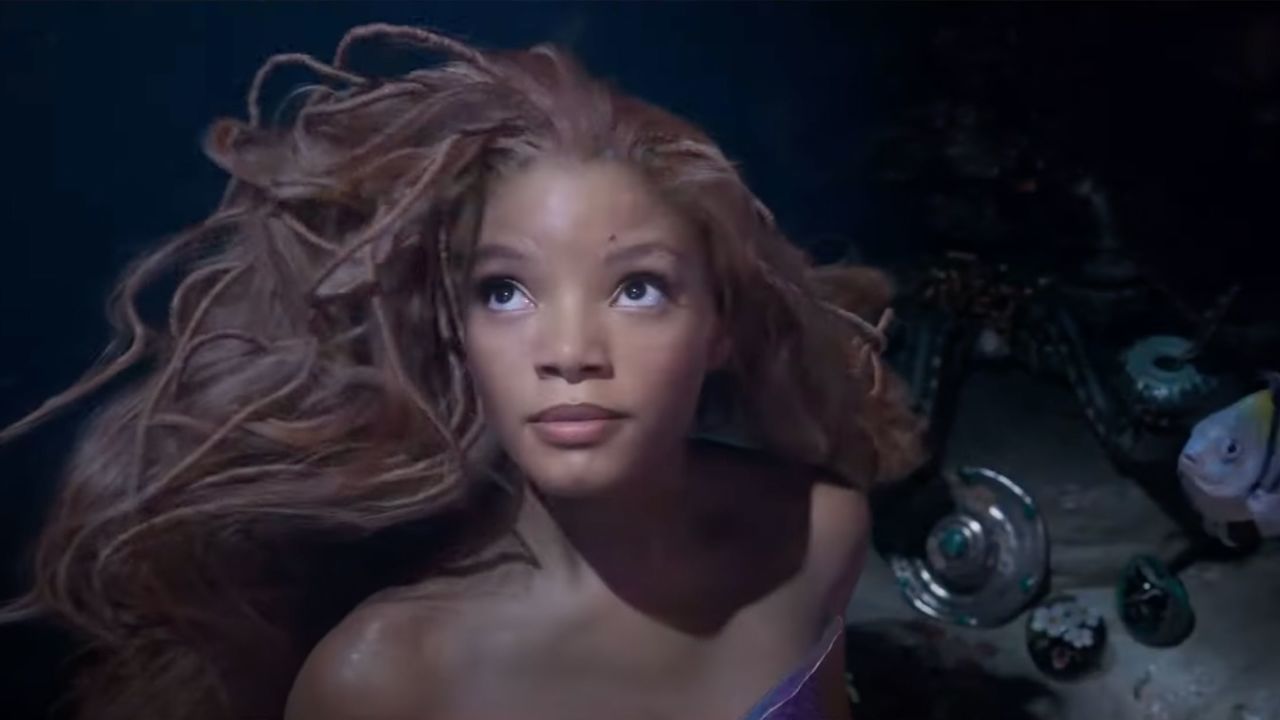
Ariel (Halle Bailey) under a seemingly waterless sea. DP: Dion Beebe. 

In Rob Marshall’s Disney adaptation (the same director of Chicago and Memoirs of a Geisha, shot by Oscar winning cinematographer Dion Beebe), Halle Bailey leads an otherwise poorly made ode to the 1989 animated film— which had the audacity to open with an Anderson quote. Bailey’s take on Ariel is the most convincing of the new cast, a young mermaid naturally curious about the entirety of the world, a collector of unique objects despite learning their meanings from the wrong sort of creature— and with a voice that carries resplendent notes through and through. Of course, anyone would want to capture that lilting sound and make it their own. Innocence, charm, and sweetness are very irresistible character traits and her gorgeous honey brown locs are a unique signifying force. Ariel is unfortunately bogged down by her main screen partners: the terribly designed Flounder and Sebastian (not a lobster, instead a googly eyed crab that must have escaped a parallel universe of Everything, Everywhere All At Once). Also, Scuttle is downright garbage. 

Flounder: sometimes you gotta smile to keep from crying and/or cringing. 

Sebastian: horrifying.

The sisters, however, were mere cameos— introduced by King Triton himself on high throne chairs in a lackluster scene that looks suspended in an outdated Windows backdrop. The animated version had the hyped girls singing “we are the daughters of Triton” during a lavish, heavily attended party. Here, the ladies representing each of the seven seas sit quietly, looking at their father as decorative objects more so than women with differing personalities. Where is the joy in the sea life? The thrills? The other merpeople? You would think that a two plus hour runtime would grant them a say, but then we wouldn’t have gotten Prince Eric or Scuttle’s awful songs. Also, King Triton shows obvious favoritism (and possessiveness) in regards to Ariel— this happens a lot in family structures, the youngest often being the apple of the parent’s eye. Yet, King Triton’s overbearing nature always seems a bit too… trifling? 

Ariel belts out an incredible Part of Your World reprise after saving Prince Eric from drowning. DP: Dion Beebe.

Apparently the sea is dull and the strict rules equals no fun. Anyone would want to escape. Plus, honestly, the above the surface shots are far more believable than the watery depths below. Ariel should be applauded for leaving such dreariness behind in order to obtain the feet that don’t hurt her. Her spellbound wonder for the majestic fireworks (probably most of the film budget) and even petting the shaggy Max are lovely touches of her affectionate nature. Despite mermaids being forbidden to interact with humans, Ariel’s longing to understand them (more importantly Prince Eric) is a universal belief akin to those of us who have a specific desire in life. Ariel’s private grotto mirrors an art collector’s trove later seen in Prince Eric’s library, even Ursula’s realm. Again, King Triton’s treasures are his daughters with one most preferred. 

We don’t talk enough about King Triton’s abuse— him destroying Ariel’s organized hoarding piece by piece would encourage even the kindest daughter to never return to someone that cruel. 

Ursula entices her niece (eye roll) with an offer she cannot refuse. DP: Dion Beebe.

As Melissa McCarthy’s Ursula did her best nod to the late Pat Carroll, Queen Latifah came to mind, especially Marshall having directed that splendid Mama’s Been Good To You number in Chicago (that should have gotten her the Oscar win). Awful choice to make Ursula and King Triton siblings. Why even? Worse, Ursula puts an amnesia spell on Ariel— so the poor girl doesn’t remember that Prince Eric must kiss her by the third day. 

Jude Akuwudike of the incredible Eyimofe (This Is My Desire) cameos as the fisherman who finds the newly limb-ed Ariel in his net and takes her to the palace at once. There, she sees Prince Eric again and they share an intense eye exchange, but he’s convinced that she is not his savior. Later, a downtrodden Ariel takes a bath— in more pretty scenes that demonstrate the look and feel of water. Sebastian arrives in her window, determined to help her fall in love, possibly feeling guilty for King Triton’s severe punishment, then again this isn’t conveyed quite clearly. A charmed Ariel wanders about the castle, well adjusted to walking and racing about on her new legs. For that, a viewer is easily swayed by her happiness and enthrallment, her captivation of human nature. The best moments are contained in Ariel’s delight— played beautifully by Bailey. 

Ariel looks around Prince Eric’s majestic library. DP: Dion Beebe.

While the other princesses have their men reflect them, for specifically Black and biracial women, Disney has a history of not finding them a Black Prince. This began in its 2009 animated adaption of Princess and the Frog. They’re still not ready to depict the soft Black boys/men that Barry Jenkins and Ryan Coogler bring to life.

Ever since reading a review calling Prince Eric a Himbro and looking up the meaning, it cannot be un-remembered. They tried to make Prince Eric a worldly, adventurous sort in a time of colonialism, but he really represents the same regurgitated formula as the other white Disney princes— blue eyed measure of attractiveness, desired rebelliousness from a privileged status, and little else. Well, Ariel if this is whom you want to flip your fins for, have at it. Interesting too, on this Caribbean influenced island that a Black Queen chooses to adopt a white child, seemingly the only baby ever to be put in this vulnerable position, the only to melt the queen’s heart. Okay. 

Ursula sees that Prince Eric is actually falling for the quiet, intelligent Ariel and ups the ante by disguising herself as the young slim Vanessa. They treat us to a godawful rap song as Scuttle’s dumb way of congratulating Ariel who sadly learns Maury Povich style that she is not the intended bride. Instead of a sunset wedding sailing away on a boat, Prince Eric has an engagement party overlooking the majestic sea. Scuttle again delivers news to Ariel sans that amazing line “she was singing with a set of stolen pipes.” Afterwards, fighting, shock, fighting, sacrifice, and finale fighting. The change to the victory may be a testament to Ariel not representing a damsel-in-distress, but man, Strong Black Woman trope came to sea us. 

Other notes: always found it an intriguing matter that in both the animated and live version, the mermaids understand and can speak English, but cannot write— which could have saved Ariel a lot of trouble. Anderson’s story is stronger because you do get the sense that the mermaid’s only language for the Prince is dancing. When King Triton returns to solid form after Ursula’s demise, the impact loses something because it is only him. None of the other poor unfortunate souls come back to fruition. Why did King Triton not give Ariel a new glittering outfit upon realization that the sea is no longer her heart’s desire? That blue dress was just overused. After Prince Eric threw it in the sea, never wanted to see it again. Definitely not Colleen Atwood’s best designs. The ending also really, really needed that Pride rainbow. Otherwise why quote Hans Christian Anderson if you’re not going to utilize the full scope of this metaphorical fairy tale masquerading his queer identity?

Prince Eric’s adopted mom the Queen is played by Noma Dumezweni aka the Black Hermoine in Broadway who is no stranger to the “Black girl taking the role of white girl” controversy. 

Furthermore, color blind casting cannot truly succeed if most of the speaking characters are white. The nonwhite people/merfolk exist as though they were props collected in Ariel’s burnt down grotto. Yes, The Little Mermaid broadcasts the star potential in Halle Bailey and a small testament to Laurence Olivier winner Noma Dumezweni’s steadily growing legacy. Yet, they feel secondary to an all-white realm even with its pockets of brown and Black figures sprinkled about. At the same time, the film gives us nothing memorable for Sienna King, Simone Ashley, and the other mermaid sisters. Those are who I showed up for— those who now have dolls in the stores— dolls that were not there in the 1990’s. It remains a lesson that just because women of color are featured in big budget vehicles doesn’t necessarily mean a promotional win regardless if minorities work behind-the-scenes. Blockbusters can mesh the explosive thrills with indie vibe storytelling— Everything Everywhere All At Once, Black Panther, Get Out. Disney, however, set in the past, remakes their old films and believes that making a Black women lead a farce excuses their years of ignoring us. So, she must endure a decent screenplay with low quality CGI and music from Lin Manuel Miranda’s EGOT thirsty pen. Bailey is an excellent singer and a brilliant songwriter (listen to Chloe X Halle) with no credits to what could be awards frontrunners, especially enjoyed her inner thoughts expressed as a mental song. Like Ursula, Miranda may be finally taking home the prize due to Bailey’s gifted voice. 

Although The Little Mermaid situates in the murky limbo between failure and triumph and is obviously not meant for someone like me, the children and Disney loving adults alike will cherish the film and truly enjoy Bailey’s multifaceted performance. Can’t wait to see her again— in an original film where she could write the music. 

Until then, I will probably reread Anderson’s story and write my own dark fairytale. Perhaps maybe centering why I cut my sister’s doll’s hair to a rather fetching shoulder length bob.