Showing posts with label African American Directors. Show all posts

Thursday, January 26, 2023

‘Rain (Nyesha)’ And Other Nods to Melvonna Ballenger

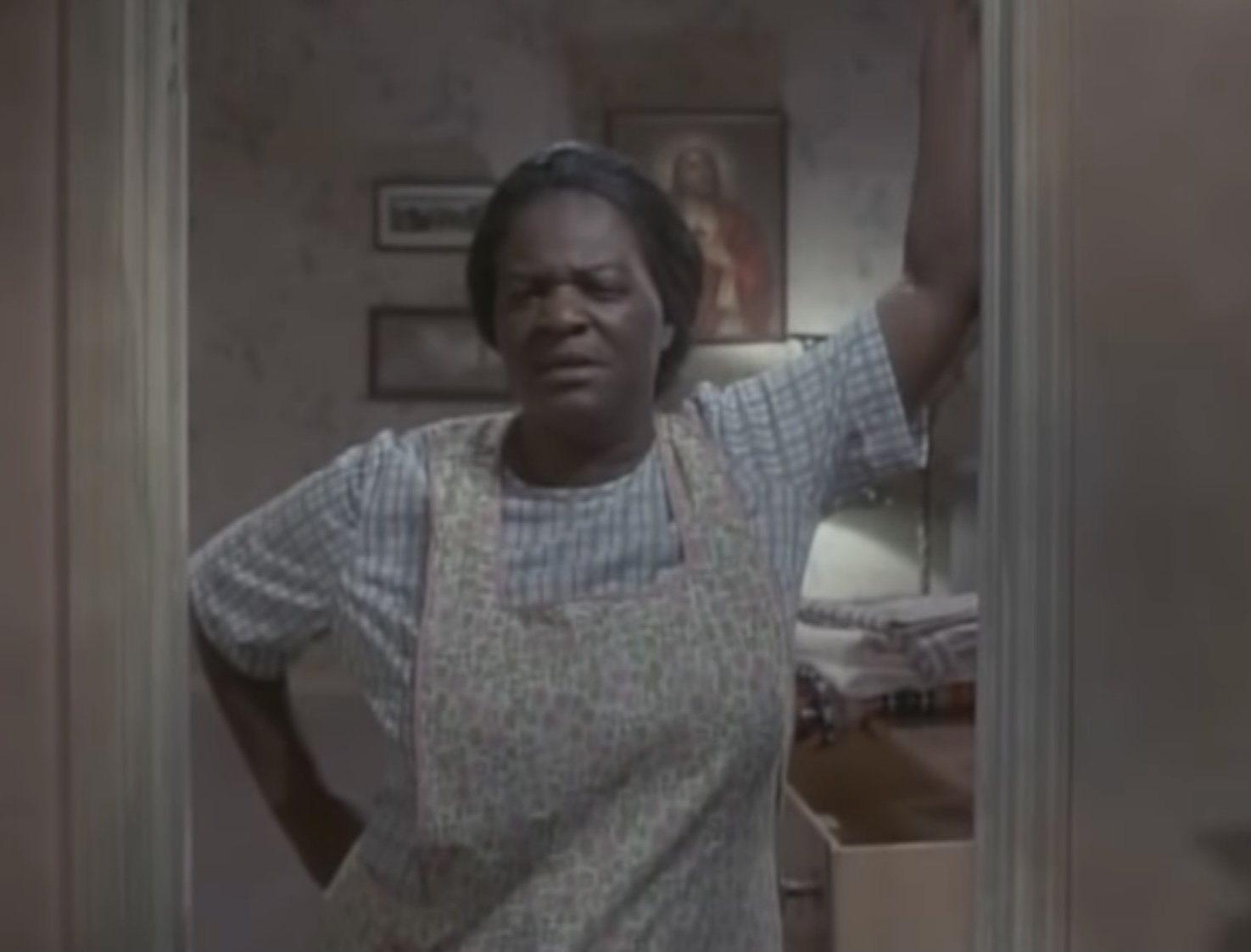
Still of Evlynne Braithwaithe as the woman from Melvonna Ballenger’s Rain (Nyesha), 1978. 

Melvonna Ballenger, a Communications graduate of Howard University, was another exceptional Black woman studying at the UCLA to become a filmmaker, befriending the likes of Alile Sharon Larkin, Stormé Bright Sweet, Zeinabu irene Davis, Jacqueline Shearer, and Julie Dash during the incredible occurrence otherwise known as the L. A. Rebellion.

Rain (Nyesha)—made as her “Project One” MFA assignment and accessible on the UCLA Film & Television Archive YouTube channel— showcases Ballenger’s commendable filmmaking promise as a twenty-four-year-old film student. She voices over the black and white short which combines the grainy moving image with experimental poetry and sound; centering on a hard working Black secretary who dreads the weary weather that invades her otherwise mundane daily routine. After some heartfelt complaining and reluctantly getting out of bed, the single Black woman draws a white robe over her white chemise and wanders about her sparse, immaculate apartment. She turns on the radio knobs, switching on station after station. In a perfect, utterly charming coincidence, they each play songs about rain including Lena Horne’s Stormy Weather, Nancy Wilson’s rendition of Don’t Rain on My Parade, and The Dramatics classic In the Rain

Our umbrella wielding girl misses her bus. However, in missing the bus, fate intervenes.  

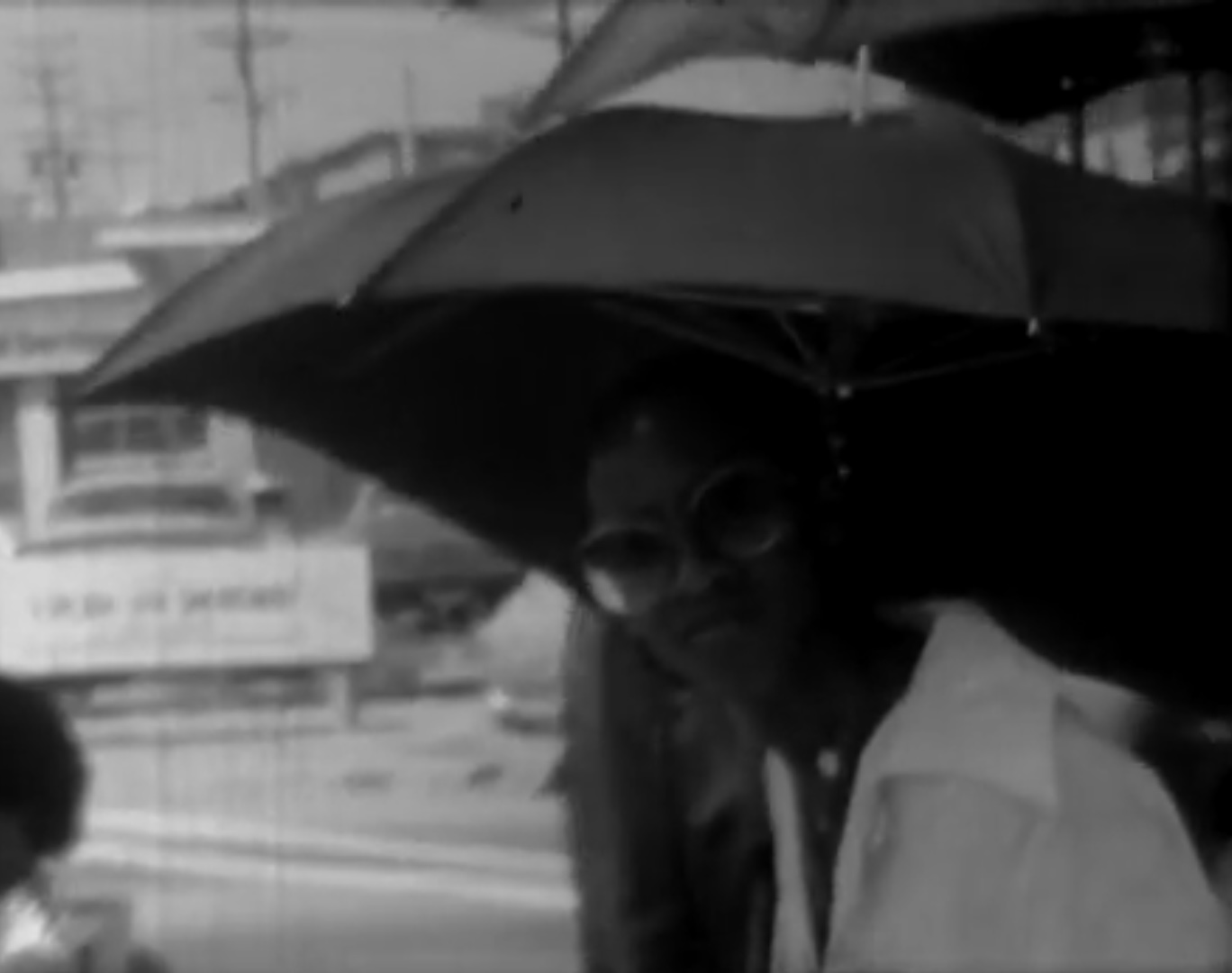
In her wait, the bespectacled woman meets the bespectacled man; their almost matching sunglasses a form of sameness. 

Haitian filmmaker/actor Bernard Nicholas portrays the man whose poetry soon meshes with the woman’s, an exchanging of mental prose eloquently blending together, a voice over another voice. The urgent need for human connection becomes an apparent matter, a tie to the threads absent in their individual lives. 

Once leaving the place she desperately longs to stay, en route to work on the smooth backdrop of John Coltrane’s After The Rain, the office typist encounters an Afro haired street activist (who slightly reminisces the great poet Gil Scott Heron in his actions) demanding liberation for all. His cause becomes her cause, a precious serendipitous moment echoes the Black person’s right to exist at the edge of the Black Is Beautiful movement. She lives, travels, and works alone, finds supreme pleasure in her own company (a woman should value herself enough to celebrate her bliss, especially a Black woman existing in a society lying to her on a daily basis). Yet, the man initiates their contact in a respectful manner, tenderly, a real chivalrous sort who respects her and requests her part in the revolution, expressing that it is theirs to share. 

Her typing job of their joint manifesto…

…also becomes his duty as well. 

At sixteen minutes long, Rain (Nyesha) is a much more provocative Black romance/activism piece than many seen over the years. The film paints a beguiling, straightforward portrait, honest and authentic, a genuine caring spirit in its two central characters. Unfortunately, this remains to be Ballenger’s solely available work. While she later did the cinematography on former school mate Alile Sharon Larkin’s Dreadlocks and the Three Bears (1983), performed script continuity on Rain (Nyesha)’s Bernard Nicholas’s short film Gidget Meets Hondo (1980), and sound mixed on Gay Abel-Bey’s Fragrance (1991), Ballenger unexpectedly passed away at the young age of forty-eight on June 25, 2003. At that time, for twenty years, she had been preparing for a compelling project described in full detail from the Los Angeles Archive Collective

Nappy-Headed Lady began production in 1980 and according to notes found with the donated materials, ‘will portray a young black woman growing up in the 1960s who rebels against her parents’ desire to have her hair straightened.’ Intent on mixing documentary footage from the period to ‘connect the protagonist’s struggle with the nationwide Black movement,’ the scripted scenes were shot on 16mm black and white film over several shoots in the Springs of 1980 and ‘81.

The Archive retains 43 items related to this project, among them the following unconformed audio elements: ‘Hair Washing takes 1, 2, 3, 4,’ ‘Health Spots (Immunization),’ ‘Swimming pool scene,’ ‘Inside kitchen,’ ‘Shower scene,’ ‘Telephone conversation,’ ‘TV noise, commercials,’ ‘wild sound,’ and a ¼ inch audio cassette tape of sound effects. The only clue to how the film may have eventually looked exists as a work-in-progress edit on a DVD transfer of a ¾ inch tape, and is available to scholars via an appointment with our Archive Research and Study Center on the UCLA campus.

This incomplete version of the film, which was assembled in 1985 likely as a work sample created in the hopes of securing completion funds, hints at what the narrative portions of the story would have depicted: a teenager’s struggle to keep her ‘natural’ against her parent’s wishes, her father’s heat-soaked beat as a mail delivery man in Los Angeles, a nurse’s argument with her supervisor about her ‘unprofessional’ Afro.”
We film cinephiles missed out on what would probably have been a remarkable, deserved-to-be-made film, especially for that time when most starred straight haired Black women protagonists (if they existed)— a noticeable presentation shift from the main character of Rain (Nyesha)

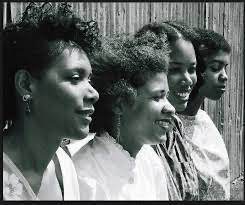
Julie Dash, Alile Sharon Larkin, Stormé Bright Sweet, and Melvonna Ballenger. L. A. Archivist Collective. 

Alile Sharon Larkin, Stormé Bright Sweet, Melvonna Ballenger, and Julie Dash. L. A. Archivist Collective. 

Nappy-Headed Lady’s intriguing scene titles “swimming pool” and “shower” would likely divulge on the intimate knowledge of Black women’s psychological displeasure of water when not surrounded by the ideals of hair washing. This Wizard of Oz Wicked-Witch-of-the-West effect (Dorothy throws water on the villain and the villain melts) mirrors our overzealous reactions to what water physically does to our strands: destroys hairstyles, promotes shrinkage and potential dryness, and temporarily alters curl patterns. Oh yes, the hair dilemma is the real struggle. Imagine a Black woman character sitting poolside, refusing to swim without a protective cap or never having learned to swim due to the generational instruction to avoid water situations that do not involve shampoo and conditioner. In the shower, on a non-wash day, she would twist her body in all kinds of ways so that the spray does not touch her head. 

This film is apparently thirty-minutes in length and maybe worth making an appointment to UCLA. 

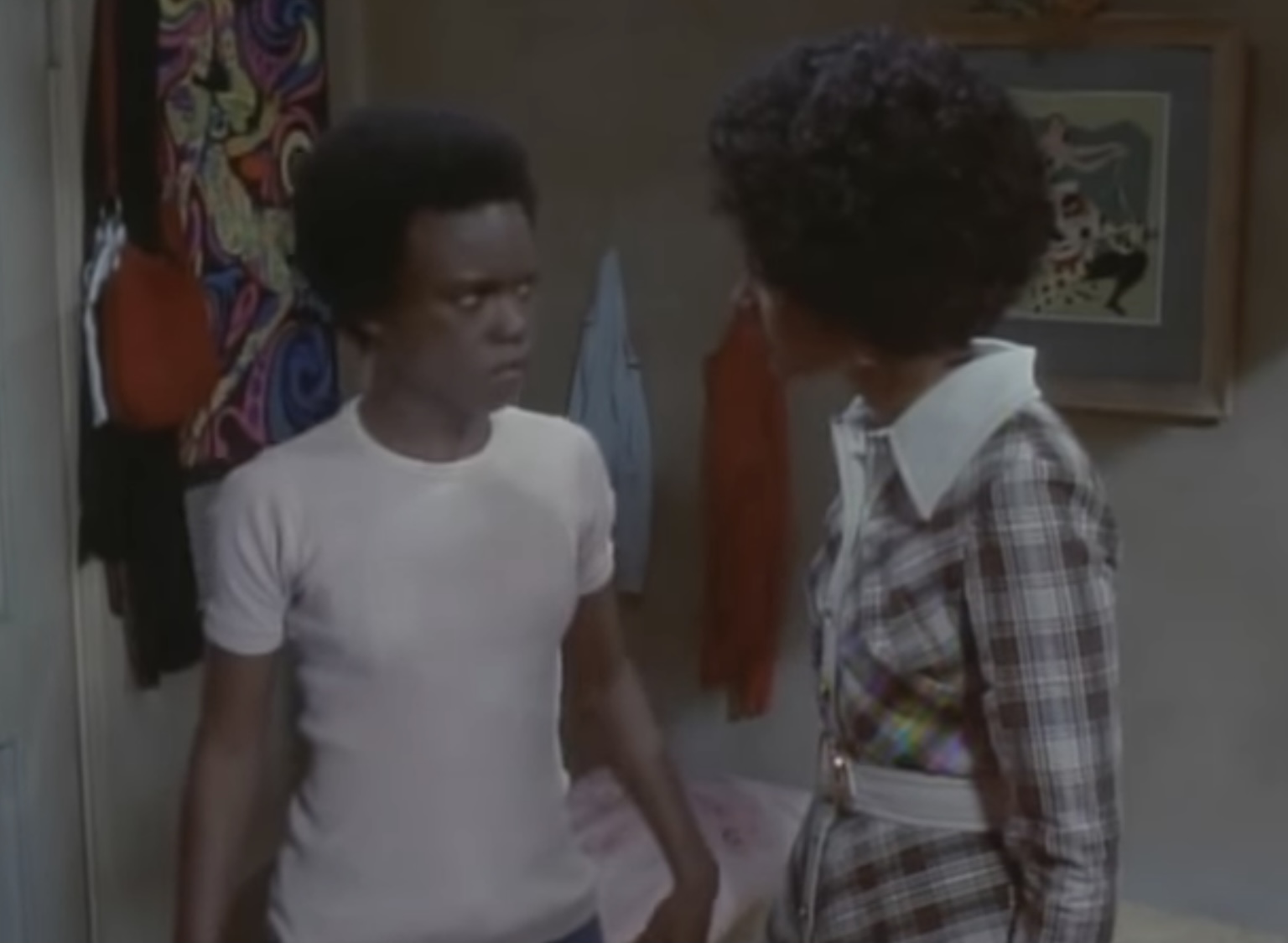
Still from Ballenger’s unfinished film, Nappy-Headed Lady. L. A. Archivist Collective

Another still from Nappy-Headed Lady. L. A. Archivist Collective.

With the jazzy renaissance that Rain (Nyesha) brings, Melvonna Ballenger delivered a quiet, satisfying narrative that has all the makings of a Black romantic classic. It simmers deeply in a poet’s soul— the repeated refrains about the woman author’s misery for the weather’s precipitation and the man’s desire for equality and peace slowly meld into a resolution that suits both parties. 


Wednesday, December 28, 2022

The Generational Plight of the American ‘Black Girl’


Black Girl film poster.

In the late 1960’s, Drama Desk winning playwright Jennie Elizabeth Franklin found success in her fourth play, Black Girl. Not to be confused with Senegalese filmmaker Ousmane Sembène’s 1966 film Black Girl set in France, the African American version directed in 1972 by Ossie Davis is adapted by Franklin, based on her work. While Sembène explores the traumatic plight of the imported immigrant, Franklin and Davis convey the consequential impact that mental conditioning has placed in the Black family structuring; mainly the weighed burdens unfairly set on matriarchs.

Betty Everett— the singer behind the popular track— “The Shoop, Shoop Song (It’s In His Kiss),” sings the title “Black Girl,” playing repeatedly throughout the film. 

Rose (Louise Stubbs) is angry that Billie Jean (Peggy Pettit) has quit school. DP: Glenwood J. Swanson.

A distressed Billie Jean taking Rose’s unleashed ire. DP: Glenwood J. Swanson.

In the American Black Girl, Billie Jean embodies the unnatural fear and hostility nestled in the minds of those who feel threatened by education’s close relationship to success and “betterment.” In order to sabotage Billie Jean, Norma and Ruth Ann, Billie Jean’s manipulative older half-sisters, jeopardize a young girl’s vulnerable mentality with verbal poison. Perhaps in addition to those who tease and taunt her in school, Norma and Ruth Ann are also other reasons that Billie Jean has dropped out. Norma and Ruth Ann represent the pains of being stuck in unhappy situations, of misery loving company. Thus, Norma and Ruth Ann taint Billie Jean’s dancer ambitions, turn it into a patriarchal testament (dancing for the lustful male gaze) instead of a young Black girl embracing the art of her graceful human body. Billie Jean moves in an elegant rhythm similar to ballet style— “ballet” is a word Norma frequently mispronounces. 

Old habits come back to bite as Rose (Louise Stubbs) passionately kisses her philandering ex Earl (Brock Peters) in front of the family. DP: Glenwood J. Swanson.

Mu’ Dear (Claudia McNeil)—Rose’s mother— believes that the “Bible belongs on the shelf not in self” whilst posing in front of white Jesus’s portrait. DP: Glenwood J. Swanson. 

The stern, sacrilegious Rose, mother of the three, is blind to Norma and Ruth Ann’s resentment, believing that Billie Jean is on her way to becoming much like her— a tired existence in a humble, multigenerational house where contempt and strife collide. Often, the disappointed Rose compares Norma, Ruth Ann, and Billie Jean to Netta, her foster daughter up in college aiming to become a teacher and upcoming law student. Rose only saw potential in Netta and gave up hope on her biological daughters altogether. That hurt Billie Jean’s already fragile self-esteem. Norma and Ruth Ann were tearing her down constantly. 

Norma (Gloria Edwards) calling Netta’s photo the callous B word to Ruth Ann (Rhetta Greene)— who then mispronounces the word “deaf.” DP: Glenwood J. Swanson.

Netta (Leslie Uggams) in her dorm talking to Rose about her Mother’s Day plans. Fifty years later, Uggams would star in Nikyatu Jusu’s feature-length debut, Nanny. DP: Glenwood J. Swanson.

Black Girl struck a personal chord with me. I was repeatedly bullied by my teachers and peers over my physical appearance— hair and clothes sadly— and dropped out my senior year of high school. My mother also experienced the same, dropping out at sixteen-years-old (she once told me that she only had two outfits) and later completing her GED after having children. I too received my GED and completed undergraduate and graduate studies; the only member in my family to achieve the feat. Although she never said “I’m proud of you,” I believe that my mother was. My brightest memory is of her clapping at my undergraduate graduation. As proud and strict a parent as Rose, my mother also wasn’t keen on apologizing (which is a strange communal trait). She demonstrated “sorry” in her actions. I believe sometimes parents never want to see their children correct them or showcase knowing what they did not learn or understand. They want to be stay in the dominant roles as parent forever, the person retaining greater knowledge. Still, I admired my mother correcting my English papers or us learning algebra together. 

Billie Jean succumbing to Ruth Ann and Norma’s deceit. DP: Glenwood J. Swanson.

During the big showdown, however, Billie Jean discovers that Norma and Ruth Ann have been destroying Netta’s encouraging letters to Billie Jean. DP: Glenwood J. Swanson.

Norma and Ruth Ann ostracizing Netta for keeping to her studies and not pursuing sexual conquests also hit home. Some people truly are uncomfortable with individuals who seek higher goals, whose ambitions focuses on career pathways and not hookups heavily prevalent in pop culture. I do not talk to my Bible wielding family about my celibacy because it causes distress, harmful jokes, and invasive questions. Last year at my brother’s grandmother’s funeral, my cousin asked me, alone in his car, “why does it seem like you don’t like sex?” In moments that Norma and Ruth Ann circle Netta, accusing her of all kinds of foul, wicked cruelty, Netta’s expression grows more intense, frightened, familiar. These are women around her own age. Why is it so important to know the sex life of someone else, to criticize those uninterested in the act? Netta is educated and virtuous too? Oh, the girls hate that. Or maybe it is not hate at all. Their misplaced envy— their dislike over Netta behaving unlike them—has transformed into a toxic rage, especially Norma, who then pulls out a knife.

Netta also privately assures Billie Jean that Rose has never said “I love you,” much less hugged her foster daughter. Rose withholding motherly affection and praise from Billie Jean has affected the young girl so much. Billie Jean almost turned into Norma and Ruth Ann. DP: Glenwood J. Swanson.

A hypocritical Rose worries that Billie Jean’s dancing will be the makings of future promiscuity, that the generational cycle will repeat. Yet, in the next instant, Rose does little to protect Billie Jean from Herbert, the other house occupant despite Billie Jean protesting her dreams go beyond empty pleasures. Billie Jean’s room connects to the kitchen and back door. Anyone can come through unsupervised. It doesn’t help that Herbert doesn’t knock. Rose nonchalantly says that Billie Jean has nothing Her set hasn’t seen before— setting Billie Jean up for potential sexual harm. Rose comes across as believing such access is natural, not unseemly. Billie Jean is a minor. Who knows what is occupying that man’s mind for him to continue shocking behavior towards a mere child? How can Rose obsess over Billie Jean’s future when she’s not even understanding the present danger under her own roof? This demonstrates the long historical pattern of women purposely turning a blind eye. 

Family at church on Mother’s Day. DP: Glenwood J. Swanson.

Netta giving Billie Jean the hope she needs to move forward. DP: Glenwood J. Swanson.

Thankfully, Netta believes in Billie Jean— a healthy relationship that Norma and Ruth Ann try to destroy. It is already bad enough that Billie Jean is named after Norma and Ruth Ann’s charismatic father, how dare she try to better herself too!

Mu Dear embracing her granddaughter Billie Jean before our heroine finishes school alongside the trustworthy Netta and trains for dancing. DP: Glenwood J. Swanson.

And Rose, finally realizing that the spiritualist was wrong in dismissing the treasure right in front of her very face, her very blood: Billie Jean. DP: Glenwood J. Swanson.

My next goal is to read Jennie Elizabeth Franklin’s Black Girl play and write a compare/contrast essay of source material versus film, seeing as Franklin wasn’t happy with this production. At least, Franklin had a win in ensuring that Peggy Pettit—star of the touring the off-Broadway version— received the starring film role; the studio wanted a lighter skinned actress (Hollywood history still repeats on this unfortunate standpoint). This film, however, does render a heavy story of generational trauma. You think about the tremendous sorrow Sembène’s girl experienced and that of Nikyatu Jusu’s modern Aisha in the horror Nanny; how these three individual vehicles connect together to form a resonating narrative. While Sembène’s girl and Aisha are visibly drowning from the subjective gravity of “slavery by another name” aka underpaid/undervalued servitude, Billie Jean’s self-esteem is constantly threatened to submerge in overwhelming doubt— doubt of which caused not just by her family, but the cyclic damage brought by white supremacy. Although no white characters are present in this piece, the consequences of colonialism is a haunting, terrifying ghost that lingers in the smallest of ways.


Therefore, Jennie Elizabeth Franklin and Ossie Davis’s Black Girl validates a simple desire to be loved and respected, to be treated as though her purpose on earth matters, and that in light of stacked generational odds, her mother will stand right beside her, embracing all that she is and all that she will become. 


Sunday, July 14, 2019

Classic 'Daughters of the Dust' Remains a Timeless Tribute to the Past

Daughters of the Dust restored film poster.
Julie Dash's phenomenal Daughters of the Dust embraces the countless ways migration-- this magical realism film's essential theme-- has impacted the Black experience in America. This powerful, riveting narrative poetically touches on how ancient traditions of the Gullah passed down generation to generation and became lost in its fragile handling, evaporated in the midst of displacement, stolen, fresh saltwater Africans desperately grasping onto their history whilst building a new legacy.

Three women: Trula (Trula Hoosier, top left), Eula (Alva Rogers, center), and Yellow Mary (top right). 
Off the coast of South Carolina, on Ibo Island, the Peazant family is led by matriarch Nana, an elder tied to ritualistic healing methods that involve utilizing the earth and carrying spirits of the ancestors. The other women find her practices backward and downright laughable, seeming already influenced by mainland thoughts, one metaphorical migration that of a Westernized mindset. Things are about to change, however, because most of the Peazants plan to move to the safe haven of North-- where historically slaves believed a promised land from the violent South. The water is how they and their ancestors arrived and thus, how they shall leave on a boat by their choice. So the going away celebration goes underway. Men dressed in their best jackets and pants while women don elegant white Victorian lace except Nana who is not going with them. 

Viola is outraged at the talk of no heaven from Nana.
Approaching via boat themselves are Viola and Yellow Mary. They bring sophisticated worldliness and culture, delivering two different forms of education. Whereas the schooled Viola comes introducing Christianity and photography by the way of the enthusiastic Mr. Snead, the well traveled Yellow Mary has a companion named Trula and a series of harsh stories, including a family who tried to keep her like property. Viola lives in a bubble and Yellow Mary paints a grim reality. Yet few women are happy about Yellow Mary's return. She is quickly ostracized, mainly by Haager, a proud, sanctimonious woman married into the family. 

The Peazant girls have dreamy perceptions of what the North would be like.
Several stories are interwoven together during this last family gathering. Eula and are expecting a child (the Unborn Child), but Eli has trouble adjusting after Eula's horrific rape. The newlyweds are still in the love phase. Iona and St. Lucien Lastchild's forbidden romance is tested. Viola's Western religion versus Nana's "hoodoo" causes a huge fuss. Through it all, the narrating Unborn Child travels on the island, her euberic spirit interacting with several characters, Nana most importantly, before reaching her parents.

Many poignant scenes feature women in the cusp of each other's company, offering strength, wisdom, and pure joy.
This family tied by blood and honor on this sacred land are moving forward to the larger landscape, to merge in and blend with American society, reluctantly leaving Nana and the old time rituals behind. The visual language is just as relative as the letters being read, broken memories of spoken are taught, and wispy book pages filled with symbolic text are turned by fingers and magic wind. Indigo also has a journey, from the forever stained hands of dyers to the inked icons and the Unborn Child's ribbon, there is a history in this precious color. 

Black girls are reading, daydreaming, existing. 
This film is one of the first to truly capture the validity of Black women's voices and their bodies. They are presented in a humanizing, nuanced light, multifaceted, loving, nurturing, cynical. Their agency and purpose grants them more freedom and dialogue than the supporting men. Between fixing each other's hair, shucking corn and prepping okra, and having conversation, these sweet women are responsible for the heart and integrity of the family, keep it alive. Some stellar scenes include Yellow Mary, Trula, and Eula bonding beautifully, everyone kneeling down to kiss Nana's "hand" that contains her mother's hair, and Eula defiantly calling out the hypocrisy and standing up for Yellow Mary. It is such a shame that these talented actresses (Cora Lee Day, Barbara O, Alva Rogers) didn't pick up accolades for their tremendous efforts.

Still, Daughters of the Dust is a treat. After all, food activist/writer Vertamae Smart-Grosvenor makes a lovely cameo and she is the subject of one of Dash's future projects. 

Nana (Cora Lee Day) and Yellow Mary (Barbara O) share a tender moment.
Memorable, fully fleshed out characters, Arthur Jafa's gorgeous cinematography, creative hairstyles that depict the incredible versatility of Black women's hair, and the harrowing music that haunts the eardrums tie together Daughters of the Dust's impressive longevity. This award winning film is a pivotal piece of art that gives Black women pedestals to bravely share their candid stories of pain, sorrow, love, anger, and longing with each other. As Dash allows them to reflect on the new world up North, religion/spirituality, womanism, and heritage, there is a real, undeniable attention to dignity and grace in every scene. The thorough research, the genuine authenticity are reasons enough that this film is worth watching again and again.


Tuesday, November 6, 2018

Love Cannot Be Barred in 'If Beale Street Could Talk'

If Beale Street Could Talk film poster.
"I hope that nobody has ever had to look at anybody they love through glass."- James Baldwin

The never ending injustices that affect brown and black bodies every single day since separation from Africa, the glaring imprint that slavery has not been abolished, is integrated in the love story of Alonzo "Fonny" Hunt and Tish Rivers. It appears an ordinary and defiant testimony despite the innocuous rage simmering in their neighborhood. Tish and Fonny are first childhood friends sans the boy abuses girl narrative. Their precious innocence naturally blossoms into kindred spirits love-- a refined soulmate tenderness not often bestowed in black romances. They dine, dance, declare feelings, make love with carefree abandon, reveling in a bubbled world of their own creation. This great swelling passion seems impenetrable and permanent.

Fonny and Tish are not the stereotypical struggle love situation. They work hard. They live together. The biggest argument was Fonny upset over Tish protecting him.

Fonny (Stephan James) creates abstract sculptures out of old industrial parts and Tish (Kiki Layne) sells perfume behind the counter at an upscale department store.
The fault of the wrecking ball lies with white supremacy-- a white cop as the highest order of the law. A white cop is never doubted or questioned. Fonny and Tish have a run in with the wrong sort. As revenge, Fonny is taken away for rape despite living on the other side of town. The victim picks him because she is instructed to. For everyone involved-- the Rivers, the Hunts, and the victim's family--the battle for justice is a long and grueling battle. On top of escalating trauma, Tish realizes that she is pregnant. The Rivers are shocked by the baby news, but celebrate over wine. The Hunts are mixed.

In the case-- a very sensitive case--Fonny is obviously innocent. The victim doesn't know that and simply cannot comprehend why a white cop would lie about her assailant. Cops are supposed to be trusting authority figures. Thus, it is disgusting that an above-the-law white cop put Fonny in custody without bothering to seek the real culprit. Beyond petty garbage, he made this a personal vendetta and tore apart a burgeoning family to get even. Sadly, this repeated narrative happens in real life America-- wrongfully accused black men imprisoned for crimes they didn't commit. 

The Rivers ladies are excited for the new generation: Ernestine (Teyonah Parris), Tish (Kiki Layne), and Sharon (Regina King).
If Beale Street Could Talk delivers subtle reminders of Coffy and Ava DuVernay's Middle of Nowhere. For example, black women having afros in love scenes speaks volumes. Back in the 70s, Pam Grier-- blaxploitation goddess-- in Coffy (seen a few years ago) definitely showcased natural hair as a sexy, unhidden gem in and out of the bedroom. Tish's hair is a wonderful halo, as pleasing as any 70's starlet. It operates differently than newer films about the modern black woman cutting off the relaxer, metaphorically using hair as an excuse to be in struggle love relationships. This afro is a part of Tish, as sacred as the deep brown of her skin, as genuine as her love for her family and Fonny-- unapologetic, untamed, and gorgeous. Although one weakness, is the submissive missionary love scene. It would have been a refreshing pace if Tish took the reins and led Fonny her own unrestrained passion. Now it doesn't have to be salacious ala Grier and Bradshaw.

Tish's campaign for justice to free her wrongfully imprisoned man like poor Ruth did in Middle of Nowhere drives home what happens to women during their men's incarceration. Both Tish and Ruth didn't have to face the tough circumstances alone-- having compassionate women on their side. The relationship between Tish, Ernestine, and Sharon are given more considerable story than Jenkins' previous women depictions in Moonlight. Their relationships are lovingly depicted. The mom would do anything for her daughter. The sisters have an incredible bond. Whereas Ruth has a strained relationship with her parolee husband (he cheated with a guard) and enters a new relationship outside the prison walls, Tish is committed to Fonny (who again is wrongfully jailed) and he is devoted to her. 

The most difficult scene to digest, however, is Fonny's father striking his wife (unfortunately some viewers in the audience laughed or applauded) after she expressed blasphemous dislike over Fonny and Tish becoming unwed parents. Nothing excuses domestic abuse-- which at the time was legal. 

This amazing scene features Tish (Kiki Layne) and Fonny (offscreen Stephan James) staring at each other.
Kiki Layne (who recently scored a Gotham Award Breakthrough Performance nomination) leads an extraordinary cast. She pulls Baldwin's story along with astounding tenacity and bravery channeled throughout a fine performance. Her articulate delivery narrating this heartbreaking love story hits key emotional points-- hope, despair, acceptance. Stephan James accompanies Layne, their chemistry poignant and unfiltered. James authentically emotes Fonny's tenderness, his agony, his frustration in ways that coax empathy. Regina King is not simply playing a mother role. She is an outstanding supportive force, igniting the screen with her multifaceted exuberance. Brian Terry Henry is also worth noting. His turn as a wrongfully convicted felon is utterly moving.

This meticulous attention to titillating detail becomes the Jenkins trademark. Alongside the acting, the editing, the sound, the cinematography balance the other. Colors are intense and sharp, like residual and effective German Expressionist paintings. Tish's yellow coat and Fonny's matching shirt. Red encompasses evocative interpretation-- seductive, furious, and flaming hot. The umbrella, splattered tomatoes, the lipstick, Fonny's abused face. The costume design reimagines the times rather brilliantly-- its busy patterns and bright solids.

If Beale Street Could Talk is joyous and painful and remarkable, striking simultaneous cords through a soft, pulsing medley. This piece is so significant and refined that Jimmy himself would raise a glass of the best wine in Harlem to toast yet another Jenkins masterpiece.

Monday, November 5, 2018

Survival Steers The Course in 'Little Woods'

Little Woods stars Tessa Thompson (Ollie, right) and Lily James (Deb, left). 
Nia DaCosta's rustic debut, Little Woods is set in a North Dakotan small town. Low income people are desperately clinging despite limited financial resources. Food, drink, hospital visits, and prescriptions are rising to unaffordable lengths-- an honest portrayal of the current horrors in America's faulty health care system.

The politicized strength ex-convict Oleander "Ollie" carries for the white characters is heavy in moral responsibilitya. She is another symbolic testimony that brown and black bodies should carry all burdens even if most of the grievance lies on whiteness. Almost off probation, she sees a kind, decent parole officer-- a shift from the hardened, callous stereotype. Single mom Deb--Ollie's sister-- prepares to take a college placement exam as Ollie pursues a promising job in Spokane. Ollie is always working. She internally fights old demons to clear her conscious, to help those in her community (migrating prepared and packaged food and hot coffee to workers), and keeping the inherited house in order.

DaCosta's gritty screenplay is a subtle nod to William Shakespeare's Othello with a complicated role reversal. Ollie is the favorite daughter, having been willed the house and is on a fulfilling path towards self sufficiency. Deb isn't ready to be left behind.

The brown bodied savior makes for a jarring tale that raises questions about the societal state, the wounds bared and subdued, the freedom close to the horizon, skeletons dangling on the edge of that opened door. Ollie's clever and resourceful, managing to take daring risks that succeed. She fails, however, on several occasions, but cannot break down in crisis. Instead, she charges onward, believing in end goals, her determination driving hard.

Little Woods contains beautiful musical choices that fit comfortably into scenes without intrusiveness. Tessa Thompson is a knight-in-shining-armor as the intelligent caregiver donning non-existent makeup and dowdy wardrobe. The beauty of this character rests in actions. Lily James delivers poise as a rough, struggling parent in a dead end job and co-dependent ex-boyfriend. Together, Thompson and James form a cohesive pair, sharing two points of womanhood and the affection sharing a kinship as strong as blood relations.

Little Woods writer/director Nia DaCosta.
Winner of the Nora Ephrom Award and Heartland Films' Truly Moving Picture honor, DaCosta is a fresh, compelling voice needed during a rather urgent time for new complex stories. While Hollywood continues remaking nostalgic classics and rebooting superhero origin stories, the indie film industry still has a problem showcasing narratives starring people of color. Let's hope that DaCosta moves forward, changing small-mindedness with a cool, collected volume of great, important stories.

Little Woods blossoms with fascinating degrees of profound and endearing promise. 


Saturday, July 14, 2018

'Hermione and the Quarter Life Crisis' Season Two: Recapping the Mischief and Mayhem

Hermione Granger and the Quarter Life Crisis opens up in a fascinating prelude: Juniper Dias (Stephanie Ezekiel, far left), Pavarti Patil (Gabby Shaikh, third), and Laquita Granger (Tamara French, far right) mime soft, poised movements as Hermione Granger (Ashley Romans, second) recites metaphoric wisdom.
Summer has been a killer frenzied return of black women creatives and black women leads: Queen Sugar is back on OWN TV, Insecure will soon be offering its third helping on HBO, and Hermione Granger and the Quarter Life Crisis is in full swing on YouTube. After a long, tormenting hiatus and a solid Indiegogo campaign, series creator Eliyannah Amirah Yisrael directs the first two available episodes of magically entertaining Hermione Granger and the Quarter Life Crisis. Ashley Romans' turn as Hermione Granger, the exceedingly smart bookworm friend of Harry Potter, is such a sensational treat.

Hermione's library ranges from Jane Austen classics to Alice Walker.

Spiking up that butterbeer.
Seven months after her cousin Laquita almost discovered their wizardry ways, Hermione has moved into a posh bachelorette pad. Her pals are more than thrilled. Well, Pavarti is thrilled. Sarcastic Juniper is happy to be freed of Hermione's couch crashing and endless brooding.

Uninvited guests, Papa Bear Herman Granger (David Stewart) and ex, Ron Weasley (Conor O'Sullivan) pop by Hermione's new place.
Papa Bear still hasn't climbed on board Forgiveness Express.
A major problematic issue with J. K. Rowling's hit series is that sex is glossed over. Yes, the books and films started off as pure children's genre, each period transitioning into darker and young adult oriented territory. At the same time, the seven part saga ends with everyone married off, happy, and raising children. Now Hogwarts didn't have sex education. Future warlocks, witches, and the like learned only about their supernatural capabilities. Perhaps if bad performing boyfriends couldn't cut it, dissatisfied lovers used wands for other purposes.

Reunited and it feels so..... bad?

Ron's second visit to Hermione's home comes unfortunate morning "break up sex." Except, Ron isn't a Casanova between the sheets. Ron has always been rather clumsy and a bit selfish. For a person often performing bad spell incantations, driving cars into trees, and running off in misguided jealous rages, Ron cannot possibly be a gratifying physical partner. He and Hermione's lack of experience sheds a light on their sexual compatibility as well as emotional and psychological. People say friends make the best lovers, but sometimes friends should remain strictly platonic.

Hermione will have a special place in the Weasley clan. They were her extended family. With Ron, however, their friendship related closely to a sibling vibe. Hermione took the right  step in setting things right with him. She had to deal with the broken engagement, leaving him behind. In fact, it was very Hermionian that amicably ended them. In her delicate case, she is slowly finding her way in Los Angeles and coming to terms with what she did to her mother. A romantic relationship probably is not the best situation.

Then again, a romantic relationship with Ron was never going to be the best for Hermione. For a woman with fire, intelligence, and passion, she shouldn't have to settle for mediocrity.

"All you need is a good horizontal refresher with a guy you don't really care about."- Pavarti
Yet Pavarti advises Hermione to rethink inhibitions about sex. Of course, having a sex buddy (sex nemesis?) would translate to Draco, the bane of her existence. Draco may say that they were children of war. That much is true. yet previous actions speak louder than words. He had slurred her most of their childhood years and considering that Hermione is now a black character, a slur can have a double edged meaning. Filthy little mudblood could also be a stab at her blackness as well as her half magic status. And in one of the most heinous acts in the Harry Potter series involved Hermione being violently tortured by Bellatrix Lestrange in Draco's own house.

Draco Malfoy (Nicholas D. Johnson) also drops by Hermione's to make a surprising declaration.

Hermione's wtf face. Just minutes before she garbs her wand. Even Draco knows Hermione knows how to use it.
At the same time, Draco is seeing a therapist. Despite his evil family's lifelong commanding influence over him, last season he had allowed homeless Hermione and her friends to stay at his house. Perhaps, he is crawling out of Lucius and Narcissa's thumb, happening since Harry Potter and the Deathly Hallows ended. It makes perfect sense for him to carry guilt. He has a lot to repent.

Hermione is right to cool things off with fellow wizard Ben van den Berghe (DJ Ester).
In other man orbiting Hermione news, cutie Ben, who looks like Dean Thomas's distant cousin, has also staked claim on our independent witchy woman. A knight-in-shining sorcery, Ben rescues Hermione's bad day with hugs, forehead kisses, and wand prepped dinner. Hermione, however , is in a rough internal place. Sweet, noble Ben is sincere and put together-- quite a striking difference than Ron, but the last thing Hermione needs is another serious clinch. She should relish in her twenties, be carefree, find the magic in the ordinary. Throughout her adolescence and teenagerhood, Hermione has always been the responsible, level headed resource, putting others before her. As pleasant as Ben appears to be, Hermione has earned "me time." She deserves to be self indulgent.

The magic gang is all here: Ben (DJ Ester), Hermione (Ashley Romans), Kang (Chase Li), Pavarti (Gabby Shaikh), Juniper (Stephanie Ezekiel), and Leslie (Robert Dowdy).
Hermione's complicated love life aside, her friends are holding little crises of their own. At the end of the first episode, via radio, star Qudditch player Kang has been injured after a match. Whilst questioning his purpose sans the uber popular magic sport, he seems to be in good spirits. He is financially set, but money isn't always the greatest source of happiness. Plus, he might be falling for Juniper-- a hardened shell to crack. Meanwhile, Leslie is running for muggle political office and confides in Hermione that he plans to propose to LaQuita. He wants to tie the knot and tell her everything! It is bad enough that LaQuita hints at Granger family secrets to Pavarti-- meaning that she may not have bought their bogus haunted mansion fib. This could have awful consequences.

After all, Hermione ran away after her marriage proposal. What's LaQuita going to do once she finds out her boo is a wizard activist?

Exciting times ahead.

Leslie's future plans will affect Hermione in a crucial way.
Hermione Granger and the Quarter Life Crisis remains an intriguing, must watch series and a wonderful, refreshing delight easily accessed on the web. It promotes positive images of black and nonblack people existing, thriving. They're magical without the negative tropes.

Isn't it enchanting that people of color have gone from speaking six minutes, eighteen seconds in all eight Harry Potter films (20 hours long), to having complete dialogues in twelve minute episodes?

Imagine that!

Catch the Episode One: Hermoine's First Day and Episode Two: What She Wants episodes of Hermione  and the Quarter Life Crisis season two on YouTube as well as the first season. 


Monday, February 19, 2018

‘Black Panther’ Gloriously Delivers Wakanda

Black Panther film poster.
Black Panther was indescribably above expectations and is the best Marvel film by far.

Although not the originally slated four hours that anxious fans desperately hoped for, the shorter run time still had plenty of juicy appeal to satisfy the appetite for all things African. This film is definitely not the average Marvel verse. At last, we see ourselves, our ancestral pride stitched in every detail. From the far and wide casting choices of black American, Kenyan, Zimbabwean, Ugandan, Rwandan actors/actresses to the elaborate costumes that pay homage to roots, to the jewelry to the sights of drums and dance and ritual to face painting, hair styles, makeup, fashion, language (both phonemic and hand communication) and scenery. Every ingredient unifies the world of Wakanda, taking audiences to a place they’ve always wanted to go, but rarely realized it could finally happen.


Nakia (Lupita Nyong'o), T'Challa (Chadwick Boseman), and Okoye (Danai Gurira) are now home.
Black Panther starts off with an unexpected betrayal in the past, an act that will unravel and change the course of Wakandan allegiances in the future. Thus, in the present-day, after catastrophic events from Captain America: Civil War, T’Challa embarks home, retrieving Nakia, a bold, brazen woman spy who often leaves him rightfully "frozen," along the way. Upon his most welcomed return, the traditional ceremony of his crowning as King of Wakanda is a joyous occasion with music, dance, and battle.

Like an eloquent black Eve bearing an apple of fruitful knowledge, Nakia, refusing to be wife, offers T'Challa the first taste of forbidden resistance. She wants to share Wakanda to those in need, to generously spread the great wealth of resources all over the world, especially to black people. This is where they differ. T'Challa wants to stick with Wakandan tradition, to remain apart, and continue on with sacred, privileged black utopia. They are on opposing sides, but the love they have for Wakanda and for one another is a delightful. refreshing energy. Their banter, their looks into each other's eyes, their handholding, and their kissing is that splendid, exasperating thing, the first black on black heterosexual love story shown in the Marvel films.

T'Challa is reluctant, but is ready to be a remarkable leader. At the same time, he is not his father. He is tested throughout, challenged to consider exactly where Wakanda's loyalties lie. In his eventual pursuit of Klaue, he faces being surveillanced under the scrutiny of public eye and finding out some disheartening truths about his father, who had once said in the astral plane, "that a father who cannot prepare his son for the future has failed as a father."

The hypocrisy levels definitely tore T'Challas's fatherly love and admiration asunder. There is no question that what the former Wakandan king had did a horrific, inexcusable wrong.
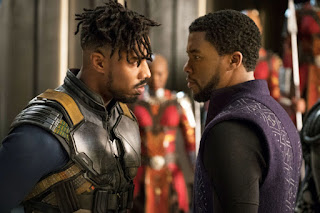
Erik Killmonger (Michael B. Jordan) faces off against T'Challa (Chadwick Boseman).

With his malice lying deep in the feelings of isolation and trauma, Erik Killmonger is such a terrific many layered villain. Beyond the bad seed trope, he is the physical consequences of residual scars of seeing the abandoned body of his dead father like that of the black body grossly depicted in history, in our current landscape, dead and unattended, left without a sliver of compassion and empathy. The desire for revenge rightfully brews in him, gaining substantial ground as he grows up on American soil, experiencing heinous racism and oppression, while desiring a place in his father’s native homeland, the very place that he blames for his tragic childhood. Thus, his extreme politics bear great similarities between of the righteous need to arm civilians with tools necessary to flourish and thrive without fearing white supremacy. He is the Malcolm X to T'Challa's Martin Luther King Jr.

The heart of the film is finding one self conflicted between T’Challa and Erik, finding both sides wrong and right on different political and social parallels. That wherein the genius.


Okoye (Danai Gurira) and her beloved spear taking names in the midst of an awesome car chase.
Black Panther fearlessly passes Bechdel and Ava DuVernay tests with flying emergent colors. The women of Wakanda were an absolute, scene stealing treat! There are no background players and props here. Firstly, the dynamism between the four leading women was a chemistry barely tapped in the Marvel Comics film sphere seeing as most of its core female characters, Black Widow especially, operate alone in a male dominated situations. In Wakanda, levels of trust and friendship went beyond protecting their supreme ruler. Queen Ramonda, Shuri, Nakia, and Okoye are a beautiful, inspiring sentiment, an awesome portrayal of the communal bonds between the black women’s love for each other and their undying allegiance to their country.

Nakia (Lupita Nyong'o) and Princess Shuri (Letitia Wright) are ready to fight for their country.
Queen Ramonda has birthed two amazing individuals who have inherited her goodness, her tenacity, and her courage. Princess Shuya, the computer tech whiz behind Wakanda’s highly advanced superior technology had more than once saved the day behind-the-scenes. She is valiant, witty, sharp, and intelligent, a supreme highlight who had some of the best deep seated one-liners, especially about colonialism. Nakia, the prince’s heart, has love for all people, wanting nothing more than to share Wakanda’s wealth of knowledge and resources to those of the diaspora, but of course, her kind of vigilantism often gets her into trouble. She too is an excellent warrior, her fighting skills a tremendous glory to watch, seen in the visually stunning choreography sequence in the casino scene with her fellow sister, Okoye, the powerful, resilient, staff wielding leader of the impressively elite Dora Milaje. Okoye is fierce and loyal to the throne, which adds to her internal struggles further down the line.

In the forests near the mountains of Gorilla City, Jabari's Tribe, Queen Ramonda (Angela Bassett) and Shuri (Letitia Wright).  

When Nakia, having successfully taken the last of Wakanda’s most precious plant as Killmonger orders it all burned down, is pleaded by Queen Ramonda herself to engulf the advanced Black Panther powers, the powers entrusted in her familial line. Even with her own young daughter standing by, it is Nakia, that Queen Ramonda believes can save them.

Other must see highlights: Nakia's first secret mission of freeing captive women (because of its heartbreaking reminder of "Bring Back Our Girls," a movement to finding the missing kidnapped girls from Chibok in Borno State, Nigeria); Killmonger wisely informing a curator of the Museum of Great Britain that they stole artifacts from Africa (because us knowledged people cannot imagine Africans gifting precious artworks to "The Other" aka colonizers); M'Baku and his people barking over Agent Everett Ross, telling him that he couldn't talk (because white people constantly tend to speak over black people). A sweet Moonlight actor makes a cameo at the end (because this brings to full circle the monumental range of diaspora unleashed in this film, us brown and darker skinned complexions with our broad noses and protruding foreheads and full lips are present together).

Wakanda Ensemble: Forest Whittaker, Daniel Kaluuya, Michael B. Jordan, Lupita Nyong'o, Chadwick Boseman, Angela Bassett, Danai Gurira, and Letitia Wright.

Black Panther does have minor adversaries. It is unsettling that a white C.I.A. operative comes to their country, wears their symbolic garb, and eventually must wield their sophisticated devices to blast down Wakandan vessels. There is no queer representation, which makes one wish that Tessa Thompson's Valkyrie, introduced in Thor: Ragnarok, would fly on down to Wakanda and have her way with a Dora Milaje soldier. Or perhaps in its sequel (oh there has got to be a sequel), Roxanne Gay can be brought into the writing room. The most glaring flaw is that black libertarianism, seemingly the real supposed villain, the conveyed message behind Killmonger's "evil," definitely conjures internalized friction. This idea to save long suffering black people from imperialism (Wakanda has plentiful which Nakia earlier addressed) isn't Wakanda's problem, but what T'Chaka did to Killmonger is. Where was Killmonger's mother? What role did she play in his life, if any? His masculinity was a toxic, misogynistic brand and yet, his desire to arm the most vulnerable people in the world was moving in spite of it.  

However, it is imperative to remember that one fictional superhero movie cannot hold everything, be everything to someone. It would be irresponsible to say the least.

Black Panther has granted us a black director (Ryan Coogler), black writers (Coogler with Joe Robert Cole), a black costume designer (Ruth Carter), a black jewelry designer (Douriean Flecther), a black production designer (Hannah Beachler), a black soundtrack director (Kendrick Lamar), and an almost all black cast from different pockets of the globe. And that stands for something undeniably profound.

T'Challa (Chadwick Boseman) has reassurance from Nakia (Lupita Nyong'o) that he can and will thrive as king of Wakanda.

Overall, Coogler and his team have helm a magnificent picture with a fine, gratifying story that passionately entails the complexities of fights within the black community. He has achieved a finesse that few filmmakers in the comic book verse have by incorporating historical and contemporary problems. The performances are meticulously top notch and powerful, possibly one of the best ensembles of Marvel. With Oscar winners and nominees, Golden Globe contenders, NAACP Awards and Black Reel accolades, and even a Pulitzer Prize nominee in the mix, the stakes were high. From Chadwick Boseman's commanding lead (kudos to his dialect coach), Michael B. Jordan's ruthless aggression to Lupita Nyong'o's ferocious vitality to Danai Gurira's stout loyalty, everyone had came with their A game. Angela Bassett, Forest Whitaker, Daniel Kaluuya, Sterling K. Brown, Winston Duke, and Letitia Wright (who was superb in that must watch Black Mirror episode, "Black Museum') also put in incredible acting efforts.

Black Panther may not have televised the whole entire revolution, but this imperative comic book film drama passionately ignites conversations to take that leap.

Now go see and support the vision of black excellence. Wakanda forever.