Showing posts with label 1980’s Film. Show all posts

Thursday, January 26, 2023

‘Rain (Nyesha)’ And Other Nods to Melvonna Ballenger

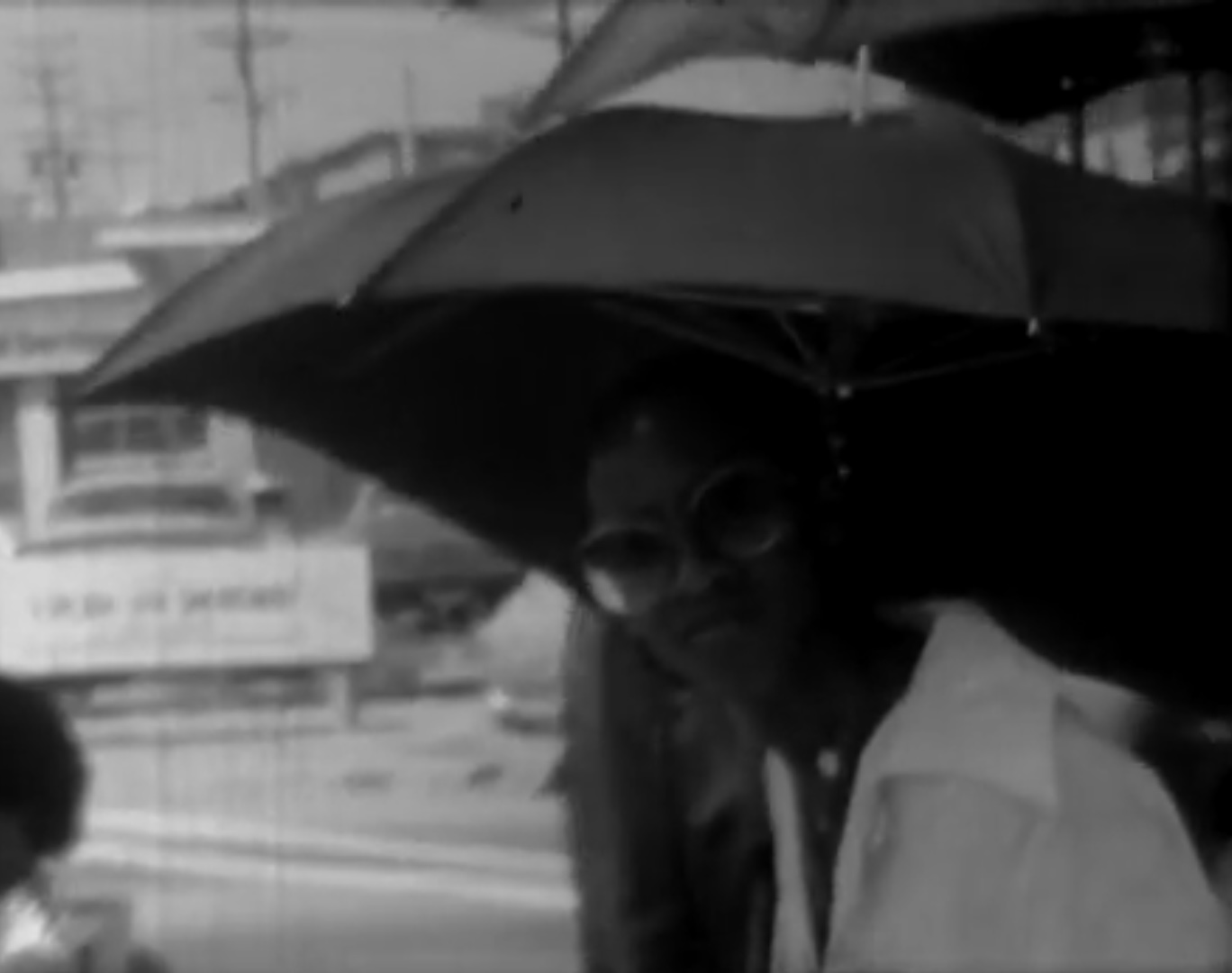
Still of Evlynne Braithwaithe as the woman from Melvonna Ballenger’s Rain (Nyesha), 1978. 

Melvonna Ballenger, a Communications graduate of Howard University, was another exceptional Black woman studying at the UCLA to become a filmmaker, befriending the likes of Alile Sharon Larkin, Stormé Bright Sweet, Zeinabu irene Davis, Jacqueline Shearer, and Julie Dash during the incredible occurrence otherwise known as the L. A. Rebellion.

Rain (Nyesha)—made as her “Project One” MFA assignment and accessible on the UCLA Film & Television Archive YouTube channel— showcases Ballenger’s commendable filmmaking promise as a twenty-four-year-old film student. She voices over the black and white short which combines the grainy moving image with experimental poetry and sound; centering on a hard working Black secretary who dreads the weary weather that invades her otherwise mundane daily routine. After some heartfelt complaining and reluctantly getting out of bed, the single Black woman draws a white robe over her white chemise and wanders about her sparse, immaculate apartment. She turns on the radio knobs, switching on station after station. In a perfect, utterly charming coincidence, they each play songs about rain including Lena Horne’s Stormy Weather, Nancy Wilson’s rendition of Don’t Rain on My Parade, and The Dramatics classic In the Rain. 

Our umbrella wielding girl misses her bus. However, in missing the bus, fate intervenes.  

In her wait, the bespectacled woman meets the bespectacled man; their almost matching sunglasses a form of sameness. 

Haitian filmmaker/actor Bernard Nicholas portrays the man whose poetry soon meshes with the woman’s, an exchanging of mental prose eloquently blending together, a voice over another voice. The urgent need for human connection becomes an apparent matter, a tie to the threads absent in their individual lives. 

Once leaving the place she desperately longs to stay, en route to work on the smooth backdrop of John Coltrane’s After The Rain, the office typist encounters an Afro haired street activist (who slightly reminisces the great poet Gil Scott Heron in his actions) demanding liberation for all. His cause becomes her cause, a precious serendipitous moment echoes the Black person’s right to exist at the edge of the Black Is Beautiful movement. She lives, travels, and works alone, finds supreme pleasure in her own company (a woman should value herself enough to celebrate her bliss, especially a Black woman existing in a society lying to her on a daily basis). Yet, the man initiates their contact in a respectful manner, tenderly, a real chivalrous sort who respects her and requests her part in the revolution, expressing that it is theirs to share. 

Her typing job of their joint manifesto…

…also becomes his duty as well. 

At sixteen minutes long, Rain (Nyesha) is a much more provocative Black romance/activism piece than many seen over the years. The film paints a beguiling, straightforward portrait, honest and authentic, a genuine caring spirit in its two central characters. Unfortunately, this remains to be Ballenger’s solely available work. While she later did the cinematography on former school mate Alile Sharon Larkin’s Dreadlocks and the Three Bears (1983), performed script continuity on Rain (Nyesha)’s Bernard Nicholas’s short film Gidget Meets Hondo (1980), and sound mixed on Gay Abel-Bey’s Fragrance (1991), Ballenger unexpectedly passed away at the young age of forty-eight on June 25, 2003. At that time, for twenty years, she had been preparing for a compelling project described in full detail from the Los Angeles Archive Collective: 

“Nappy-Headed Lady began production in 1980 and according to notes found with the donated materials, ‘will portray a young black woman growing up in the 1960s who rebels against her parents’ desire to have her hair straightened.’ Intent on mixing documentary footage from the period to ‘connect the protagonist’s struggle with the nationwide Black movement,’ the scripted scenes were shot on 16mm black and white film over several shoots in the Springs of 1980 and ‘81.

The Archive retains 43 items related to this project, among them the following unconformed audio elements: ‘Hair Washing takes 1, 2, 3, 4,’ ‘Health Spots (Immunization),’ ‘Swimming pool scene,’ ‘Inside kitchen,’ ‘Shower scene,’ ‘Telephone conversation,’ ‘TV noise, commercials,’ ‘wild sound,’ and a ¼ inch audio cassette tape of sound effects. The only clue to how the film may have eventually looked exists as a work-in-progress edit on a DVD transfer of a ¾ inch tape, and is available to scholars via an appointment with our Archive Research and Study Center on the UCLA campus.

This incomplete version of the film, which was assembled in 1985 likely as a work sample created in the hopes of securing completion funds, hints at what the narrative portions of the story would have depicted: a teenager’s struggle to keep her ‘natural’ against her parent’s wishes, her father’s heat-soaked beat as a mail delivery man in Los Angeles, a nurse’s argument with her supervisor about her ‘unprofessional’ Afro.”
We film cinephiles missed out on what would probably have been a remarkable, deserved-to-be-made film, especially for that time when most starred straight haired Black women protagonists (if they existed)— a noticeable presentation shift from the main character of Rain (Nyesha). 

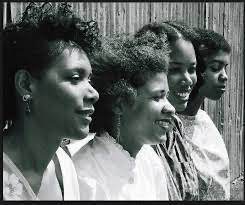
Julie Dash, Alile Sharon Larkin, Stormé Bright Sweet, and Melvonna Ballenger. L. A. Archivist Collective. 

Alile Sharon Larkin, Stormé Bright Sweet, Melvonna Ballenger, and Julie Dash. L. A. Archivist Collective. 

Nappy-Headed Lady’s intriguing scene titles “swimming pool” and “shower” would likely divulge on the intimate knowledge of Black women’s psychological displeasure of water when not surrounded by the ideals of hair washing. This Wizard of Oz Wicked-Witch-of-the-West effect (Dorothy throws water on the villain and the villain melts) mirrors our overzealous reactions to what water physically does to our strands: destroys hairstyles, promotes shrinkage and potential dryness, and temporarily alters curl patterns. Oh yes, the hair dilemma is the real struggle. Imagine a Black woman character sitting poolside, refusing to swim without a protective cap or never having learned to swim due to the generational instruction to avoid water situations that do not involve shampoo and conditioner. In the shower, on a non-wash day, she would twist her body in all kinds of ways so that the spray does not touch her head. 

This film is apparently thirty-minutes in length and maybe worth making an appointment to UCLA. 

Still from Ballenger’s unfinished film, Nappy-Headed Lady. L. A. Archivist Collective. 

Another still from Nappy-Headed Lady. L. A. Archivist Collective.

With the jazzy renaissance that Rain (Nyesha) brings, Melvonna Ballenger delivered a quiet, satisfying narrative that has all the makings of a Black romantic classic. It simmers deeply in a poet’s soul— the repeated refrains about the woman author’s misery for the weather’s precipitation and the man’s desire for equality and peace slowly meld into a resolution that suits both parties. 


Friday, January 7, 2022

‘My Brilliant Career,’ A Forty-Year-Old+ Classic Nod to Womanly Independence Hits Home


My Brilliant Career DVD cover.

My Brilliant Career, a Criterion Collection gem, started out as a surprising HBO Max recommendation. It only sat in the watchlist for a few hours before the play button was hit. 

Set in rural Australia, Sybylla Melvyn is passionate, intelligent, multitalented young girl heavily reminiscent of Emily of New Moon’s Emily Byrd Starr—a character that too has ambitions to become a writer and not ever marry. While Emily is an orphan living with her dead mother’s eccentric relatives in Prince Edward Island, Canada, Sybylla’s rather large family are too poor to keep her on. She is sent to live with her rich, aristocratic grandmother and Aunt Helen. Both Sybylla and Emily disregard the rules, have strong temperaments, and have tendencies to disrespect their elders. Yet Emily will eventually marry (at the end of the L. M. Montgomery’s book series) and Sybylla does not ever conform. 

The unique Sybylla (Judy Davis) loves to run around nature whether it be on the clearest day or in the pouring rain. Some believe it scandalous and improper, but Sybylla does what she wants— most of the time. 

For Sybylla, life among superior company is carefree and charming— a place to act out in ways restricted on the family farm. Although Sybylla has suitors desiring the affections of a wild, red haired girl, she desires more than the notion of an inconvenient marriage. Sybylla has witnessed her impoverished mother struggle with bearing many children and a drunken husband to boot, listened to her beautiful Aunt Helen recount an affair that ended in humiliation (the man left her for another woman), and performing indentured servitude (thanks to that father of hers) to a woman with six children. She is aware that relationships change, that people evolve more so that the consequences are often for worst than for the better. In fact, Sybylla’s true romance is figuring out exactly where her heart lies— not being subjected to the lives of hardship and disdain similar to the older women she interacts with. Sybylla is moderately skilled at piano, admits to loving the arts, and teaches children well enough as a short-lived governess. Yet it is writing that she loves— many scenes contain her writing stories, letters, reading her prose aloud. 

Sybylla must write even in the oddest places. 

However, various people including her grandmother call out Sybylla for her ill manners and selfishness— the selfishness in choosing not to marry. For example, she is almost considered a tease for tempting the handsome Harry Beecham (a beautiful Sam Neill)—who often is hell bent on receiving a reward (a kiss) for doing the bare minimum, but restrains the urge in time. The jealous older Frank Hawdon overly exaggerates Sybylla’s flamboyant behavior to Harry in order to manipulate Sybylla into choosing him. A resolute Sybylla disallows herself to become compromised despite the blossoming tenderness shown to Harry. Although she adores him very much, having a career ambition as great as writing requires seclusion, a certain devout purity that Sybylla will not give up for the tainted world. 

Furthermore, yes, the undeniable chemistry between Sybylla and Harry charges like magnets, burning innocently and passionately, brewing from pleasant encounters between dear friends to affectionate playfulness and roaring desire between soulmates. These two characters have a natural ease together. Separation means unbearable yearning, kindling added to a ferocious flame. Their longing eyes speak volumes whenever on each other, proving that such a thing can be briefly entertained yet not always bloom to full blown expectation. Thus, while the urge to ship them together (as we’re conditioned to) weighs heavily with their every scene together shows two stubborn young people falling stupendously in love, Sybylla has free agency to choose the outcome to their situation. 

When her drunken father owes an unaffordable debt, Sybylla is forced out of her comfortable situation with her grandmother and Aunt Helen to govern six unruly children in a poor household. 

Filmmaker Gillian Armstrong’s debut feature film adaptation of Miles Franklin’s My Brilliant Career novel is a fairly beautiful depiction of an early independent woman— a significant part of having a huge women’s production. Under Armstrong’s direction her team includes Eleanor Witcombe’s screenwriting, Margaret Fink and Jane Scott as producers, Luciana Arrighi’s production design, and Anna Senior’s costume design tie it all together with an incredibly riveting Judy Davis (who at times can be mistaken for Nicole Kidman) leading the reins in her believable portrayal of the vivacious Sybylla. 

In this day and age, an anti-marriage character is a rare treat. Many terribly shallow romances in both contemporary film/TV lead people into believing that happiness can only be found in another— that our career ambitions will not provide enough sustenance, that sometimes we even have to settle for less than deserved. To be alone, especially for women, is still on occasion considered a crime, a penance. Spinsterhood was a former joke, a ridicule. Sybylla— proclaiming herself egotistical— knew what she wanted— to become a writer. She let that love guide her in ways that a man could not. Bravo!