Showing posts with label Short Film. Show all posts

Saturday, June 15, 2024

A Quiet, Symbolic ‘Grace’ Goes Against The Grains Of Sanctimonious South


Grace film poster.


Grace—the latest coming-of-age effort after writer/director Natalie Jasmine Harris’s debutante short film, Pure—adds another effective gem to a promising filmmaking oeuvre. 

Grace (Jordan Wells) embodies her name in every way. DP: Tehillah De Castro.

As a carefree, ordinary girl named Grace approaches her milestone birthday and upcoming baptism, she succumbs to the joyful pleasures of youth alongside her sister and Louise, a childhood friend. The charisma between the triad presents a natural friendship depiction. The lines of love are drawn in its unadulterated forms— affectionate sibling biology and the kindred camaraderie. What happens when those invisible lines are unexpectedly blurred? Can an innocent heart stay ruled by a strict upbringing or will it surpass the safe, platonic road? 

Big Mama’s teachings on the Deep South stage heightens Grace’s burgeoning sexuality dilemma. It’s where the unsettling righteousness bellows beneath the exterior of precious girlhood. Between the delightful smiles and the singsong handclap games, the devout undertones disturb the humble peace. 

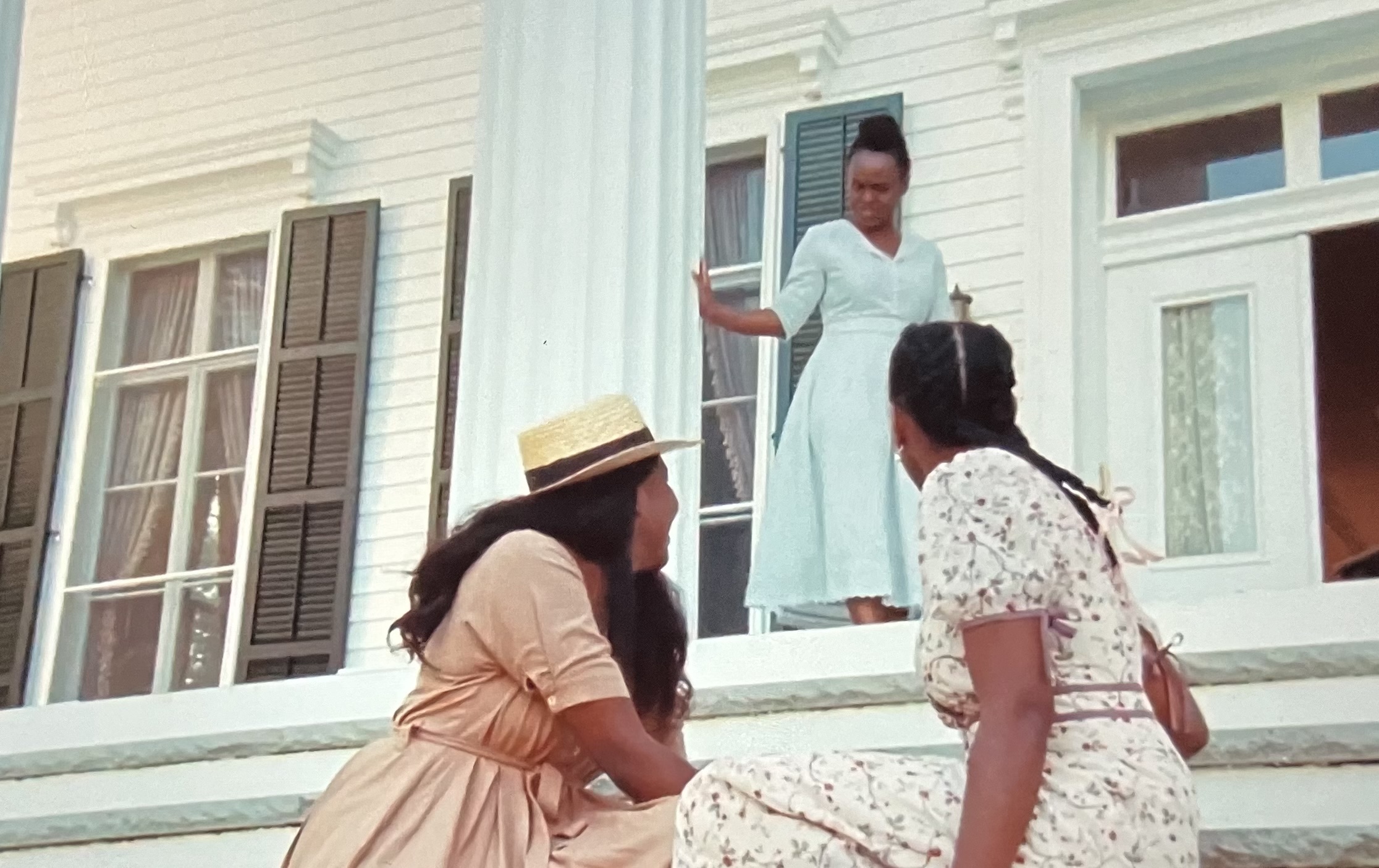
Louise (Alexis Cofield) stands on the porch, smiling down on Grace (Jordan Wells) and her sister (Mikayla Lashae Bartholomew). DP: Tehillah De Castro.

Among the pastel colored walls and the elegant white curtains parted on large, charming windows, Grace feels the pressure to be good, to follow Big Mama’s respectable example. Inside the American Gothic styled house, intentional cross patterns are repeated cues upholding the Bible structure. Although no men occupy this makeshift Black feminine utopia, an ominous presence operates as a patriarchal beacon, the judgment ensuring that all young girls must eventually submit to their duties as wives, to suppress any other “unlawful” inklings. 

Moreover, Grace’s baptism will bring the ultimate test. 

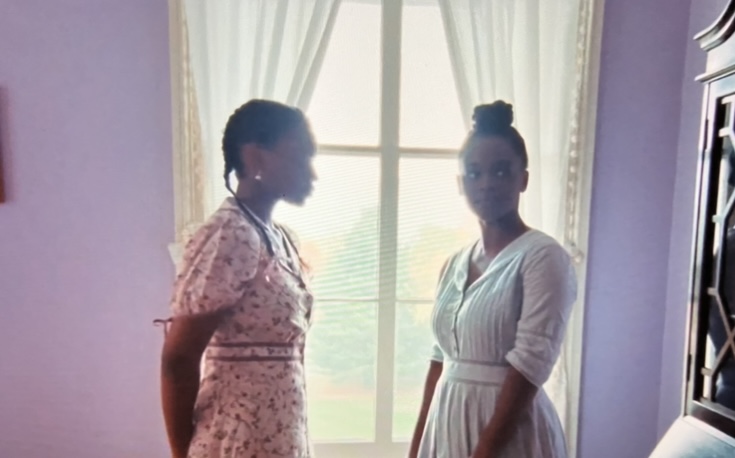
Grace and Louise strike a cord. DP: Tehillah De Castro. 

In the trajectory of Juliana Kasumu’s Losing Joy, Allie Morgan’s Sisters, Mz Roth’s code switch, Harris’s Pure, and many other Black sapphic films eloquently helmed by Black filmmakers, Grace sheds profound light on soft queer films highlighting multifaceted experiences. These brave creators are not rehashing the same, copy/paste narratives that we’re accustomed to seeing in regards to how Black women, girls, and femmes are portrayed. 

By centralizing blackness through an authentic lens, the characters must battle the fights (both internal and external) that come with the global impact of the dominant heterosexual landscape. These are the directors that deserve to invent original stories and adapt the inherent literature (Alice Walker, Toni Morrison, Maya Angelou, Gloria Gaynor, Paule Marshall…) for us to devour, to engage. Since their films asks and answers questions long raised in Black community, they need our support the most. 

The most metaphorical shot in the film. DP: Tehillah De Castro.

A straightened haired Grace rejects Louise. DP: Tehillah De Castro.

After premiering earlier this year at the Sundance Film Festival, Grace has been shown around various other film festivals such as Inside Out Toronto, Newfest Pride, and the upcoming Frameline and BlackStar Film Festival. Grace —a word meaning simple elegance— is a must see for embracing its definition beyond the leading character. Every element (small or large) enriches the layered, impactful narrative: tightly knitted frames containing vital symmetries and subtle performances by a talented cast led by its director, some period costumes (which Harris designed) call to mind Julie Dash’s Daughters of the Dust— the white dresses nodding to the film’s costume designer Arline Burks Gant, and the house right down to the object placements, an appropriate foundation for stern religious order. 

Overall, Grace is cinematic magic without spells being cast onscreen. While the visual feast thoughtfully conveys a Black girl grappling with her awakened identity, its story teaches the notion that being true to oneself is more so a blessing than a sin to be cleansed away. 


Thursday, June 29, 2023

‘Veracity,’ An Impactful LGBTQ Short Film

Veracity film poster. 

Olivia learns the hard way that popularity can turn on a dime, especially in high school. It offers no protective shield against the early developmental stages of teenage homophobia— a condition that some will continue to latch onto in adulthood. Unfortunately, it has deep negative history in the Black community, that of which still exists today. 

Olivia (Kiki Layne) performs her monologue in drama class. DP: Tommy Maddox-Upshaw.

Carolyn (Christina Harper) begs Olivia (Kiki Layne) to attend James’s party with her, saying that only with Olivia can Carolyn receive entry. DP: Tommy Maddox-Upshaw.

Veracity highlights the super quick turnaround Olivia faces after she’s discovered kissing the new student Imani, a quiet, isolated girl kicked out of her old school for the very thing Olivia is suddenly ostracized for. Carolyn, the best friend character immediately removes herself as Olivia’s sidekick, becoming instead a fellow instigator. 

Olivia (Kiki Layne) is very much intrigued by the new transfer in her drama class Imani (Shea Vaughan-Gabor). DP: Tommy Maddox-Upshaw.

At James’s house party where lots of underage drinking happens, Olivia is assaulted by James. Yet, no one seems to care about it. She even brushes it off and warms him that his advances remain unwanted. Instead, Olivia finds out Imani lives there. Since unsuccessful at getting the quiet girl to enjoy the party backfires, the two watch television together. A tickling session becomes a full out passionate session which is then rudely interrupted, causing a huge humiliation for both Olivia and Imani. Everyone is so comfortable seeing James kiss on Olivia without her consent, but two girls making out because they want to disgusts their young impressionable minds— minds that are conditioned to only be okay with heteronormativity. 

Olivia walking through the hallways, feeling the repercussions from the party. DP: Tommy Maddox-Upshaw.

The heart of the matter is that growing up many Black parents/guardians teach the values in respecting racial differences/backgrounds. The later sexual talks (uncomfortable as they are) only focus on heteronormativity. Thus, when queerness comes, everybody is appalled, unprepared to react accordingly. Parents will abandon their children, even disown if they’re not “acting normal.” There can be no celebration when there’s little understanding and lack of empathy. 

Imani coldly informs Olivia that before she was kicked out of her old school, she had a girlfriend and received consequences for it including expulsion. DP: Tommy Maddox-Upshaw.

Olivia makes the girl’s bathroom her escape place. DP: Tommy Maddox-Upshaw. 

With award-winning actress Kiki Layne in a stellar debut as Olivia, brilliantly directed by Seith Mann, and bravely written by Janaya Greene (who wrote the screenplay during her senior year of high school), Veracity could have easily transformed into a full-length feature, a perfect companion piece to dee rees unforgettable Pariah— a film that came out three years prior which also started as a short. Veracity touches on significant changes the outcasted Olivia undergoes in order to put her mental health on a good path— attending support group and compromising with Imani that she is there to be a friend, not necessarily form a romantic relationship.

Another student offers Olivia a positive outlet. DP: Tommy Maddox-Upshaw.

A man shares his story about falling for his teammate, losing that friendship, and being disowned by his mother. DP: Tommy Maddox-Upshaw.

Olivia is moved by the story, perhaps seeing the commonality in her own present. DP: Tommy Maddox-Upshaw.

Veracity deserves immense love and flowers for bringing awareness to the issues LGBTQIA+ teenagers experience on top of trying to get an education. They have to survive daily bullying from their peers at school and whatever exists at home— that’s stacked pressure weighing on their vulnerable impressionable minds often leading to self-harm. Imani definitely presents the identity struggle, contemplating doing the unthinkable as events continue escalating for her, her own cousin disgusted by who she is. Although it is unclear what Olivia endures in her home life, she no longer has to channel her lesbianism alone and neither does Imani. 

So Carolyn doesn’t need Olivia around to get into James’s good graces. DP: Tommy Maddox-Upshaw.

Imani contemplates the tragic way out. DP: Tommy Upshaw-Maddox.

Often, a hug can bring the most beneficial source of comfort— something of which the quiet Imani needed from Olivia. DP: Tommy Maddox-Upshaw.

From beginning to the powerful end, Veracity showcases that there is love and care— a supportive community waiting— to all those who are undergoing traumatic consequences for being different. This solid short film is available to view on YouTube as part of the Scenarios USA series. 


Tuesday, May 9, 2023

‘Nightwatcher,’ Greatest Vulnerabilities Reveal A Black Girl’s Greatest Weapon


Leila (Arséma Thomas) has a very special gift. DP: Alexander Mejía.

Octavia Butler’s Kindred seems to arrive in the surprising form of Amira Hasib’s 2018 short film, Nightwatcher. Newcomer Arséma Thomas (who portrays Queen Charlotte’s young Lady Agatha Danbury) stars as Leila, a Black woman with the phenomenal ability to leave situations that frighten her. However, unlike Dana whose shifts from past and present occur the moment she moves into a new home, Leila appears to have had the adapted the skill since childhood— and it happens a whenever she needs saving. 

A passive Leila (Rylee King) quietly takes the abuse. DP: Alexander Mejía.

In the schoolroom, Leila endures cruel teasing from two giggling girls and a teacher who does little to reprimand the bullies. Leila’s friend and classmate Lance tells Leila to ignore them— an early instruction to be complacent, to simply say or do nothing. A conditioned Leila must be on her best behavior even when all around her is civil disobedience and undermined chaos. She internalizes her frustration, her agony, and her despair. To stand up for herself against her attackers (the innocent white girls) potentially categorizes Leila as disrespectful, wild, and unruly. 

“Please just ignore them,” Lance (Destin Hopkins) repeats. DP: Alexander Mejía.

Lance cannot protect Leila either. The collateral damage thrown his way means a more severe punishment for him and a cry out for feminism (and it’s problematic lack of intersections). Despite Lance’s soft and tender nature, if he blasted the two girls, they would paint him as a violent catalyst— an instigator. 

Thus, in these few minutes alone, only two kids are allowed a carefree existence (under the disguise of prejudice) while Leila and Lance withhold any disciplinary reaction. Once class is dismissed, Leila runs out into the bathroom and the two bullies give chase with a concerned Lance hot on the trail. As the torturers play an even naughtier game, daringly raising scissors near the bubblegum they’ve stuck into Leila’s hair, Leila suddenly vanishes into thin air. 

An unsmiling Leila takes a look at her reflection. DP: Alexander Mejía.

Leila stretches her hair against her cheek. DP: Alexander Mejía.

The mirror repeatedly reinforces an acknowledgment.  

Leila is beautiful, lovely, precious.  

The colonized globe wants everyone to hate their reflections and mimic all things European. It takes time for a persuaded mindset to relearn history; to prioritize self over prevalent media representation. Often, the first people that harm us are not the pictures on television or in books— it’s our peers in the classroom. Leila’s crushing experiences are eerily similar to endless Black girls. This still exists today and will exist tomorrow. 

Older Leila (Arséma Thomas) is pleased with her appearance— straight haired bob and impeccable makeup. DP: Alexander Mejía.

At a mundane party, an adult Leila practices her powers in the mirror; hoping to return home. The disappearance act only works in genuinely frightening situations— not as an operative excuse to flee boring life events. That small isolated moment grants a taste of Leila’s carefree spirit. Perhaps she has been practicing for years, testing out her powers for other possibilities. Still, she deserves inside joking as a coping mechanism in light of her supernatural abilities relying on pure vulnerability, on being extremely scared. 

Meanwhile, Leila surrounds herself with good friends Lance and Kailey. Instead of hanging out at Leila’s place, however, Kailey has other plans: a man who can afford an expensive Uber XL to pick her up from random parties. 

Leila and Michelle (Sydney Thomas) hide out in a dull party’s bathroom. DP: Alexander Mejía. 

Older Lance (Jashawn Richardson), Michelle (Sydney Thomas), and Leila (Arséma Thomas) leave out the party. DP: Alexander Mejía.

Once Kailey’s ride comes and she ditches her friends for a boyfriend rendezvous, Leila and Lance walk alone in the night together. If only the generous boyfriend had paid for Leila and Lance to get home too— even though, yes, that’s a tough ask in this society, in this economy.

Leila and Lance are stopped before heading home. DP: Alexander Mejía. 

The man berates them and acts like a cop. DP: Alexander Mejía.

Unfortunately, Leila and Lance are immediately pursued. The white male stranger tells a story of a nearby robbed liquor store, believing they fit the description. He does not allow them to leave. The situation escalates, the man impermissibly searching and pushing Lance on the ground. The man— conditionally convinced of guilt and wrongdoing— does not buy their stories or that their IDs are genuine. A horrified Leila moves her body, seeming prepared to launch an attack of her own. Instead, Leila grabs hold; causing both she and Lance to disappear together. 

Leila pulls off her wig and breathes. Maybe she remembers wanting to flee the party earlier. Lance probably would not have made it home. DP: Alexander Mejía.

Lance is still shaken by the event. DP: Alexander Mejía.

Nightwatcher— found on Thomas’s Wikipedia page versus IMDb and Letterboxd— showcases the various racist encounters that Black people face every single day, no matter their age. People would write off girls putting gum in another’s hair as “something kids do,” write off bullying as though bullying does not impact emotional/psychological development in addition to Leila’s temporarily destroying physical presentation. Moreover, the harmful neighborhood watch, police, and “do-gooder” bystanders cause trauma.  

Pratt Institute alum writer/director Amira Hasib demonstrates tenacious skill in Nightwatcher— a piercing dedication to the many Black girls and women in the tragically ongoing Say Her Name movement. A story begins with ferocious laughter at a Black girl’s expense and ends on a Black woman’s tearful note echoes the daily struggle, that familiar sad rite of passage. Hasib candidly depicts Leila’s presence as one to be tolerated or extinguished. Yet, Leila’s bravery lies in the supernatural force ensuring that the latter does not become an option for her or Lance. She can be afraid, she can let fear overcome her senses, her entire being. Although Lance implies that Leila can save others, the question becomes could her consciousness bear the heavy burdens of trauma after trauma— hers and those that she rescues? Then, the lingering memories would perhaps overload her mind, destroy any remaining fragilities. She is human too. 

Hasib’s unique fifteen-minute narrative should have been a remarkable basis for that Kindred series— something that Mrs. Butler would applaud. Leila is the modern-day Dana— just a Black girl surviving and trying to thrive in a society that still reminds her and her friends that they will always be treated differently. 

Leila and Lance reflect on the rooftop. DP: Alexander Mejía.

The cast shines in their limited yet powerful screen time: Rylee King (who utters not a single word) and Arséma Thomas both portraying Leila at specific moments where they are made aware of the Black stigma; Destin Hopkins and Jashawn Richardson as two Lance’s, a little worried boy who encounters the most horrifying experience as a Black young adult male. The saturated colors, especially the pleasing pinks and purples of Alexander Mejía‘s commendable cinematography build up Leila’s complicated world. Plus, perfectly lit Black skin impresses every scene. 

The evocative, thought-provoking Nightwatcher inches between realistic drama and subdued science fiction; keeping in mind that Black people are rarely allowed an opportunity to be innocent in the eyes of those who do see color first and human last— if ever at all. 

Leila’s purpose is both a beautiful sentiment and a profound poem embodying authentic Black love. 


Thursday, March 23, 2023

The Short Films of Nikyatu Jusu


The short films of Nikyatu Jusu.

As another Women’s History Month comes to a close, a tremendous blessing has been revisiting Nikyatu Jusu’s phenomenal work. She has four short films available to stream on the Criterion Channel: Flowers, Say Grace Before Drowning, African Booty Scratcher, and Suicide By Sunlight. Meanwhile, Black Swan Theory is available on Vimeo. 
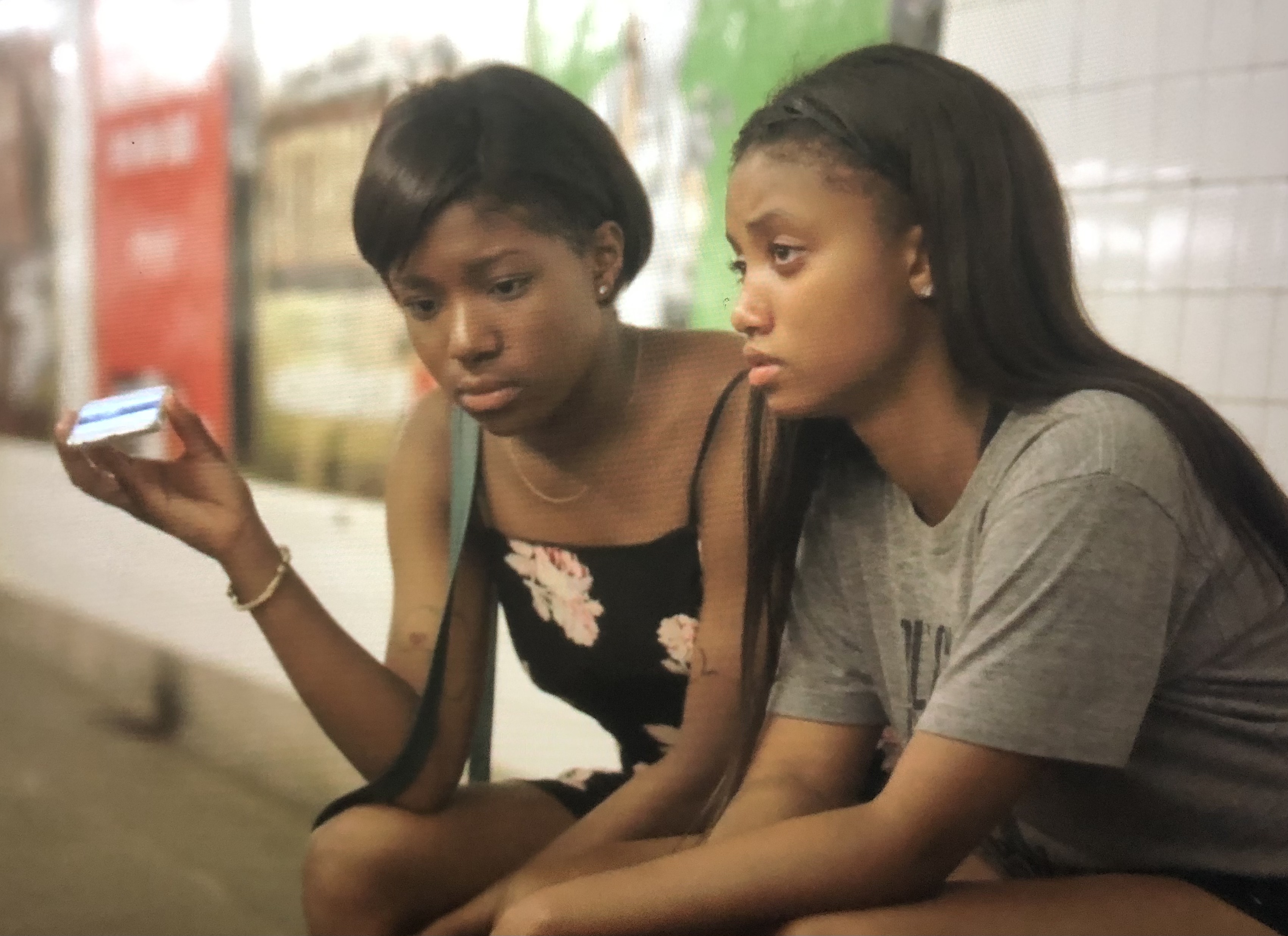
Mya (Amee Apedo) and Erin (Belle Legrand) survive a very dangerous situation in Flowers. DP: Jamal Solomon. 

In Flowers (2015)— co-directed and co-written with Yvonne Michelle Shirley— Mya and Erin set out to avenge Mya’s honor nearly tarnished by her white male tutor, Mr. Ryan. After all, Black girls are not often believed when assaulted. It would be her word against his and hers would bear less weight. Even the ease Mya enters his secure home raises questions. He trusts her like that? Clues reveal Mr. Ryan before he even arrives— mainly the brown baby on his refrigerator. So, he has a taste for Black women, eh? 

When the tension surmounts near the end, an unhinged Mr. Ryan becomes a greater villain, having no problem inflicting sexual or physical assault on Black girls. Has he done this before? Put his hands on the defenseless? His own unseen partner, pregnant with his second child? Through a red haze, he’s only thinking that Erin may destroy his reputation. Heart-pounding fear intensifies for Erin as the adult and teen fall on the floor battling over her phone. How far will both go for control? Mya returns, standing in complete shock at this escalated violence. Gratefully, Mya does not film this— her own tutor taking away her best friend’s agency; stripping away Erin’s earlier candor. The girls have played a hot gamble and they must leave before the flames burn any brighter. 

Mya and Erin both experienced abuse by the hands of Mr. Ryan—  traumatic in different ways and would impact their friendship forever. 

Grace (Ellie Foumbi, director/writer of the buzzy Our Father, the Devil) is impressed that her daughter Hawa (Dennise Gregory) can read well in Say Grace Before Drowning. DP: Daniel Patterson.

Say Grace Before Drowning (2010) sheds light on Grace, a sexual assault survivor— narrated from the point of view of Hawi, her daughter. Hawi was the first to leave their country, sheltered by Grace’s sister Aisha and her husband Chris. Upon Grace’s arrival, everyone treats her with special care, including Chris who’s touchy-feely actions trigger Grace’s assault. Her reactionary behavior stems from untreated memory dissociation, a mental disorder that stems from heavy, undisclosed trauma. Often, a withdrawn Grace disappears within herself and brightly returns to being Hawi’s mother, braiding her daughter’s hair, complimenting her reading, and sleeping beside her at night. 

By mistaking Chris’s kindness, Grace may be reminded of the soldiers’ mistreatment. After the family pool trip in which Chris teaches Grace to swim, she sets out to seduce her brother-in-law. During a spaghetti meal that Chris is preparing, Grace grinds on him during a song— right in front of Hawi. Grace transforms into her aggressive attackers launching herself at Chris, refusing to take “no” for an answer. In an assault as detrimental as sexual harm, power and domination over the body is essentially the key. Grace wants to repeat that history, but with herself as the wielder of power and domination over Chris, blind to consequences, to Aisha and Hawa’s feelings. Did the soldiers consider Grace’s family or their own wives, girlfriends, daughters as they violated Grace? 

Hawi hears the screaming match between Grace and Chris and abandons the spaghetti to see what the fuss is about. Spaghetti, when not watched and stirred frequently, gets clumped together, uneasy to eat. 

Toby (Angela Burnett) longs for her ancestral foundation. DP: Charles Burnett.

Hawa almost shadows Toby in Alile Sharon Larkin’s Your Children Come Back To You (1979)— story about a child wishing for a Black world whose mother too frequently dissolves into deep depression, neglecting Toby in the process. Whereas Hawi has her aunt Aisha, Toby has a compassionate grandmother. 

Abbie (Ebbe Bassey) and her teenage daughter Isatu (DeWanda Wise) reach an important solution to the prom in African Booty Scratcher. DP: Daniel Patterson.

African Booty Scratcher (2007), an earlier Jusu work, gets its title from an offensive, known and well-traveled taunt. The short stars DeWanda Wise as Isatu, a teenager looking forward to prom. Her hard-working immigrant mother Abbie wants Isatu to wear a traditionalist gown broadcasting her heritage. Isatu’s peers negatively blast anything associated with Africa. Thus, a tradition as American as apple pie, the prom is the biggest event in a young girl’s life— the fashion statement made here can either elevate your status or bring you down. Of course, Isatu believes that wearing  a typical name brand designer would have all eyes on her.

Terence Nance cameos as the mean teen who dumps Isatu via note. What a class act. DP: Daniel Patterson.

At Abbie’s restaurant (serving jollof rice and stews), Isatu works cleaning tables and waitressing in order to obtain money for her dream dress. Isatu sees firsthand that the teasing from schoolmates is nothing compared to how some Black adults look down on African immigrants, a seething hatred that manifests into verbal malice. A potential customer disrespects Abbie and their food in the process— further claiming that the Asians know what Black Americans desire more than the Africans. This avenue plays into Isatu’s own Americanized thought process— her laughing at the girl with the “African Booty Scratcher” card on her back, her preference for pasta over jollof rice, her reaction to the gown Abbie made for her. Perhaps Isatu too will become as bitter as the stranger, turning her back on her ancestral background for the comfort of fried food. Unfortunately, her mental institution has already begun.

Isatu realizes that she too has participated in Abbie’s humiliation. 

Mind-enhancing cocaine allows Sonya (DeWanda Wise) to blur her world in order to cope with her past life as a sniper. DP: Hans Charles.

The dark, disturbing Black Swan Theory (2011)— also starring Wise— focuses on as Sonya, a murder for hire dressed in black sporting a killer braided faux hawk hairstyle. This avant-grade experimental piece has an Afro futuristic meets parental advisory video game aesthetic. Sonya high on drugs and strapped for cash, takes on a murder-for-hire job. Already, she’s imagining killing someone— in a crueler affliction that implies personal vendetta versus a flying bullet. 

The men (played by Erik Clancy, Jeevan D’Souza, Stephen Hill) receive code names straight out of college textbooks—Italian renaissance artist/theorist/engineer Leonardo Da Vinci, French playwright/political activist/critic/existentialist philosopher Jean-Paul Sartre, and German poet/philosopher/composer Friedrich Nietzsche. DP: Hans Charles.

Meanwhile, Sonya’s code name Black Swan lacks that same consideration. DP: Hans Charles.

If there are therapeutic outlets for abuse survivors, do those who killed in the name of their country also have support? What therapist could possibly empathize with cold-blooded murder— even under the semblance of justice? How does a society expect veterans to navigate with normal mental/psychological capacity? Furthermore, Sonya has photographic memory. Even if she shot one person, that image rests in her mind forever. 

Seemingly without support beyond Jordan— her ex and former military comrade coping with the past in his own way— Sonya takes an assignment reminding her of the only skill she acquired whilst overseas. 

Valentina (Natalie Paul) in the subway in Suicide by Sunlight. DP: Daisy Zhou.

Suicide by Sunlight (2019) currently sits at number one on a list of short films that could be excellent full-length features. Seriously. An amazing film about Black vampires— without the Marvel comic book associations or Eddie Murphy antics. In this incredible world, vampires with melanin have the unique gift of walking through sunlight unscathed and those lacking die by the sun rays if they choose to be brave (or stupid). The shots on Black vampires glowing in the day are stunning; as though the still images bring the style of Gordon Parks to a vivid, creature-feature technicolor. 

Valentina tries to see her daughters, but their father  refuses to relent. DP: Chloe Zhou.

Gorgeous, stylish nurse Valentina juggles her career, bloodlust, and motherhood. She cares deeply for cancer patient Micah, a little boy on the cusp of death. Micah is around the same age as Valentina’s two daughters Hope and Faith and ex Langston makes it impossible for Valentina to see them. He’s part of those in town deadset against the vampires, not realizing that their precious daughters are not excluded— a whole new perspective on the one drop rule. 

Valentina balances her nursing duties; withholding a ferocious hunger that her co-workers and patients know nothing about. At night, however, her lust is insatiable— deadly seductions turn into passionate clenches of her razor sharp fangs piercing flesh. Shockingly, though, Valentina pukes it all up, looking as guilty as Buffy’s ex-boyfriend Angel— the redemptive vampire with a soul. 

When Valentina discovers that Langston has introduced a new woman to Hope and Faith— perhaps as some misguided attempt to replace Valentina and give the girls a makeshift nurturing he himself cannot provide— Valentina decides to give him a lesson. In the process, Valentina shares who they truly are to both Hope and Faith. 

Don’t ever cross Valentina. A beloved mother would do anything to see her children. DP: Daisy Zhou.

The girls Hope (Juniah Williams-West) and Faith (Madison Spicer) trust in their mother. DP: Chloe Zhou.

Jusu’s five short films are well-crafted, sophisticatedly put together and beautiful as a whole oeuvre. All four cinematographers—Jamal Solomon, Daniel Patterson, Hans Charles, Chloe Zhou— captured the rich, multifaceted variations of Black skin in exceptional styles that would make Bradford Young proud. In addition to the experience, it is lovely to see that the same names continue popping up in the credits— Yvonne Shirley (sound mixer on African Booty Scratcher and Say Grace Before Drowning), Terrance Nance (guest actor, producer/title card maker, renaissance Da Vinci, etc), and quadruple threat Jusu editing and production designing. 

Hawa playing in her mother’s makeup as young girls love to do. DP: Jamal Solomon.

“The Oscars are not my center,” Nikyatu Jusu recently said on the Independent Spirit Awards carpet—a valid statement to speak against an industry placing the Academy Awards above all others— the symbolism of “making it” in the filmmaking art. 

Yet, that problematic space relies heavily on its white cinematic history repeating over and over; an institution excluding Black women for years, continuing to nominate the same folks filling the Guinness Book with their record victories. So, even if they fail every year to recognize Black women’s talents onscreen and behind-the-scenes, the audience desires to see themselves reflected, most importantly by women who mirror them, who know their pains and joys, not stories from the anthropologist lens dominating our cinematic experience for far too long. 

“I’ve done a lot of spiritual, intellectual, physical labor, being in predominantly white spaces for my entire life. So now allow me to just focus on the work. But everything comes with a price. Money’s never free; success is never free.... the more breaks I have for myself, the more I’m like, Do I want to be part of that machine and do everything that comes with that? Or do I want to make something I truly believe in every few years and still teach and have my little quiet house and live below my means? The more you see of the figurative monster that is the industry, the more you assess what you’re willing to do to get what other people have gotten.”— Nikyatu Jusu to film critic Angelica Jade Bastién in Vulture

Jusu’s works matter. Every last one. Her brilliant feature-length debut Nanny included. Brown and dark-skinned women star across genres that usually exclude them. Horror rarely ensures their survival. Jusu sets the wrongs to rights, presenting Black women and girls in either unaddressed community topics or imaginative scenarios that broaden the modular spectrum. She utilizes key elements to a solid cinematic experience: breathtaking stories, compelling cinematography, and fresh talented actors/actresses, ensures that the audience will be wholly invested. Plus, the casting stays excellent— friends having believable chemistry, mothers/daughters looking alike. 

Whether Nikyatu Jusu makes another short film between her booked schedule of two feature-length films, whatever comes next will be well worth the wait. The representation of Black girls and women are safe in her capable hands. 


Tuesday, October 11, 2022

‘Code Switch,’ A Poignant Short Film Gazing on the Black Femme


Code Switch film poster. 

Code Switch, likely the shortest short film ever reviewed at a length of five minutes, does not make it any less significant than a full-length feature running past three hours. From beginning to end, the experimental portrait presents a singular Black body situated in safe, nonthreatening spaces— spaces that hold historical significant symbolisms/ties to Black culture. 

Code switch by definition linguistically means “altering two or more languages.” In workplace environments or locations lacking a true inclusivity, Blackness (mainly Ebonics, attitude, style, etc.) must often be smoothed over, toned down to appease the masses. Yet, in this particular short film, this term is used to illustrate an aspect of a person’s appearance and identity, finding the balance in the authenticity of their gender. 

Pick out at the barbershop. DP: Hany Osman, Yojin Yohe, and Joe Cozza. 

Inside of a busy barbershop, a non-binary figure receives a fresh trim to their illustrious low cut Afro aka a tapered TWA (teenie weenie afro). Others come and go with their evenly toned and hydrated flesh, widened smiles— a beautiful, engaging people. The camera pans on these individuals who pay the protagonist no mind. Each engaged in conversation after conversation against the cool background R&B track that plays as crisp as a vinyl record. This particular experience in the barber’s chair is a familiarity expanding towards he, she, and they. These grooming tools have no gender roles, no gender expectations despite what society claims to be true, to be normal. The protagonist belongs there among the strangers receiving their own washes and haircuts, a place that doesn’t ask who you are or where you’ve been, just usually “how would you like to be styled today?”  

The split duality of finding allegiance to both dominantly male barbershop culture and the beauty that Black women possess. DP: Hany Osman, Yojin Yohe, and Joe Cozza. 

Later, the protagonist— in a powder blue durag and matching shirt— gazes upon pictures in their white walled bedroom. Scattered magazine images of iconic women celebrities celebrate unambiguous Black beauty from Aretha Franklin to Maya Angelou, Missy Elliott, Kerry Washington, and Lauryn Hill, a period of the 1960’s-2000’s, something alarmingly outdated as the culture of now shifts towards lighter complexions and looser hair textures. Yet among these voguish faces are outspoken queer individuals such as Da Brat and Janelle Monae— probably the most current. This scene certainly presents another dynamic altogether, that of dualism: two separate entities existing in one body. The natural, organic being who appreciates the media representation of the glamorous makeover while simultaneously embracing their true identity, bravely stating that “yes, these are beautiful historical figures holding high standards, but this honestly will never be where I stand.” 

The ending grants the first spoken words that are not song lyrics— kind, gentle vocals from the unseen mother on the phone entailing a much needed acceptance into the ears of the silent figure whose warm, pleasing face and shorn hair has captivated us throughout this timeless piece.  

Nothing more idyllic than the capturing of smoke escaping nostrils and lips. DP: Hany Osman, Yojin Yohe, and Joe Cozza.

Although we still live in troubling, violent times where people refuse to understand and acknowledge that there are more than two genders, Code Switch opens up a fresh dialogue. A film told through a caring, thoughtful lens offers a gratifying story in three hundred, twenty-two seconds. It shows the beauty of a deserving existence. 
Writer/directors Mx. Roti and Davis Alexander James’s must see Code Switch, a winner of the Frameline Completion Grant, has shown at various film festivals across the country including the 46th Annual Frameline in San Francisco, the 40th Annual Outfest in Los Angeles, the 5th Annual Black Femme Supremacy Festival in Baltimore, and the 24th Roxbury International Film Festival in Boston. It will then show at the 17th Annual LGBT in Dayton, the 9th Alphabet Festival in Chicago, and the 22nd Annual Indianapolis LGBT Festival in Indianapolis.