Showing posts with label Asian Women Directors. Show all posts

Friday, August 19, 2022

‘Barrier Device’ Takes An Intriguing Inspection Into The Other Woman


Barrier Device film poster.

Audrey is an independent researcher conducting a study on the female condoms. Life could not be anymore complicated— that is until one of Audrey’s subjects adds an unexpected personal commonality. Serena just so happens to be sleeping with Jay, Audrey’s ex. 

Audrey (Sandra Oh) interviews a new candidate for her research study on female condoms. DP: Patti Lee.

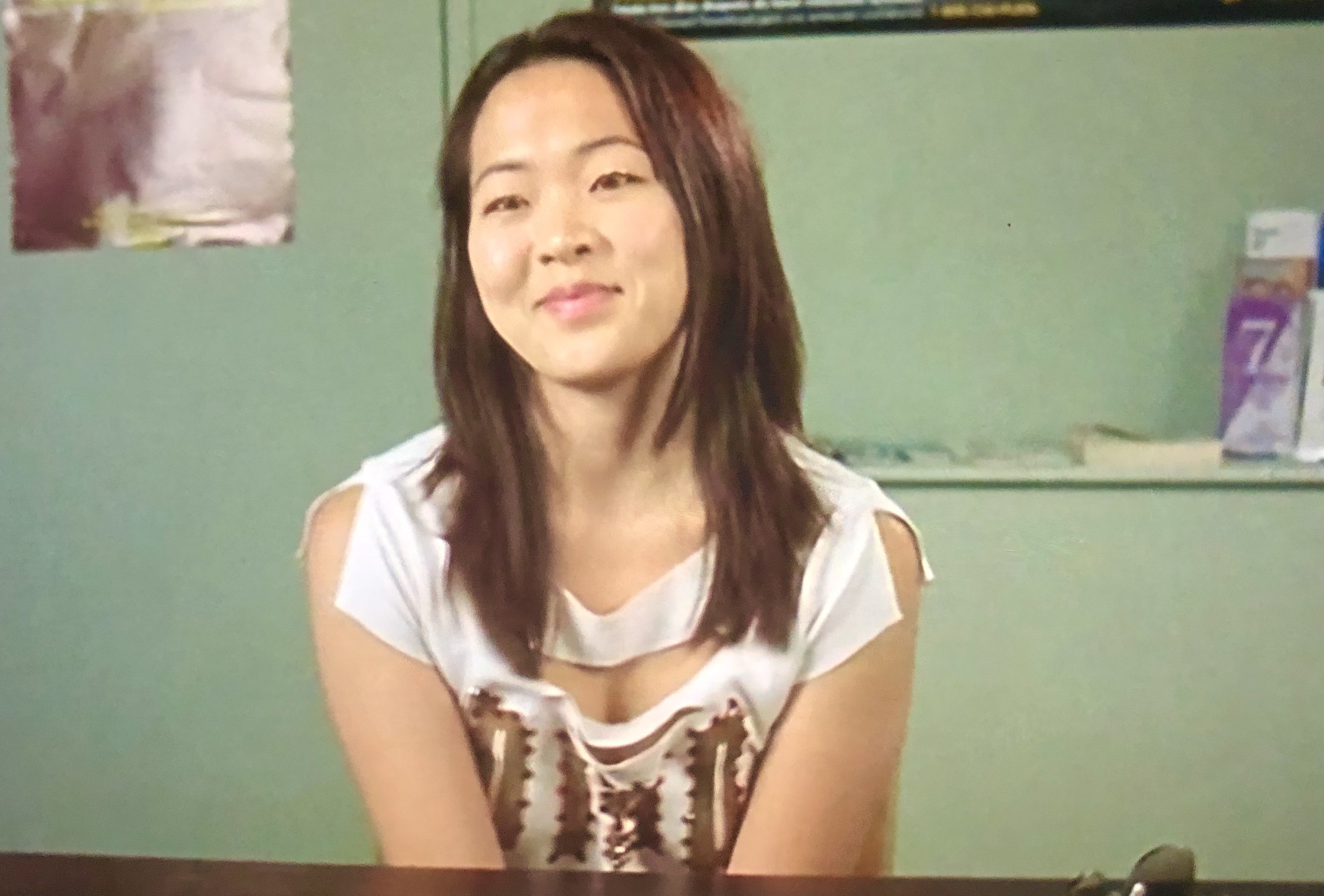
Serena (Suzy Nakamuru) is selected. DP: Patti Lee.

Serena comes in for further conversation with Audrey, telling her that she is currently intimate with two men— Jay and Michael. DP: Patti Lee.

Serena is everything that Audrey is not— younger, vivacious, adventurous. Serena has an open outlook on the world around her. However, Serena also proudly wears Audrey’s grandmother’s necklace with every outfit no matter how much it doesn’t suit her clothes. Perhaps the necklace is not aligned with the wearer as well. The jewelry holds sentimental value to Audrey. In fact, prior to, Audrey calls Jay to find it for her. He is no help. Serena wields a certain power over Jay, a lying, facetious man who only wants Serena because she is not as sexually frigid as Audrey. For him to even ruthlessly give away an object precious to Audrey paints him in a cold, callous light despite his voice being the only thing the audience hears. Jay— although unseen— is a present force occupying space between Audrey, Serena, and Audrey’s grandmother’s necklace. As a result of his shallow, untrustworthy behavior, Audrey is able to put the heartbreaking pieces together. 

Audrey has called her ex about her grandmother’s necklace, but he swears having not seen it and hangs up. Later, Audrey sees it... DP: Patti Lee.

On Serena’s neck. DP: Patti Lee.

Multiple times. DP: Patti Lee.

Still, Audrey cannot resist this newer form of research. It is in her nature to be curious and test situations; seek results. Thus, Audrey begins invading Serena’s life casually, going down the rabbit hole of friendship, seemingly as a mere experiment. After all, the lonely, isolated Audrey lets work occupy her time. Essentially, Audrey’s getting to know Serena on a deeper, connective level appears similar to her work, analyzing and comparing notes— comparing herself to her ex’s new lover. While Audrey has trouble adjusting to the female condoms, Serena is quite adept at getting Jay to use them. 

Audrey reads through Serena’s sex journal. DP: Patti Lee.

Apparently, Serena and her man are quite active. DP: Patti Lee.

Serena shares her sex journal with Audrey. Naturally, Audrey assumes that this is with Serena’s other partner, Michael. It is a much easier exercise than imagining your ex having an excessive amount of physical enjoyment whereas Audrey has trouble getting a man to even fathom the idea of female condoms. One such partner asks, “can we just do it the normal way?” As though the very act of role reversal muddies the potential pleasure experience for both parties. When Serena admits her journal is all about Jay and that Jay enjoys using the female condoms, this puts more blow to Audrey’s already fragile self esteem. Not only is Serena sexually explorative (and even good at a few lies in the act), but she has gotten Jay actively involved, actively participating. The real kicker is that Serena supports Jay’s writing too— another intimate sector that breaks Audrey’s heart. Worse, Jay’s writing is influenced by their past relationship. Audrey, putting work above everything in her life including Jay who needed the ego boost that Serena could offer him. 

Audrey even goes to Serena’s house. There she finds her grandmother’s necklace among Serena’s jewelry. Serena enters and suggests that Audrey try it on. DP: Patti Lee.

However, Jay is not the winning side. Jay is no hero in this catastrophe. He cheated on Audrey with Serena and had the audacity to present Audrey’s grandmother’s necklace to Serena.

Serena cleans out Audrey’s ears and picks out Audrey’s gray hairs. DP: Patti Lee. 

Smartly written and directed by Grace Lee, Barrier Device, a near thirty minute short film riddled with lighthearted womanist connections, tense drama, and warm humor, is a worthwhile watch due to the remarkable chemistry between its leads Sandra Oh and Suzy Nakamuru. When the confrontation finally happens near the end, Oh and Nakamuru play Audrey and Serena’s emotional spirals with great believable ease. Audrey’s despair over Serena’s perfection and Serena’s agony over being misled by Audrey touches on the darker sides of women relationships— especially how jealousy can be a severe, jeopardizing poison. Yet after the hard truths are revealed and the grandmother’s necklace is returned to its rightful owner, Audrey and Serena reach a genuinely sweet understanding. 

Audrey unleashes her fury onto Serena who has barged into one of Audrey’s sessions. DP: Patti Lee.

Serena claims that Audrey has destroyed her life. DP: Patti Lee.

Audrey and Serena reach the climatic point to a rather complex relationship. DP: Patti Lee.

Although it would seem that Jay ironically brought Audrey and Serena together, perhaps their mutual togetherness comes too from the recognizable necklace too. Maybe it was Audrey’s grandmother encouraging Audrey and Serena to see how they had the ability to help each other— with the combined strength and resilience to move past Jay.  


Friday, March 25, 2022

‘Double Happiness,’ Always A Treat to Revisit


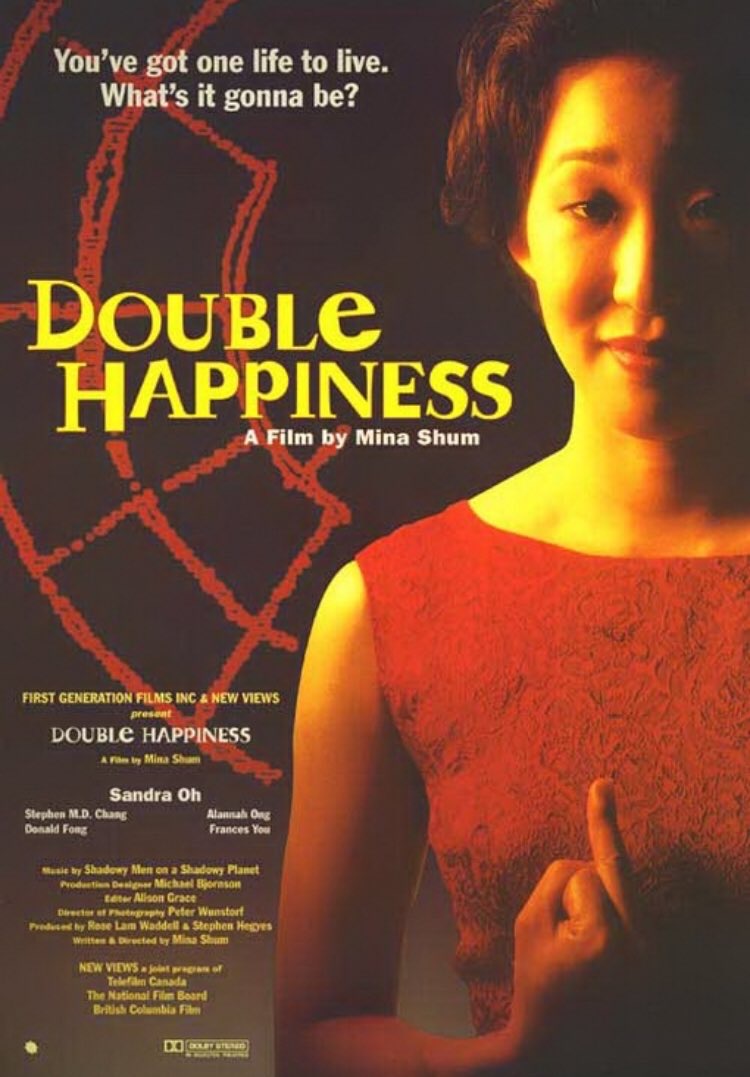
Double Happiness film poster. 

Although I have yet to watch Sandra Oh’s latest film release— the horror Umma helmed by Iris K. Shim— in honor of Women’s History Month, it seemed like the perfect opportunity to revisit another Asian director, Mina Shum, whom Oh has worked with several times in Canada. The humorous classic Double Happiness brings all kinds of joy to behold. 

Jade (Sandra Oh) jokingly reflects that the difference between her family and The Brady Bunch is that hers have subtitles. DP: Peter Wunstorf. 

Sandra Oh stars as aspiring actress Jade Li in a family of Chinese immigrant parents. Her younger sister Pearl looks up to her. They share a bedroom despite Jade being twenty-two-years old. The girls also have an older brother Winston, but his memory is locked up in a secret box beneath the bed. Apparently, he has been disowned (mostly by their stern, family values protective father) and this symbolism will remain in affect throughout due to Jade’s rebellious spirit. Much like her absent brother, Jade has the desire to break tradition. 

Jade (Sandra Oh) and Pearl’s (Frances You) relationship is an adorable illustration of sisterhood. They protect each other, dance, eat, and everything in between. DP: Peter Wunstorf.

Born in Hong Kong and raised in Toronto, Jade is the product of her surroundings, primarily the television and wanting to be on it. Jade is naturally gifted at mimicking everything that she sees and hears— Southern accents and all. Yet in two very specific instances, Jade is confronted by an uncomfortable reality of living in an awkward duality. She must decide between portraying the terribly offensive stereotypical accent or truly understanding what being outside of China has done to her. Jade may be able to speak the Cantonese her parent have taught her, but when it comes to reading the very language itself, it makes her question herself as a Chinese woman. The questions raised to her are valid, deeply personal and will affect her throughout the film. What does being of Chinese descent illustrate to the next generation being raised in a place far removed and situated in another culture? 

Jade (Sandra Oh) and Lisa (Claudette Carracedo) share hopes for the future. DP: Peter Wunstorf.

When Jade’s best friend Lisa asks what her dream is, Jade softly responds that she wants to win the Academy Award for a big part. This is such a sad, bittersweet statement in a twenty-eight year old film where limited stride has been made in an institution that favors white actresses above all others. Last year, Youn Yuh-Jung won Best Supporting Actress for her role as the grandmother in Minari and the previous win in that category was Sayonara’s Miyoshi Umeki in 1957– sixty-four years prior. Truly great Asian actresses from Michelle Yeoh to Maggie Leung and Ziyi Zhang and more have been glaringly overlooked. Thus, Jade’s future hopes are not only incredibly impossible odds— they are proof of the blatant unfairness and racism in Hollywood film awards. Jade is already struggling to find casting directors that appreciate her multifaceted techniques. With the doors continuing to close on her, how could Jade even begin to break out of achieving one slice of her desire? 

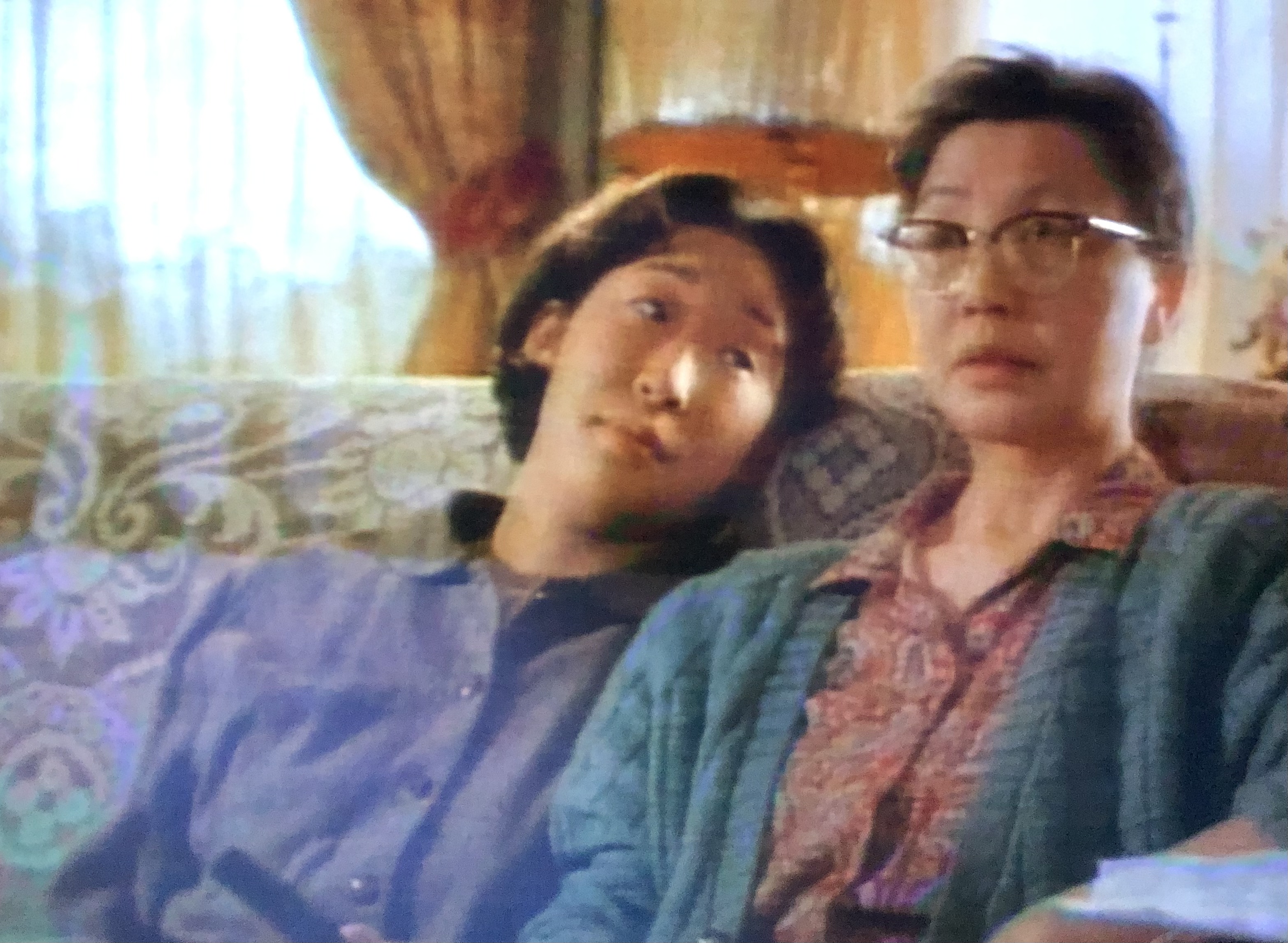
Even though her parents not completely invested in Jade’s career choice, Mom (Alannah Ong) doesn’t mind if she takes a more respectable journalism gig. DP: Peter Wunstorf.

Meanwhile, Jade’s parents and friends continue setting her up with different Asian men in hopes of marrying her off. This dated customary setup doesn’t suit the current landscape. Jade has far too many unconventional ideas, is too focused on independence than subjecting herself to fitting in with the old ways. In Toronto, she feels encouraged to follow another path that does not include the ideal mate, but a preferred partner of her own choosing. 

The sisters must hide their photo with Winston... 

Under the bed. DP: Peter Wunstorf.

A very important factor into Jade’s story is Winston continuously being brought up. People would ask how their son is doing. The mother makes up stories, but the father speaks nothing of him. Winston’s blacklisting from the family— his disownment— is primarily the father’s doing. Jade’s sheer independence starts bothering her father, especially the acting and the “talking back.” Jade is supposed to be respectful, demure, obedient, and quiet. Whenever her father becomes angry or disappointed in her, Jade brings him red bean buns and tea as a forgiveness branch. She also becomes mother hen-ly— massaging his back and combing his hair, seeming more wifely than daughterly. Beneath trying to appease her father, Jade aches to be her true authentic self without his constant backlash.  

Jade imagines herself a Southern belle. DP: Peter Wunstorf.

Unfortunately, casting agents see one opportunity for women like Jade. DP: Peter Wunstorf.

So while the older generation continues speaking in their native Cantonese tongue, Jade, Lisa, and Pearl exemplify the turning tide. They understand the language and respond back in English. 

When Dad introduces his daughters to Uncle Hong, they must recite a greeting in perfect Cantonese. 

Uncle Hong (Donald Fong) making dumplings from scratch with his sister-in-law. 

Double Happiness also shows a huge relationship between food and community. Jade’s family and their friends gather around the table—a constant sturdy structure— eating hefty portions with their chopsticks, having conversations, or making homemade dumplings. It almost has that family restaurant quality, seeing that the mother prepares everything because it is expected of her as the daughters set the table. 

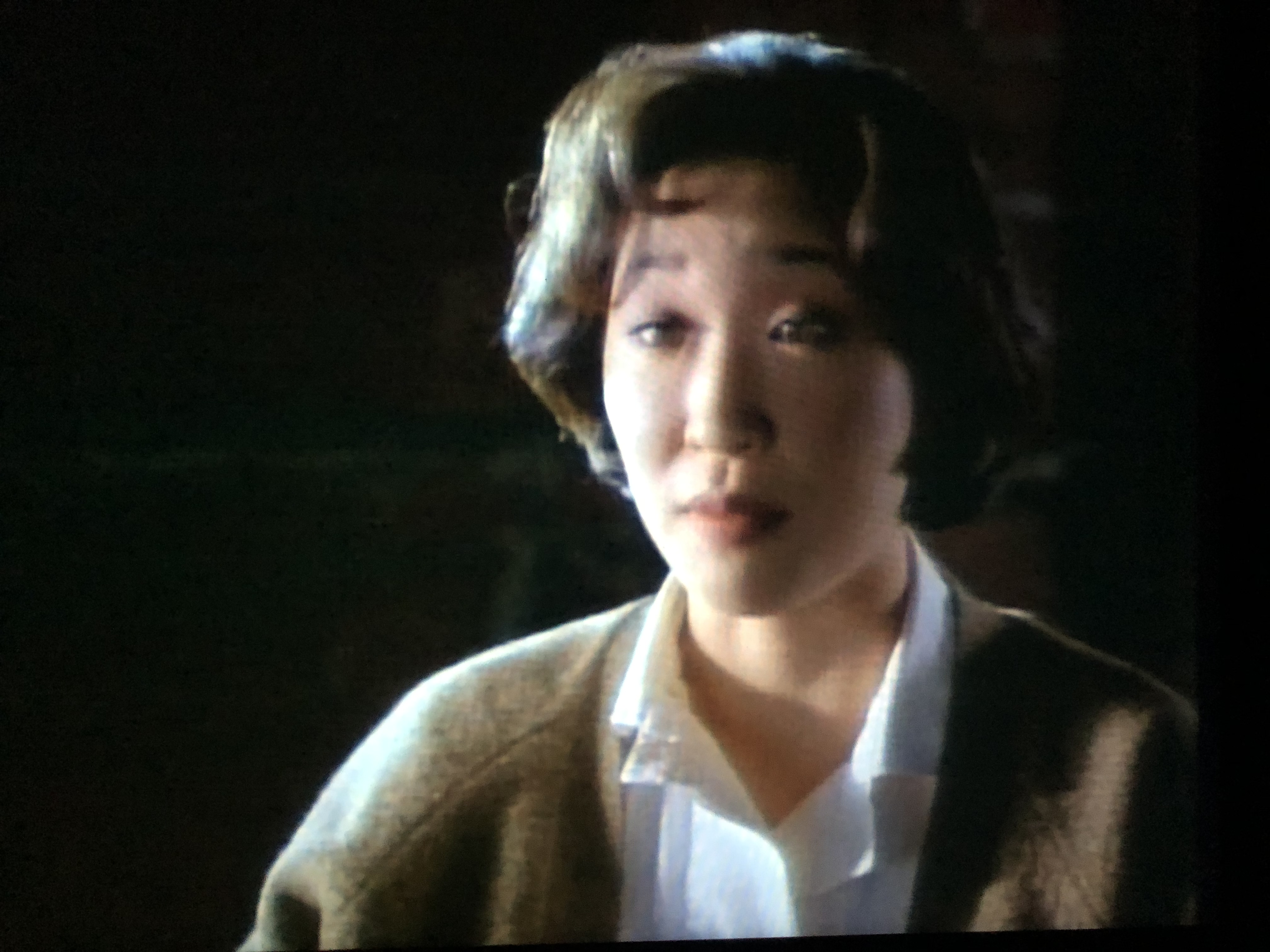
In the standard white dress and classic pearls once more, Jade realizes that the life of her traditional parents is not the life for her. DP: Peter Wunstorf.

A solid prize winner at the Toronto International Film Festival and Berlin International Film Festival,  writer/director Mina Shum’s charming, delightful screenplay is chalk-full of humor, wisdom, and defiance. In a role fresh after the candid biopic The Diary of Evelyn Lau, an utterly brilliant Sandra Oh breathes life into the free-spirited Jade. Oh was deserving of her awards— the Genie Award for Best Actress (the former Canadian equivalent of the Oscars) and a special mention from the Torino International Festival of Young Cinema. 

Red bean buns will not always have sway for Jade’s dad (Stephan Chang). DP: Peter Wunstorf.

Currently streaming on Prime Video, Double Happiness will have anyone laughing, resonating with a woman’s modern-day independence, and coming back stronger in the face of abject rejection/racism. 


Friday, September 13, 2019

Young Sisters Survive Abandonment in 'Treeless Mountain'

Treeless Mountain film poster.
Jin is the oldest of two sisters and the only one in school. After class ends, Jin plays pogs and she's quite good at earning a considerable stack. Due to having a little fun, Jin is late in picking up her little sister Bin from an upset caretaker. From the scene, it sounds as though the caretaker too has had enough of Jin and Bin's mother and must take frustrations out on the children. Jin and Bin's mother isn't happy either, having enforced Jin to leave the precious parts of childhood behind at way too early an age.
"Why were you late?" The mother asks.
Jin doesn't respond, likely fearing disappointment that she wasted that time playing games. 
This foreshadows the mother's role in the film, in Jin and Bin's lives. The girls did what was expected of them by the mother, but the mother reappears the moment "she's supposed to."

The mother (Soo-ah Lee), Jin (Hee-yeon Kim), and Bin (Song-hee Kim) set out for an uncertain future. 
Later on, the mother has been evicted and goes off with her daughters via bus to stay with her sister-in-law. The next day, however, the mother leaves Jin and Bin a pink plastic piggy bank and promises to return once it is filled. She either knows that they will not make enough change or that she will truly reunite with their absent father. Thus, this reveals that children alone do not make unbelievable notions-- adults living in fanciful worlds can harm the family foundation. After all, the mother has been treating Jin like a babysitter and less like a little girl. It is not that she is shirking motherly duties because she doesn't want them, she can't afford the harsh realities that come with parenting. Financial burden--even with a job--is too heavy a burden and she seems to have no where to turn. She could drop the girls off from place to place, but where can a mother go?

Bin and Jin still watch out for their mother each day and work hard for their drunken aunt-- a woman who scolds and yells. She barely gives them coins for their piggy bank. Suddenly, there are times, Jin is sent to bed without supper or their aunt is passed out drunk, leaving the girls with nothing to eat. They befriend a neighborhood boy and his sweet, affectionate mother (who gladly feeds them). In fact, the mother is like a mother they should have had, a caring, thoughtful, generous woman who always has a plate of cookies to spare. The cookies are comforting to Jin and Bin. Yet they don't want to keep using her. Instead, they find a resourceful way to support their hunger pangs and fill the piggy bank. It is the grasshopper--an ancient symbol of good luck-- that helps them.

Unfortunately, Jin and Bin will realize that sometimes adults say things they are powerless to mean.

Bin (Song-lee Kim) watches her sister, Jin (Hee-yeon Kim) prepare grasshoppers. They sell these for cheap to make money-- more so than their aunt can give. 
Writer/director/producer So Yong Kim (who has directed episodes of Queen Sugar, American Crime, Good Girls, and Divorce) has rendered a narrative rich in beautiful cinematography and laudable characters. The poignant closeups on Jin and Bin's innocent, doe-eyed faces shows that portrayers Hee-yeon Kim and Song-lee Kim expertly express the pains and sorrows of growing up motherless. Their performances are riveting and heartbreaking, great vehicles to drive the film forward as the characters move from the city life to pitiful poverty to the simplistic farm life of their grandparents. Also, the use of food is important-- the characters eating at the table, picky Jin's dislike of her aunt's food, Bin's compulsion to "eat anything," their grandmother making dough from scratch-- it is all relative.

Bin (Song-lee Kim)  and Jin (Hee-yeon Kim).
The brave, candid Treeless Mountain is an exceptional film about two little girls relying on each other for emotional, moral, psychological, and physical support. Whenever nourishment is lacking, Jin will comfort Bin and likewise. In a world that can easily leave girls behind (especially irresponsible adults), Jin and Bin have to toughen up and let their imaginations breeze into the wind. By the end, the resolution is a somber, appropriate tone to all that of which they have carried and learned from the people around them. Patience ultimately becomes their biggest foe and their greatest ally.