Showing posts with label Black Writing. Show all posts

Sunday, February 11, 2018

The Tale of Four: Gabourey Sidibe's Charged Directorial Debut

The Tale of Four film poster.

Promise reveals itself through the thoughtful directorial debut of Oscar nominated actress Gabourey Sidibe. Between delicately plucking tender flowers to passionately snatching the plants out of their soil pots, Sidibe breaks open Nina Simone's powerful song, "Four Women," composing a short narrative that places itself into contemporary America. In the course of a single day, four different women occupy an apartment complex, facing personal turmoil, coping with images and events that lead to emotional and mental health fragilities that black women must often confront alone, without support. It has always been a disturbing perception that black people, black women in particular, are conditioned to be strong, to be so above showing emotional "weakness."

The Tale of Four shares the struggles, triumphs, and failures of Aunt Sarah, Saffronia, Sweet Thing, and Peaches.

Ledisi is Aunt Sarah.

First, duress and agitated, the black Aunt Sarah, obviously broken by the murder of a black man, cannot bear playing the parental role to two children whom so desperately need her. She is a morose creature, restless demons haunting the despair in her eyes, the burden weighing heavily upon someone so grossly unprepared for offering love to those in need.

Megan Kimberly Smith is Saffronia.

Battered and beaten, Saffronia, on the other hand, is the yellow scarred teen hiding secrets to her mother. In fact, this daughter/mother are both keeping traumatic wounds from each other, these wounds being emotional, sexual, and physical manifestations that must get out in some way before swallowed into internal gutter.

Dana Gourrier is Sweet Thing.

Confident and cocky, Sweet Thing is the tan, curvy vixen who wields sex as a weapon, as her sultry power source. She is raw and sensual. Yet brewing beneath the need for instant gratification, lies a desire for a deeper, fulfilling connection, something much more beautiful than the easy seconds to discard one's body for the empty, meaningless pleasure.  

Aisha Hinds is Peaches.

Peaches is the brown reckless crusader, a power-to-the people savior. Her room is an aggressive triggering of past images. From Emmitt Till's casket photos to slain young black people of our now, the little pictures and newspaper clippings that surround her add fuel to her angry rants, the flare of her message seemingly breaking the fourth wall, instructing viewers to take immediate charge, to bear no more suffering in an unjust society that has never wanted to be equal with any minorities. 

Gabourey Sidibe on set.

The Tale of Four's script is written by Ayanna McMichael and Kia Perry, two women who have worked in various departments of the film industry. This is their first imDb writing credit and the joined effort is pretty solid. It is definitely one of the most captivating perspective's of Nina's wondrous song. There is depth here as if they took the lyrics apart piece by piece and set these individual characters in this specific place, in this specific time. The performances also strengthened the short, especially the gritty significance of Peaches, that rough, embittered particle that passionately screams out injustice. 

Therefore, this short is a resonating piece to add to anyone's Black History Month roster.

Wednesday, August 30, 2017

'Love Jones,' 20 Years, 5 Months Later, A Motion Still Tumbled in Earth

Love Jones DVD cover.
“This here, right now, at this very moment is all that matters to me. I love you and that’s urgent like a mother….”
How can a sis not swoon over grandiose words spoken by teenage crush, Larenz Tate, playing this beatnik brother poet, Darius Lovehall? Trust and believe that is the hardest notion of all, fighting against problematic perceptions of the young black Chicagoan male. Darius is intelligent, eclectic, and charming, the laidback, ear pierced black man whose tiny apartment makes room for an impressive library, listens to the rustic scratchy sounds vintage records make, and understands distinct difference between sadness and melancholy.

Twenty years ago, I wasn’t quite old enough to see Love Jones in theaters, but saw it much, much later. Recently, I rewatched the Sundance Film Festival Audience Prize Winner, hooked to the sweetness of black artists falling in love with each other and their respective practices.

Nina (Nia Long) and Darius (Larenz Tate) giving each other the Kool-Aid smile.
The queen bee eating up spoonfuls of Darius's freestyle scat is gorgeous, talented, fiercely ambitious Nina Mosley. With her crop top blouses (including that amazing outfit at the end), high-waisted denim jeans, and dark lipstick, she defined fashion. An up and coming photographer whose vignette portraits have a Gordon Parks meets James Van Der Vee in the 90s kind of vibe, Nina uses vintage cameras, taking her passion onto the streets, capturing mostly people in love. Big shot magazine editors don't like her style. A man calls her "unpolished" without really defining his criticism. This rejection adds stress to a woman who left her selfish fiance.

Darius and Nina first meet at The Sanctuary, a hip underground nightclub for bohemian sisters and brothers who collectively snap their fingers to open mic visionaries. Darius is part of a black bohemian posse of knowledgeable sophisticates-- Afrocentric vibing Sheila, humble married Savon, cool Eddie, and player Hollywood. The sparks fly immediately, even after a minor fumble at the bar, but Darius walks up to the mic and spills out a raw, sexy poem, Brother to the Night, (A Blues For Nina). Nina's embarrassment is genuine. She doesn't like its sexual components, but she is a tiny bit flattered, putting on a sisterly blush. They meet again and stubborn Darius continues to woe her with sweet, explicit music and dance.

I love that after Nina recites Sonia Sanchez's poetry, Darius believes that Nina will come up with words of her own. He knows it. As well as he knows she is skilled with the camera, he knows that she has other skills up her sleeve, that she too is a poet at heart.

Now growing up, in regards to film watching, I had been mostly exposed to white romances-- white people falling in love, white faces kissing, white bodies thrusting together, the whole nine yards. Hell, my entire middle school sex education was an instructive white people "doing it" cartoon. To see Darius and Nina becoming deeper than two passing strangers: dancing at a reggae spot, passionately making out at her doorstep, dissolving into full fledged intimacy in a beautifully compiled erotic montage. This epic thing of wonder charged with poetic moments of clarity utterly shook and dismantled my whitewashed education. I thought, damn, is this what Hollywood is afraid of? That black people can be fully realized, three dimensional beings that can love the living life out of each other? That they can be hot, sexy, and set the screen on fire without stereotypical exaggeration?

Nina (Nia Long) working with the professional camera.
Darius and Nina have their ups and downs. At the same time, so does the married Savon. Trust is the enemy. Everybody makes mistakes and smashes that needed relationship essential. I understand that Nina wanted to see if she would miss something with Marvin, but his ill-fitting childish behavior obviously wasn't ever going to change. Plus, he would have smothered Nina's independence. Meanwhile, Darius finds Lisa, a new squeeze to warm his bed, but she incites no spark of inspiration. Nina returns to Chicago and is immediately broken-hearted over seeing Darius and Lisa. She turns to Hollywood (eerily similar to Marvin) for affection and fair play turnabout. Savon is lonely after his wife leaves with their son, bringing questionable companions to the posse get togethers. He has a valid outlook on love and relationships, ultimately stating that it's the staying in love that is the most challenging hardship. It's tough seeing his struggle in the marriage. Troubles do not end after "I do." And that's real.

Josie (Lisa Nicole Carson) and Nina (Nia Long).

Ava DuVernay said, “I think that women definitely have a special bond as friends that is hard to describe to men, and we don't often see that portrayed narratively."

That is sort of expressed greatly here. With their amazing girlfriend chemistry, Nina and Josie's onscreen conversations mostly revolve around men and their relationships with them. Apparently, Josie has an active sex life, but her purpose (in this film) is to live vicariously through Nina. However, the taxi cab scene is hilariously memorable, a real game changer in how women discuss male anatomy. When Nina explains that Darius speaks to her down there, it was so much more hysterical than any fake deli orgasm. This was straight fire. Though the male taxi driver overhears and is thoroughly amused, carnal sharing is for the benefit of sisterhood spillage, not for him.

Still, it is a huge missed opportunity to not have the girls celebrating Nina scoring a break (after months of being dismissed) with Vibe Magazine. Would have loved to see these women toasting to that milestone. I appreciated her phone call to Darius and the crushing train scene afterward, but I needed a Nina/Josie girl party. Plus, what the heck did Josie do for a living anyway? She wasn't exactly fleshed out. Also, it is such wasted potential that none of the fine brothers of the posse wanted to engage with her. For example, Hollywood has always wanted Nina-- friend's girl or not. Eddie is a closed book, great deep voice, the host of the soirées, but without a partner. He and Josie would have hit it off if the chance had been granted. 

On the other hand, Sheila is an amazing, sensational independent woman. She works at Last of the Old Time Record Stores with giant posters of Janet Jackson's Design of a Decade, Eric Clapton's From the Cradle, and funky posters on the front door. She spoke her mind and put characters like Hollywood and Savon in their place if they stepped off. Her side eye expressions put everyone on notice.

Darius and Nina looking like a "One in a Million" couple on the motorcycle.
The film is put together brilliantly, each piece playing its part to utmost perfection-- the acting, the script, the cinematography, the music. From Lauryn Hill’s guitar strumming serenade “The Sweetest Thing” to spoken word sensuality of Meshell Ndegeocello and Mark Miller’s “Rush Over,” the music selection is ridiculously slick, keeping interest flowing from Darius's sexy ode to Nina to Nina's "virgin" popping at Darius in front of the mic. The in between is a lacy groove set of Maxwell, Cassandra Jones, and Duke Ellington designed to never let the mood shift out of a lover's mindset.
Earlier this year, Love Jones received the ABFF (African Black Film Festival) honor for being the Ultimate Black Love Classic.  Omari Hardwick introduced the sweet award to the cast: Bernadette Clarke (Sheila), Theodore WItcher (writer/director), Lisa Nicole Carson (Josie), Larenz Tate (Darius), Leonard Roberts (Eddie), Nia Long (Nina), and Isaiah Washington (Savon).  Bill Bellamy (Hollywood) wasn't present, but they shouted him out. 
Nominated for three Image Awards and four Acapulco Film Festival Awards (winning for Best soundtrack), Love Jones was way above the time of its 1997 release date. Cumulative box office total says nothing about the kind of impact this film made on so many people. The story of Darius and Nina and their surrounding friends stands on the paramount of black romance, standing atop a pedestal so grand that few others can topple its worthy place in nostalgia.

Darius and Nina reuniting in the pouring Chicago rain! 
The Love Jones ending is a special kind of gold that all sisters appreciate. When a grown woman runs out in the pouring rain, risking the world (yes, getting a nice straight press/relaxer wet), that is a sign of true dedication, a willingness to sacrifice everything in the name of love.


Sunday, August 27, 2017

Black Women Filmmakers of the 1970's And Where They Are Now

Barbara O (who played the wonderful Yellow Mary in Daughters of the Dust) is the title woman living simply above mountaintops.
Lightbox Film Center shared six pieces from four black women writer/directors. Julie Dash (Daughters of the Dust), Alile Sharon Larkin, Fronza Woods, and the late Jacqueline Shearer (Eyes on the Prize) were granted rare showing, some 16mm films seen for the first time in years. These profoundly significant works made it important to know who these four women pioneers were, why they mattered, and where they are now. Unfortunately, they have paltry IMDb biographies. The information is further scarce on Woods and Shearer. No good quality photographs of them exist on the internet.

The black nun writes profusely.
Diary of an African Nun, a black and white picture, eloquently rendered a great Alice Walker short story. Pious Ugandan nun is indebted to her white sisters, the ones who inspired quiet marital bliss. She is comforted by cold showers, picturesque window views, and writing daily prose. The narrative, however, grows darker as she reveals pangs of being an "exotic stranger," a fascinating relic to travelers who question her nunnery decision. Among dangling rosary beads and hinged cross, she writes and speaks with soft tenderness, a vision of black woman innocence draped in demure black and white cloth. Suddenly, an escape from a Gothic religious horror, the camera pans creepily onto that hanging cross, zooming onto white savior version of Jesus, the tormented angles of his body, the sorrowful downcast eyes, the nails in his feet. As the black nun narrates, the music is stilted, passionate as the fire of her voice, articulating her agency, the push and pull of freedom and caged bird.

Linda Martina Young embodies Nina Simone's Aunt Sarah, Saffronia, Sweet Thing, and Peaches in Dash's Four Women (1977).
Four Women uses hauntingly raw albeit controversial Nina Simone ballad. Linda Martina Young, a light skinned dancer, plays all four characters. While Saffronia is yellow and Sweet Thing is tan, Aunt Sarah and Peaches are black and brown respectively. The solitary dancer moved to piano keys trembling underneath inherited pain following struggles of black women archetypes/colorism. In each segment, she changes clothes, hats, and hairstyles, signifying time periods. As sophisticated the choreography and luscious the cinematography, it couldn't escape problematic flaws of using this one sole body to portray what Nina specifically conveys.

While What Happened, Nina Simone?, directed by Liz Garbous, a white woman was heavily praised, Cynthia Mort's Nina was a fabricated, grossly ingenuous mess featuring Zoe Saldana in black face. Everyone wrote about the disgrace including Nina's daughter Simone and MacArthur Fellow Ta-Neshi Coates. Now Adepero Oduye (inspired by Coates' essay) and Gabourey Sidibe have joined in the fray. In her second directed short, To Be Free, Oduye plays Nina. Sidibe's version of Four Women, called The Tale of Four, stars Ledisi as Aunt Sara, Meagan Kimberly Smith as Saffronia, Dana Gourrier as Sweet Thing, and Aisha Hinds as Peaches. Playwright Christina Ham takes the song to heightened degrees. She plays Peaches, who meets the other three at 16th Street Baptist Church in Birmingham.

Moreover, though Dash's Four Woman presents a stunning visual, but it falls flat in terms of the meaning behind this powerful song.

Out of the four black women filmmakers, New York City born Julie Dash has the most concrete biography. She is present in social media, including an active Twitter account. With Daughters of the Dust, released in 1991, Dash is the first African American woman to have a film released in the United States- a little late than never. A member of the L.A. Rebellion, during her years at UCLA, she joined other filmmakers such as Haile Gerima, Zeinabu irene Davis, and Barbara McCullough for the right to show and make black centric films. She directed music videos for Tracy Chapman, Tony! Toni! Tone!, and Adriana Evans. She has been nominated for many awards including the Sundance Film Festival Grand Jury Prize and a Directors Guild Award for Outstanding Directional Achievement for Primetime Movies Made for Television-- another black woman first. Her films have won NAACP and Black Reel Awards. Daughters of the Dust has been restored, remastered, and rereleased, earning a well-earned place in the Library of Congress.

Still keeping busy, Dash is currently working on Traveling Notes for a Geechee Girl and directed Queen Sugar's ninth episode of season two (coming up in October).

Despite what IMDb and Google would have a researcher believe, Angela Burnett, who played intelligent Ruby in Alile Sharon Larkin's Your Children Come Back to You (1979), is niece of renowned L.A. Rebellion filmmaker Charles Burnett and costume designer Gaye Shannon-Burnett- not their daughter.
Your Children Come Back to You strongly nailed everything that is still wrong with American society. The little girl protagonist embodied overused adjective "woke." In a poverty stricken ghetto rife with trash and struggle, lives a single pregnant mom raising this feisty precocious child. She is frank, way above her years. Her wild imagination places Africa with positive symbolism, implanted by her father who left his young family for Africa. A wealthy married sister is obsessed with adopting her brother's niece, believing that welfare is an improper place to raise a child.

"Are you adopted, Auntie?"

The little girl recites an allegorically layered story to her spoiled, disillusioned aunt, that specifically addresses this question asked three times. It goes (paraphrasing): once upon a time there was a Mother (Africa) whose children were stolen from her (ala slavery). She wept and wept, grieving each loss. The thieves instilled their way of thinking (colonialism) into the children. Whilst forcing them to work hard, they gave them new names, new religions, new languages. Eventually, however, some of the children (adults) come back to her (Africa), one by one, remembering the gift of life (ancestral heritage) that she gave them.

The outraged aunt immediately wanted her niece away from this school too, glaringly revealing her self-hatred, ignorance. Now in America, it is easy to manipulate children, to persuade them into buying fictional accounts-- "Christopher Columbus was great," "treasure our founding fathers of George Washington, Thomas Jefferson," and so forth. Conditioned individuals, like the aunt, believe everything they were ever told and strive to live as closely to white people as possible. With fancy house containing polished silver and glass, the little girl knew that her aunt allowed herself to be adapted, to allow being rich in materialism to outweigh hereditary affluence.   

Your Children Come Back to You is an exceptional piece that sound be shown widely. It has a terrific message, asking the audience, who do you want to be-- the aunt, the mother, or the child?

In addition to winning film awards from the Black American Cinema Society, Black Filmmaker Foundation, and runner up prize from FILMEX, Chicago hailed Alile Sharon Larkin is an author, artist, and award winning educator, having taught early education to college. Dreadlocks and the Three Bears Productions, her production company, "creates Afrocentric and global multimedia and arts experiences for children and families." She continued making more shorts including The Kitchen, A Different Image, and a children's animated film, Dreadlocks and the Three Bears.

A still from Fannie's Film (1979).
In Killing Time, a satirical soliloquy, a brown actress contemplates suicide. When the film opens, she appears already gone, lying on her bed, eyes closed, body still, phone off the hook. A second flashes, she is up like a charged battery, sweeping through a chain of motion, trying on different clothes, flopping back and forth on wanna be deathbed. She plans this death like a stage set, wanting it to be theatrically creative. Her hilarious inner monologue is sarcastic deadpan, a drone pitch of someone defeated, purposeless. There is no explanation to her misery. Suicide is a strange road to take humor on, but between burning undergarments in the oven, deciding an exacto blade is too messy, and ripping crisp white pants ruins a jump off the fire escape, Woods does so with morbidly fascinating delivery.

Frannie's Film, lighthearted and sweet, centers on a charming elder cleaning woman who absolutely loves her role at an all white gym. Fannie is not the average well-to-do black custodian. She talks about her upbringing with glee as the camera focuses in and out on her wiping down a mirror, giving her visibility and invisibility at once. In the same breath, she can be candid about simplicity of marriage. Her independence is a source of pleasure, where she has everything she needs, and is fulfilled, rustic voice singing "Amazing Grace."

Fronza Woods, according to Women Make Movies, is "a Detroiter turned Manhattanite." In addition to her only two short films (a huge, crushing loss), she worked as an assistant sound engineer on The Brother From Another Planet (which stars Emmy winner Joe Morton) and taught as an Associate Professor of Film at University of Wisconsin, Milwaukee.

She lives in France and has co-translated several books on aesthetics with Simon Pleasance.
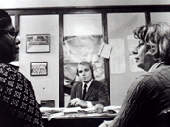
This tiny cap of Jackie Shearer's A Minor Altercation (1977) seems to be only proof the short film existed.
Brilliant A Minor Altercation is the longest at half an hour long. In a girl's bathroom at a Boston high school, a white girl, angry that she didn't get into a computer class, instigates a melee with a black student, who the counselor coerced into taking the class. They are both suspended for fighting. Furthermore, the larger complex issue is how both families discuss the matter in their respective homes. The women operate on soothing levels, wanting their daughters to stay at the school, but the fathers want opposite, the angry white father going as far as using the "n" word to state a racist point.

Both mothers decide to head up to the school, three days before they're supposed to, in order to discuss the matter-- primarily a concern of the guidance counselor. Of course the guidance counselor is not present. The early arriving black mother is faced with atrocious disrespect whereas the later white mother is cooed and prodded, even allowed to go into the principal's office first.

A Minor Altercation  is another that should be shown in classrooms. The discussion about how families discuss race/racial problems operates on different wavelengths.

Boston native Jackie Shearer was a graduate of Brandeis University. She also founded a documentary company and worked for her hometown radio and TV stations. As a documentarian, Shearer wrote and directed episodes of Eyes on the Prize and produced/directed American Experience's episode, Massachusetts 54th Colored Infantry.

On IMDb, rests this sole personal statement in her barren biography:
Much to my own relief, I found that there was nothing for me to be ashamed of in the story of Blacks and their participation in the Civil War. Black soldiers hadn't been the unwitting dupes I had once imagined them to be. It was these men who were the bedrock of abolitionism, not well-intentioned, benevolent whites as history has claimed.
Shearer sadly passed away at the age of 46 of colon cancer four days before her birthday.


Sunday, August 20, 2017

'Ayiti Mon Amour' Shares Triumphant & Whimsical Tales in Haiti

Ayiti Mon Amour.

Back in 2010, on a January afternoon, Haiti was hit by a ferocious earthquake, killing thousands. Global relief efforts, meant to bring aide to devastated families, were stolen and squandered, leaving the very poor, destitute and hopeless. Filmmaker Guetty Felin created Broken Stones, a documentary about the terror and turmoil left behind, showcasing great devastation brought onto a country that lost many irreplaceable lives and homes. In Ayiti Mon Amour, Felin pens and directs an imaginative collection of poignant fables that offer healing and joy after the storm.

 Orphée (Joakim Cohen) and his mother (Pascale Faublas) have trouble adjusting to the neighborhood due to colorism. 
Set five years later, Orphée is a troubled young boy often fighting at school. However, that doesn't deter unique sensibility, the supernatural elements. He is fascinating, speaking between Japanese, French, and English, playing with his friendly black dog, always pensive, brooding. His mother is worried, rightly so, for he isolates himself from others, but looks at them with fierce longing. He is dreamy eyed and thoughtful, wandering through broken parts of Haiti, still grieving a father who had died in the earthquake.

Anisia Uzeyman (The Muse) is an inspiration for a troubled writer (James Noel). 
Originally tied down to a writer’s block afflicted writer, an energetic, cheery muse hollers like a wild banshee into his tormented mind. The stylish, slender beauty is bubbling with anticipation, almost rupturing to the surface. She demands him to give her tasks, let her live more than as a silent figure. The tired, frustrated man cannot think with petulant eagerness, natural inclination to roam beyond what is permissible, but stoically promises to present ideas despite ever present fatigued mood. Days pass by, he has no story for her. Unable to wait, she packs up her little suitcase, and leaves him. Her adventurous thirst is tasted as she explores areas of dilapidated buildings and broken spirits, rides boats floating in endless sea, and joins in a parade.

Jaurès the fisherman (Jaurès Andris) shares smiles and dances with his beautiful wife.
Jaurès is concerned about his wife in a poignant love story that entails not just surviving violent storms and , but coming to terms with growing old and finding ways to stay in love. One devout way is caring for the other when that person is ill. As this sweet fisherman feeds her, gently spooning bowls of soft mushiness into her reluctant mouth, she turns her head in between, not able to eat entire serving. She is listless, worn, despaired. Her illness is more than physical, emotional and mental anxiety exists within. He is committed to healing her and searches for remedy in his personal realm/haven.

Although the solitary writer doesn't interact, it is the muse who brings needed delight into Orphée's solitary darkness. She and Jaurès both offer him a reason to feel grateful.
An official 2016 TIFF selection and winner of Black Film Festival’s Best Narrative Feature, Guetty Felin’s Ayiti Mon Amour is the first Haitian film to be directed by a Haitian woman. That significant feat is an encouraging path to follow, especially to young girls hoping to capture homeland through their own eyes. A fiction with incredible heart and nostalgic wealth, Felin filmed specifically in a region affected by the earthquake, going into village areas, using locals as actors, knowing dates imperative to her written script. The sewing of the forgotten weaves well into the picture, each scene casts spells on audience, bedazzling with quixotic images frozen in a lingering time. It is also wonderful that Mira Nair (Queen of Katwe and Mississippi Masala) produced-- great to see women of color directors celebrating other women of color directors. This must continue onward.

Director/writer Guetty Felin with her real life son, Joakim Cohen.

Ayiti Mon Amour ends the way it begins. A single finger slowly traces uneven line of a crack, carefully following each jagged mark. This deliberate action seems to metaphorically describe lineage of life and death, the impossible circumstances impact future, bring unexpected change and growth. In these layered stories, a connection forms between characters, real or imagined, in a peaceful, integral sea as serene as mesmerizing blue waters captured in most breathtaking cinematography. Felin is reminding us of Haiti. Underneath memories of a colossal tragedy, of ashes and ghosts of the dead, births new images entailing magic and hope.

Haiti is not a graveyard. It is a real, majestic home unlike any place on earth.


Wednesday, August 16, 2017

The Awkwardness & Hilarity About Sex in 'Hello Cupid'

Hello Cupid: Farrah takes a look at Farrah..
"Accurate!"

That single exclamation repeated itself throughout audience showing of Hello Cupid, a film from the studio behind Black and Sexy TV. Tina Cerin, Numa Perrier, and Dennis Dortch directed with Perrier, Cerin, and Thais Francis (Cassie) writing this humor laced story about a young black woman virgin, bravely embarking on sexual journey riddled with frankly honest complications.

The opening focuses on quirky, stylish Farrah dressed in a long black duster, tee, and jeans; a free spirited, bare faced skateboarder with a killer massive Afro and infectious gap toothed grin. Her innocence is refreshingly genuine, a rarely depicted characterization in black women portraiture. In most popular modern films, television, and books, black women automatically know the ins and outs of sexual intercourse without ever a mention of first time experience.

Before Farrah enters a queer mixer, she has the attention of Justin, another skilled black skateboarder. Originally, she intended to meet Cassie, a confident, assertive, dark skinned beauty whose smile borders between sticky sweet to falsely chipper.

Farrah (Gabrielle Maiden) was first seen in Sexless.
Hello Cupid is a like a rich contemporary reminiscence of Janie Crawford's path to sexuality in first acts of Their Eyes Were Watching God. With a comedic twist that is. Between her flustered blushing and inability to look pursuiters in the eyes, Farrah's bee sting is quite apparent, buzzing about her, attracting those around her, especially Justin and Cassie. Although Farrah is curious about which sexual destiny is best for her, she tests what each offers. Fascination mixed with hilarity and chaos ensues. Sometimes Farrah seems ready and other times, she allows herself to be coaxed. With overeager Cassie, Farrah is cautiously wary, but allows the gratification, succumbing to an alarmingly good, bathroom sink ride to orgasm ville. The aftermath, however, is awkward as hell-- Cassie acts strangely distant while Farrah is starry eyed enchanted. It's that sad Pariah scene again-- one is thrilled by the act and the other wants to bow out gracelessly. Yet the difference is that Cassie is out and proud, not shamefully hiding in the shadows clinging to misguided societal demands like Bina.

Still, Farrah is flashbacking to the heated moment of her "deflowering," changed provocatively, wearing makeup and little black dress to symbolize maturity. Out of fear of further rejection, she avoids Cassie, who appears interested again, and turns to Justin. They have a great date--skating, ice cream eating, the works. Unfortunately, the sex is awful. All degrees of clumsiness and fumbling occurs, which laughably crafted is the sordid truth. No one is a maestro overnight.

In comparison with introductive experience, obviously one is far more enjoyable than the other for Farrah.

Beautiful, talented Thais Francis, who co-wrote Hello Cupid: Farrah,
brought laughs and eyebrow raises as the strong willed Cassie. 
Hello Cupid's laudable highlight is that Farrah has a supportive She Circle. Her roommate is the first person she tells about her newfound sexual awakening and she is over the moon happy and supportive of her friend "finally getting some." Sex isn't always the most comfortable subject matter, often taking time to discuss openly. It was great that Farrah could confide in her female friends. Another amazing part featured a Farrah inspecting her lady parts in the bathtub and the real apprehension of acquiring an STD-- which more than likely was a result of Farrah's giant over exaggeration. The rivalry between Cassie and Justin was also very funny. One wondered if the scene of unseen stranger knocking on Cassie's door was in fact, a jealous Justin lusting for Farrah.

In the end, Farrah, having gained separate experiences, remains holding onto lost innocence, still believing that she carries the virgin status card. Perhaps she has room to grow in her sexual path and it looks like Cassie might be the way.