Showing posts with label 2018 Film Release. Show all posts

Thursday, March 24, 2022

‘Solace’ Courageously Examines A Quiet Black Girl’s Eating Disorder


Solace film poster.

Tchaiko Omawale’s candid feature-length debut Solace strikes home hard. It focuses on Sole, a seventeen-year-old Black girl, who uses food and art as a coping mechanism after her father’s death. Instead of staying in New York City with a teacher who truly cares about her well-being, Sole is sent to live with her judgmental maternal grandmother Irene in Los Angeles. 

Sole (Hope Olaide Wilson) in her new bedroom in Los Angeles. 

Solace resonates with a personal history that still carries through my daily life. Sole reminds me of many weekends spent in my bedroom not eating in hopes of maintaining an extremely underweight frame. This mindset was a mixture of admiring the frail girls on the WB network and the hope to not have the same body types as my maternal side of the family. Still, I binged on snacks primarily candy like a high junky craving munchies whilst dreaming of flattened breasts and flattened stomach. Several scenes have Sole’s fingers blindly reaching inside snack bags and robotically stuffing chips, crackers, etc. into her mouth, eating and eating out of pain, out of boredom no matter the hour. Despite this constant snacking, Sole is obsessed with her figure and the figure of her thinner neighbor, Jasmine. 

Sole has trouble seeing eye to eye with Irene (Lynn Whitfield). 

Irene wants Sole to go out more— especially with the local church girls— although Irene herself is not the typical Christian values woman. 

As Sole often scrummages the cabinets for midnight cravings, the rough tension escalates between her and Irene. A headstrong, determined Sole anxiously yearns to return home and false church lady Irene desperately wants to build a relationship with her granddaughter. Sole sees right through Irene’s phoniness right down to the strange relationship between Irene and her special friend, Pastor Clay. It also doesn’t help that Irene makes negative comments on Sole’s eerie eating habits and labels her “fat.” 

Guedado (Luke Rampersad) and Jasmine (Chelsea Tavares) are two broken spirits that draw Sole into their world of drugs, alcohol, clubbing culture, and kissing experimentation. 

Jasmine falls asleep in Sole’s arms. 

Positioned between Sole’s story is an abstracted nude Black woman wrapped in clear plastic, trying to break free from the barrier. This avant-garde break may metaphorically imply the mental trappings that overwhelm the physical self so much that it interferes in the way of daily existence. This body cries out in despair, in agony. Most importantly, she is fighting to escape alone. 

“If you’re silent about your pain, they will say you enjoyed it,” Zora Neale Hurston said in How It Feels To Be Colored Me, a quote that highlighted my personal struggles, that extends towards Sole’s quiet pain. 

Meanwhile, Sole prefers becoming intimately close with her neighbors Jasmine and Guedado instead of Irene’s church friends’ daughters (which includes Martha played by Pariah’s Sahra Melllesse aka Alike’s accepting younger sister, Sharonda). Sole needs their help for winning an art project that would fund her return to New York. Eventually, however, the trio are an inseparable triangle with a curious Sole attracted to both Jasmine and Guedado— both affecting her in different ways. Yet between the jarring opposite magnets pulling the lost, vulnerable Sole in deeper and deeper, her eating disorder overwhelms any possible high or munchy craving. 

At the same time, the chain smoking Irene—pissed at her granddaughter for choosing the eccentric neighbors over her own family— is getting in good with her friend Pastor Davis. The film does not stray away from the notion of older people having sex, lingering on every curve of hypocritical Irene’s body and every indented line of Clay’s. Whilst in the throes of passion, Irene giggles, hoping Sole doesn’t hear them. 

The trio successfully shoot in front of Pastor Clay’s church— that is until he comes down and threatens to call the cops. 

Winner of the Best Ensemble Cast Award at the Los Angeles Film Festival and Narrative Feature Audience Award at the New Orleans Film Festival, Solace deserves more praise and attention for responding to the quiet underbelly of Black girls suffering from constant body criticism. Ours is much different than that of others. 

When Sole reaches a startling breaking point, Irene is there to pick up the shattered pieces. 

Solace made me feel seen and understood. This powerful film addressed an inner battle to make a resolution to my past body issues. Black girls and women much like Sole have to be encouraged to break through this glaring cycle of hatred, of not valuing what is before us. Although societal standards still vouch for European ideals, Omawale’s important film instructs Black women to embrace the distinctive shape of their bodies, to accept their appearances in all its facets. Haven’t we been punished enough already in this world? 

Furthermore, Solace is an experimental expression that not only discusses the Black female body, it blends together grief in a coming of age narrative, sexuality/sexual politics, and art form. 


Thursday, May 28, 2020

‘The Weekend’ Is a Smart, Relatable Romantic Comedy

The Weekend film poster. 
Although most romantic comedies contain a grossly exaggerated raunchiness that borders on unrealistic caricature, especially rated R films, The Weekend is well above the average. It has the rarity of putting Zadie, a Black woman in a leading role while also placing her at the forefront of desire— the attention of two men. What is not to love?

Zadie is a sarcastic, wise-cracking comedian. Her standup material mixes situational humor and making light of mental health struggle. She wears basic t-shirts (black, white, yellow) and high waisted blue jeans, even wearing the same outfit twice. In fact, she does not change those blue jeans.

In the premise, Zadie is spending the weekend at her parents’ rustic bed and breakfast with her ex-boyfriend Bradford and his girlfriend Margo. Now Bradford and Zadie are extremely close exes. Their intimacy is stronger than friendship, unlike a sibling vibe. Margo— who puts on a brave face— certainly feels the rift. The odd dynamic becomes overwhelmingly complicated due to Zadie’s increased meanness towards Margo. Aubrey, the handsome unattached guest, immerses himself into the triad, drawn specifically to Zadie. This incites Bradford’s own green-eyed monster. Beneath his kind and warranted protectiveness lies that need for Zadie. As days steeped in nature slowly press onward, that need cannot stay quiet. Even Zadie’s judgmental mother, Karen, sees it.

Bradford (Tone Bell) enjoys being in the middle of Margo (DeWanda Wise) and Zadie (Sasheer Zamata) until Aubrey (Y’lan Noel) enters the picture with eyes on Zadie.
On occasion, the four young people at the apex of this trip experience third wheel shifts: Zadie’s discomfort with Bradford and Margo, Bradford’s insecurity with Zadie and Aubrey, and Margo’s invisibility with Bradford. Throughout this interplay, Zadie is trying to keep a firm head as her anxiety wavers. She continues acting out, hiding secrets, secrets within herself. Aubrey, fresh from a breakup, is intrigued by Zadie and does not allow her to push him away.

Black girls ruling nature: Zadie and Margo try to have a civil conversation. 
Zadie’s most reliable male relationship seems to be with her father— who is absent during this mini vacation. He “appears” on the phone with her, though the audience never hears his voice. The busiest shirt that Zadie happens to wear is a patterned pink shirt taken from her father’s closet— while bike riding with her two love interests. Still, it is not too difficult for Zadie to embrace being brutally honest. Aubrey brings out another side of her, that awkward girl who often feels like a “supporting character and not the leading lady.” Even though Bradford knows Zadie’s every fault, he broke up with her because the dueling personalities were too heavy a burden. It is understandable, a partner with mental illness can be challenging exercise. However, cultured, sophisticated Margo— the “normal” woman— is not convincing him to commit enough. The well-traveled, articulate, fashionably conscious Margo has the flawless paper performance. Yet Bradford and Margo have not been intimate in months. Bradford sneaks off every chance to see Zadie, warning her against Aubrey, threatened by their obvious connection.

One of the most hilarious scenes in the film are Zadie, Aubrey, and Bradford biking together. 
Writer/director Stella Meghie helmed a brilliantly entertaining piece. The story arouses questions on the longevity of relationships, of finding balance and setting boundaries. There are Black comedians, Black photographers, Black business owners, scenes lit beautifully, capturing brown skin in all its glorious range. Plus, a deep complexioned, 4C haired Black woman leads a phenomenal cast operating smoothly together. Sasheer Zamata has an utterly riveting screen presence as Zadie, able to transition between deadpan humor and an authentic vulnerability with degrees of heartfelt seriousness resonating deeply. Her star should rise further in multifaceted roles, letting that natural candor shine through. The promising Tone Bell (Little), the exceptional DeWanda Wise (The Underground, Shots Fired, and She’s Gotta Have It), leading man material Y’lan Noel (Insecure’s heartthrob Daniel and funnily enough playing a younger version of Issa Rae’s character’s father in Meghie’s other film, The Photograph). Kym Whitley’s Karen provided a sweet, delightful surprise, a humbling performance that too allowed another real-life comedian to show impressive layers of humility and strength.

Tone Bell (Bradford), DeWanda Wise (Margo), Sasheer Zamata (Zadie), Kym Whitley (Karen), and Y’lan Noel (Aubrey) make up The Weekend cast. 
The Weekend is a refreshing look at the ways of discovering the constant things in life that heal us and the others that are quite toxic. Zadie learns in three days what will help her grow and what holds her back.

Zadie in darker jeans, an optimistic shirt, and a new hairstyle.
In the end, Zadie’s bright yellow t-shirt matching a great big smile assures viewers she made the healthiest choice for herself.


Tuesday, April 28, 2020

The Colorful ‘Jinn’ Comes at the Right Time

Jinn film poster. 
Once a menace came into presidency and signed a dangerous, very prejudiced Muslim Ban into order, this caused a great ruckus across America. Prior to and even after 9/11, films and television ostracized the Muslim community, always depicting them as the bad guy. 

The amazing Jinn portrays the religion in a humanized light, weighing its pros and cons. It centers the significant journey that converting into Muslim religion presents between a Black mother and daughter residing in the Inglewood neighborhood of Los Angeles, California. Jade is a local meteorologist and Summer is a creative, outgoing high school senior and aspiring dancer hoping for acceptance into SoCal’s art program. 


Jade (Simone Missick in maroon) is entranced by the words of Islam and hopes that Summer feels the same rapture. 
Firstly, the carefree Black girl will never be a tiring image. Summer riding her bike, dancing with passionate determination, expertly skateboarding, dying her curls, and even slyly flirting with girls are some authentic, rarely seen film components of a Black girl growing up, unafraid to let spirit and fluidity fly. This adds layers to a refreshing coming of age drama. Interesting parallels uniquely weave how Jade and Summer enter into this new chapter together, how it changes them, how it clashes and creates new boundaries.

Sometimes Jade (Simone Missick) comes off too strongly against Summer (Zoe Renee), who is still very young and learning. 
Jinn’s script illustrates a thoughtful, tender depiction of a religion that is often ridiculed and villainized in media much like that of Black and brown bodies. The writing lends itself to having a loving, tender care, analyzing each part with both a graceful hold and sharp critique. This nuanced treatment shows the beautiful side (the penmanship of Arabic language, the poetry in its words, the incredible headscarves) as well as its disturbing misogyny (that yes all religions hold women to some oppressive standard). For instance, Summer’s #HalaiHottie image causes quite a stir, reaching the mosque. She is humiliated in a stern, heavy handed manner by both the Muslim community and her mother. Jade is suddenly at a crossroads, forgetting too that Summer is still between childhood and adult womanhood. Thus, the storminess crashes down on this peaceful calm that the religion supposedly brings into the weatherwoman’s life. On top of trying to understand her daughter’s actions, Jade faces microaggressions at work, the disdain of mostly white peers unimpressed by her new “unAmerican” look. 

Summer (Zoe Renee) having fun times in her bike with Tahir (Kelvin Harrison Jr.). What a joy!
Love is explored between mother/daughter, father/daughter, father/daughter/father’s girlfriend, mother/religion/daughter, girl/boy. Summer’s parents are not together due to Jade’s compulsion to switch it up on short notice, changing routines like the seasons impacting her forecast. Religion has all the makings of a coupling— the magic of falling in deep and the pitfalls of how it hurts when identity comes into play. Jade has fallen head over heels with the religion, but also the leader of their mosque— which Summer notices. Meanwhile, Summer shows interest in girls in that pansexual, fleeing sort of way, but is drawn to the brooding Tahir, a boy in her class raised Muslim. She is utterly impressed by his parents, almost idolizing. Summer and Tahir’s love is that first burgeoning taste into the unknown. She is the embodiment of American culture and he is the testament of relegated faith. Their pure, innocent union softens the chaos of high school and critical surveillance. 
After killing it on stage with an awesome dance routine, Summer (Zoe Renee) recites a bittersweet poem about her experiences since converting and her tense relationship with Jade. 
Jinn’s every intention from its eclectic music choices to the casting breathes in perfect symmetry. Nijla Mu’min’s soft, poetic narrative collides beautifully with the key saturated hues of Bruce Francis Cole’s cinematography— the light playing on Summer’s bike rides, the intimate close up of Tahir’s fingers untying her red headwrap, the eyes speaking volumes in the silence. The performances of newcomer Zoe Renee, seasoned award-winning Kelvin Harrison Jr. (of Waves, Luce, and The Photograph), and Simone Missick (who stars as Judge Lola Carmichael in All Rise, Misty Knight in all the Marvel Netflix series,’ and a great cameo in American Koko) memorably stand out, leaving behind the hope that Hollywood knows their names as well. 

Jinn gives audiences the solemn promise that emerging Black director/writers are truly out there making must watch film. And we must champion their rise. 


Monday, November 19, 2018

'Widows' Is a Hyperbolic Machine of Big Names and Cheap Thrills

Widows film poster.
Widows failed to truly understand and convey the racial turmoil in the gritty parts of Chicago. The weak script-- a joint effort by director Steve McQueen and Gillian Flynn's adaptation of Lynda La Plante's novel-- suffered to stand ground. It relies heavily on media perceptions of black trauma and sugarcoats political strife, but doesn't penetrate inside the underbelly of the problem.

Jamal (Brian Tyree Henry) threatens Veronica (Viola Davis) and her little dog too. 
First of all, the heist plotline didn't adhere in a seamless execution . Jack Mullins is running against Jamal Manning. Contractor thief Harry and his pals have been burned alive with Jamal's two million dollars. Jamal barges inside Veronica's penthouse, threatens her dog-- a dog that she often carries around like a rich white socialite-- and demands she give him that money. Veronica is left Harry's crime book and utilizes this to involve the other widows.

Now Widows deliberately celebrates white desirability in ways that could mentally harm and damage a black psyche. Alice, the youngest, calls Veronica a bitch and a cunt and even slaps her. Meanwhile, Alice's mother is ten times worse. She doesn't undermine her mother face to face. However, she treats a complete black woman stranger like the enemy. She is supposedly too broken and shattered, a woman treated objectively. Yet it is this black woman that she can fully launch unrepressed venom and hatred.

Too little, too late: Veronica (Viola Davis) seems to live for white compassion, i.e. Alice (Elizabeth Debicki). 
Veronica and Harry seem to have the perfect life-- her being a teacher and him being a criminal and all-- but it turns out to be terrible fiction. They play up the background Nina Simone ballad reminding the audience that this sultry magnificent singer with prominent African features and dark ruddy skin had also married a white man. Harry and Veronica's teenage son dies in a twisted, unbelievable cop narrative that just harms true American reality. This catalyst drives them apart, leaving Harry to cheat and make a white on white baby. At the end of the day, white was right and safe for Harry. To worsen matters, backstabbing Harry-- who turns out to be alive and well-- is quick to point a gun at Veronica after she pulls off a finicky heist with Harry's own handwritten instructions. A real win for the interracial love marketing team.

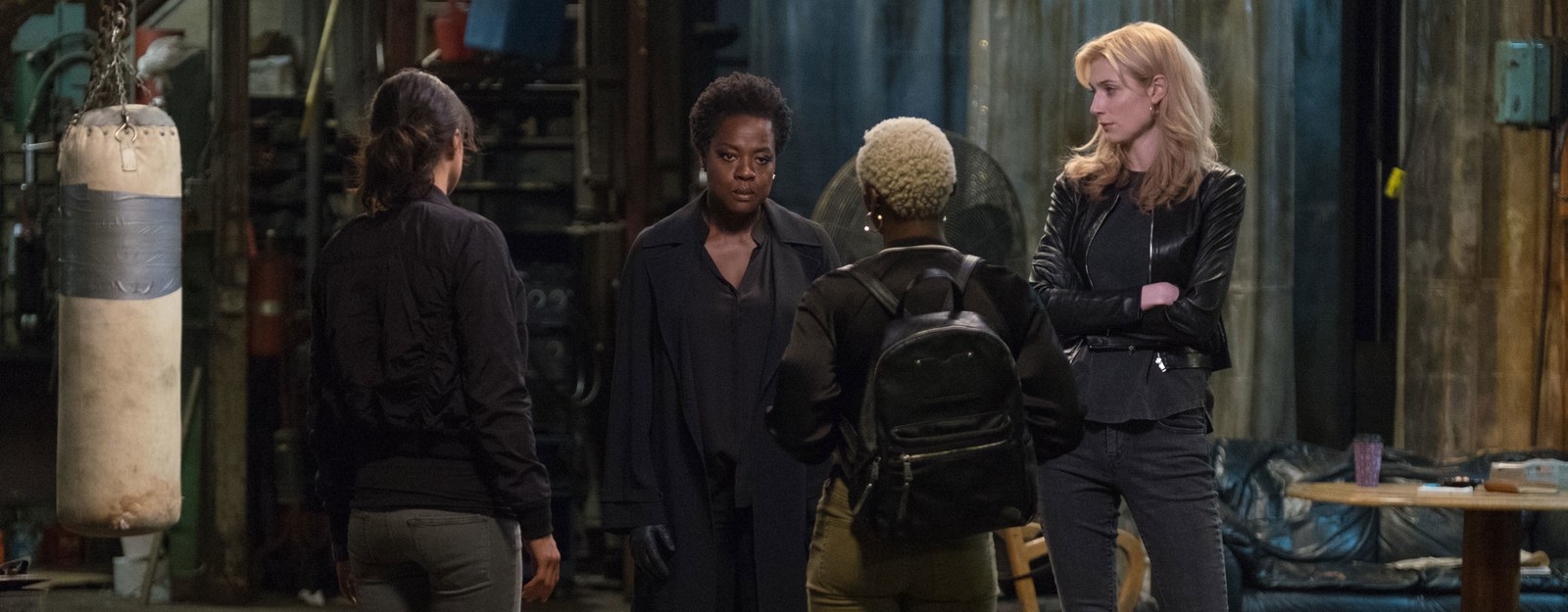
Thus, the black women depictions were not kind, lacking genuine tenderness and care. Belle is introduced to Veronica as the driver. They attack each other without reason. The only scene they are alone together, the two women have no dialogue. As if McQueen's camera artfully focusing on their gazes at one another is enough. Well, it's not. It's lazy. In one unnecessary scene, the slender, muscled Belle beats a punching bag like she's Rocky. Again, she's just the driver. Yet also a single mother, she spends more time with Linda's kids than her own-- an indentured servant role, the black mother nursing white babies, or in Belle's case Latinos. She barely shows affection to her daughter. Whereas, Veronica, the older woman, mother hens everyone. Other than distracting flashbacks with Harry, she has no purpose beyond obtaining Jamal's money. 

Veronica (Viola Davis) leads the three: Linda (Michelle Rodriguez), Belle (Cynthia Erivo), and Alice (Elizabeth Debicki).

The casting decisions were not the best. Viola Davis-- astounding in the degrees of acting proficiency-- could not rescue this tangled web that hurts more than it helps. Whereas Elizabeth Debicki is bad and difficult to watch, Michelle Rodriquez's Linda is severely underdeveloped. Cynthia Erivo is thrown in rather late in the film. As a whole, these actors (a majority of overseas talent) were not believable Chicagoans. Despite McQueen's avante garde camera angles, Widows was not the film in which one could be creative and thought-provoking due to the terrible script.

Widows is especially insensitive to the needs of black women film viewers, demonstrating by story and imagery a glaring disrespect that is calculative and deceitful. This painful illustration is not at all as intelligent as the trailer disguises itself to be. 

Other than that, Adepero Oduye deserves better than this.


Monday, November 12, 2018

'Rafiki' Defies LGBTQIA Odds in Fiction and Reality

Rafiki film poster.
Rafiki is a modern forbidden love story told in a strict political society condoning unions between same sex couples. The heinous parable is introduced through a silent male figure. He is constantly abused by other men-- verbally and physically assaulted for existing as gay, illustrating also etched in miscontrued religious context. His story, seemingly small, is a significant integration into the lives of main characters, Zika and Kena.
Zika (Sheila Munyiva) has dreams of being a nurse, but it's Kena pushes her to become more.
Zika and Kena's fathers are running for the same political post. Zika works in her father's store and hangs out with womanizing Blackstar and his posse-- the bullies who abuse the gay man. Outgoing, carefree Kena is always out with two lively girls dancing and jiving, entirely girlish. Her big smiles and pastel rainbow hair seem an anomaly in their environment. Zika often watches Kena, intrigued yet shy.

Zika and Kena come together in a refreshing, natural way. Their mesmerizing camaraderie sewn eloquently-- an abandoned van for clandestine trysts, raw, unconfined joy at the carnival, glowing together at a nightclub.

Once the fallout happens, the families reactions are both expected and surprising. Yet the community's reaction is ugly and horrific.

Sheila Munyiva and Samantha Mutgatsia are dynamite partners portraying Zika and Kena. Their chemistry blooms beautifully from tentative stares to an affectionate friendship to passionate kisses. The actresses resonate a genuine tenderness for these characters and for each other, articulating vulnerabilities and demanding strengths. It is also a plus that Munyiva and Mutgatsia have distinctive skin tones and features lacking in black films. The camera poignantly focuses on Munyiva's eyes and lips and Mutgatsia's hair and smile with deliberate celebration and pride.

Kena (Samantha Mutgatsia) and Zika (Sheila Munyiva) have the most fun together. 
Other wonderful highlights include a great soundtrack (the opening sequence plays high colored credits while Muthoni Drummer Queen's Suzi Noma pumps in the background), cinematography has amazing shots of Kenya city life (and chapiti), and African print cloth duelly operating as fashion and home decor. Every stitch of the film comes together to deliver a special experience.

The church is no taboo to show love for Kena (Samantha Mutgatsia, right), but Zika (Sheila Munyiva, left) isn't ready.
Africa Academy Award winner (for From a Whisper) Wanuri Kahiu overcame a huge battle in obtaining Rafiki's rightful consideration for representing Kenya in the tight Oscar category Best Foreign Language Film. Kenya retains outdated opposition on same sex relationships and allowed government interference in this colossal case against Kahiu.

Activist art is imperative across the globe. Kenyan Wangechi Mutu, whose has a framed collage featured, creates pieces centering Afrofuturism and earth and runs Africa Now!-- an organization advocating for the continent's LGBTIA communities. South African Zanele Muholi and her team document harmed lesbians, telling their stories inside endless galleries and institutions. Meanwhile, Kahiu's great cinematic achievement expresses hostile turmoil, aggravated battery, and cruel separation in communities collectively despising and interfering on a love that does not look like their program.

The goddesses of Cannes: Sheila Munyiva (Zika), Rafiki writer/director Wanuri Kahiu, and Samantha Mutgatsia (Kena).
Rafiki is a gentle outstretched hand. On the fine, delicate lines of the palm, rests a beating heart yearning for human decency, acceptance, and respect. The viewer has no choice but to succumb to Zika and Kena's everlasting love. Forced bigoted trials and tribulations are no match against the strongest, most sacred emotions. No time or distance (or government interference) can defeat such an important narrative.

Friday, November 9, 2018

'Burning' Is a Shocking Thriller To the End


Burning film poster.
Recent fiction major grad, Jong-su works part-time whilst coping with writer's block and caring for the family property while his father is in jail for assault. He runs into former neighbor Hae-mi on a lunch break. Though it takes Jong-su moments to remember, the two have an awkward liason. Hae-mi is aloof, adventurous, and unpredictable as opposed to Jong-su's coy, meek personality. Before she goes to Africa (on a vapid, imperialist mission), she has Jong-su watch her cat, Boil. And the mysterious Boil eventually unravels a key moment.
Jong-su (Ah-In Yoo) runs around daily to inspect greenhouse.
Burning sets up a slow building tension that escalates to an unsettling disturbia. Hae-mi returns with a new friend, Ben. A jealous Jong-su can see their relationship has evolved to a much more intimate capacity, leaving him as a third wheel oddity. His curiosity of the rich, elusive Ben is worthwhile. Ben's sleek insinuation into the lives of two spacy young adults, using them both for sheer amusement like objects on a gameboard raises valid suspicion. Ben soon introduces Hae-mi and Jong-su--whom awkwardly stand out-- to his sophisticated socialite friends. Two worlds collide for Ben with Hae-mi and Jong-su merely setting the stage to entertain his fickle pleasures.

A striking visual of a young boy watching a burning greenhouse.
Burning contains exciting and jarring twists and turns that'll leave hypothetical guesses til the end. Director and co-writer Lee Chang-dong states:
"The leaping holes in the chain of events -the missing piece from which we can never know the truth- alludes to the mysterious world we live in now; the world in which we sense that something is wrong but cannot quite put a finger on what the problem is."
The character triad is a compelling and complicated weave and the chosen actors have crafted the relationships well enough. From glazed stares to pout lips, Ah-In Yoo finesses the quiet introverted Jong-su driven to a simmering madness. Jong Seo-Joen--in her first major role-- plays the naive, storytelling Hae-mi in an airy, effervescent manner despite Hae-mi's flawed, off putting insensitivity about a culture different than her own. Steven Yeun brilliantly oozes charm, sensuality, and danger into narcissistic Ben downright to the creepy laughter and bored yawns. He emotes such cynical precision that is almost frightening in Ben's loving fascination with setting fire to greenhouses. Yoo commiserates, entailing Jong-su's own past as a reluctant firestarter.

Nudity still conveys a strong attribution to male gaze. Whenever Hae-mi is nude (which happens on two separate occasions), her lithe body is the lure and attraction to the males. For example, after Jong-su, Ben, and Hae-mi smoke pot, Hae-mi takes off her blouse and languidly spins around topless. Jong-su's bare form, however, suggests a more constructive narrative. Although he frequently masturbates, especially in Hae-mi's room, his later nude finale conveys power, guilt, rebirth. At the same time, his nakedness is not humorous or self-deprecating as American cinema often ostrasizes male Asian bodies.

Jong-su (Ah-In You), Hae-mi (Jong Seo-Jeon), and Ben (Steven Yeun) revel in the view and smoke pot together on Jong-su's family property.
Burning references classic white male American literature (nodding to William Faulkner and F. Scott Fitzgerald) yet doesn't forsake Asian aesthetics for the Western gaze in this adaptation to Haruki Mumokari's short story, Barn Burning. The cinematography is an excellent backdrop to the intense drama, a thrilling chain of events leaves behind unhinged skepticism throughout twisted narrative. The minor fault is that some sequences are either stretched too long or not given substantial weight.
"So I creep--yeah." TLC came to mind during Jong-su's (Ah-In Yoo, left) amateurish surveilance of Ben (Steven Yeun, right).
Overall, Burning is sensational escapism and utterly deserves the honor of representing South Korea for the Academy Awards Best Foreign Language Film category. It would be an even greater triumph if Yeun and/or Yoo receive awards nods for delivering complex performances-- dismantling the stereotype that Asian actors are not expressive.

With fire symbolically scorching broken histories, abandonment, and evidence, turning structural bodies into char and ash, Burning will stun and disturb throughout suspenseful clarity.

Tuesday, November 6, 2018

Love Cannot Be Barred in 'If Beale Street Could Talk'

If Beale Street Could Talk film poster.
"I hope that nobody has ever had to look at anybody they love through glass."- James Baldwin

The never ending injustices that affect brown and black bodies every single day since separation from Africa, the glaring imprint that slavery has not been abolished, is integrated in the love story of Alonzo "Fonny" Hunt and Tish Rivers. It appears an ordinary and defiant testimony despite the innocuous rage simmering in their neighborhood. Tish and Fonny are first childhood friends sans the boy abuses girl narrative. Their precious innocence naturally blossoms into kindred spirits love-- a refined soulmate tenderness not often bestowed in black romances. They dine, dance, declare feelings, make love with carefree abandon, reveling in a bubbled world of their own creation. This great swelling passion seems impenetrable and permanent.

Fonny and Tish are not the stereotypical struggle love situation. They work hard. They live together. The biggest argument was Fonny upset over Tish protecting him.

Fonny (Stephan James) creates abstract sculptures out of old industrial parts and Tish (Kiki Layne) sells perfume behind the counter at an upscale department store.
The fault of the wrecking ball lies with white supremacy-- a white cop as the highest order of the law. A white cop is never doubted or questioned. Fonny and Tish have a run in with the wrong sort. As revenge, Fonny is taken away for rape despite living on the other side of town. The victim picks him because she is instructed to. For everyone involved-- the Rivers, the Hunts, and the victim's family--the battle for justice is a long and grueling battle. On top of escalating trauma, Tish realizes that she is pregnant. The Rivers are shocked by the baby news, but celebrate over wine. The Hunts are mixed.

In the case-- a very sensitive case--Fonny is obviously innocent. The victim doesn't know that and simply cannot comprehend why a white cop would lie about her assailant. Cops are supposed to be trusting authority figures. Thus, it is disgusting that an above-the-law white cop put Fonny in custody without bothering to seek the real culprit. Beyond petty garbage, he made this a personal vendetta and tore apart a burgeoning family to get even. Sadly, this repeated narrative happens in real life America-- wrongfully accused black men imprisoned for crimes they didn't commit. 

The Rivers ladies are excited for the new generation: Ernestine (Teyonah Parris), Tish (Kiki Layne), and Sharon (Regina King).
If Beale Street Could Talk delivers subtle reminders of Coffy and Ava DuVernay's Middle of Nowhere. For example, black women having afros in love scenes speaks volumes. Back in the 70s, Pam Grier-- blaxploitation goddess-- in Coffy (seen a few years ago) definitely showcased natural hair as a sexy, unhidden gem in and out of the bedroom. Tish's hair is a wonderful halo, as pleasing as any 70's starlet. It operates differently than newer films about the modern black woman cutting off the relaxer, metaphorically using hair as an excuse to be in struggle love relationships. This afro is a part of Tish, as sacred as the deep brown of her skin, as genuine as her love for her family and Fonny-- unapologetic, untamed, and gorgeous. Although one weakness, is the submissive missionary love scene. It would have been a refreshing pace if Tish took the reins and led Fonny her own unrestrained passion. Now it doesn't have to be salacious ala Grier and Bradshaw.

Tish's campaign for justice to free her wrongfully imprisoned man like poor Ruth did in Middle of Nowhere drives home what happens to women during their men's incarceration. Both Tish and Ruth didn't have to face the tough circumstances alone-- having compassionate women on their side. The relationship between Tish, Ernestine, and Sharon are given more considerable story than Jenkins' previous women depictions in Moonlight. Their relationships are lovingly depicted. The mom would do anything for her daughter. The sisters have an incredible bond. Whereas Ruth has a strained relationship with her parolee husband (he cheated with a guard) and enters a new relationship outside the prison walls, Tish is committed to Fonny (who again is wrongfully jailed) and he is devoted to her. 

The most difficult scene to digest, however, is Fonny's father striking his wife (unfortunately some viewers in the audience laughed or applauded) after she expressed blasphemous dislike over Fonny and Tish becoming unwed parents. Nothing excuses domestic abuse-- which at the time was legal. 

This amazing scene features Tish (Kiki Layne) and Fonny (offscreen Stephan James) staring at each other.
Kiki Layne (who recently scored a Gotham Award Breakthrough Performance nomination) leads an extraordinary cast. She pulls Baldwin's story along with astounding tenacity and bravery channeled throughout a fine performance. Her articulate delivery narrating this heartbreaking love story hits key emotional points-- hope, despair, acceptance. Stephan James accompanies Layne, their chemistry poignant and unfiltered. James authentically emotes Fonny's tenderness, his agony, his frustration in ways that coax empathy. Regina King is not simply playing a mother role. She is an outstanding supportive force, igniting the screen with her multifaceted exuberance. Brian Terry Henry is also worth noting. His turn as a wrongfully convicted felon is utterly moving.

This meticulous attention to titillating detail becomes the Jenkins trademark. Alongside the acting, the editing, the sound, the cinematography balance the other. Colors are intense and sharp, like residual and effective German Expressionist paintings. Tish's yellow coat and Fonny's matching shirt. Red encompasses evocative interpretation-- seductive, furious, and flaming hot. The umbrella, splattered tomatoes, the lipstick, Fonny's abused face. The costume design reimagines the times rather brilliantly-- its busy patterns and bright solids.

If Beale Street Could Talk is joyous and painful and remarkable, striking simultaneous cords through a soft, pulsing medley. This piece is so significant and refined that Jimmy himself would raise a glass of the best wine in Harlem to toast yet another Jenkins masterpiece.

Monday, November 5, 2018

Survival Steers The Course in 'Little Woods'

Little Woods stars Tessa Thompson (Ollie, right) and Lily James (Deb, left). 
Nia DaCosta's rustic debut, Little Woods is set in a North Dakotan small town. Low income people are desperately clinging despite limited financial resources. Food, drink, hospital visits, and prescriptions are rising to unaffordable lengths-- an honest portrayal of the current horrors in America's faulty health care system.

The politicized strength ex-convict Oleander "Ollie" carries for the white characters is heavy in moral responsibilitya. She is another symbolic testimony that brown and black bodies should carry all burdens even if most of the grievance lies on whiteness. Almost off probation, she sees a kind, decent parole officer-- a shift from the hardened, callous stereotype. Single mom Deb--Ollie's sister-- prepares to take a college placement exam as Ollie pursues a promising job in Spokane. Ollie is always working. She internally fights old demons to clear her conscious, to help those in her community (migrating prepared and packaged food and hot coffee to workers), and keeping the inherited house in order.

DaCosta's gritty screenplay is a subtle nod to William Shakespeare's Othello with a complicated role reversal. Ollie is the favorite daughter, having been willed the house and is on a fulfilling path towards self sufficiency. Deb isn't ready to be left behind.

The brown bodied savior makes for a jarring tale that raises questions about the societal state, the wounds bared and subdued, the freedom close to the horizon, skeletons dangling on the edge of that opened door. Ollie's clever and resourceful, managing to take daring risks that succeed. She fails, however, on several occasions, but cannot break down in crisis. Instead, she charges onward, believing in end goals, her determination driving hard.

Little Woods contains beautiful musical choices that fit comfortably into scenes without intrusiveness. Tessa Thompson is a knight-in-shining-armor as the intelligent caregiver donning non-existent makeup and dowdy wardrobe. The beauty of this character rests in actions. Lily James delivers poise as a rough, struggling parent in a dead end job and co-dependent ex-boyfriend. Together, Thompson and James form a cohesive pair, sharing two points of womanhood and the affection sharing a kinship as strong as blood relations.

Little Woods writer/director Nia DaCosta.
Winner of the Nora Ephrom Award and Heartland Films' Truly Moving Picture honor, DaCosta is a fresh, compelling voice needed during a rather urgent time for new complex stories. While Hollywood continues remaking nostalgic classics and rebooting superhero origin stories, the indie film industry still has a problem showcasing narratives starring people of color. Let's hope that DaCosta moves forward, changing small-mindedness with a cool, collected volume of great, important stories.

Little Woods blossoms with fascinating degrees of profound and endearing promise. 


Saturday, August 25, 2018

Poignant 'Night Comes On' A Reflection On Sisterhood and Regret

Night Comes On film poster.
I left Philadelphia's downtown Prince Theatre from watching Night Comes On with an urgent sea of unhinged sadness rushing forward, wiping away spilt tears and trying to regain some semblance of decent composure. This raw, barren film struck such a resonating cord, my own two lost sisters, two dear friends whom I will never see or hear again, floating at the forefront of my mind.

Sisters on board: Abby (Tatum Marilyn Hall) gets Angel (Dominique Fishback) to go to Long Island under false pretenses.
Night Comes On, set in Philadelphia where every scene bears familiarity, begins with Angel's release from juvenile detention. She is about to turn eighteen, the age of consenting adulthood. The first thing on her agenda, however, is not seeing her sister from whom she's been separated for months. Filled with grief and anger over witnessing a violent tragedy, the revenge devil rests on her shoulder, the dark clouded apparatus that cloaks judgment.

The road to nowhere-- sans dreams and ambitions-- seems to be the package for every brown and black girl in America, a tougher plight in the fifth largest city of poverty, tougher still for one with criminal history. Without a nurturing maternal figure to lead Angel down a redemptive path or a sympathetic counselor to heal inner wounds, her lack of self worth muddies her second chance out in the cruel, harsh landscape. She makes heartbreaking choices, allowing her own body to be disrespected, mentally holding onto the visions of pulling other weaponry triggers

Still, Angel is happy to see Abby despite deleting her text messages. They have an awkward exchange. A silence stretched for miles highlights the fragile relationship between young siblings, a thread that can easily sever at the most tremulous times. Yet the biological bond between sisters is felt as Angel goes to Abby's latest foster home. They make small talk. Abby is more excited about Angel's birthday than Angel. Angel is void and distracted, bloodthirsty. She perks up at the mention of their father. Her stern parole officer couldn't give personal information due to circumstances, but she believes that Abby would.  However, Angel underestimates that Abby is perceptive and intelligent. This will later cause major conflict.

Angel then faces more setbacks. Her girlfriend dumps her, leaving Angel in a hopeless, sunken place. During a vulnerable evening, silent and solemn Angel has no one to ask for help. She seeks loneliness and safety among shady places and those that make her invisible. By the wee dawn, all that is lost is lost again.  
Angel constantly reminisces about her mother (Nastashia Fuller)-- a quiet, gentle figure whose demure presence shapes Angel. Sadly, it is likely that the father had been abusing the mother, but she could not leave him. Angel witnessing her death 
Angel and Abby certainly have different personalities. Whereas Abby can make instant friends, Angel is intensely quiet and guarded. They make friends on the bus to Long Island. These girls are typical friendly girls, a clique of jubilance and innocence, a little younger than Angel and older than Abby. Angel stares at them, observing like a spectator in the wrong group. Abby seems right at home.

Angel is upset by Abby's betrayal-- that their whole trip wasn't to see their father at all.

At the beach, however, Angel and Abby showcases how anger dissolves into splendid happiness and bliss. Everything can be forgiven and forgotten. No amount of time apart diminishes the way sisters can mean to each other. Abby is the remaining light in Angel's life, her hope and moral compass. The love conveyed between them a thrilling spectacle frolicking in the water, their brown girl bodies a beautiful contrast against endless blue waters and coarse white sand. Almost reminds one of Moonlight's Juan and Little.

Girls at the beach.

Angel carries Abby on her back.
Throughout, I was caught by the feelings that an older sister has for her younger one, the follower, the one who looks up, which the screenplay expresses vividly well. I recalled countless annoyances, the many mini battles, late night conversations, good times. For ten years, I shared a bunk bed with her. Like Abby, my sister (and our brothers) were eventually in the system, roaming from foster home to foster home. The family would meet on Mondays at juvenile courts in a room with one door. She was finally emancipated at eighteen. We spent time together-- so much catching up, having been separated. We had spats and arguments along the way. She disappeared in 2010, leaving behind no trace. Her absence cuts like a knife.

Meanwhile, my other younger sister on my father's side whom I never met, died two years ago in September. I will always remember her high pitched voice, our long conversations on Facebook, and regret never taking the time to see her in the flesh.

Night Comes On is a medicinal balm soothing the few broken parts inside. Angel and Abby's sisterhood struck a cord-- an art that moved and expressed vicarious feeling difficult to release day by day. It means something profound and sacred to find a tie to one's own personal struggle from that of two characters framing a beautiful picture.

Angel's got a gun.
Jordana Spiro has directed a powerful, significant film with a raw, intelligent screenplay co-written with Angelica Nwandu. The merit lies fully in the dignified performance of Fishback, offering a complex portrait of a girl who realizes at the most pivotal moment that she has something to lose-- her sister, the most important person in her world. Tatum Marilyn Hall in her first role is quite stellar, holding her own against seasoned Fishback, expressing the right emotional notes from heartbreak to disappointment.

Night Comes On is a solid revenge tale with an affectionate twist. Angel faces her demons alone and realizes that the act of pressing forward positively far outweighs the aftermath of an even greater tragedy. Angel can build a new start and become the steady, influential figure Abby can count on. They need each other in order to survive in a remorseless system that chews and spits them out.

Moral of this sentimental narrative: a sister's love will always be eternal regardless if the sister is here on the earth or in spirit.

Monday, February 19, 2018

‘Black Panther’ Gloriously Delivers Wakanda

Black Panther film poster.
Black Panther was indescribably above expectations and is the best Marvel film by far.

Although not the originally slated four hours that anxious fans desperately hoped for, the shorter run time still had plenty of juicy appeal to satisfy the appetite for all things African. This film is definitely not the average Marvel verse. At last, we see ourselves, our ancestral pride stitched in every detail. From the far and wide casting choices of black American, Kenyan, Zimbabwean, Ugandan, Rwandan actors/actresses to the elaborate costumes that pay homage to roots, to the jewelry to the sights of drums and dance and ritual to face painting, hair styles, makeup, fashion, language (both phonemic and hand communication) and scenery. Every ingredient unifies the world of Wakanda, taking audiences to a place they’ve always wanted to go, but rarely realized it could finally happen.


Nakia (Lupita Nyong'o), T'Challa (Chadwick Boseman), and Okoye (Danai Gurira) are now home.
Black Panther starts off with an unexpected betrayal in the past, an act that will unravel and change the course of Wakandan allegiances in the future. Thus, in the present-day, after catastrophic events from Captain America: Civil War, T’Challa embarks home, retrieving Nakia, a bold, brazen woman spy who often leaves him rightfully "frozen," along the way. Upon his most welcomed return, the traditional ceremony of his crowning as King of Wakanda is a joyous occasion with music, dance, and battle.

Like an eloquent black Eve bearing an apple of fruitful knowledge, Nakia, refusing to be wife, offers T'Challa the first taste of forbidden resistance. She wants to share Wakanda to those in need, to generously spread the great wealth of resources all over the world, especially to black people. This is where they differ. T'Challa wants to stick with Wakandan tradition, to remain apart, and continue on with sacred, privileged black utopia. They are on opposing sides, but the love they have for Wakanda and for one another is a delightful. refreshing energy. Their banter, their looks into each other's eyes, their handholding, and their kissing is that splendid, exasperating thing, the first black on black heterosexual love story shown in the Marvel films.

T'Challa is reluctant, but is ready to be a remarkable leader. At the same time, he is not his father. He is tested throughout, challenged to consider exactly where Wakanda's loyalties lie. In his eventual pursuit of Klaue, he faces being surveillanced under the scrutiny of public eye and finding out some disheartening truths about his father, who had once said in the astral plane, "that a father who cannot prepare his son for the future has failed as a father."

The hypocrisy levels definitely tore T'Challas's fatherly love and admiration asunder. There is no question that what the former Wakandan king had did a horrific, inexcusable wrong.
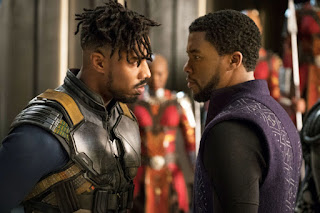
Erik Killmonger (Michael B. Jordan) faces off against T'Challa (Chadwick Boseman).

With his malice lying deep in the feelings of isolation and trauma, Erik Killmonger is such a terrific many layered villain. Beyond the bad seed trope, he is the physical consequences of residual scars of seeing the abandoned body of his dead father like that of the black body grossly depicted in history, in our current landscape, dead and unattended, left without a sliver of compassion and empathy. The desire for revenge rightfully brews in him, gaining substantial ground as he grows up on American soil, experiencing heinous racism and oppression, while desiring a place in his father’s native homeland, the very place that he blames for his tragic childhood. Thus, his extreme politics bear great similarities between of the righteous need to arm civilians with tools necessary to flourish and thrive without fearing white supremacy. He is the Malcolm X to T'Challa's Martin Luther King Jr.

The heart of the film is finding one self conflicted between T’Challa and Erik, finding both sides wrong and right on different political and social parallels. That wherein the genius.


Okoye (Danai Gurira) and her beloved spear taking names in the midst of an awesome car chase.
Black Panther fearlessly passes Bechdel and Ava DuVernay tests with flying emergent colors. The women of Wakanda were an absolute, scene stealing treat! There are no background players and props here. Firstly, the dynamism between the four leading women was a chemistry barely tapped in the Marvel Comics film sphere seeing as most of its core female characters, Black Widow especially, operate alone in a male dominated situations. In Wakanda, levels of trust and friendship went beyond protecting their supreme ruler. Queen Ramonda, Shuri, Nakia, and Okoye are a beautiful, inspiring sentiment, an awesome portrayal of the communal bonds between the black women’s love for each other and their undying allegiance to their country.

Nakia (Lupita Nyong'o) and Princess Shuri (Letitia Wright) are ready to fight for their country.
Queen Ramonda has birthed two amazing individuals who have inherited her goodness, her tenacity, and her courage. Princess Shuya, the computer tech whiz behind Wakanda’s highly advanced superior technology had more than once saved the day behind-the-scenes. She is valiant, witty, sharp, and intelligent, a supreme highlight who had some of the best deep seated one-liners, especially about colonialism. Nakia, the prince’s heart, has love for all people, wanting nothing more than to share Wakanda’s wealth of knowledge and resources to those of the diaspora, but of course, her kind of vigilantism often gets her into trouble. She too is an excellent warrior, her fighting skills a tremendous glory to watch, seen in the visually stunning choreography sequence in the casino scene with her fellow sister, Okoye, the powerful, resilient, staff wielding leader of the impressively elite Dora Milaje. Okoye is fierce and loyal to the throne, which adds to her internal struggles further down the line.

In the forests near the mountains of Gorilla City, Jabari's Tribe, Queen Ramonda (Angela Bassett) and Shuri (Letitia Wright).  

When Nakia, having successfully taken the last of Wakanda’s most precious plant as Killmonger orders it all burned down, is pleaded by Queen Ramonda herself to engulf the advanced Black Panther powers, the powers entrusted in her familial line. Even with her own young daughter standing by, it is Nakia, that Queen Ramonda believes can save them.

Other must see highlights: Nakia's first secret mission of freeing captive women (because of its heartbreaking reminder of "Bring Back Our Girls," a movement to finding the missing kidnapped girls from Chibok in Borno State, Nigeria); Killmonger wisely informing a curator of the Museum of Great Britain that they stole artifacts from Africa (because us knowledged people cannot imagine Africans gifting precious artworks to "The Other" aka colonizers); M'Baku and his people barking over Agent Everett Ross, telling him that he couldn't talk (because white people constantly tend to speak over black people). A sweet Moonlight actor makes a cameo at the end (because this brings to full circle the monumental range of diaspora unleashed in this film, us brown and darker skinned complexions with our broad noses and protruding foreheads and full lips are present together).

Wakanda Ensemble: Forest Whittaker, Daniel Kaluuya, Michael B. Jordan, Lupita Nyong'o, Chadwick Boseman, Angela Bassett, Danai Gurira, and Letitia Wright.

Black Panther does have minor adversaries. It is unsettling that a white C.I.A. operative comes to their country, wears their symbolic garb, and eventually must wield their sophisticated devices to blast down Wakandan vessels. There is no queer representation, which makes one wish that Tessa Thompson's Valkyrie, introduced in Thor: Ragnarok, would fly on down to Wakanda and have her way with a Dora Milaje soldier. Or perhaps in its sequel (oh there has got to be a sequel), Roxanne Gay can be brought into the writing room. The most glaring flaw is that black libertarianism, seemingly the real supposed villain, the conveyed message behind Killmonger's "evil," definitely conjures internalized friction. This idea to save long suffering black people from imperialism (Wakanda has plentiful which Nakia earlier addressed) isn't Wakanda's problem, but what T'Chaka did to Killmonger is. Where was Killmonger's mother? What role did she play in his life, if any? His masculinity was a toxic, misogynistic brand and yet, his desire to arm the most vulnerable people in the world was moving in spite of it.  

However, it is imperative to remember that one fictional superhero movie cannot hold everything, be everything to someone. It would be irresponsible to say the least.

Black Panther has granted us a black director (Ryan Coogler), black writers (Coogler with Joe Robert Cole), a black costume designer (Ruth Carter), a black jewelry designer (Douriean Flecther), a black production designer (Hannah Beachler), a black soundtrack director (Kendrick Lamar), and an almost all black cast from different pockets of the globe. And that stands for something undeniably profound.

T'Challa (Chadwick Boseman) has reassurance from Nakia (Lupita Nyong'o) that he can and will thrive as king of Wakanda.

Overall, Coogler and his team have helm a magnificent picture with a fine, gratifying story that passionately entails the complexities of fights within the black community. He has achieved a finesse that few filmmakers in the comic book verse have by incorporating historical and contemporary problems. The performances are meticulously top notch and powerful, possibly one of the best ensembles of Marvel. With Oscar winners and nominees, Golden Globe contenders, NAACP Awards and Black Reel accolades, and even a Pulitzer Prize nominee in the mix, the stakes were high. From Chadwick Boseman's commanding lead (kudos to his dialect coach), Michael B. Jordan's ruthless aggression to Lupita Nyong'o's ferocious vitality to Danai Gurira's stout loyalty, everyone had came with their A game. Angela Bassett, Forest Whitaker, Daniel Kaluuya, Sterling K. Brown, Winston Duke, and Letitia Wright (who was superb in that must watch Black Mirror episode, "Black Museum') also put in incredible acting efforts.

Black Panther may not have televised the whole entire revolution, but this imperative comic book film drama passionately ignites conversations to take that leap.

Now go see and support the vision of black excellence. Wakanda forever.