Monday, May 12, 2025

‘Beyond the Gates’ Can’t Make Us Hate Eva Thomas

Eva Thomas (Ambyr Michelle) is currently being dragged through the mud at Fairmount Crest. 

Eva Thomas has been our favorite Beyond the Gates character since the soap opera’s big February debut. The parted Afro wearing, bohemian styled former hairdresser stepped onto the scene as noted psychologist Nicole Dupree Richardson’s assistant after her own deranged mother Leslie Thomas hit Eva’s predecessor Laura Peterson with a motorcycle (unbeknownst to Eva). Of course, Eva discovered just how awful her single parent was during Ted and Nicole’s anniversary party. Yikes.  

In the beginning, despite not having held any previous administrative experience, Eva gets the job based on Nicole’s other assistant Mona Wilson’s recommendation. Eva tries to be the best person for the job, going above and beyond her duties to ensure Nicole that she’s the right fit. However, Eva is Leslie’s tool into ingratiating with Nicole’s family as a means to gather dirt on Ted’s wife— as Ted was Leslie’s affair partner and Eva’s biological father! Plastic surgeon Ted Richardson, lauded by Nicole as a better man than her ex-brother-in-law Bill Hamilton, cheated on his wife long ago. Sadly, Nicole doesn’t know about Ted’s straying. Shaped by Leslie’s ironed manipulation, a conditioned Eva plays niceties while carrying the burden of her mother’s hatred. 

Eva (Ambyr Michelle) the assistant at Nicole’s home office near the gorgeous framed art on the wall. 

The main reason that we must advocate on Eva’s behalf is because a crazy woman named Leslie raised her— a woman who is not even stable enough to adopt a cat. Leslie may have been super abusive to Eva, inciting her to hate the Richardson and Dupree clan prior to meeting them, likely ingraining into Eva’s development that she’s less than. Leslie continuously lied and gaslit Eva into believing things that weren’t true, fed her the most outlandish information in hopes of passing down her ire. The moment a happy, enthused Eva returned home from helping Nicole write her awards dinner speech, a jealous Leslie offered no congratulations or praise. She sought to bring Eva to a sunken, depressing place— a hole of her creation. It showed that that was perhaps Eva’s upbringing. Any amount of Eva’s joy that did not benefit Leslie would be cruelly snatched away. When Eva started suspecting Leslie’s foul games including how an awakened Laura became too ill to leave the hospital, Leslie shut it down by nastily elevating her voice and calling Eva, “little girl.” To say “little girl” is almost as belittling as men spouting out “females” or white men shouting “boy” to full grown individuals. This was Leslie’s way of bringing down Eva, mentally and psychologically and to ensure that her “weapon” kept running at revenge coded factory settings. 

Eva (Ambyr Michelle) and heartless mama Leslie (Trish Mann-Grant) scheme together.

As Eva interacts further with Ted and Nicole, however, her stance softens, soon blossoming into reluctance and regret. Often, she’s pictured with her mind operating against Leslie’s wishes, instead fantasizing about being pictured in the Hamilton family photographs. She has seen their genuine kindness and feels an affection that must have been severely lacking in the Thomas household. Eva then makes moves to protect them at Nicole’s awards dinner, having her wig-donning mother thrown out. It was certainly a demonstration of Eva’s manipulative tactics put to good use— a notion that the girl’s allegiance shifted, that in her heart of hearts, she knew intuitively that Leslie was in the wrong. 

The style of Eva (Ambyr Michelle)— cutesy chic turtlenecks, cozy sweaters, and patterned tops— could be the height of soap opera fashion. Lipsticks are always on point.

The other downside in Eva’s world is Kat— the uppity, spoiled daughter of Ted and Nicole who hated Eva on sight. An ice cold Kat goes on and on about Eva’s lack of experience and cracks on Eva’s clothes and hairstyling employment yet rarely sees the hospitalized Laura, the girl she can’t wait to see back at the job. Kat’s instincts regarding Eva’s intentions may be right on some instances, but her behavior indicates that she views Eva as a simple peasant undeserving of respect and care. Then add the boring Tomas character as another division between Eva and Kat. The classicism was enough without a triangle element. Now we have the virgin Kat versus the around-the-way Eva with Eva having already spoken about past men discarding her. Heck, Leslie is bound to throw Eva under the bus in the same deliberate manner as throwing a framed picture of them in the trash can! Eva needs girl friends, unconditional girlfriends, not a man that her sister’s radar is failing to vet on. We’d love to see a healed Laura become Eva’s bestie, an eventual storyline of Eva rescuing Laura from more harm, and a tender slow burn romance (with a better man) for Eva. 

Eva’s devastations are felt by the viewers watching her despair. Her whole life has been a complete lie and she has to pick up the scattered pieces.

Thus, the colossal reveal happens, Eva finally learning that Ted never knew she existed, that the carefully calculated vengeance was fueled by Leslie’s jealousy of Nicole and nothing more. Kat’s then dead to Kat, fired by Nicole, and disowned and kicked out by Leslie. It is Ted who promises a hotel room and eventual apartment to the abandoned young woman who slept in her car. While Mona and the hoity-toity Dupree women Anita and Dani attempt to sink Eva’s self-esteem to lower degrees, our girl has won money at the casino (here’s looking at you, Dr. Doug McBride— the addict) and vows to begin anew. 

Side note: Leslie showed more hurt / sympathy at losing Mona’s friendship and more love for Teddy than she ever did for Eva. Goodness, a tough watch. Thankfully, Eva wasn’t present for that. 

Poor Eva.

Apparently, Eva’s March 13th fantasy of being Ted’s (Maurice Johnson) perfect daughter will come true this week right down to the blazer material. We hope she returns to her unique style that sets her apart from the other women. Surely, Ted will accept her true fashion, either or. 

Eva Thomas couldn’t be possible without portrayer Ambyr Michelle’s masterful performances each week, showcasing the extreme depth of Eva’s inner turmoil— the emotional nuances of pain, sadness, anger, and love. Michelle renders remarkable vulnerable complexities, broadcasting resilience and dignity to this wronged character, a beautiful, riveting woman determined to make amends. She operates well with her chosen scene partners, especially Trish Mann-Grant (terrific at being an unrootable doppelgänger villain). Their storyline contains the juiciest entertainment elements, the most dynamic duo to the afternoon. By putting Michelle and Grant in huge positions during the three day exposè complete with the following aftermath showed the soap’s strongest acting and direction since the debut. They both received Soap Opera News’s Performers of the Week and Michelle had this honor for Soap Wire as well. They must be bound for nominations galore at next year’s Daytime Emmy Awards. 

If anyone deserves the nod and the win— it’s Ambyr Michelle, eligible for the new Emerging Talent in a Daytime Drama category. 

Eva Thomas has been on fire from the very beginning. We only hope the fuel remains lit. 


Monday, July 15, 2024

The First Slayer’s Unbelievable Trauma


The first Slayer had no name on the series.

The first Slayer— Sineya according to the comic book yet listed as Primitive on IMDb—starts appearing in Buffy the Vampire Slayer’s season four finale, Restless written and directed by problematic showrunner Joss Whedon. Prior, the Scooby Gang (Buffy, Willow, Xander, and Giles) called forth on the Sineya’s ancient powers in order to defeat Adam (the show’s weakest Big Bad). Unfortunately, the consequences include conjuring up the original Slayer’s vengeance. Sineya comes to the four at their most vulnerable— in their dreams, attempting to kill them one by one. 

Buffy tells Sineya that she understands her role as a Slayer and that she is free in a newer world. Buffy doesn’t extend remorse or empathy for what Sineya has endured. Since Buffy’s speech saves the day, the gang wakes up nonchalant acting as though Sineya was just another Monster of the Week. No one considers showing gratitude for taking her powers. 

Than again, Slayerhood is a thankless calling. It’s another piece to add to Sineya’s already violent backstory. 

Sineya visits subconscious Buffy last and is defeated. Of course, Buffy insults Sineya’s hair before waking up. DP: Michael Gershman.

Set upon by the Shadowmen (the earliest incarnation of the Watcher’s Council pre-British headquarters), the defenseless woman is held against her will— chained in a cave. The negative connotations speak volumes. They can never stop imagining Black people bound up (see medieval Missandei in Game of Thrones). Then forced with the elements of evil in order to defeat the vampires and other harmful creatures that walk the earth, Sineya is no longer a normal girl. She’s become part demon. Although almost facing the same fate in season seven, episode fifteen’s Get It Done, Buffy outsmarts the Shadowmen unlike Sineya. Whereas the later Slayers will not scream in pain as these powers flow through their blood, Sineya’s sacrifice is an ingrained destiny unasked for— not as sacred or valiant as Giles made it out to be. Even the season three episode, Helpless shows that the Watchers Council prefers continuing to subject the Slayer to dangerous tactics without her knowledge. The patriarchal white male institution keenly invests themselves in their Slayer cargo versus the impact that the supernatural inflicts on the world.  

Thus, Sineya—the original— paid the ultimate price. 

According to the Buffy Wiki, Sineya’s far more advanced skills include superhuman strength, speed, agility, stamina, accelerated healing, astral projection into dreams, and foretelling the future. Although each Slayer has a somewhat diluted essence of her pronounced abilities, they still retain many factors. 

Sineya, however, does not have a Watcher. She’s an ostracized figure fighting alone and unguided. Revered and feared, no one in Sineya’s village wants her around. 

Sineya becomes Buffy’s guidance in season five, episode eighteen’s Intervention written by Jane Espenson and directed by the late DP Michael Gershman. 

During harrowing season five— which brings about significant changes to Buffy’s life— Sineya is again conjured by Giles. She’s the guide in Buffy’s vision quest, now fully representing the Magical Negro Trope. Sineya offers no explanation about herself because she and her past does not matter, has never mattered beyond what it can do for the core team. Sineya is not realized until comic books that take great liberties with prehistory. The television series often gives Black characters no purposes beyond helping the save the day and vanish into obscurity. 

Portrayer Jamaican born actress and dancer Sharon Ferguson outside of Sineya costume. 

Sineya’s physical appearance cements the running gag on the production’s limited scope of history. While Kendra hails from a made-up Jamaican village, the first Slayer comes from prehistoric Africa, likely the Sub Saharan region (since they’re not brave enough to be specific). The barefoot Sineya sports an awful wig— synthetic shoulder-length hair that tries to be locs and makes The Walking Dead’s Michonne look an A plus effort. Sineya dons white and black body paint and dresses in wispy fabric reminiscent of cobwebs. Although Sineya is buried beneath heavy makeup, the beautiful, talented actress and dancer Sharon Ferguson moves gracefully, persuading with her swaying. The way her bilious arms flex, her limber knees bend, she elevates the scripted material by her body’s natural inclination to exude fluid rhythm. 

Buffy teaches us that Slayers suffer in more ways than one. 

However, Sineya— the first to endure the pain and struggle with the external and internal beasts— withstood the greatest, most horrific torture of them all. 


Sunday, July 14, 2024

The Tale of Two Nikki Woods’

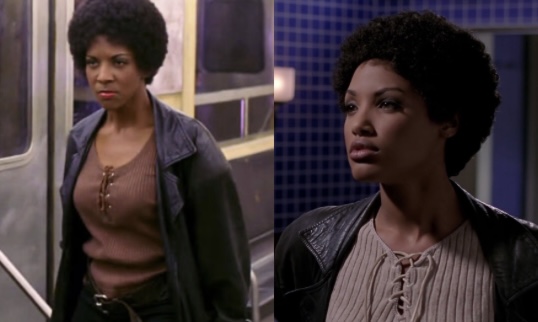
Two actresses of different phenotypes depicted the 1970’s slain Slayer Nikki Wood. DP: Michael Gershman and Raymond Stella.

Nikki Wood, a Black Slayer with a last name, continued Buffy the Vampire Slayer’s problematic depiction of Black women. In season five, episode seven’s Fool For Love written by Douglas Petrie, Spike— Nikki’s own murderer— sheds his personal history with Buffy regarding killing the New York City based single mother. Spike feels comfortable sharing this story to a woman he’s nearly killed on various occasions. Initiative chip in the head or not, Buffy allows him to speak because she ironically enough respects the vampire, an uneasy truth to swallow. She knows her death is coming and wants to know (from the killer’s perspective) how other Slayers died. 

Nikki needed to tell her own narrative in her own words. She’s a Chosen One who has lived longer than usual for most Slayers. It’s a huge feat to balance between confronting the dual evils (racial and supernatural) of the gritty NYC landscape and raising a son Robin— the future principal of renovated Sunnydale High School. According to the Nikki Goes Down comic story, also written by Petrie, the black duster jacket she wears was her lover’s— a deceased police officer (ugh, no other profession exists?). 

After draining an Asian Slayer’s blood with Drusilla seventy plus years prior, Spike reduces Nikki as a chick he fought in an abandoned train, a playful source to take out his vampiric frustration. The blackout gives Spike the added momentum to overpower Nikki and snap her neck. He then steals her coat, proudly wearing the lengthy black duster as surely as George Washington smiled with all his slaves’ stolen teeth in his mouth. 

The first Nikki Wood (April Weeden-Washington, a stunt double) battles Spike (James Marsters) in Fool For Love. DP: Michael Gershman. 

The second version of Nikki Wood arrives in season seven, episode seventeen’s Lies My Parents Told Me written by Drew Goddard and David Fury. Production made sure she wore the same outfit as the first actress— long leather coat, oatmeal knitted sweater, and Afro wig. Before the tragic subway murder, Spike reveals that he’s been tracking Nikki for a while as they fight in a downpour. Nikki brought Robin— hiding behind a bench— to her supernatural realm, seeming to have no babysitter available.

The second Nikki Wood (former model K. D. Aubert) gets to speak, fight Spike in the rain, and act maternal in Lies My Parents Told Me. DP: Raymond Stella.

The watching young Robin (Damani Roberts) inadvertently saves his mother from certain death. DP: Raymond Stella. 

Wood’s first portrayer, April Weeden-Washington also stunt doubled for Bianca Lawson in What’s My Line Part 1 and stunted on various other series and films. In Doux Reviews, the actress reveals auditioning for the speaking role:
“I thought I was a shoo-in because I had already established the character. There weren't many lines. Then I got a phone call from casting stating that there was ‘a certain maturity’ about me now, and that I didn't get the part.”
Wow.

For a show that hired actors in their obvious late-twenties as teenagers, it’s pretty offensive that they felt that in two years, Weeden-Washington “matured too much” to resume playing the role. They preferred a lighter-skinned, lighter-eyed K. D. Aubert as Nikki, putting her in a 4C Afro textured TWA wig ala pre-Zoe Saldana’s portraying Nina Simone. Aubert also spoke whereas the unambiguous Black woman fought for her life and died on public transportation. Casting directors definitely know the difference between what they envision as the Black women who deserve a voice versus the ones who should remain silent and/or placed in limiting conditions.

Buffy may always be a pop culture staple, but it’s depiction of minority characters— especially Black women— were outdated and show blatant colorism. Thus, with history dooming to repeat itself, it was best that the intended reboot— which they hoped would star a Black Buffy— fell under the cracks. You cannot trust non-Black showrunners to tell caring, compassionate stories centering Black womanhood, not when they’re still making up deplorable fantasies riddled in harmful stereotypes. 

Nikki Wood is a prime example of that. 


Saturday, July 13, 2024

The Wasted Potential of Kendra the Vampire Slayer

Promo of Buffy Summers (Sarah Michelle Gellar) and the next Slayer in line, Kendra (Bianca Lawson).

Almost twenty-seven years ago, just episodes after Buffy the Vampire Slayer’s Inca Mummy Girl featured a nonwhite guest star Ara Celi (which did not age well), the two-parter What’s My Line saga featured the first appearance of the iconic Kendra (portrayed by the phenomenal Bianca Lawson). The no-surname-having second slayer was called after Buffy Summers’s short death in season one’s Prophecy Girl. It matters not that Buffy had been revived, let alone back to work in tip top shape. Her replacement is coming.

Mind you, six months later. 

The beautiful, mysterious Kendra had a feline grace in her fighting prowess. Of course, they wanted us to believe she was an Order of Taraka assassin, the jaguar card. DP: Michael Gershman.


Buffy promo that puts Angel in the center.

Kendra arrives to Sunnydale, California via hidden inside of an airplane cockpit— no tickets for a proper seat, no luggage. Her Watcher Sam Zabuto does not alert Rupert Giles of her arrival (then again this happened with Faith Lehane as well). It’s unclear on what Kendra’s done since knocking out an airport employee in the light of day. At night, however, Kendra sees Buffy and vamp faced Angel making out at the skate rink. Thus, she either has impressive vampire radar skills or the girl’s been tailing Buffy for reasons unknown. Kendra later fights Angel at Willy’s club and gains the upper hand, imprisoning Angel to meet the sunlight. Somehow, Kendra finds Angel’s apartment and almost kills a napping Buffy. In the midst of the battle, Buffy asks who her attacker is despite knowing that The Order of Taraka trails her (she doesn’t ask the other two assassins who they are). 

A gloomy Buffy is not a fan of Kendra and Giles sharing jokes. However, it’s nice to see Kendra laugh. Between diligent training and learning books on demonology, she’s probably ironed to ignore any emotion— fun and joy mainly. DP: Michael Gershman.

In the second part, Kendra shows that she’s quite the proficient Slayer, trained in both combat and inherent book knowledge. The studious Slayer bonds quickly with Giles, laughing over the footnotes and recommending readings that the Sunnydale Watcher finds useful. Meanwhile, Buffy’s minor jealousy comes crashing out as she nicknames the fellow Slayer, a She-Giles. Willow Rosenberg encourages Buffy with “you’re the real Slayer” and makes no attempts to befriend Kendra.

While she’s good at pouncing on Buffy’s friends and the slimy Willy, Kendra’s booksmarts do not fully prepare her for real-life field work. During the big showdown, helping Buffy and her team free a kidnapped Angel, Kendra’s easily bested by the advanced Spike, not managing to block his hits very well. It further proves that she should have stayed in town in order to learn more technique. Unless there’s a Hellmouth in Jamaica, why does Kendra need to return to the islands if prepared (or as prepared as she can be) to face the greater evils? 

Even though she’s only known her for a day, Kendra is brave enough to address certain things to Buffy that Giles doesn’t. Giles gives his Slayer a lot of freedom, an action that surprises Kendra. DP: Michael Gershman.

Most importantly, Kendra wisely remarks on the dangers of having the former villainous Angelus cloud Buffy’s judgment. This heavy foreshadowing indicates that her hormonal heart distracts Buffy from the main duties at hand— saving the world. If Angel had died during the ritual, less peril for the future. A few episodes later, Buffy and Angel grow closer (often making out like crazy during patrols), he then loses his soul, causing a devastated Buffy to wait many months to kill him, leaving a wake of bodies including her fellow classmates. So yes, it would have been beneficial if Kendra returned immediately after the events of Surprise and Innocence. Spike and Drusilla were confirmed to be still alive, especially with the addition of Angelus. Kendra could have aided in taking up the reigns (not Giles) as Buffy dealt with her depression in the middle of junior year.

“You talk about skating like it’s a job. It’s who you are”—Kendra to Buffy on reconsidering negative, defeatist attitude regarding being a Slayer. DP: Michael Gershman.

Another six months later, when Angelus seeks to destroy the world much like The Judge, Kendra finally returns for the another two-parter, the Becoming saga (well, for one episode). Kendra has evolved slightly in fashion, sporting an olive green tank top, black leather jacket, and a thin necklace. She’s also a bit more open, prone to infectious smiling, and tells a few wisecracks. Buffy’s American slang and demeanor has rubbed off, softening the robotic warrior undertones of Kendra’s earlier appearance. Again, this significant character arc would have been rewarding to see onscreen, seeing how Kendra progressed both as a person and a supernatural force. 

Kendra gives Buffy two gifts— a sword and a stake. The sword was blessed by monks that defeated Acathla’s first rise to power— a blessed heritage from Kendra’s own community. Although she’s an excellent swordswoman, Kendra is not meant to fight against Angelus. Whereas Angel’s weakness lies in harming humans as little as possible unless provoked, the remorseless Angelus would have outmaneuvered Kendra in a heartbeat. Plus, it’s less poetic. The battle is between lovers turned enemies. Mr. Pointy, a sophisticatedly carved stake, Buffy will have among her possessions for years. That’s humor in itself, a Slayer naming her weapon. It would have been so un-Kendra like. Still, it’s sad because not only does Kendra believe Buffy will kill Angelus with it, this intimate moment will be their final exchange in the series. 

Kendra gives Buffy Mr. Pointy. DP: Michael Gershman.

When it comes to the most tragic character deaths in the series, folks often highlight Buffy’s mother Joyce Summers’s demise in I Was Made To Love You / The Body or Buffy’s heroic self-sacrifice in The Gift. Kendra, however, embodied “gone too soon.” Kendra doesn’t stand a chance in a horrific trap (eccentric considering Buffy and her friends usually can sense these). Drusilla and her minions storm the library and hurt everyone in order to kidnap Giles. Unfortunately, as witnessed in an earlier battle with Spike, Kendra is no match for his superior girlfriend. Under the hypnosis, Drusilla slits Kendra’s throat, causing the young Slayer to fall to the ground, bleeding out. It’s as offensive as Spike’s own kill of Slayer Nikki Woods. According to Slayer lore, Slayer blood is the most alluring, most valued to drink from. In two instances, these two European vampires let them go untasted. 

Kendra is hypnotized to her death by full-strength vampire Drusilla (Juliet Landau). DP: Michael Gershman.

Poor Kendra.

An innocent woman trained to be a soldier via through the cold Watchers Council grew to find the value in a Slayer having friendships too late.

Furthermore, the glaring cons of Kendra’s characterization leaves a lot to process. Firstly, Kendra grew up isolated from her family and peers, having no friends, no connections other than fulfilling duty. She almost symbolizes the premiere minority student selected into a predominantly white gifted program (or a PWI institution) and seeing limited reflection of themselves among the students and staff. The purpose of Slayerhood is to operate alone. Sadly, Kendra represents why that often fails. The previous Jamaican accent was terrible, sounding as though latched on seconds before the cameras rolled. Portrayer Bianca Lawson said in SFX Magazine: 
“I really hated that accent! I got the part, and I didn't originally have an accent. Then, literally the night before, they said, ‘What about a Jamaican accent?’ I didn't have a chance to get comfortable with it. And the thing is, certain things - if you say it properly [in Jamaican patois], people don't really fully understand it, so they would change things. They'd say, "Well, say it like this" and it's like, "Would that be accurate in that accent though?" ‘It doesn't matter because no-one's going to understand you!’”
Why was it so important for production to force an accent and not make Kendra an American girl raised in the states like Faith and the others? Talk about the erasure of Black American women. It would have been better if they selected an actual Jamaican actress. This was an example of problematic portrayals regarding Caribbean/African peoples in their imaginations so hellbent on inventing narratives on cultures that already exist. 

Furthermore, Kendra arrived in one outfit— a long sleeved, midriff bearing top, fuchsia drawstring pants, a necklace, and choker. It looked an outdated perception on ethnic appearances than the reality of late 1990s Caribbean fashion. Maybe we’re supposed to believe that since raised by Zabuto, the Watcher lives in the dark ages, teaching her skills and not the clothes of the day. Imagine if Giles raised Buffy and enforced eccentric fashion habits on her. 

Kendra with the pivotal sword that will soon send Angel elsewhere. DP: Michael Gershman.

Lawson— like Sarah Michelle Gellar— would have been Cordelia Chase (meant to be killed off in season one). Lawson did a great job with the material the production required of her. She’s why we remain memorializing this character— a character that needed more time for viewers to know. It goes beyond the braided updo with the puffed out ponytail, the smoldering eyes, glossy lipstick, and the funny one-liner about losing her only shirt. She transcended the material of white writers who wrote about blackness with inauthentic depictions mixed in with the Chosen One folklore. Thus, it makes it all the more wonderful to see Lawson move onto more nuanced roles such as the frail, sobered Darla Sutton-Bordelon in Ava DuVernay’s poignant Queen Sugar.

Still, every time Kendra’s three episodes come on, you cannot help rewatching and wishing that this Slayer had as big of a role as Faith, the season three Slayer, the last of a unique line. Kendra deserved so much more. 

For starters, why did it take a comic book to give her a last name— a glimpse of her voice? 


Saturday, June 15, 2024

A Quiet, Symbolic ‘Grace’ Goes Against The Grains Of Sanctimonious South


Grace film poster.


Grace—the latest coming-of-age effort after writer/director Natalie Jasmine Harris’s debutante short film, Pure—adds another effective gem to a promising filmmaking oeuvre. 

Grace (Jordan Wells) embodies her name in every way. DP: Tehillah De Castro.

As a carefree, ordinary girl named Grace approaches her milestone birthday and upcoming baptism, she succumbs to the joyful pleasures of youth alongside her sister and Louise, a childhood friend. The charisma between the triad presents a natural friendship depiction. The lines of love are drawn in its unadulterated forms— affectionate sibling biology and the kindred camaraderie. What happens when those invisible lines are unexpectedly blurred? Can an innocent heart stay ruled by a strict upbringing or will it surpass the safe, platonic road? 

Big Mama’s teachings on the Deep South stage heightens Grace’s burgeoning sexuality dilemma. It’s where the unsettling righteousness bellows beneath the exterior of precious girlhood. Between the delightful smiles and the singsong handclap games, the devout undertones disturb the humble peace. 

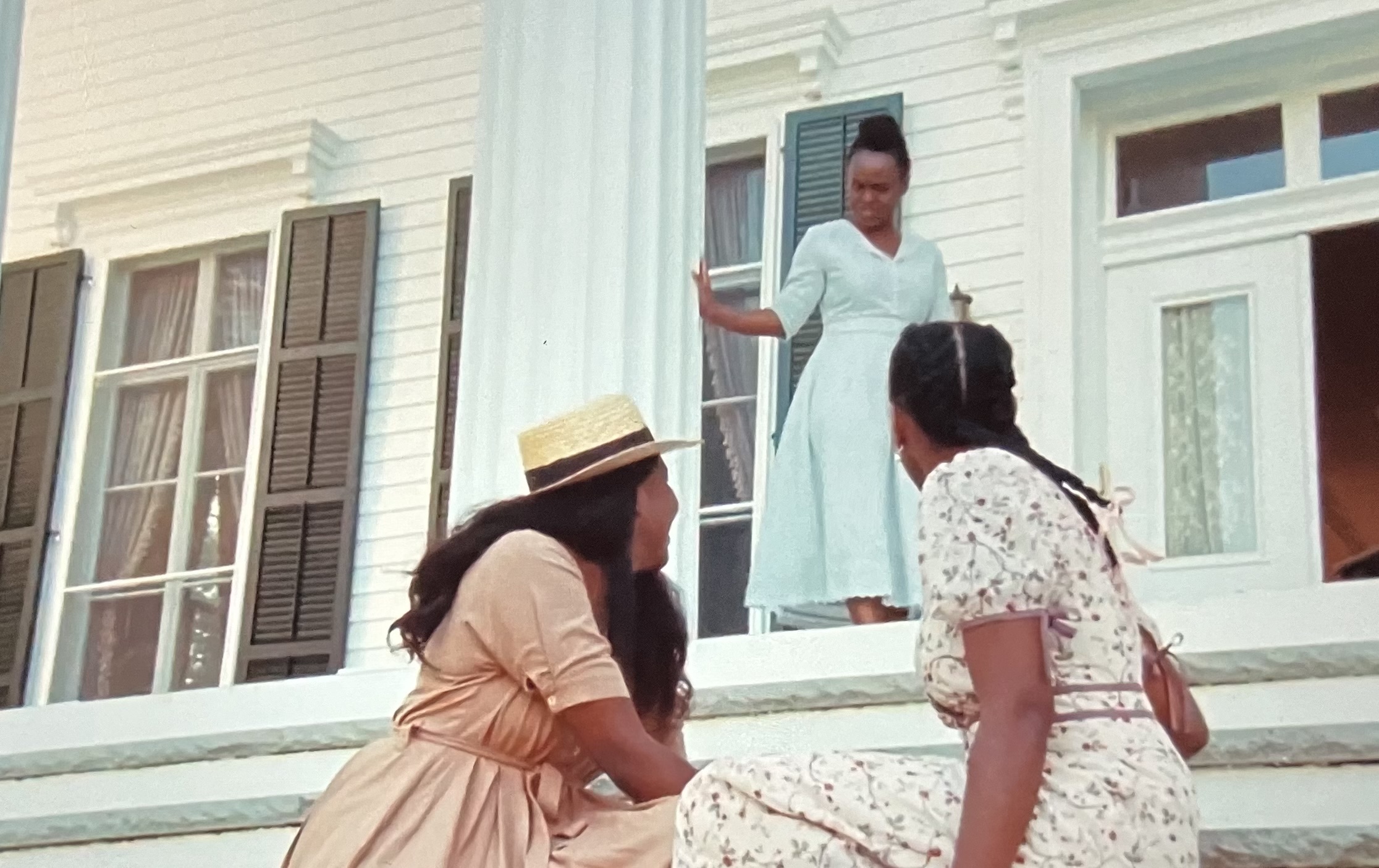
Louise (Alexis Cofield) stands on the porch, smiling down on Grace (Jordan Wells) and her sister (Mikayla Lashae Bartholomew). DP: Tehillah De Castro.

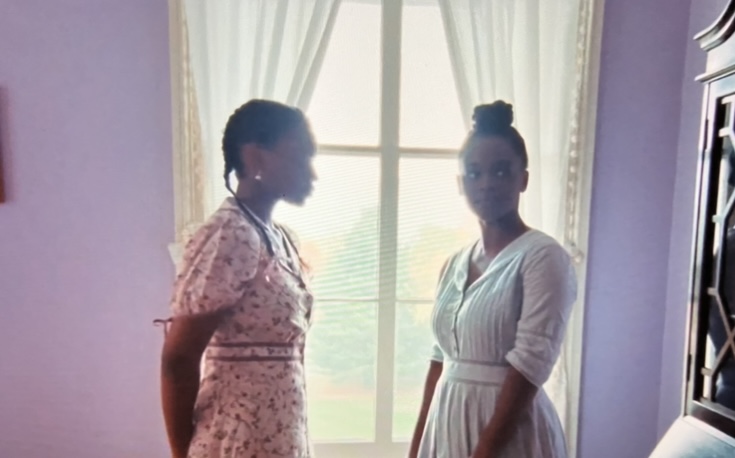
Among the pastel colored walls and the elegant white curtains parted on large, charming windows, Grace feels the pressure to be good, to follow Big Mama’s respectable example. Inside the American Gothic styled house, intentional cross patterns are repeated cues upholding the Bible structure. Although no men occupy this makeshift Black feminine utopia, an ominous presence operates as a patriarchal beacon, the judgment ensuring that all young girls must eventually submit to their duties as wives, to suppress any other “unlawful” inklings. 

Moreover, Grace’s baptism will bring the ultimate test. 

Grace and Louise strike a cord. DP: Tehillah De Castro. 

In the trajectory of Juliana Kasumu’s Losing Joy, Allie Morgan’s Sisters, Mz Roth’s code switch, Harris’s Pure, and many other Black sapphic films eloquently helmed by Black filmmakers, Grace sheds profound light on soft queer films highlighting multifaceted experiences. These brave creators are not rehashing the same, copy/paste narratives that we’re accustomed to seeing in regards to how Black women, girls, and femmes are portrayed. 

By centralizing blackness through an authentic lens, the characters must battle the fights (both internal and external) that come with the global impact of the dominant heterosexual landscape. These are the directors that deserve to invent original stories and adapt the inherent literature (Alice Walker, Toni Morrison, Maya Angelou, Gloria Gaynor, Paule Marshall…) for us to devour, to engage. Since their films asks and answers questions long raised in Black community, they need our support the most. 

The most metaphorical shot in the film. DP: Tehillah De Castro.

A straightened haired Grace rejects Louise. DP: Tehillah De Castro.

After premiering earlier this year at the Sundance Film Festival, Grace has been shown around various other film festivals such as Inside Out Toronto, Newfest Pride, and the upcoming Frameline and BlackStar Film Festival. Grace —a word meaning simple elegance— is a must see for embracing its definition beyond the leading character. Every element (small or large) enriches the layered, impactful narrative: tightly knitted frames containing vital symmetries and subtle performances by a talented cast led by its director, some period costumes (which Harris designed) call to mind Julie Dash’s Daughters of the Dust— the white dresses nodding to the film’s costume designer Arline Burks Gant, and the house right down to the object placements, an appropriate foundation for stern religious order. 

Overall, Grace is cinematic magic without spells being cast onscreen. While the visual feast thoughtfully conveys a Black girl grappling with her awakened identity, its story teaches the notion that being true to oneself is more so a blessing than a sin to be cleansed away. 


Saturday, June 8, 2024

Saturday Soapy Flashback: NAACP Image Award For Outstanding Acting in a Daytime Drama

If Victoria Rowell aka The Young and the Restless’s Drucilla Barber was nominated, the other soap opera actress nominees had no chance against her at the NAACP Image Awards. She played the role on/off from 1990-2007.

Last night, the 51st Daytime Emmys aired, the last sole honor for talented soap opera actors to grasp an accolade for their proficient ability to act out three-hundred page scripts on the daily. Some are very, very good at it. Others are obvious models who believe they have what it takes beyond looking beautiful. Unfortunately, actors of color— rarely preferred over the predominantly white nominees— felt a disappointing absence when the NAACP Image Awards stopped awarding the Outstanding Actor and Outstanding Actress in a Daytime Drama Series in 2015. The category was introduced post-Generations in January 1994– with The Young and the Restless’s Victoria Rowell and the late Kristoff St. John not having competition for the first two years of its inception. 

The Young and the Restless has eighteen wins out of twenty-one victories for actors and nineteen of twenty-two for actresses. No male actor was nominated in 1995. 

Years after One Life to Live’s Al Freeman Jr. won the first ever acting Daytime Emmy Award for a Black actor in 1979, All My Children’s Debbi Morgan was next in line. Her 1989 win, however, was shared. She won Image Awards in 2009 and 2010.

Yes, it would be fair to criticize the Image Awards for its obvious preference— Rowell has a whopping eleven wins including a few consecutive runs, St. John has ten, Shemar Moore has six, and Tatyana Ali has four. All My Children received love in the Best Actor category circa 2010, 2011, and 2012– likely because St. John wasn’t competing. Passions scored a win in 2007 for Tracey Ross (Eve Russell) and All My Children held back to back wins for Debbi Morgan’s return as Angie Baxter. 

The late Kristoff St. John won the first (1994) and the last (2014) honor in the category for portraying Neil Winters on The Young and the Restless (1991-2019).

There are only these categories per year. No supporting because quite frankly, that is the role most minorities are granted onscreen anyway— props to the leads. Still, plentiful performances were robbed of receiving recognition from that time forward including those who kept being nominated, favored for the aforementioned repeat winners. It’s on the same tier as so and so having five Best Lead trophies at the Daytime Emmys.

Currently, four soap operas are airing (Days of Our Lives is behind a paywall streaming service Peacock) until The Gates— the first primarily cast Black soap opera to air since Generations— will perhaps help boost up this dwindling genre. Although there’s no chance in heaven that the NAACP will resurrect this category, let’s look back on some who were nominated and never won versus the others coming up behind post removal.


Memorable Past Nominees

The late Kamar de los Reyes (featured in the In Memoriam segment) was nominated once for playing Antonio Vega on One Life to Live (1995-2009) and won an Alma Award in 2008. He guest starred on SEAL Team, Sleepy Hollow, The Rookie, and The Passage and films Love & Suicide and First Strike Butcher Knife. His last appearance was Coach Montes on All American and the upcoming Washington Black. 

Renee Elise Goldsberry was twice nominated for playing Evangeline Williamson on One Life to Life (2004-2007) and won a Soap Opera Digest Award for being in a lopsided love triangle. Since Goldsberry’s controversial end to the role, she’s won a Tony and Grammy and received nominations for a Critics Choice, Black Reel, and Primetime Emmy (a win here would make her an Oscar win away from EGOT status).

Retired actress Renée Jones was nominated five times for playing Stefano DiMera’s reformed daughter Lexie Carter on Days of Our Lives (1993-2012). She also played an earlier character, Nikki Wade on the soap in 1982.

Amelia Marshall was nominated three times for playing Belinda Jeffries on All My Children (1996-1999). She later moved onto the villainous Liz on Passions (2001-2004) only receiving a Soap Opera Digest nod. 

Karla Mosley was nominated once for playing Maya Avant Forester— the center of the most powerful Black story ever told on Bold and the Beautiful (2013-2019). Mosley has since starred and produced short films including the Wed-locked web series with Bold and the Beautiful and Guiding Light co-star Lawrence St. Victor.  

Peter Parros was nominated twice for playing Dr. Benjamin Harris on As the World Turns (1997-2009). Prior to, he held roles on One Life to Live and The Young and the Restless. He continues to guest star on various television series.   

Nathan Purdee— the original Nate Hastings on The Young and the Restless (1986-1993)— was nominated seven times as the District Attorney Hank Gannon on One Life to Live (1992-2009).

Timothy Stickney—a gifted thespian— was twice nominated for playing villain R. J. Gannon (Hank’s younger brother) on One Life to Live (1994-2009) and won a Soap Opera Digest Award for Outstanding Villain. Stickney has guest starred on various television series including Evil and Elementary and is a theatre practitioner.

Theatre actress Tamara Tunie was nominated twice for playing Attorney Jessica Griffin on As the World Turns (1987-1999). Tunie also played medical examiner Melinda Warner for twenty-one years on Law & Order SVU, worked with the phenomenal Denzel Washington twice (co-starred with him in Flight and co-starred in his directed Journal for Jordan). She has been received the Reel Sisters Trailblazer Award in 2017.

 
The trophy. 

The Never Will Be Nominated

Tabyana Ali currently plays the third Trina Robinson on General Hospital (2022-present) and there’s a lot of promise when the writers give Trina stories. Ali— a comedian— has guest starred on New Girl and the Horror Noire anthology. She wrote a short film screenplay Before it’s Too Late. 


Sean Blakemore, Daytime Emmy Award winner played Shawn Butler on General Hospital (2003-2022), first starting out as another character Chase Wright. Blackmore has since starred in many shows All Rise, Greenleaf, and Quad. He also co-starred with Shemar Moore in the scandalous x-rated drama Motives and the sequel in addition to S.W.A.T.

Tanya Boyd played Celeste Perrault, the sensuous oracle and sidekick to Stefano DiMera on Days of Our Lives (1994-2007). Boyd never fully received her props for bringing a Grace Jones like vibe to Salem. Meanwhile, she guest starred on many classic shows such as What’s Happening!!, Good Times, A Different World. She also directed two short films, Supremacy (2011) and Hold Up (2004). 

The late Sonya Eddy played the wise, scene-stealing Nurse Epiphany Johnson on General Hospital (2006-2022). Eddy guest-starred in various shows— Everybody Hates Chris, Black Jesus, The Black Lady Sketch Show, etc. She won a Daytime Emmy posthumously— from her first nomination. 

Jason George played the lovable doofus lifeguard Michael Bourne on Sunset Beach (1997-1999) and received a Daytime Emmy nomination. George has been seen on Girlfriends (Toe Sucking Charles is unforgettable, sorry), Eve, Roswell, and Half & Half. Currently, he stars on the Grey’s Anatomy spinoff Station 19. 

Even though most characters listed here are “goodie types,” Dominique Jennings deserved some recognition for playing the kooky Virginia Harrison on Sunset Beach (1997-1999). 

Napiera Groves as adult Bonnie McKechnie #1 on As the World Turns (2001-2004). Groves had a small part in Jordan Peale’s Us and directed/produced the full Kickstarter backed short film Aisle 2. 

Lauren B. Martin played breast cancer survivor Camille Bennett on As the World Turns (1998-2001). Martin also starred in other soaps: Another World, All My Children, and Guiding Light. Currently, she is an award-winning producer behind Anacostia, Asunder, and Reality Sets In and has several independent projects on the works. 

Sidney Mikaela, two-time Daytime Emmy nominee, played the second Trina Robinson on General Hospital (2019-2022). Mikaela is mostly remembered for playing a young Gabby Douglas in The Gabby Douglas Story and has lent her voice to animated series: Dew Drop Diaries, Fright Krewe, and Hailey’s On It! 

Mishael Morgan— first Black woman to win a leading actress in a Daytime Series Emmy and a femfilmrogue favorite— played Hilary Curtis and twin Amanda Sinclair on Young and the Restless (2013-2018 and 2019-2024 respectively). Morgan has starred in a few films and produced award nominated Sway. 

Sherri Saum played Vanessa Hart, the nosy, resourceful reporter on Sunset Beach (1997-1999) and the criminal sociology professor Keri Reynolds on One Life to Live (2001-2003). Saum starred in the hit ABC Family drama The Fosters and recently directed an episode of the spinoff Good Trouble. She also made appearances in How To Get Away With Murder, Girlfriends, and  Mrs. Davis.

Veronica Redd played the fabulous Mamie Johnson #2 off/on Young and the Restless (1990-1995, 1999-2004, 2023-present)— Jill Abbott’s best other nemesis next to the late Jeanne Cooper’s Katherine Chancellor. The first Black actor to receive a contract from The Young and the Restless, Redd also guest starred in various shows— Living Single, 227, The Jeffersons, and The Women of Brewster Place and films: The Five Heartbeats and Bluehill Avenue.