Sunday, January 18, 2026

Revisiting The Significance Of Trish O’ Day In ‘Romeo Must Die,’ Nearly Twenty-Six Years Later


Romeo Must Die film poster. 

Romeo Must Die finds an authentic, modern-day Juliet Capulet in Trish O’Day. She’s a cherished figure in the community, often smiling and laughing, especially around the neighborhood children— joy is at the top of her hierarchy. Her vibrant, colorful Serpentine Fire boutique features women coworkers and seems a positive base for the frequent youth. They call her name with singsong cheerfulness, implying a valuable reciprocated kindness. This protective healing ground is a carefully built strategy for her, a positive luxury stemming from rising above her past environment, a turmoil that she seeks to escape. While some would reap the benefits of nepotism and allow the privileged lifestyle to inflate their egos, Trish embodies “being the change you want to see in the world” philosophy. An individual can be raised rich and affluent, but knowing the whys and how’s of being rich and affluent can push a humble spirit into setting themselves apart, building a foundation on healthier terms. 

Trish (Aaliyah) choreographing a dance with her coworker Lori (Fatima Robinson—Aaliyah’s primary real-life choreographer and friend) and the kids.

Serpentine Fire Crew: Trish and Lori. DP: Glen MacPherson.

Trish’s father Isaak O’Day seems too polite to be in gang affiliation while his associate Mac has an oily ruthlessness that shines bright. Mac does not employ loyalist qualities and Isaak’s heavy reliance on him is not a good look for someone who has been in gang-related business a long time. Also, what happened to Trish and Colin’s mother— death at the hands of a vengeful foe or a clandestine departure? Trish’s situation bears similarities to the problematic Disney Princess trope as most of those girls grow up motherless and dealing with either overprotective or centered masculine characters. Again, Isaak acts like a gentle papa bear and wouldn’t be a Titan figure setting off to blow up Trish’s most treasured boutique. Though a barbershop does explode among other events for the small owners who refuse to sign over their deeds. 

When breaking down the name Serpentine Fire, serpentine meaning snake-like and fire as burning flames, a phoenix comes to mind, a powerful bird that rises from the ashes. Trish has that mentality of being reborn, reshaping herself by creating a close-knit workplace. Although there are not many scenes in the shop, it comes up in as also being used by Trish’s brother Colin, his preference to hide behind his sister’s good deeds. She isn’t dumb, however— keenly aware what game he’s playing and telling him not to bring that mess. 

In order to escape her newly assigned bodyguard, Trish hops into the cab of Han Sing (Jet Li). DP: Glen MacPherson.

Despite stranger danger, Trish doesn’t mind being in Han Sing’s stolen cab or Han later entering her apartment without the chivalry of knocking. It is Darius grabbing Nina’s address off the check in the record store in Love Jones or Jason following Lyric’s bus to her door in Jason’s Lyric— red flags bow tied as romance. Except in Trish and Han’s case, they behave as strictly platonic friends that save each other throughout the film. 

Colin (DB Woodside) obviously would come to a bad end. DP: Glen MacPherson.

Trish blames her father Isaak (Delroy Lindo) for Colin’s bad choices. DP: Glen MacPherson.

Now Colin O’Day shares a single apiece with Trish and Isaak. The reactions to his fate seem grossly unearned, especially in juxtaposition with Han’s storyline. We’re not given much to prove Colin, Trish, and Isaak as a connective family, as loving and supportive of each other in light of lacking a maternal figure (Han has this as well). Trish is defensive with Colin and rightfully so as he constantly weaponizes Serpentine Fire. If the brother truly loved his sister, he would have found a better place to conduct whatever his mysterious plans were. Meanwhile, Colin informs Isaak about wanting to be his own man, his own boss, to step out of the O’Day shadows. Later, we learn that both Trish and Colin were college educated. Why didn’t Colin want to be on a straight and narrow path like Trish? Had Isaak unintentionally enticed Colin into gang related warfare? Furthermore, Isaak planned to finally leave that life and own a sports team, leave behind a legacy for Colin to run. Isaak waiting until his children are full grown adults to be legit though? That’s wild. It is ninth-world  wonder Colin and Trish survived as long as they did. 

Trish’s pretty apartment is painted in lighter shades of purplish pink with gold accents. DP: Glen MacPherson.

Trish’s sweet, sentimental embellishments in her childhood bedroom tell a story of innocent girlhood. DP: Glen MacPherson.

A wide awake Trish lays next to her stuffed animals. DP: Glen MacPherson.

Trish’s vulnerable moments are reserved with Han who shares commonalities. Han’s backstory is almost perfectly constructed (except again, no mother). The disgraced former cop escaped a Chinese prison and manages to find his family in America. His only mission is to figure out who killed his little brother, no indication if he is interested in law enforcement. When Han finds out that his last phone call was Serpentine Fire, Han requests Trish’s help. 

What joy looks like— big grins and ice cream cones. DP: Glen MacPherson.

Trish sharing a story about a prank gone wrong. DP: Glen MacPherson.

Trish mimics Han— entering his apartment (technically his deceased brother’s home)— without knocking. During this poignant scene, Trish gives a moving monologue, a small glimpse into her childhood, confessing that she fully understands her mother’s reaction to a heinous prank. With cartoons and video games promoting violence as everyday hijinks, naturally giving kids grand ideas, Trish and Colin’s mother probably easily believed this horrible joke because she witnessed the realities that her family faced firsthand. 

Han uses Trish to help fight an assassin. DP: Glen MacPherson.

The moves are playfully referenced in Aaliyah’s award-winning Try Again music video. 

Romeo Must Die’s all male production team— from the direction by Polish director Andrzej Bartkowiak to three writers Mitchell Kapner, Eric Bernt, and John Jarrell, and to cinematographer Glen MacPherson— could have made a film along the lines of Foxy Brown type blaxplotation to Proud Mary and other films that mirror it. Ironically enough, men shepherded Aaliyah’s whole musical career including her own uncle. Trish existed in the man’s world that James Brown sang about— a character made for Aaliyah to play. However, having no mother figure, Trish is shielded from being stripped of her agency, balancing between an outgoing, free-spirited nurturer to strong and firm in her values, her enigmatic quality lending itself to Aaliyah’s charismatic portrayal. The strongest range of depth was Trish’s sensitive emotional state, her grieving both a brother and mother through a distinctive core memory, a promising indication that acting could have been Aaliyah’s next step achievement. 
“What I like about Trish is that she's tough. She's independent,” Aaliyah says. “She doesn't take anything off anybody. But at the same time, she loves her family. She's got a sweet side. So I felt I could play her, and people could get into her. It would be realistic to people, being that people know me as Aaliyah, the artist -- there is this image that I have. I wanted to make the right transition and have people understand where I was going, and I felt Trish embodied all of that.”
Aaliyah’s magical chemistry with Jet Li also makes for a wonderful watch. The deep connective friendship between them created a believable strength onscreen. That familiar Romeo and Juliet formula—two different worlds meeting and colliding— works here. Unfortunately, mute-worthy, badly cast Anthony Anderson ruins things a bit. With plentiful peppered in laughter and light-hearted moments, the goofy, incompetent moronic bodyguard wasn’t needed, especially by an actor whose exploits will never age well and almost tarnishes the film’s legacy. Isaak would have selected a more capable, stern figure to protect his daughter. Delroy Lindo, one of the finest, most underrated thespians, put on a terrific performance as a father in the late-blooming stage of doing right. DMX as Silk the shortlived nightclub owner was a bonafide scene stealer. If only they gave him more than five minutes…

Trish in her childhood bedroom. DP: Glen MacPherson.

Trish in her element on the dance floor. DP: Glen MacPherson.

Other highlights are the dynamite fighting sequences— Han using Trish as a creative weapon is still riveting. The killer soundtrack features Aaliyah’s four songs produced by Timbaland (music executive of the film), Joe’s Rose in a Concrete World (playing in two different scenes), and Chanté Moore’s This is a Test— the film’s other saving grace. 

Trish with the smoking gun. DP: Glen MacPherson.

Trish O’Day will go down in history as a soft-hearted woman who had her father’s fire flowing on her veins. She couldn’t deny the instinctual prowess to become a valiant leader, knowing that when it comes to survival and shielding people that you care about from harm, sometimes violence is the answer. 


Friday, January 16, 2026

Happy Heavenly Birthday, Aaliyah: Fem Film Icon Spotlight


Aaliyah, photographed by Joe Wright.

Aaliyah Dana Haughton. 

Every time this January date arrives, it remains hard to stop imagining what would have happened if Aaliyah were still alive, still blessing us with edgy music and sleek dancing as well as advancing in her acting career. She had an incredibly layered vocal range coated in honey tinged softness— and she held back a lot, didn’t let us hear the full capacity of her depth. Furthermore, her screen presence delivered vivacious elegance in both her own classic music videos and in the cameos she brought to her friends Lil Kim and Missy Elliott— a unique style combination blending urban aesthetics with sophisticated fashion. She was in a class all her own, often duplicated yet no one else compared.  

Aaliyah singing on Star Search

Born on the same day as one of her favorite singers the enigmatic Sade, Aaliyah first performed at age ten on Star Search, choosing a sweet and hearty rendition of My Funny Valentine. Her loss to her competitor became our eventual gain. She would release three albums—two of which remain on heavy rotation ever since the days of middle school when the kids were performing the One in a Million beat on the cafeteria tables. Hard to believe that that iconic song did not win a Grammy (nor any other Aaliyah effort) proving that the show doesn’t always have the best musical record. She came out with an air of mystery, eye covered by a fringe of dark hair, soft spoken and articulate, effortlessly beautiful. 

Aaliyah was that 90’s cover girl from Sophisticated Black Hair to Teen Vogue

On the verge of pending stardom, Aaliyah starred in only two feature-length films— Romeo Must Die and Queen of the Damned, both directed and written by men. Even though this almost mirrors her musical history (with the abuser producer of her debut and Timbaland who has said weird comments about her), it was always wonderful seeing her with other incredible women— Missy Elliot, Lil Kim, 702, Changing Faces, Da Brat. She was set to star in the two Matrix sequels, Honey, and Sparkle— a film produced by Whitney Houston who looked forward to working with her. If only she had been supported and cared for, Aaliyah would have remained an unstoppable force, continued to be everywhere, smiling with such an infectious grace. 

Aaliyah in the Matrix sequels (scenes were reshot with her replacement Nona Gaye), as Trish O’Day in Romeo Must Die, and Akasha in Queen of the Damned

On August 25, 2001, the world lost the commendable Aaliyah in an awful, terrible way. During that time, we had been utterly riveted by her interviews—her excitable nature, her esteemed intelligence, her sweet humor, and her supreme modesty. She desired to branch out, to explore her artistry— testing out new sounds, playing new roles— the true sentiment of an entertainer. 

And although she didn’t get to show us as much as she hoped, we are forever grateful for what we received from her. 

Memorable Aaliyah quotes:

“Keep working hard and you can get anything that you want. If God gave you the talent, you should go for it. But don't think it's going to be easy. It's hard!”

“When I'm long gone, I want to be remembered not just as an actress or singer, but as a full-on entertainer.”

“I stay true to myself and my style, and I am always pushing myself to be aware of that and be original.”

“You have to enjoy your job; you should wake up every day and love what you do... I honestly do... From the bottom of my heart to the depths of my soul. I'm truly happy.”


Wednesday, December 31, 2025

Twentieth Anniversary Of Heartfelt Student Film ‘Saving Jackie’


Saving Jackie film poster.

“One morning, I was standing in the kitchen freebasing, three or four days had gone by, I said to my husband, ‘wait a minute, what are we doing?’ I don’t want to be a professional drug addict.” 

This past summer the second annual Dayton Black Women’s Film Festival featured a special presentation of Selena Burks-Rentschler’s evocative documentary, Saving Jackie, a film she made while a student at Wright State University. This incredibly unique work debuted at the late Robert Redford’s founded Sundance Film Festival, a prestigious institution that continues to embrace and encourage the spirit of independent filmmaking in a box office favored cinema. 

Burks-Rentschler’s tragic picture explores the domino effects drugs places on the vulnerable communities, especially families succumbing to those activated desires rather than participating as full-time parents and partners. The 1980’s epidemic put a tougher penalty on Black and brown communities, both the drug dealers and the drug addicts always depicted as monsters— villains. The leading film’s subject— Jackie, the filmmaker’s own mother— has such a vivacious personality intensely punching through the screen. Burks-Rentschler prepares us, the soft-toned voiceover promises a “selfish and stubborn woman.” Sharp, oftentimes unapologetic and brazen, Jackie admits her imperfections, owning up to the harm she’s caused her loved ones. As she smokes a cigarette, she’s well aware of the sacrifices and struggles that have occurred due to her twenty-year crack addiction, regret and sadness reflected in her deep brown eyes. Whenever Jackie smiles or releases a laugh, there lies a contagious need to do so alongside her, to reassure this woman the humanness in having joyous feelings, however rare it seems in her case. 

Burks-Rentschler and her younger sister Lorita both appear, two growing figures voicing desperation and fear for their mother. Instead of traditional girlhood rites of passage, their shared experience has deepened their sibling bond, strengthened by their need to lean on each other, escape the severe plight they’re in together. If only Jackie could commit to remaining clean, if only she showed up for her daughters the way they keep showing up for their mother. Although the world crashes down all around her, losing a home, a car, and eventually custody of her two children, Jackie’s sad, all too familiar story paints a dreary picture of dangerous ingrained habits— that becoming high in any way possible meant more to her than anything. 

Poignant, powerful Saving Jackie’s tight editing arouses questions regarding how much heartbreaking footage remains as there must be hours worth of sensitive material, hours worth of pain and grief for the filmmaker’s family. It takes phenomenal bravery to turn the lens on a beloved family member, to reveal the deep dark depths of the fall from grace. For all her mistakes, Jackie still deserved to live until old age, to watch her daughters become full-fledged adults. 

Saving Jackie crafted a road to a mother’s redemption, unearthing the real culprit in the face and the consequential aftermath of choosing an unhealthy path over real, unconditional love. And that’s what feelings come as the credits roll— an intense, burning sentiment that a daughter has for her mother even in light of her mother having wronged her. 


Thursday, September 11, 2025

‘Claudine’ Reenforces My Decision To Remain Childfree


Claudine film poster which puts James Earl Jones’s name first as opposed to Diahann Carroll.

I watched John Berry’s Claudine for the first time. Despite starring beloved, Tony and Emmy award-winning actress Diahann Carroll as the title character—I was never keen on viewing the film prior. Claudine Price—a single (secretly working) mother raising six children: Charles, Charlene, Paul, Patrice, Lurlene, and Francis on welfare— falls for Rupert “Roop” Marshall, an ignorant garbage man who isn’t exactly reciting poetic sweet nothings. Although unclear on what dissolved Claudine’s past romances— whether due to divorce or death—the glaring reality is that Claudine’s other men left behind their seeds, left their legacies for her, lending no financial, physical, or emotional support. 

Claudine resonates deeply. 

Claudine’s six children from left to right: Francis, Patrice, Charles, Paul, Charlene, and Lurlene. DP: Gayne Rescher.

My late mommy and her five children, my siblings and me.

My own childhood memories revolve around living in a cramped environment (the projects), the lack of positive male figures, and surviving solely on government handouts. The 1990’s welfare system was not that different from the 1974 film's accurate portrayal of the constant surveillance. We too had monthly inspections, kept up a neat appearance (a façade), and answered the social worker’s questions, our mother treated like a criminal on parole. Poverty's psychological and mental weight took a vital toll, rupturing forth my inspiration to not become a part of the ongoing statistic. I pursued art and writing, graduated from two colleges, and also had my own personal struggles—continuous struggles that I could not imagine bringing a child into. I do, however, recall my ignorance regarding sex and having a relationship with an older person who didn’t believe in condoms, a risky situation still pressed onto impressionable young girls and women today. Former classmates and strangers would ask, “do you have kids?” or say “the right one will come along to change your mind.” Or worse, “I thought like you too until I had them.” 

I have a high priority preference for being alone, traveling the world, watching good cinema and television, and seeing my sweet family and friends whenever possible, providing all the valid intimacy my life needs. No other dramas needed. My body is mine. 

The women on Claudine’s bus laugh and joke, implying that Claudine needs to get laid. Sex is not the only pleasurable outlet. Yet, it’s implied as the surefire way to have fun— a stress reliever. DP: Gayne Rescher. 

Patriarchal societies often employ religion—omnipresent entities— as guiding instructions or scare tactics, pushing outdated notions that women are supposed to happily have children, that they’re “blessings from above.” Motherhood’s the intended end goal for her life regardless if she has any nurturing instincts, let alone any extra money or room in her household. After all, the current United States political regime ran on this 1950’s campaign promise that women would be at homes raising the children, not entering the workforce— cat ladies be damned. In my experience, some men deliberately lie and scheme, seeking their own pleasures. There are no dates. No outings. No romance. Just an expectation for sex— the cheapest activity known to humankind. So be it if a child comes along (or any STDs)— a disruption to a woman’s accessibility. My decision has had people calling me unnatural, weird, odd, even selfish for prioritizing peace, art, reading, writing, and seclusion over maternity. 

Claudine speaks the facts of life to Charlene way too late. DP: Gayne Rescher.

Now Claudine’s two eldest children embark on different paths, choosing to either repeat the problematic cycle or end any contributions that could be made in continuing it. The story within a story exposes Claudine’s hypocrisy, her outrageous reactions to both decisions. Unfortunately, Charlene’s destined to mirror her mother’s habits. Her mother has no goals, no real ambitions next to working and acquiring boyfriends and making children. What other options does Charlene believe to exist? First, Charlene tries to sneak out in a scandalous outfit, talking about a boy who has found Islam and renames himself. Next, she returns home drunk, having been out with the same boy and calls herself “nothing.” When Charlene’s pregnancy is revealed, Claudine goes into a wild rage, ripping the top of her daughter’s nightgown, baring her breasts— an uncomfortable moment that borders on sexual assault. A teary Charlene vows to marry the boy— a girl with low self-esteem, no job, no ambitions, limited education, and an underdeveloped brain, her plight almost reminiscent of Just Another Girl on the I.R.T.’s Chantal and Love My Mama’s Leola. Robbed Black girlhood thrusts them into adult roles before they can acquire a first apartment to fully understand themselves as individuals, having no real preparation for mental and emotional health. Chantal and Leola work harder to accomplish their goals. Charlene— a product of a worse time— doesn’t have resources to do the same. 

Charles often snaps at Claudine. DP: Gayne Rescher.

Charles post operation. DP: Gayne Rescher.

On the other hand, a passionate, resilient Charles harbors a great hatred for his mother’s lifestyle, finding an outlet in the Black Panther Party cause and Black politics. He eventually undergoes a vasectomy. Perhaps he can’t understand society’s easygoing acceptance of a mother’s suffering. Or maybe he sees an ingrained possibility that he will someday abandon a woman when she most needs him. As the oldest, he has obviously taken on his mother’s responsibilities by parenting his siblings, roleplaying as a makeshift father instead of a brother, a burden that tends to happen in huge, poor family dynamics. Charles must have felt resentment at being an unpaid babysitter, delaying his own dreams in the process, rarely even getting mothered. Still, an upset Claudine considers Charles’s sterilization a government interference, an experiment hellbent on erasing the race. She believes Black people must honor the sacred privilege of having children, speaking to him rather tenderly as opposed to demonstrating violence as she did with Charlene. Charles’s power to alter his body also shows the autonomy men are allowed to have while women had to ask husbands for permission as though they didn’t know their own minds and bodies. Although close in age, Charlene would have not be given the chance to succeed in preventing reproduction the way that Charles does. 

Roop with Claudine’s children. DP: Gayne Rescher.  

Furthermore, judgmental Roop has three children of his own, three children that he doesn’t see at all, much less look after. Roop too exhibits hypocritical tendencies, blasting Claudine for the amount she has. The reaction bears similarity to how men hate a high sexual body count— a reminder that there’s been others before him. In light of their rudeness, Roop acts kind towards Claudine’s six children and begins to earn their trust by displaying a firm, solid influence. However, the combined weight of the critical welfare system and child support docking his pay causes Roop depression. Fatherhood has become too tough to handle, inclining him to repeat past mistakes—leaving behind children who were counting on him to be different. 

Roop also reminds me of Mr. Postell, a kind-hearted older man that my mother found in the singles newspaper ad. Whenever he came over, Mr. Postell often asked my siblings and I advice regarding her likes and dislikes, even what she valued in a man. One Christmas he gave us individual bags stuffed to the max with our names attached on them. I remembered wishing that she married that generous man. Yet, an overwhelmed Roop leaving Claudine for a while showcases that sometimes instant responsibility can be difficult to handle. Fatherhood is not a one-time, side hustle where a man shows all his polite attentions, hiding away the rest of himself. Parenting is a challenging, everyday effort. Mothers and fathers are raising human beings— not just babies and toddlers. 

Claudine and her youngest daughter Lurlene. DP: Gayne Rescher.

Claudine also paints a vilifying picture on the problems that arises in close knit quarters and stair ladder age children. They’re using vulgar language, inhabiting incestuous curiosities i.e. Charlie saying, “look at Charlene’s breasts,” which a brother shouldn’t be doing or Paul sneaking into the room to uncover the blanket hiding Charlie’s post-operation results. Perhaps their flagrant introduction to sexuality is being housed together day after day, growing up alongside whirlwind hormones, no outlet to explore if not regularly attending school— a situation akin to a disturbing V. C. Andrews storyline. Claudine isn’t necessarily granting them talks and several don’t have a keen interest in education. 

Overall, the blaxploitation Claudine hits home, affirming the rightness in choosing a peaceful seclusion, a decision that my own mother was proud of. It highlights systemic oppression quite well, the dangers of cyclic behavioral patterns, the inaccessibility to healthier foundations. I contribute to the world in other avenues, sharing my legacies through painting, drawing, printmaking, and writing— penning thoughtful essays that connects with certain readers, spreading love via language and compassion. I may not ever become wealthy, but romanticizing poverty or generational trauma or promoting the “children make the life rich” philosophy will never be my cup of tea. 


Sunday, July 20, 2025

Chelsea Hamilton and Dr. Madison Montgomery’s Romance Heats Up Faster Than The Speed of Light


Chelsea (RhonniRose Mantilla) isn’t afraid to dive in with young neurologist Dr. Madison Montgomery (Kenjah McNeil). DP: Vincent Steib.

Beyond the Gates continues making soap opera history with its latest story— Chelsea Hamilton and her girlfriend Dr. Madison Montgomery. 

Chelsea, the retired supermodel and newbie purse designer, has explored her bisexual status since the soap’s February debut. Originally, an enthusiastic third for adventurous couples, Chelsea’s the type not to be defined by labels. Craig and Allison, Chelsea’s last polyamorous relationship, saw her choosing to primarily commit to her lesbian side, setting out to separate Allison from her husband for a while. The move seems straight out of the Bill Hamilton playbook, predatory cheating strategies showcasing that the apple doesn’t fall far from the tree. In her personal life, Chelsea can behave similarly like her father— a man who committed adultery for years. 

Yet, Chelsea has the tendency to fall hard and fast—perhaps a trait of her zany mother Dani Dupree-Hamilton? 

Chelsea and Dr. Madison share wine and affection at the pad that Chelsea shares with her cousin and best friend Kat Richardson. DP: Vincent Steib.

After being dumped by Allison just before June’s Pride Month started, Chelsea meets a mysterious woman at the hottest nightclub in town, flirting up a storm. It turns out Madison is a neurologist— her own father’s stroke doctor. Chelsea holds nothing back, becoming a full-fledged seductress of the highest order, ambushing the gorgeous doctor at the hospital, thirsty as heck despite not getting the water her inpatient father needed. Skipping many steps including the crucial angst part, Dr. Madison succumbs to Chelsea anyway— a couch date, the quickest blink-or-you-miss-it love scene, the introduction to the uppity Dupree family, and the “I love you,” hearts in her eyes. Chelsea and Dr. Madison are moving at the speed of light, ultimately symbolizing the unfortunate U-Haul trope. Does this mean that their fast relationship could crash out at the same pace? Sugar can only jolt the adrenaline for so long. What exactly are Dr. Madison’s intentions towards Chelsea? 

While it may seem downright boring in a soap opera— a genre often thriving on pushing wild, outrageous envelopes and overzealous acting decisions— the fascinating parts about Chelsea and Dr. Madison are their Bechdel Test passing conversations. They center topics such as coming out to their respective families and their individual career paths. Chelsea’s extrovert personality could clash with Dr. Madison’s humbleness. These hardworking women share a common passionate drive and of course— a growing ardor for each other. Sure, we’ve missed the longing looks cementing a fresh romance, but we’ve got public handholding, smooches, and dialogue. With a cast this stacked (and talented), it is pure luck to even receive little tidbits of these lovers.  

Allison (Brianna Roberts) lets Chelsea (RhonniRose Mantilla) that she wants her back. It won’t make Dr. Madison (Kenjah McNeil) pleased. DP: Vincent Steib.

A heavily accessorized Chelsea reassures Dr. Madison that she’s locked in. DP: Vincent Steib. 

Chelsea and Dr. Madison’s romance is put to the test by the sudden reappearance of Chelsea’s married ex Allison. This latest development complicates Fairmount Crest’s overwhelmingly saturated landscape of triangles and quadrangles— Kat/Tomàs/Eva, Hayley/Bill/Dani, Dani/Andre/Ashley/Derek, Nicole/Ted/Leslie. A slightly deranged Allison’s urgent desire for Chelsea pinpoints the Beyond the Gates writers’ leniency on interlopers to create a couple’s conflict. If the other dynamics didn’t exist and the overly rushed Chelsea and Dr. Madison were shown more frequently, this Allison angle would be enticing front burner stuff. After all, it is not everyday you see three Black women fighting for each other romantically in daytime. 

Chanel (Reagan Gomez) and Nova (Rutina Wesley) from Queen Sugar.

Max (Chanté Adams) and Esther (Andia Winslow) from A League of Their Own.

Eva (Gail Bean) and Tye (Jerrie Johnson) from Harlem also had a U-Haul relationship. 

Black women falling head over heels with each other onscreen remains a rarity. Television and film have a longstanding preference for interracial LGBTQIA couples from Cheryl Dunye’s classic The Watermelon Woman to Maria Maggenti’s The Incredibly True Adventures of Two Girls Falling in Love. Even this Buzzfeed list contains mainly white or interracial TV lesbian couples. Every now and again, a thoughtful Black woman filmmaker makes slow burned sapphic cinematic masterpieces: dee rees’s Pariah, Wanuri Kahiu’s Rafiki, and Natalie Jasmine Harris’s Pure and Grace are prime examples. Nova and Chanel were short-lived territory in Queen Sugar, Max and Esther briefly steamed up the sadly cancelled in A League of Their Own, and Eva and Tye got engaged in Harlem. Chelsea and Dr. Madison adding to this equation has the opportunity to shift the narrative in a powerful way— to inspire a new normal that other TV/film writers could build off on. 

Madison and Chelsea are having problems with Allison. DP: Vincent Steib.

Beyond the Gates, a soap opera staunchly committed to being a revolutionary force, provides the “love in the afternoon” lunch hour with some gorgeous Chelsea and Dr. Madison interactions. As the two women navigate their journey among the affluent Fairmount Crest community, let’s pray that intriguing twists and turns keep their union strong. Although this may be challenging as we’ve seen the characters interact in the same locations each week, Chelsea and Dr. Madison should be attending the movies together (especially the big D.C. queer film fest), taking trips to the pool, shooting photo booth strips, hopscotching and pushing each other on swings, dancing, sharing ice creams and cakes, throwing down a game of Uno, and all kinds of lovey duvey activities to squeeze into their tight schedules. Interrupt our broadcast shenanigans with a sweet induced drama that’ll make our hearts race and burn. 

Chelsea does have a type though— Dr. Madison and Allison look alike. May the best woman win. DP: Vincent Steib.

The key to crafting groundbreaking material as sensitive and rare as Chelsea and Dr. Madison is to reflect on the viewers at home. Analyze the question— is this a valid, authentically rendered romance that audiences deserve to bear witness to? The brave writers must prove that this story truly represents a Black sapphic love worth vouching for. 


Monday, July 14, 2025

A Parisian Dream for Chéryl in ‘Jane Austen Wrecked My Life’


Jane Austen Wrecked My Life’s side character Chéryl (Annabelle Lengronne) inspired thoughts. DP: Pierre Mazoyer.

Shakespeare & Co.—one of my favorite places to visit in Paris— is a whole dreamy, otherworldly realm. This charming bookstore contains organized book sections and beguiling stairs leading towards sweetly bound mysteries, overall presenting the best place to lose oneself. My old supreme goal was to have a published book in fiction and my framed picture included among the famous authors wall. Long ago, the bookstore even held an unorthodox residency— spend nights at the bookstore and write a required piece to include in their collection of past residents. 

Bookseller Agathe (Camille Rutherford) is the main character. DP: Pierre Mazoyer.

The shop’s an excellent other character in former employee Laura Piani’s feature length debut, Jane Austen Wrecked My Life. The film dotes on Agathe, a burgeoning writer who doesn’t feel confident enough in her abilities, a trait we have in common. She’s confidently shelving books or reading the anonymous letters posted on the mirror for limerant bookworms and returns home to a pretty flat she shares with her sister and nephew. Unbeknownst to her, Félix, a coworker nicknamed “Breadcrumber,” secretly enters Agathe’s work into the selective Jane Austen Writers Residency. 

She gets in. 

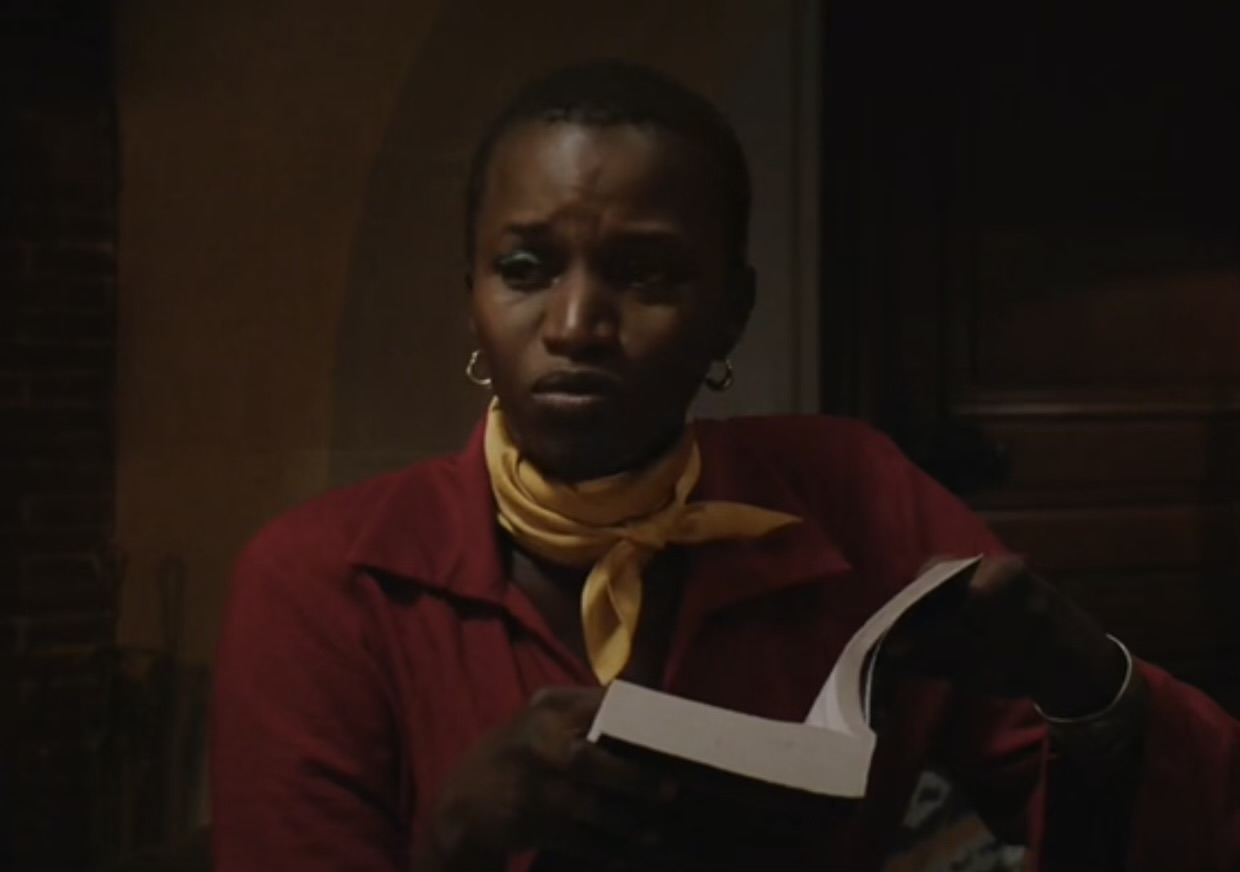
Wearing a cozy purple sweater with fetching dangled earrings touching her neck, Chéryl (Annabelle Lengronne) writes, a cup of tea nearby. DP: Pierre Mazoyer.

At the prestigious Jane Austen Residency located in a rustic French countryside that takes a ferry ride and an eventful car ride, Agathe is joined with other writers including Chéryl, a poet. None of the residents are given backstories except Oliver, an Austen ancestor and his aunt and uncle that run the pleasant house for the occupants. Apparently, Oliver personally read and chose the winners. Chéryl must have been an exceptional candidate out of many. She likely wrote her application as opposed to Agathe. That is not to say that Agathe has no merit or right to be among the chosen few. 

The reclusive Agathe comes out of her shell, befriending the residency creators and a few residents. Agathe and Chéryl hit it off by playing a game steeped in astrology culture and romance. As Agathe is conflicted by her newfound desire for Félix and her tormented affliction for Oliver, Chéryl’s book holds the key to such a predicament. The ladies later have drinks and sing karaoke at an establishment. Chéryl seems an open extrovert personality who loves exploring the earthiness around her with nonjudgmental perspective. 

Chéryl passes along the birthday information Agathe requires— another way to employ the character as a guiding point for Agathe’s conflicted heart. DP: Pierre Mazoyer.

An opened up Agathe has drinks and sings karaoke with Chéryl. DP: Pierre Mazoyer.

The residency hosts a special period soirée where the writers are invited to don clothing worn during Austen’s time. The lovely Chéryl helps prepare Agathe as though she’s her personal servant while the other ladies dress themselves in the background. The moment certainly draws back to historical contexts— Olympia by Èdouard Manet in the Musee D’Orsay (the other museum in Paris as famous as the Louvre) came to my mind, this performative act of kindness and servitude that further relegates the purpose of Chèryl’s character. At the soirée, Agathe dances twice with the surprise visitor Fèlix and Oliver. Chèryl doesn’t receive the honor of dancing with anyone and there’s barely a shot of her full attire. Like Bridgerton, a period show containing beautiful dark-skinned background characters, Chéryl is relegated to be a part of the scenery. 

A corseted Chéryl (Annabelle Lengronne) assists Agathe (Camille Rutherford) with her apricot colored dress. DP: Pierre Mazoyer.

Including lacing it up in the back. Hopefully, Agathe did the same for Chéryl. DP: Pierre Mazoyer.

A closeup of Madeleine the servant from Édouard Manet’s 1863 painting Olympia.

Agathe makes a decision that would devastate anyone who knows the difficulties of applying to residencies (especially abroad opportunities where odds are less than one percent). This leaves us on the abrupt end of Chéryl, the unsubtle incompleteness of the poet’s story. In my imagination, she has finished the requirements necessary for the residency, wishing goodbye to all the attendants and taking her own ferry back to her Paris. She too must work at a place where books live and breathe, a place as wondrously magical as Shakespeare & Co. Maybe she has a flat filled with plants, stuffed notebooks, and autumn sweaters, patterned tea cups and tea pots and lidded jams sit on her clean (or cluttered) counters, and a purple collared black cat awaits. She finds a healthy rhythm between the virtuous recluse and modern day freethinker, her heart yearning for prose alone. Her mailbox would be packed to the brim with love letters, love letters as precious as the ones posted on the Shakespeare & Co. mirror. 

Chéryl (Annabelle Lengbonne), Beth (Liz Crowther), and Agathe (Camille Rutherford). DP: Pierre Mazoyer.

I recommend Jane Austen Wrecked My Life for the delicious cinematography, the terrific score, and its ode to bookworms and sheltered writers. While Agathe and Oliver’s story had my romanticist insides swooning from the sensuous dance to the Mr. Darcy line, my heart still mourned for Chéryl’s potential, for what could never be told, only envisioned. Her talented, scene-stealing portrayer Annabelle Lengronne (known for her award-winning turn in Léonor Serraille’s Mother & Son) deserved more light to shine bright in, a story as vivid and rich as Alice Diop’s Saint Omer. In another world, we could definitely see the English professor / novelist Rama hitting it off with Chéryl, the poet, discussing modern Black women writing around Parisian landscapes as imperative as bookstores like Shakespeare & Co. 


Friday, July 4, 2025

Viscountess Kate & Viscount Anthony Moments From Bridgerton Season Three, Part II (Spoiler Heavy)


Kate (Simone Ashley) and Anthony (Jonathan Bailey)’s short-lived return takes endless missteps. DP: Alicia Robbins. 

A year before the Benedict centered fourth season debuts, this long awaited second part sheds light on more moments that Viscount Anthony Bridgerton and his lovely wife Viscountess Kate Bridgerton’s shared in Bridgerton season three. The viscount and the viscountess have nineteen minutes across the two episodes: Tick Tock and Joining of Hands, more than the paltry eight minutes depicted here.

Kate in her trademark contemplative state. DP: Alicia Robbins.

Writers are often instructed to “show, not tell.”

Kate and Anthony vocalize accounts without the production giving them the necessary screentime. For example, in Tick Tock, season three’s fifth episode, Kate and Anthony take a grand carriage ride back to the Bridgerton family home, returning from another extended offscreen holiday. Kate’s expecting their first child despite their sparse love scenes always showing Anthony giving his wife oral penetration as opposed to the usual way that pregnancy is achieved. Now this bears no disregard on the emphasis of women’s gratification being the pinnacle pleasure hallmark as male-dominated films and television programs historically placed a man’s desire above all else—consent or not. Yet, it’s questionable choices to have their most intimate moments tucked away, left onto the watcher’s imagination as opposed to using these two gifted actors with phenomenal chemistry to depict these acts on camera. Otherwise, the behind-the-scenes decision making seems to invent that their child came from a stork or happens to be immaculately conceived. 

An insatiable Anthony wants what he wants whenever he wants unfortunately things couldn’t become too steamy as…

Newton, nation’s favorite corgi, was watching. DP: Alicia Robbins.

Furthermore, in season three, episode seven’s Joining of Hands, Anthony talks to Colin about his nervous jitters and drinking profusely before his second wedding— a wedding yet to be seen. A flashback would have helped move the eldest brother’s thoughts along, but of course, this wasn’t Kate and Anthony’s season anymore. We are no longer supposed to care about them, invest in the fragmented puzzle pieces of their happiness, of just how their nuptial bliss came about. Were there lilies filling and smelling up the place— in a church or outside someplace? Did it happen around morning or near evening? What did they wear? Had Kate and Anthony wrote their own vows? What did they say to each other? Where was the barely mentioned Mary— Kate’s stepmother? 

Kate and Anthony being pure and affectionate. DP: Jeffrey Jur.

The laziest, most offensive writing involves Kate recounting her sister Edwina riding horses and marrying a scholar (as she DID in the book). Anthony senses his wife’s displeasure and suggests that they take a third holiday— to India. While completely understanding that Anthony adores his wife, it’s unbelievable that he would shirk his familial obligations and present a dangerous opportunity to a pregnant woman. All the money in the world (during that particular time period) would not protect Kate from the dangers of extended boat travel. The Bridgerton series as a whole takes extreme liberties disregarding the appropriate history, hair, fashion, and music— but this eccentric direction feels an aggressive slight to remove Kate and Anthony, to not even let them linger in the background. 

Overall, Simone Ashley and Jonathan Bailey delivered the smoldering gold that keeps us connected to Kate and Anthony’s love story. Yet season three presence reemphasizes downplaying a great couple deserving to be championed onscreen and off. Sure, there are promising moments worth rewinding— a dance, smooches, Kate hosting her first function as viscountess, a game of charades, Newton appearances, and vulnerable conversation. It’s simply not enough for a couple of this excellent caliber— a couple with many potential storylines that twenty plus minutes sporadically sprinkled across a few episodes will not cut. 

Shondaland should invest in a Kate and Anthony spin off series like yesterday.